
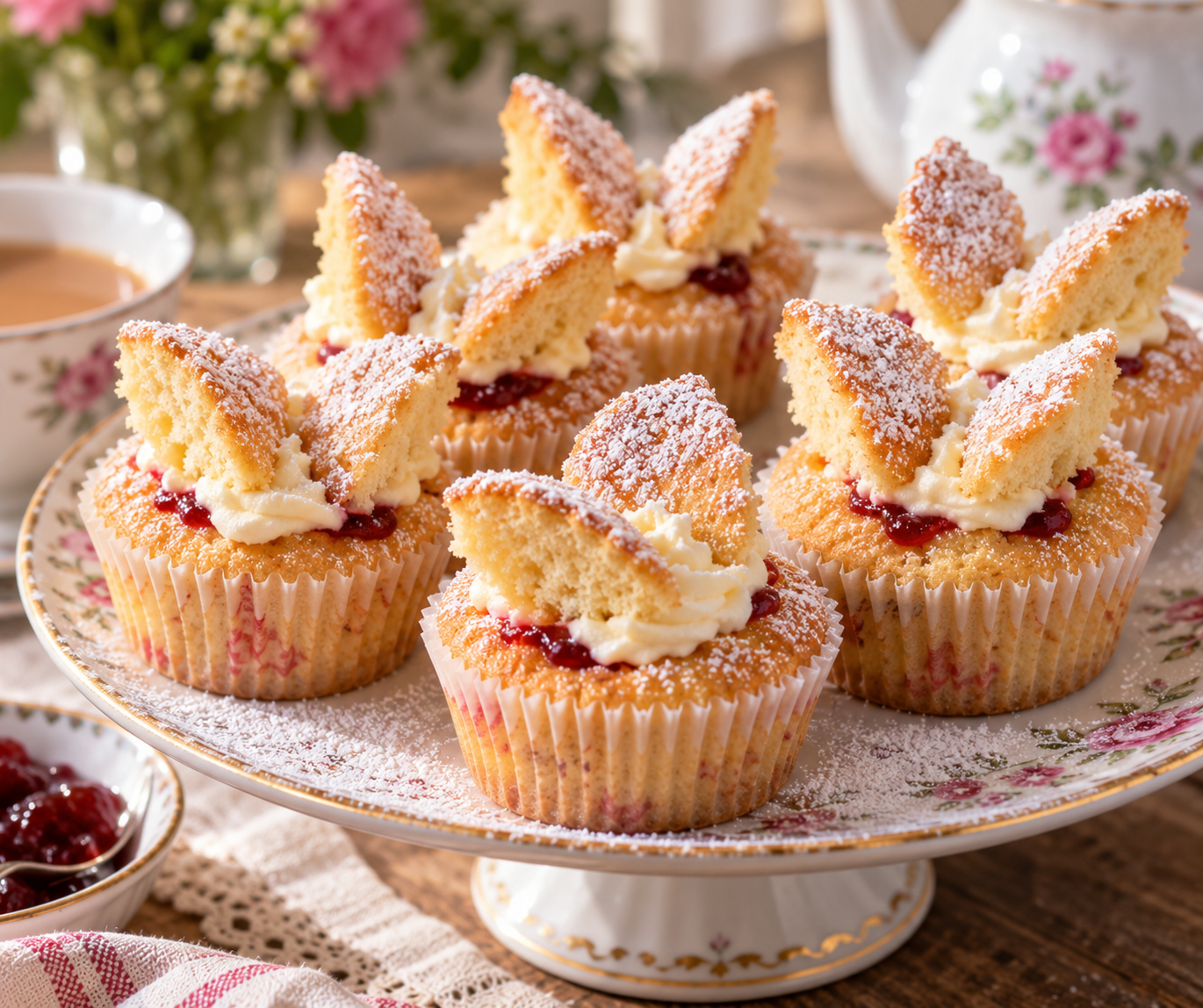
Making butterfly cakes was always one of the fun parts of British childhood baking. You’d cut a little circle from the top of each vanilla sponge, add a spoonful of buttercream, then turn the two cake pieces into butterfly wings.
A dusting of icing sugar was all they needed. No elaborate piping, fancy decorations or perfectly matching wings required!
These pretty little cakes were a familiar sight at children’s birthday parties, school bake sales and afternoon teas. They’re also wonderfully easy to recreate in an American kitchen.
In Britain, butterfly cakes are closely related to fairy cakes — the small individual cakes that appeared at countless children’s parties, school bake sales and afternoon teas.
For American bakers, they’re perhaps easiest to imagine as the smaller British cousin of a cupcake.
But there are a few differences.
British fairy cakes are traditionally smaller and less heavily frosted than American cupcakes. Instead of a towering swirl of buttercream, butterfly cakes have just enough filling to hold their delicate little cake wings in place.
Here’s how to make them in an American kitchen.
Affiliate disclosure: Brit & Skillet may earn a commission from qualifying purchases made through links on this page, at no additional cost to you.
What Are British Butterfly Cakes?
Butterfly cakes are individual vanilla sponge cakes made in a muffin or fairy-cake pan.
Once cooled, a small circle or cone of cake is removed from the top.
The hole is filled with buttercream, and the piece of cake that was removed is cut in half.
Those two halves are then placed upright in the buttercream so they resemble butterfly wings.
A dusting of powdered sugar finishes them.
They’re sometimes filled with jam as well as buttercream, and lemon versions are also popular.
Are Butterfly Cakes the Same as Fairy Cakes?
Not exactly, although the terms are closely connected.
A fairy cake is the small British sponge cake itself.
Turn that fairy cake into a butterfly cake by cutting out the top, filling it and arranging the cut cake pieces as wings.
In everyday British baking, you’ll see plenty of variation in how the names are used.
Are British Fairy Cakes the Same as American Cupcakes?
They’re similar, but traditional British fairy cakes are generally smaller and more restrained.
American cupcakes are often baked in deeper muffin cups and topped with a generous amount of frosting.
A classic fairy cake is a simple little sponge that rises just above its paper case.
For butterfly cakes, that’s useful because we want enough cake at the top to create our wings without producing an enormous cupcake.
You can still make these in a standard American 12-cup muffin pan — just don’t overfill the liners.
If you need a suitable pan, Fat Daddio’s Anodized Aluminum Cupcake & Muffin Pans are available in standard and mini sizes, making them useful for butterfly cakes as well as other individual British bakes.
What Makes a Good Butterfly Cake?
The sponge should be:
- Light
- Soft
- Buttery
- Gently vanilla-flavoured
- Firm enough to cut without falling apart
The buttercream should be smooth and creamy without overwhelming the little cake underneath.
And the wings certainly don’t need to be identical.
In fact, slightly uneven butterfly cakes look much more like the homemade British cakes many of us remember.

Traditional British Butterfly Cakes
Ingredients
Equipment
Method
- Preheat the oven to 350°F (175°C) and line a standard 12-cup muffin pan with paper liners.
- Beat the softened butter and granulated sugar for 3–4 minutes, until noticeably lighter and fluffy.
- Add the eggs one at a time, beating well after each addition, then mix in the vanilla. If the mixture begins to look slightly curdled, add a spoonful of the measured flour.
- In a separate bowl, whisk together the flour, baking powder and salt. Gently fold the dry ingredients into the butter mixture, adding enough milk—usually about 2 tablespoons—to make a soft batter that drops easily from a spoon. Don’t overmix.
- Divide the batter between the 12 liners, filling each approximately half to two-thirds full.
- Bake for 16–20 minutes, until lightly golden and the centers spring back when gently touched. A toothpick should come out clean or with just a few soft crumbs.
- Cool in the pan for about 5 minutes, then transfer to a wire rack and cool completely before decorating.
- Beat the softened butter for approximately 2 minutes, until smooth and creamy.
- Gradually beat in the powdered sugar, beginning on low speed. Once incorporated, beat until light and fluffy, then add the vanilla and salt.
- Add the milk or cream a little at a time until the buttercream is soft enough to spoon but firm enough to support the cake wings.
- Using a small sharp knife, cut a shallow circle or cone from the top of each cooled cake. Don’t cut too deeply.
- If using jam, spoon approximately ½ teaspoon into each hollow, followed by approximately 1 tablespoon buttercream.
- Cut each removed piece of cake in half. Place the two halves at a slight angle in the buttercream, with the cut sides facing inward, to form butterfly wings.
- Just before serving, lightly dust the cakes with powdered sugar.
Notes
Butterfly wings: Don’t worry about making the wings perfectly symmetrical. Slightly uneven wings are part of the homemade charm of traditional butterfly cakes.
Self-rising flour: You can substitute 125 g self-rising flour for the all-purpose flour. If you do, omit the baking powder and salt.
Jam: Strawberry and raspberry both work well. Raspberry has a slightly sharper flavor that balances the sweet buttercream particularly nicely.Brit & Skillet Tip: Traditional British fairy cakes are smaller than many American cupcakes. When using a standard American muffin pan, fill the liners only about half to two-thirds full. We’re looking for neat little cakes rather than large bakery-style cupcake domes.
Can I Use Self-Rising Flour?
Yes! Many traditional British butterfly cake recipes use self-raising flour.
For this recipe, you can substitute 125 g of American self-rising flour for the all-purpose flour. Just leave out the baking powder and salt.
King Arthur Unbleached Self-Rising Flour is a convenient option for American bakers making traditional British-style cakes.
If you’re unsure about the difference between British and American baking ingredients, our British Baking Ingredients Americans Need to Know guide explains some of the terminology you’ll encounter in British recipes.
Can I Make Butterfly Cakes With American Cake Flour?
You can, but it isn’t necessary.
Regular American all-purpose flour produces an excellent result when combined with baking powder.
The traditional cake should be light but still sturdy enough to cut and decorate.
Can I Use Salted Butter?
Yes.
Simply omit the additional salt from the sponge and buttercream.
British baking traditionally uses plenty of butter, so this is one recipe where using good-quality butter makes a noticeable difference.
Can I Add Lemon?
Absolutely.
For lemon butterfly cakes, add the finely grated zest of 1 lemon to the cake batter.
Replace the vanilla in the buttercream with approximately 1 tablespoon fresh lemon juice, adding additional powdered sugar if necessary to maintain the right consistency.
Lemon curd can also replace the jam.
If you enjoy British lemon cakes, our Traditional British Lemon Drizzle Cake is another lovely one to try.
Can I Use Chocolate Buttercream?
Yes.
Chocolate isn’t the most traditional version, but there’s no reason you can’t use it.
Replace approximately ¼ cup (25 g) of the powdered sugar with unsweetened cocoa powder and adjust the milk as necessary.
Why Did My Butterfly Cakes Sink?
A small dip isn’t a disaster because we’re going to cut into the centre anyway.
More significant sinking can happen if:
- The oven door was opened too early
- The batter was overmixed
- Too much baking powder was added
- The cakes weren’t completely baked in the centre
Try not to open the oven during the first 14 minutes of baking.
Why Are My Cakes Dry?
The most common cause is overbaking.
Small cakes cook quickly.
Start checking around the 16-minute mark and remove them as soon as they’re lightly golden and spring back when touched.
Too much flour can also produce a dry cake, which is why weighing flour in grams is particularly helpful.
Why Did My Buttercream Melt?
Either the cakes were still warm or the butter itself became too warm.
If the buttercream feels very soft, refrigerate it for approximately 10–15 minutes, then beat briefly before using.
Make sure the cakes are completely cool before decorating.
Can I Pipe the Buttercream?
Of course.
If you’d like a neater finish, pipe a small swirl into the centre before adding the wings.
But piping isn’t necessary, and the simpler spooned version is closer to the nostalgic homemade style we’re aiming for.
What Jam Should I Use?
Strawberry and raspberry are both excellent.
Raspberry has a slightly sharper flavour that balances the sweetness of the buttercream particularly well.
You only need a little.
Too much jam can make the butterfly wings slide around.
What to Serve With Butterfly Cakes
Butterfly cakes are perfect with:
- A pot of British tea
- Coffee
- Fresh berries
- Afternoon tea sandwiches
- Other small British bakes
They would sit beautifully alongside Classic British Scones, Traditional Jam Tarts or slices of Victoria Sponge Cake for an afternoon-tea spread.
Can Children Help Make Butterfly Cakes?
Yes.
This is an especially fun baking project for children because the decoration doesn’t require precision.
An adult should handle the knife used to cut the cake tops, but children can spoon in the filling, arrange the wings and dust the finished cakes with powdered sugar.
And because no two butterflies need to look identical, there’s very little pressure for them to be perfect.
Can I Make Butterfly Cakes Ahead?
You can bake the cakes one day ahead.
Once completely cool, store the undecorated cakes in an airtight container at room temperature.
Prepare and decorate them the following day.
For the freshest appearance, wait until shortly before serving to dust them with powdered sugar.
How to Store Butterfly Cakes
Store finished butterfly cakes in an airtight container at cool room temperature for approximately 2 days.
If your kitchen is particularly warm, refrigerate them because of the buttercream.
Bring refrigerated cakes back toward room temperature before serving so the sponge and buttercream soften again.
Can You Freeze Butterfly Cakes?
The undecorated cakes freeze very well.
Cool completely, wrap individually and freeze in an airtight container for up to approximately 3 months.
Thaw at room temperature before adding the buttercream, jam and wings.
You can technically freeze decorated cakes, but the finished appearance is much better when they’re decorated fresh.
A Little British Cake With Plenty of Charm
Butterfly cakes aren’t complicated, fashionable or extravagant.
And that’s exactly why they’re so lovely.
A simple vanilla sponge, a little buttercream and two pieces of cake are enough to create something that generations of British children have been delighted to find on a party table.
They also prove that a cake doesn’t need six inches of frosting to feel special.
Put the kettle on, dust your butterflies with powdered sugar and don’t worry if every pair of wings looks slightly different.
That’s how homemade butterfly cakes should be.
For more classic British baking, try our Traditional British Lemon Drizzle Cake, Victoria Sponge Cake, Traditional Jam Tarts and Classic British Scones.
And if you’re translating British recipes for an American kitchen, take a look at British Baking Ingredients Americans Need to Know.
Browse all of our Brit & Skillet Recipes for more British favourites made approachable for American kitchens.
Leave a Reply