
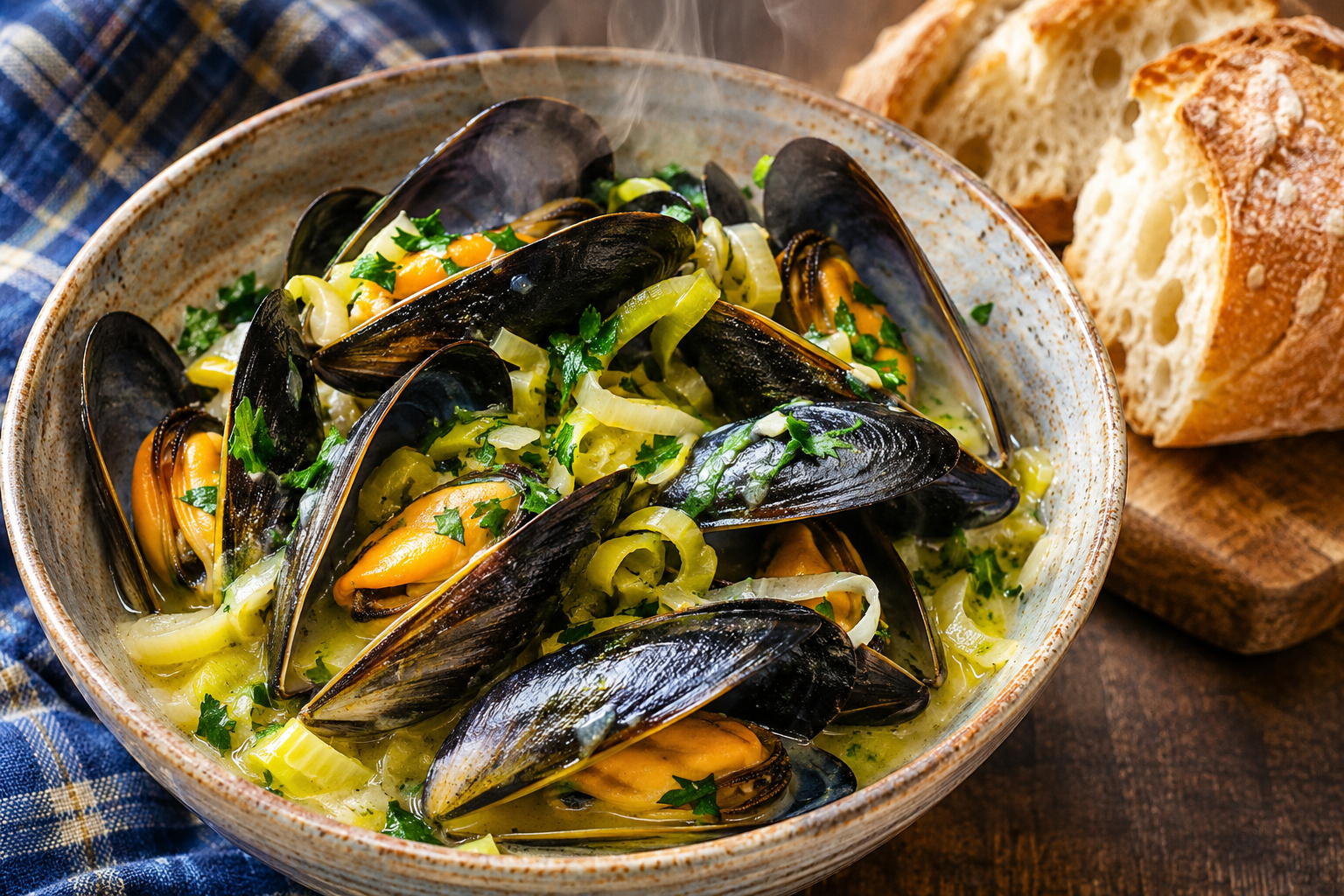
A big bowl of steaming mussels, a generous chunk of crusty bread and plenty of buttery broth to mop up. Now that’s my idea of a good seafood supper!
Scotland has a wonderful seafood heritage, and mussels are one of the treasures of its coastal waters. With their naturally sweet flavour, they need very little fuss to become something delicious.
My own affection for Scotland’s coastal food comes from childhood summers spent at my great-aunt Ina’s farm near Newmachar in Aberdeenshire. Fresh fish from Peterhead was part of the local food culture, and those memories have stayed with me.
For this Scottish mussels recipe, we’re combining tender mussels with softened leeks, good butter, fresh herbs and a wee splash of Scotch whisky. The result is a light, savoury broth that lets the seafood shine.
And don’t worry if you’ve never cooked mussels before! They’re surprisingly straightforward once you know how to clean them, check they’re fresh and steam them properly.
I’ll explain everything for American kitchens, including which mussels to buy, how to prepare them safely and what you can use instead of whisky.
Just make sure you’ve got plenty of bread ready. Leaving all that lovely broth behind would be a terrible waste! 😂
Affiliate Disclosure: Brit & Skillet may earn a commission from qualifying purchases made through links on this page, at no additional cost to you.

Scottish Mussels with Leeks, Butter and Whisky
Ingredients
Equipment
Method
- Inspect the mussels carefully, discarding any with cracked or broken shells. Tap any open mussels gently and discard those that do not close. Rinse under cold running water, scrub away debris and remove any remaining beards. Keep refrigerated until ready to cook.
- Melt the butter in a large, heavy-bottomed pot over medium heat. Add the sliced leek and cook gently for 5 to 7 minutes, stirring occasionally, until softened but not browned. Add the garlic and thyme and cook for another 30 seconds.
- Pour in the Scotch whisky, if using, followed by the vegetable or seafood stock. Add the black pepper and bring the liquid to a gentle simmer. For an alcohol-free version, replace the whisky with an equal quantity of additional stock.
- Add the cleaned mussels to the pot and cover immediately with a well-fitting lid. Steam for approximately 5 to 9 minutes, shaking the pot gently once or twice, until the shells open and the mussels are cooked through. Discard any mussels that remain closed.
- Remove the pot from the heat. Stir in the chopped parsley and lemon juice. Taste the broth and adjust the seasoning if needed. Divide the mussels between four warm bowls and spoon the buttery leek broth over the top. Serve immediately with crusty bread.
Notes
What Makes These Mussels Scottish?
Scotland’s coastline provides some wonderful seafood, and mussels have become an important part of the country’s shellfish industry.
Scottish cooking often makes excellent use of simple ingredients that allow fresh produce to speak for itself. Butter, leeks and herbs are familiar flavours, while a little Scotch whisky brings something distinctly Scottish to this particular dish.
This recipe is a Scottish-inspired preparation rather than a claim to an ancient traditional method. It takes inspiration from Scotland’s coastal seafood and combines it with ingredients that are easy to find in American supermarkets.
Unlike creamy white wine mussels, this version has a lighter broth, with the sweetness of the leeks and the natural juices from the mussels doing much of the work.
It’s simple, comforting and just a little bit special.
Buying Fresh Mussels in America
If you’ve never bought fresh mussels before, you might be surprised by how easy they are to find.
Many American supermarkets with seafood counters stock live mussels, particularly blue mussels. You can also ask your local fishmonger.
Look for mussels sold by a reputable seafood supplier, preferably with information about where and when they were harvested.
The shells should be intact, and the mussels should smell fresh and pleasantly of the sea rather than strongly fishy.
How Many Mussels Do You Need?
For this recipe, we’re using approximately 4 pounds (1.8 kg) of live mussels to serve four people as a main course.
Remember that much of the weight comes from the shells, so the amount of edible mussel meat will be considerably smaller.
If you’re serving the mussels as a starter, you can reduce the quantity accordingly.
How to Clean and Prepare Fresh Mussels
Preparing mussels is probably the part that makes new cooks most nervous, but there’s nothing particularly complicated about it.
The important thing is checking that your mussels are alive and in good condition before cooking.
Check the Shells
Discard any mussels with cracked or broken shells.
If a mussel is slightly open, tap it gently against the counter or another shell. A live mussel should respond by closing.
Discard any that remain open and unresponsive.
Rinse and Scrub
Rinse the mussels under cold running water and gently scrub away any sand or debris.
Some mussels have a small cluster of fibrous threads protruding from the shell. This is known as the beard.
To remove it, grasp the threads firmly and pull towards the hinge of the shell.
Many farmed mussels arrive relatively clean, so this step may take only a few minutes.
Keep Them Cold
Keep live mussels refrigerated until you’re ready to cook them.
Store them in a bowl or colander covered loosely with a damp cloth. Don’t seal them in an airtight container or leave them submerged in fresh water.
Prepare them as soon as practical after purchasing.
Why Leeks Work So Well with Mussels
Leeks are one of my favourite ingredients for this sort of cooking.
They’re related to onions but have a gentler, sweeter flavour that works beautifully with seafood.
When cooked slowly in butter, leeks become wonderfully soft and almost silky.
For this recipe, we use one large leek, finely sliced and thoroughly washed to remove any grit hiding between the layers.
American supermarkets generally sell the same type of leeks used in British cooking, so there’s no special substitution needed.
Does Scotch Whisky Make a Difference?
A small splash of Scotch whisky adds warmth and a subtle depth of flavour to the broth.
You don’t need an expensive single malt for this recipe. A modest amount of ordinary blended Scotch whisky will work perfectly well.
The idea isn’t to make the mussels taste strongly of whisky. We want just enough to complement the buttery leeks and seafood.
If you prefer not to cook with alcohol, simply replace the whisky with additional vegetable or seafood stock and a small squeeze of lemon juice.
It’s worth remembering that cooking does not necessarily remove all the alcohol, so use the stock alternative when preparing an alcohol-free meal.
The Best Pan for Cooking Mussels
A large, heavy-bottomed pan with a well-fitting lid is ideal for steaming mussels.
You need enough room for the shells to open and for the steam to circulate without overcrowding the pan.
I particularly like using sturdy cookware that distributes heat evenly, especially when preparing the buttery leek base.
The Staub Traditional Deep Skillet is a lovely option for smaller quantities if you have a compatible lid and sufficient capacity. For the full four-pound recipe, a large lidded Dutch oven or stockpot may be more practical.
For preparing the leeks and herbs, a set of King Arthur Stainless Steel Mixing Bowls is another useful kitchen staple.
Whatever pan you choose, make sure it has a secure lid. The trapped steam is what cooks the mussels quickly and evenly.
Brit & Skillet Tip: Don’t Overcook Your Mussels
Mussels cook much faster than many people expect.
Once the broth is steaming and you’ve added the mussels, keep the lid on and allow them to cook until the shells open and the meat is cooked through.
Shake the pan gently during cooking to help distribute the heat.
Depending on the size of your mussels and your pan, steaming usually takes around 5–9 minutes.
Discard any mussels that remain closed after cooking.
Overcooking can make mussels rubbery, so there’s no need to leave them simmering away for ages.
And remember to save the broth! The juices released by the mussels combine with the butter, leeks and stock to create a delicious sauce.
What to Serve with Scottish Mussels
For me, the most important accompaniment is good crusty bread.
There’s something very satisfying about dipping a thick slice into the buttery broth once you’ve finished the mussels.
You could also serve them with:
- Warm sourdough or crusty farmhouse bread
- Buttered new potatoes
- A simple green salad
- Steamed seasonal vegetables
- Homemade potato wedges
For a larger Scottish-inspired meal, these mussels would make a lovely starter before our Traditional Scottish Mince and Tatties.
And if you enjoy traditional Scottish seafood, don’t miss our Traditional Scottish Cullen Skink, a rich smoked haddock soup from the northeast coast of Scotland.
Our Traditional British Fish Pie is another lovely choice for anyone who enjoys comforting seafood dishes.
Can You Make Scottish Mussels Ahead of Time?
Mussels are best cooked immediately before serving.
However, you can prepare the leeks and other ingredients ahead of time to make the final cooking process easier.
Slice and wash the leeks, chop the parsley and measure the stock before you begin.
You can even cook the buttery leek mixture slightly ahead of time and refrigerate it promptly, then reheat it thoroughly before adding the mussels.
I wouldn’t recommend cooking the mussels hours in advance for a dinner party. They’re at their best when served fresh from the pan.
Storing Leftover Cooked Mussels
If you have leftovers, remove the cooked mussel meat from the shells and refrigerate it promptly in a covered container.
Use refrigerated leftovers within three to four days, although the texture is best when eaten sooner.
Reheat leftovers thoroughly to 165°F (74°C).
Don’t leave cooked mussels sitting at room temperature for extended periods.
And never try to save mussels that were rejected during the cleaning or cooking process.
Frequently Asked Questions
Are Scottish Mussels Different from American Mussels?
Scottish mussels are often blue mussels, a type also sold in the United States.
The flavour and size can vary depending on where they’re grown, but good-quality American blue mussels work beautifully in this recipe.
Can I Make This Recipe Without Whisky?
Absolutely!
Replace the whisky with additional vegetable or seafood stock and a little lemon juice.
You’ll still have a delicious buttery leek broth.
Do I Need Cream?
Not for this recipe.
We’re keeping the broth light and allowing the butter, leeks and mussel juices to provide the flavour.
We’ll save the cream for another mussel recipe!
How Do I Know When Mussels Are Cooked?
The shells should open during cooking, and the mussel meat should be fully cooked and opaque.
Discard any mussels that remain closed after cooking.
Can I Use Frozen Mussels?
You can use commercially frozen mussels, but follow the package instructions because many frozen products are already cooked.
The timing and preparation will differ from this recipe, which is written specifically for fresh, live mussels.
What Can I Use Instead of Leeks?
A small sweet onion or a few shallots will work if you can’t find leeks.
The flavour will be slightly different, but both are lovely with butter and seafood.
A Little Taste of Scotland’s Coast
One of the things I love about Scottish cooking is how a few good ingredients can come together to make something memorable.
These mussels don’t need an elaborate sauce or hours in the kitchen. Just fresh seafood, sweet leeks, good butter and a little patience.
The optional splash of Scotch whisky gives the broth a lovely Scottish twist, while the simple preparation allows the mussels to remain the star of the dish.
Serve everything straight from the pan, put a basket of crusty bread on the table and enjoy.
And don’t be surprised if everyone ends up fighting over the last spoonful of broth! 😂
From my British kitchen to yours — happy cooking!
Jane at Brit & Skillet
Leave a Reply