Discover why Britain celebrates November 5th with bonfires, fireworks, and comforting autumn food, from Yorkshire parkin and treacle toffee to jacket potatoes and hearty family suppers.
Growing up in Britain, Bonfire Night was always one of those evenings I looked forward to. Every November 5th, my family would enjoy a warming supper of chilli con carne served with jacket potatoes before heading into the back garden for fireworks and sparklers.
My brother and I would celebrate with Mum and Dad, and sometimes close friends would join us. There was something wonderfully exciting about wrapping up against the November cold, watching the fireworks light up the night sky, and enjoying an evening together.
It wasn’t an elaborate celebration, but those are some of the memories that have stayed with me.
Here in America, Guy Fawkes Night isn’t widely celebrated, but in Britain, November 5th has been an important date for more than 400 years.
And although the fireworks are what most people remember, the food is an equally lovely part of the tradition.
From sticky Yorkshire parkin and old-fashioned bonfire toffee to piping-hot jacket potatoes, sausages, and comforting homemade suppers, Bonfire Night is a celebration of everything warming and delicious about British autumn cooking.
So, whether you’re a British expat feeling a little nostalgic or an American curious about this unusual tradition, let’s explore the history of Guy Fawkes Night and the foods that make November 5th so special.
What Is Guy Fawkes Night?
Guy Fawkes Night, also known as Bonfire Night or Fireworks Night, is celebrated in Britain every year on November 5th.
The tradition dates back to 1605, when a group of English Catholic conspirators attempted to blow up the Houses of Parliament in London.
Their plan, known as the Gunpowder Plot, was intended to kill King James I and members of Parliament during the State Opening of Parliament.
At the time, England was deeply divided by religious conflict, and Catholics faced discrimination under the Protestant monarchy.
The plot was led by Robert Catesby, although Guy Fawkes became its most famous participant.
Fawkes, who had military experience with explosives, was responsible for guarding and preparing the gunpowder hidden beneath Parliament.
In the early hours of November 5th, authorities discovered him alongside 36 barrels of gunpowder.
The plot had failed.
Bonfires were lit to celebrate the king’s survival, and in 1606, Parliament established an annual day of thanksgiving.
Over the centuries, the celebrations evolved into the Bonfire Night traditions that many British families recognise today.
Although the occasion originally had strong political and religious associations, modern celebrations generally focus on fireworks, community gatherings, and family traditions.
Remember, Remember the Fifth of November
One of the most familiar parts of Guy Fawkes Night is the traditional rhyme:
Remember, remember the fifth of November,
Gunpowder, treason and plot.
Generations of British children have grown up hearing these words, even if they didn’t fully understand the historical events behind them.
Traditionally, children sometimes made a figure representing Guy Fawkes, known simply as a “Guy,” using old clothes stuffed with newspaper or straw.
The figure would be placed on top of a bonfire and burned during the celebrations.
Although this custom is less common in some areas today, the association between Guy Fawkes, bonfires, and fireworks remains firmly established in British culture.
For many families, Bonfire Night is now less about the historical events of 1605 and more about enjoying an autumn evening together.
And, of course, enjoying some wonderful food.
What Do British People Traditionally Eat on Bonfire Night?
Unlike Christmas dinner, Bonfire Night doesn’t have one particular meal that everyone eats.
Instead, the foods associated with November 5th tend to be warming, filling, easy to prepare, and practical for eating outdoors.
Some dishes are regional traditions, while others have become family favourites over generations.
Here are some of the foods most closely associated with British Bonfire Night celebrations.
1. Yorkshire Parkin — The Traditional Bonfire Night Cake

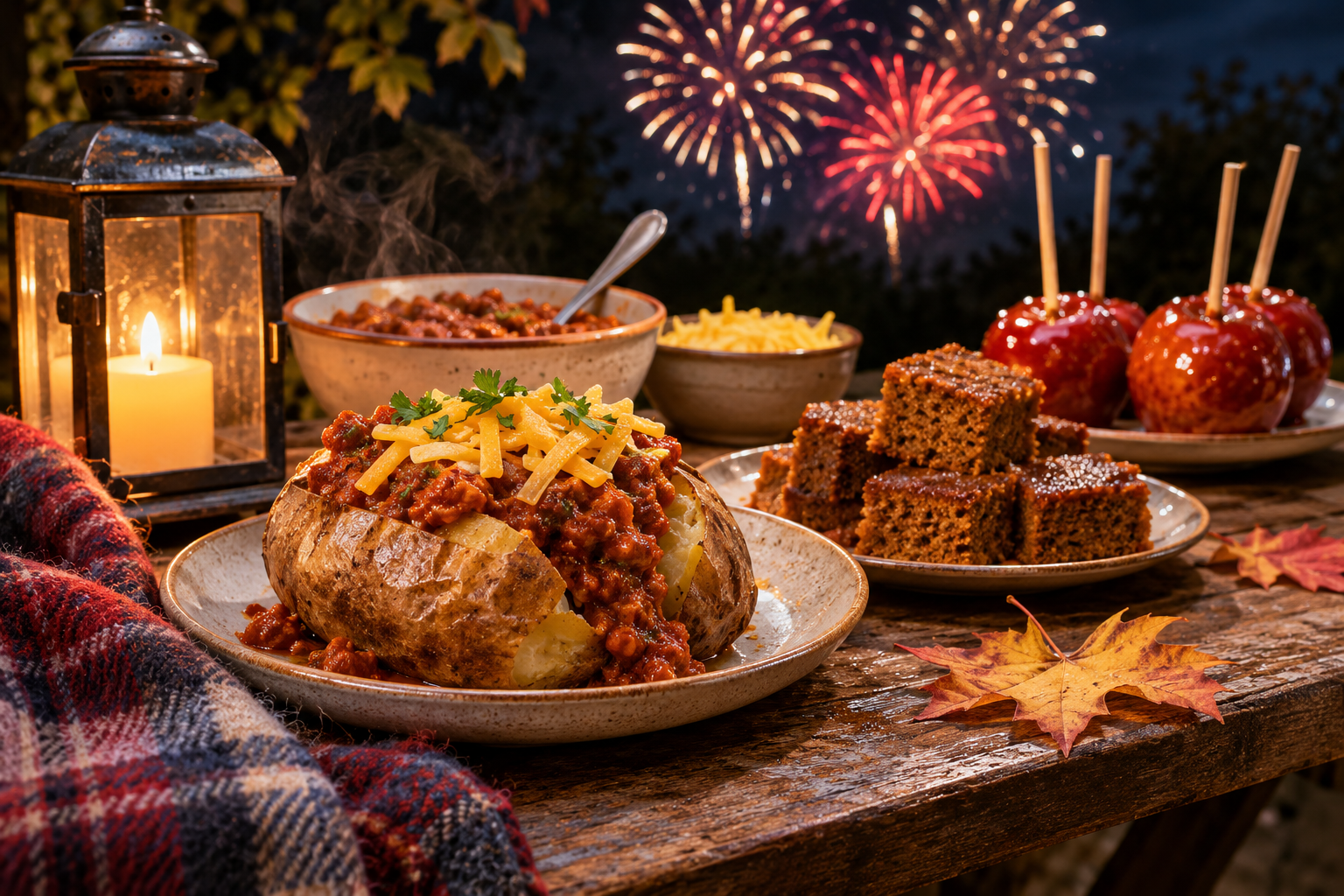
If there’s one cake particularly associated with Bonfire Night, it’s Yorkshire parkin.
This traditional northern English ginger cake is made with oatmeal, flour, ginger, and treacle or golden syrup.
Unlike an ordinary sponge cake, parkin has a wonderfully dense, moist texture and a rich, warming flavour.
One of its most interesting characteristics is that it actually improves after being stored for a few days. The cake gradually becomes softer and stickier as the flavours develop.
In Yorkshire and parts of Lancashire, parkin has long been associated with autumn celebrations, particularly November 5th.
It’s easy to understand why. A square of sticky ginger cake is just the thing to enjoy with a hot cup of tea after standing outside watching fireworks.
If you’d like to make this traditional Bonfire Night treat, try my Traditional Yorkshire Parkin Recipe, made with ingredients suitable for American kitchens.
Brit & Skillet Tip: Make your parkin two or three days before Bonfire Night and store it in an airtight container. Its texture and flavour will become even better.
2. Bonfire Toffee — A Traditional Northern English Sweet
Bonfire toffee, sometimes called treacle toffee or plot toffee, is another traditional November 5th favourite.
This old-fashioned British sweet is particularly associated with Yorkshire and Lancashire.
It’s made by boiling sugar, black treacle, butter, and sometimes golden syrup until the mixture sets into a firm, brittle toffee.
The result is dark, rich, and intensely sweet, with a slightly bitter depth from the treacle.
Traditionally, the cooled toffee is broken into irregular pieces rather than cut into neat squares.
It’s quite different from the soft, chewy caramel candies commonly found in America.
Bonfire toffee is hard and crunchy, so it’s best enjoyed in small pieces.
For American cooks, British black treacle is similar to dark molasses, although the flavour isn’t exactly identical.
3. Toffee Apples — A Bonfire Night Favourite
Few treats feel quite as nostalgic as a shiny toffee apple on a stick.
Toffee apples have long been associated with British autumn fairs, Halloween, and Bonfire Night celebrations.
They’re made by coating whole apples in a hot sugar syrup that hardens into a crisp, glossy shell.
Some are bright red, while others have a more traditional golden or amber-coloured coating.
The combination of sweet, crunchy toffee and tart, juicy apple is delicious.
In America, they’re often called candy apples, although American caramel apples usually have a softer coating.
For a traditional British-style toffee apple, the sugar coating should be hard and crisp rather than chewy.
They’re especially popular with children, although they’re certainly not the easiest thing to eat gracefully!
4. Jacket Potatoes — The Perfect Bonfire Night Supper
Jacket potatoes are one of my favourite foods associated with Bonfire Night because they were such an important part of my family’s celebrations.
For anyone unfamiliar with the British name, a jacket potato is simply a baked potato cooked in its skin until the inside is fluffy and the outside is crisp.
In Britain, they’re commonly served with fillings such as butter, grated cheddar cheese, baked beans, tuna mayonnaise, or chilli con carne.
Growing up, our family’s Bonfire Night supper was chilli con carne served with jacket potatoes.
It was the perfect meal before going outside into the cold.
The potatoes were filling, the chilli was warming, and everyone could enjoy a proper supper before the excitement of the fireworks began.
Even now, I think it’s one of the nicest ways to celebrate November 5th.
If you’re recreating a British Bonfire Night in America, large russet potatoes work beautifully for traditional jacket potatoes.
Bake them until the skins are crisp, split them open, and fill them with your favourite toppings.
Brit & Skillet Tip: For beautifully crisp jacket potato skins, rub the potatoes lightly with oil and salt before baking them directly on the oven rack. Avoid wrapping them in foil during baking, as this traps moisture and softens the skins.
5. Bangers and Mash — A Comforting British Classic
Another excellent Bonfire Night supper is traditional British bangers and mash.
Juicy sausages, creamy mashed potatoes, and rich onion gravy make a wonderfully comforting meal on a chilly November evening.
Sausages are particularly practical for larger family gatherings because they’re easy to cook in batches.
At outdoor events, sausages may be served in bread rolls, making them easier to eat while watching fireworks.
For a sit-down supper before heading outside, however, it’s difficult to beat a proper plate of bangers and mash.
You can find my Traditional British Bangers and Mash Recipe here at Brit & Skillet.
It’s a lovely choice if you want a traditional British supper without spending hours in the kitchen.
6. Homemade Soup and Hearty Stews
Bonfire Night falls at a time of year when British evenings are usually cold, damp, and dark.
That makes homemade soups and stews especially appealing.
A steaming bowl of vegetable soup, lentil soup, or a hearty beef stew is ideal before heading outdoors.
At larger gatherings, soup can even be served in mugs, making it easier for guests to enjoy while standing around a bonfire.
Traditional British beef and ale stew is another wonderful choice.
Slow-cooked beef, vegetables, and rich gravy create the sort of satisfying meal that’s particularly welcome on a November evening.
My Traditional British Beef and Ale Stew is a lovely option for a family Bonfire Night supper.
And if you’re looking for more comforting British dishes, you’ll find plenty of inspiration among the traditional recipes here at Brit & Skillet.
7. Flapjacks — A Sweet Treat for Autumn Evenings
British flapjacks are another excellent treat for a Bonfire Night gathering.
If you’re American, you might be surprised to learn that British flapjacks aren’t pancakes!
They’re sweet, chewy oat bars traditionally made with rolled oats, butter, brown sugar, and golden syrup.
They’re easy to prepare in advance, simple to transport, and perfect for sharing with family and friends.
Their rich, buttery flavour makes them particularly satisfying alongside a hot drink.
Try my Traditional British Flapjacks Recipe if you’d like an easy homemade treat for your Bonfire Night celebrations.
Regional Bonfire Night Food Traditions Across Britain
Although many Bonfire Night foods are enjoyed throughout Britain, some traditions are particularly associated with certain regions.
In Yorkshire, parkin is one of the best-known November treats, while bonfire toffee has strong connections with northern England.
In parts of Lancashire and Yorkshire, pie and peas are another traditional choice at autumn gatherings and bonfire celebrations.
These hearty pies, often served with mushy peas, are especially suited to cold evenings.
Elsewhere, families might enjoy sausages, baked potatoes, homemade soup, or whatever warming meal has become part of their own November 5th tradition.
And that’s something I particularly love about Bonfire Night.
There isn’t one correct menu.
For my family, it was chilli con carne and jacket potatoes. For someone else, it might have been parkin, sausages, and toffee apples at a village bonfire.
The food is part of what makes the celebration personal.
How Is Bonfire Night Celebrated in Britain Today?

Modern Bonfire Night celebrations vary considerably depending on where you live.
Many towns and villages organise public firework displays, sometimes accompanied by large bonfires, food stalls, and fairground attractions.
Families gather in parks, recreation grounds, and other open spaces to watch the displays.
In some areas, celebrations take place on the weekend closest to November 5th rather than on the date itself.
Private family celebrations are also part of the tradition, although fireworks laws and local restrictions vary.
Growing up, our celebrations were usually in the back garden.
After supper, we’d wrap up warmly, head outside, and enjoy sparklers and fireworks with my parents and brother.
Sometimes friends would join us, making the evening feel even more special.
Today, public displays are often the safest and easiest way to enjoy fireworks, particularly for families with young children.
How to Celebrate a British Bonfire Night in America
If you’re living in America and would like to introduce your family to this British tradition, you don’t need an enormous bonfire or an elaborate celebration.
In fact, I think a simple family evening is often the nicest way to do it.
Start with a warming British-inspired supper.
Jacket potatoes topped with chilli con carne would naturally be my first choice, but bangers and mash, homemade soup, or a hearty stew would be equally lovely.
For dessert, serve slices of Yorkshire parkin, homemade flapjacks, or toffee apples.
You could also prepare a few mugs of hot chocolate or tea to enjoy afterwards.
If you’d like to include fireworks, look for a professionally organised public display and follow your local laws and safety guidance. Sparklers can cause serious burns, so they require close supervision and aren’t suitable for young children.
Even without fireworks, you can still enjoy the occasion by learning about the Gunpowder Plot, sharing traditional British food, and spending a cosy autumn evening together.
It’s a wonderful way to introduce children to a little British history and culture.
Frequently Asked Questions About Guy Fawkes Night
Why do British people celebrate Guy Fawkes Night?
Guy Fawkes Night commemorates the failure of the Gunpowder Plot of 1605, when conspirators attempted to blow up Parliament and kill King James I. The occasion developed from historical celebrations of the king’s survival into the modern tradition of bonfires, fireworks, and family gatherings.
What date is Bonfire Night in Britain?
Bonfire Night is celebrated on November 5th every year, although some organised events take place on the nearest weekend.
What is the most traditional Bonfire Night food?
Yorkshire parkin and bonfire toffee are among the foods most strongly associated with November 5th, particularly in northern England. Jacket potatoes, toffee apples, sausages, and warming suppers are also popular.
Is Bonfire Night the same as Halloween?
No. Halloween takes place on October 31st, while Bonfire Night is celebrated on November 5th. Although both occur in autumn and have their own traditions, they have different historical origins.
Do people celebrate Guy Fawkes Night in America?
Guy Fawkes Night isn’t widely celebrated in modern America, although British expatriates and families with British connections sometimes continue the tradition.
What is Yorkshire parkin?
Yorkshire parkin is a traditional British ginger cake made with oatmeal, treacle or golden syrup, and warming spices. It’s particularly associated with Yorkshire and Bonfire Night.
A Little Taste of Home on November 5th
For me, Guy Fawkes Night will always bring back memories of family evenings in Britain.
I remember our chilli con carne and jacket potatoes, the excitement of going outside after supper, and watching fireworks with my brother and parents.
Those simple traditions are often the ones we remember most fondly.
And while Bonfire Night has a fascinating and complicated history, today’s celebrations are also about family, community, and sharing a little warmth during the colder months.
Whether you decide to make a traditional Yorkshire parkin, prepare a batch of British flapjacks, or serve jacket potatoes piled high with chilli, I hope you’ll enjoy discovering a little more about this uniquely British November tradition.
From my British kitchen in Colorado to yours, happy Bonfire Night!
Jane at Brit & Skillet
British Inspiration for Your American Kitchen
Leave a Reply