
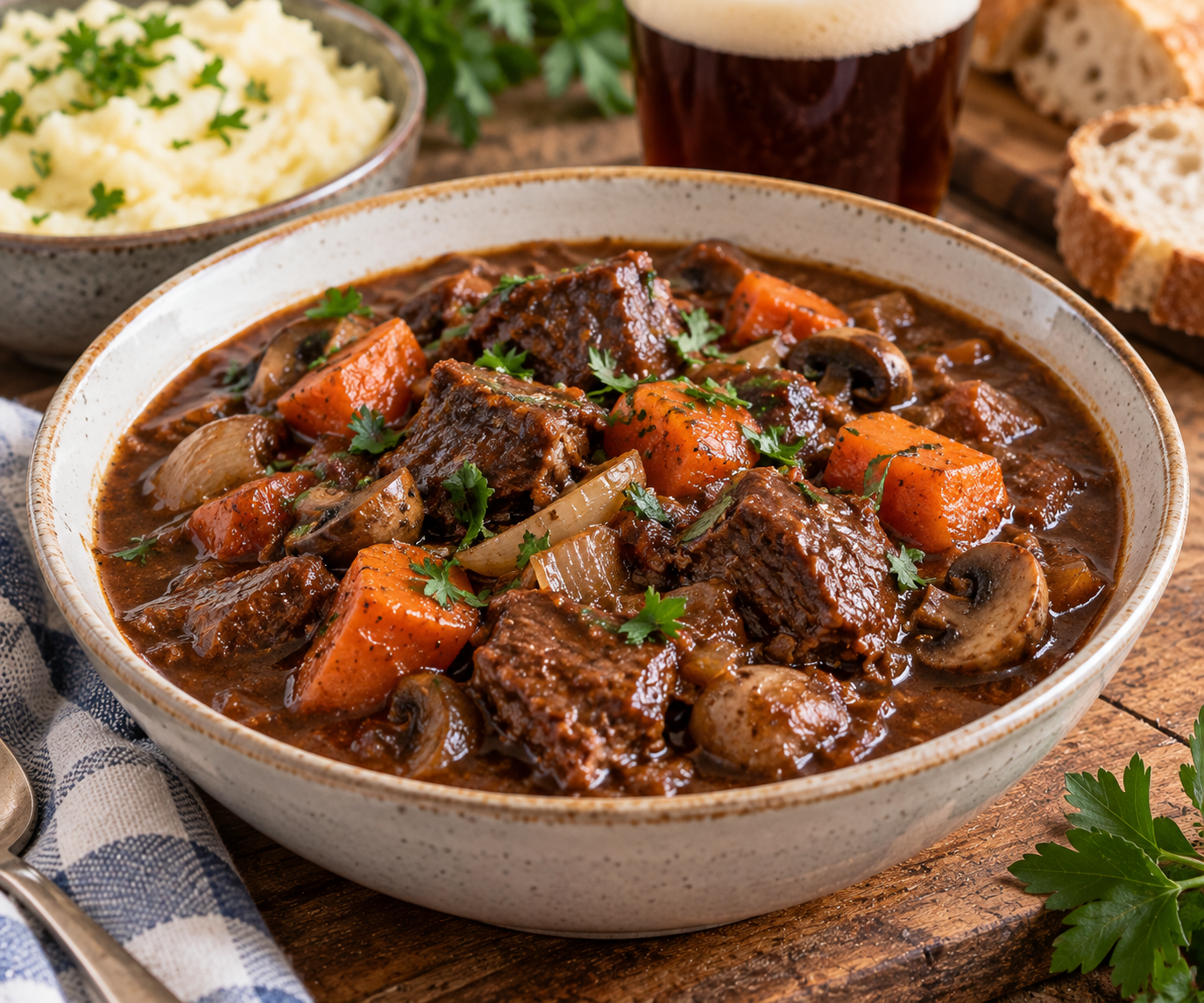
There are few things more comforting than a pot of beef stew slowly bubbling away on a cold afternoon.
British beef and ale stew takes that familiar idea and gives it a distinctly pub-style twist: chunks of beef are cooked slowly with onions, carrots, herbs and ale until they’re meltingly tender and surrounded by a rich, deeply savoury gravy.
It’s hearty, uncomplicated food — exactly the sort of thing you’d hope to find on the menu of a country pub when the weather outside is miserable.
And although the word ale can make an American version of the recipe seem complicated, it really isn’t. You don’t need a particular British beer, and you don’t need an expensive cut of beef.
In fact, inexpensive chuck roast is one of the best choices.
The important things are choosing an ale that won’t make the gravy bitter, browning the beef properly and giving the stew enough time to cook slowly.
Here’s how to make a proper British-style beef and ale stew using ingredients readily available in an American kitchen.
What Is British Beef and Ale Stew?
Beef and ale stew is a traditional British comfort-food dish made by slowly braising pieces of beef with vegetables, herbs, stock and ale.
As it cooks, the beef becomes tender while the ale, stock and cooking juices reduce into a dark, savoury gravy.
There isn’t one definitive recipe.
Some versions contain mushrooms, some don’t. Some include potatoes in the stew, while others are served over mashed potatoes. Worcestershire sauce, tomato paste and herbs are also common additions.
Our version uses carrots, onions and mushrooms while leaving the potatoes out so there’s plenty of room for creamy mashed potatoes alongside.
Is Beef and Ale Stew the Same as Steak and Ale Pie?
They’re closely related, but they’re not the same dish.
Our Traditional British Steak and Ale Pie uses a rich beef-and-ale filling beneath golden puff pastry.
Beef and ale stew skips the pastry entirely and is served straight from the pot with plenty of gravy.
That makes it simpler to prepare and particularly good for slow cooking.
What Beef Should Americans Use?
Look for beef chuck roast.
Chuck contains connective tissue and fat that soften during long, slow cooking. Given enough time, an inexpensive chuck roast becomes much more tender and flavourful than many leaner cuts.
Packages labelled stew meat can work, but the pieces may come from different cuts of beef and therefore cook unevenly.
When possible, buy a whole chuck roast and cut it into chunks yourself.
Aim for pieces approximately 1½–2 inches (4–5 cm) across.
What Kind of Ale Should I Use?
Choose an ale you’d be happy to drink.
Good choices include:
- Brown ale
- Amber ale
- English-style pale ale
- Mild ale
- Red ale
You want something malty rather than aggressively bitter.
Very hoppy IPAs aren’t my first choice because their bitterness can become stronger as the stew reduces.
You don’t need to track down an imported British beer. A good American brown or amber ale works beautifully.
Can I Use Stout Instead?
Yes.
A stout will produce a darker stew with a more roasted flavour.
Something like Guinness works well, although technically you’ll then be making something closer to a beef-and-stout stew than a traditional beef-and-ale version.
Both are delicious.
Can I Make Beef and Ale Stew Without Alcohol?
Yes.
Replace the ale with additional beef broth or stock.
For extra depth, add another teaspoon of Worcestershire sauce.
It won’t have exactly the same flavour as the ale version, but you’ll still have an excellent beef stew.
Traditional British Beef and Ale Stew Recipe
Prep Time: 25 minutes
Cook Time: 2½–3 hours
Serves: 6
Equipment
- Large Dutch oven or heavy-bottomed pot with lid
- Cutting board
- Sharp knife
- Wooden spoon
- Measuring cups and spoons
Ingredients
- 2½ lb (1.1 kg) beef chuck roast, cut into 1½–2 inch chunks
- 1½ teaspoons fine salt, divided
- ¾ teaspoon freshly ground black pepper
- 3 tablespoons (24 g) all-purpose flour
- 2 tablespoons vegetable or neutral oil, divided
- 1 large yellow onion, sliced
- 3 medium carrots, cut into thick pieces
- 8 oz (225 g) cremini or button mushrooms, halved or quartered
- 3 garlic cloves, minced
- 1 tablespoon tomato paste
- 1 tablespoon Worcestershire sauce
- 12 oz (355 ml) brown or amber ale
- 2 cups (480 ml) beef stock or broth
- 1 teaspoon dried thyme or 3–4 fresh thyme sprigs
- 2 bay leaves
- 1 teaspoon brown sugar, optional
- 1 tablespoon chopped fresh parsley, for serving
Instructions
1. Prepare the Beef
Pat the beef thoroughly dry with paper towels.
Cut it into approximately 1½–2 inch chunks if your butcher hasn’t already done so.
Season with about 1 teaspoon of the salt and the black pepper.
Sprinkle the flour over the beef and toss until the pieces have a light, even coating.
Brit & Skillet Tip
Dry beef browns.
Wet beef steams.
Taking a minute to pat the meat dry before seasoning makes a surprisingly large difference to the flavour of the finished stew.
2. Brown the Beef
Heat 1 tablespoon of the oil in a large Dutch oven over medium-high heat.
Add the beef in a single layer without crowding the pot.
You’ll probably need to work in 2–3 batches.
Brown the pieces for approximately 2–3 minutes per side.
They don’t need to cook through.
Transfer the browned beef to a plate and repeat with the remaining batches, adding the second tablespoon of oil as needed.
Don’t worry about the dark brown bits accumulating on the bottom of the pot.
We want those.
Brit & Skillet Tip
Resist the temptation to put all the beef into the pot at once.
Crowding lowers the temperature and releases too much moisture, leaving you with grey steamed beef instead of the deeply browned pieces that create a rich stew.
3. Cook the Vegetables
Reduce the heat to medium.
Add the onion and carrots to the same pot.
Cook for approximately 5 minutes, stirring occasionally and scraping up some of the browned bits.
Add the mushrooms and cook for another 4–5 minutes.
Add the garlic and cook for about 30 seconds.
4. Add the Tomato Paste
Stir in the tomato paste.
Cook for approximately 1 minute, stirring constantly.
This brief cooking step removes the raw tomato flavour and helps deepen the gravy.
5. Deglaze With the Ale
Slowly pour in the ale.
Use your wooden spoon to scrape the bottom of the pot thoroughly.
All those browned bits from the beef should dissolve into the liquid.
Let the ale simmer for approximately 3–4 minutes.
6. Build the Stew
Return the beef and any accumulated juices to the pot.
Add the beef stock, Worcestershire sauce, thyme, bay leaves, remaining salt and optional brown sugar.
The liquid doesn’t need to completely cover the beef.
Bring everything to a gentle simmer.
7. Slow Cook
Cover the pot and reduce the heat to low.
Cook very gently for approximately 2–2½ hours, stirring occasionally.
The stew should barely simmer rather than boil vigorously.
Begin checking the beef after about 2 hours.
It’s ready when a piece can easily be broken apart with a fork.
If the beef still feels tough, keep cooking.
Brit & Skillet Tip
One of the biggest mistakes with beef stew is assuming tough meat has been overcooked.
With chuck roast, the opposite is often true.
If the beef is still chewy after two hours, it usually needs more time for its connective tissue to break down.
Give it another 20–30 minutes and check again.
8. Thicken the Gravy
Once the beef is tender, remove the lid.
Discard the bay leaves and any woody fresh thyme stems.
Simmer uncovered for approximately 15–20 minutes, or until the gravy reaches the consistency you like.
Stir occasionally.
Taste and adjust the salt and pepper.
9. Rest Before Serving
Remove the pot from the heat and allow the stew to sit for approximately 10 minutes.
This gives the gravy a chance to settle and thicken slightly.
Sprinkle with chopped parsley before serving.
How Do I Get a Thick Beef Stew Gravy?
Three things help thicken this stew naturally.
First, the beef receives a light coating of flour before browning.
Second, the stew cooks slowly for several hours.
Finally, we remove the lid near the end so excess liquid can evaporate.
If your gravy still seems thinner than you’d like, simply simmer it uncovered for another 5–10 minutes.
Don’t add large quantities of flour directly to the finished stew — you’ll risk creating lumps and a raw flour flavour.
What If My Gravy Is Too Thick?
Add a splash of beef stock.
Stir it in and simmer for a minute or two.
Remember that the gravy will thicken slightly as the stew cools, so stop reducing it when it’s just a little thinner than your ideal finished consistency.
Why Is My Beef Tough?
It probably needs more time.
Chuck roast becomes tender when its connective tissue has had enough time to break down.
Cooking temperature also matters.
A hard boil can tighten the meat and evaporate the liquid too quickly.
Keep the stew at a gentle simmer and be patient.
When it’s ready, the beef should yield easily to a fork without becoming completely shredded.
Why Does My Stew Taste Bitter?
The ale is usually the culprit.
Very bitter or heavily hopped beers can become more bitter as they’re cooked and reduced.
That’s why a malty brown or amber ale is generally safer than an aggressively hopped IPA.
If your finished stew has a slight bitter edge, the optional teaspoon of brown sugar can help balance it.
Don’t add too much — this is a savoury stew, not a sweet one.
Do I Have to Add Mushrooms?
No.
Mushrooms add savoury depth and work particularly well with beef and ale, but they’re completely optional.
Simply leave them out if you don’t like them.
You can add another carrot or onion instead.
Can I Add Potatoes to the Stew?
Yes.
Add approximately 1 lb (450 g) Yukon Gold potatoes, cut into large chunks, during the final hour of cooking.
However, I usually leave them out.
Serving the stew over mashed potatoes gives you a wonderful contrast between the rich gravy and creamy mash — and feels particularly appropriate for British pub-style comfort food.
Can I Make This in a Slow Cooker?
Yes.
Brown the beef and cook the onions as directed first.
Deglaze the pan with the ale, scraping up all the browned bits.
Transfer everything to your slow cooker.
Because slow cookers don’t allow as much evaporation, reduce the beef stock to approximately 1½ cups (360 ml).
Cook on:
LOW: approximately 7–8 hours
HIGH: approximately 4–5 hours
Cook until the beef is completely tender.
If the gravy needs thickening, remove the lid and cook on HIGH for a little longer, or transfer some of the liquid to a saucepan and reduce it separately.
Can I Cook It in the Oven?
Absolutely.
In fact, a Dutch oven in the oven is one of my favourite ways to make it.
Prepare the recipe through Step 6.
Cover the Dutch oven and place it in a 325°F (165°C) oven for approximately 2½–3 hours.
Check occasionally after the first two hours.
When the beef is tender, remove the lid and return the pot to the oven for approximately 15 minutes if the gravy needs to reduce.
Can I Make Beef and Ale Stew Ahead?
Yes — and it’s arguably better the next day.
Cool the stew, cover and refrigerate overnight.
The flavours deepen as it rests.
Reheat gently on the stovetop until piping hot throughout, adding a splash of beef stock if the gravy has become too thick.
What to Serve With Beef and Ale Stew
For a proper comfort-food dinner, serve it with:
- Creamy mashed potatoes
- Crusty bread
- Buttered peas
- Steamed green vegetables
- Roasted root vegetables
You could also serve it with Traditional Yorkshire Puddings, particularly if you want something capable of soaking up every last bit of gravy.
How to Store Beef and Ale Stew
Allow leftovers to cool, then refrigerate them in an airtight container.
They’ll keep for approximately 3–4 days.
Reheat gently on the stovetop or in the microwave until thoroughly hot.
You may need to add a small splash of stock because the gravy becomes thicker after refrigeration.
Can You Freeze Beef and Ale Stew?
Yes.
This is an excellent freezer meal.
Cool completely, transfer to freezer-safe containers and freeze for up to approximately 3 months.
Thaw overnight in the refrigerator before reheating.
If you’re planning specifically to freeze the stew, leaving potatoes out is another advantage because potatoes can sometimes develop a slightly grainy texture after freezing.
A Proper British Cold-Weather Dinner
Beef and ale stew isn’t complicated food, and that’s part of its appeal.
A relatively inexpensive piece of beef, a bottle of ale and a handful of ordinary vegetables become something deeply comforting when they’re given enough time.
Brown the beef properly, choose a malty ale and don’t rush the cooking.
Then put a generous spoonful of mashed potatoes into a bowl, ladle that rich beef-and-ale gravy over the top and you’ll understand exactly why this sort of dinner has remained a British pub favourite.
If you enjoy hearty British comfort food, try our Traditional British Steak and Ale Pie, Traditional Lancashire Hotpot, Traditional Cottage Pie and Traditional British Toad in the Hole next.
And don’t forget the Traditional Yorkshire Puddings if you want something particularly good for catching the gravy.
Browse all of our Brit & Skillet Recipes for more traditional British favourites made approachable for American kitchens.
Leave a Reply