
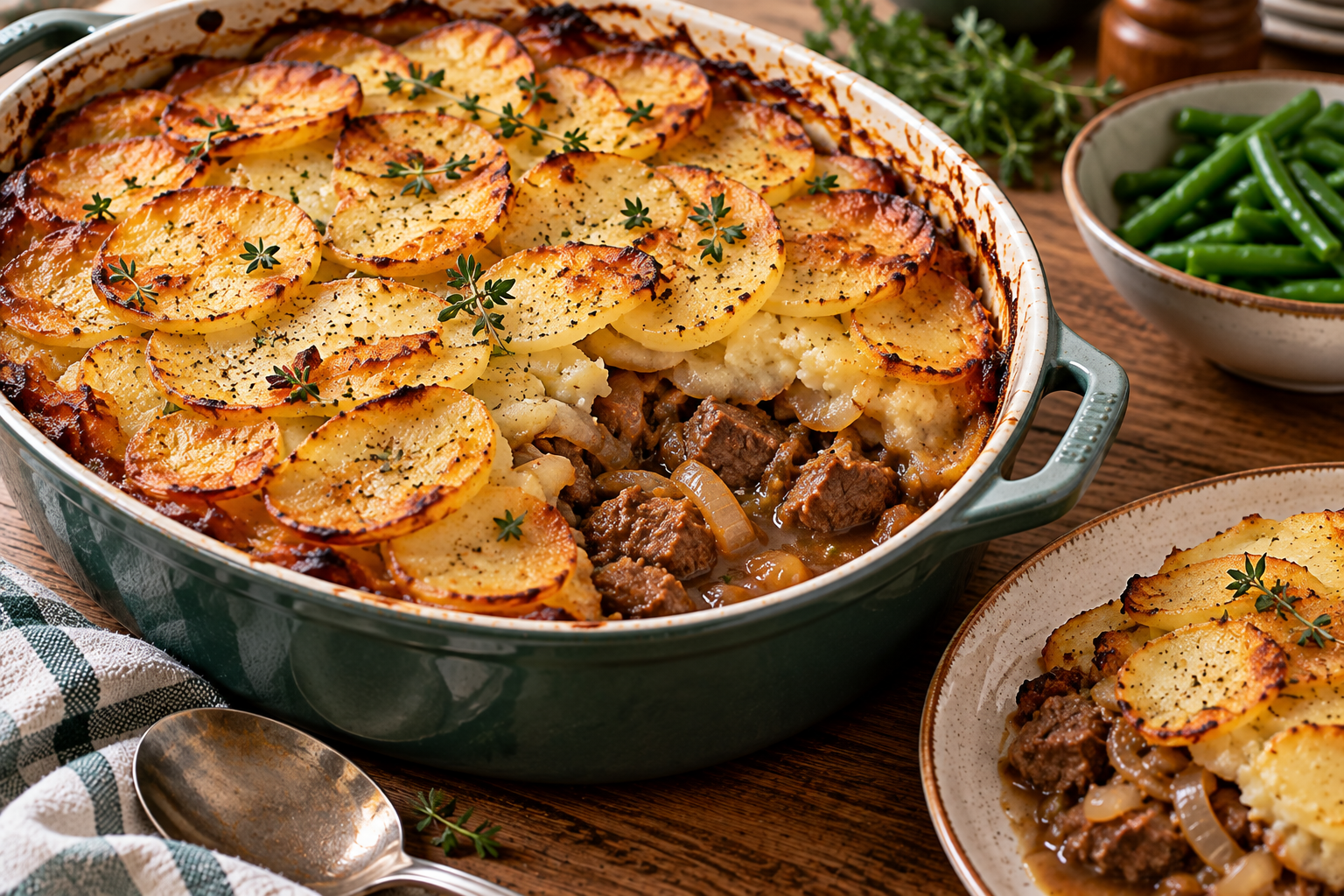
Lancashire hotpot is one of the great comfort foods of northern England: tender lamb and onions slowly cooked beneath a layer of thinly sliced potatoes that become beautifully golden and crisp on top while soaking up the rich gravy underneath.
It’s hearty, uncomplicated and exactly the sort of dinner you want when the weather turns cold.
Unlike shepherd’s pie, there’s no mashed potato topping. Instead, raw potato slices are arranged across the casserole before it goes into the oven, creating the distinctive overlapping golden crust that makes a Lancashire hotpot immediately recognizable.
And although older British recipes sometimes call for mutton or cuts of lamb that aren’t commonly sold in American supermarkets, it’s very easy to adapt the dish using lamb readily available in the United States.
This Brit & Skillet version keeps the character of the traditional dish while using ingredients and measurements that make sense in an American kitchen.
What Is Lancashire Hotpot?
Lancashire hotpot is a traditional dish from Lancashire in northwest England.
At its simplest, it consists of lamb or mutton, onions and potatoes cooked slowly together in a covered casserole.
The meat and onions form a rich gravy underneath, while overlapping slices of potato cover the entire surface of the dish.
Toward the end of cooking, the casserole is uncovered so the potatoes can become crisp and golden.
It’s proper British comfort food — warming, filling and made from relatively simple ingredients.
Why Is It Called a Hotpot?
The name refers to the cooking vessel and method rather than the type of stew Americans might associate with the word “hot pot.”
Traditionally, the ingredients were placed together in a heavy pot and left to cook slowly.
Lancashire hotpot became particularly associated with the industrial communities of Lancashire because it could be assembled ahead of time and left to cook slowly while people were working.
Lamb or Mutton?
Traditional Lancashire hotpot was often made with mutton, meaning meat from an older sheep.
Mutton has a stronger flavour than lamb and benefits from long, slow cooking.
It’s much less common in American supermarkets.
Fortunately, lamb works beautifully and is widely used in modern versions of Lancashire hotpot.
For an American kitchen, lamb shoulder is our preferred choice.
What Cut of Lamb Should I Buy in America?
Look for boneless lamb shoulder if you can find it.
It has enough fat and connective tissue to become tender and flavourful during the long cooking time.
Cut the lamb into approximately 1½-inch pieces.
If your supermarket doesn’t carry boneless lamb shoulder, ask the butcher or meat counter whether they can prepare some for you.
Lamb stew meat can also work, although the exact cuts included can vary.
Traditional Lancashire Hotpot Recipe
Prep Time: 30 minutes
Cook Time: 2 hours
Serves: 6
Equipment
- Large skillet
- Approximately 3-quart casserole or baking dish with a lid
- Sharp knife or mandoline
- Wooden spoon
- Pastry brush
Ingredients
For the Lamb Filling
- 2 pounds (900 g) boneless lamb shoulder, cut into approximately 1½-inch pieces
- 1 teaspoon salt
- ½ teaspoon freshly ground black pepper
- 2 tablespoons (16 g) all-purpose flour
- 1 tablespoon neutral oil, if needed
- 2 large yellow onions, thinly sliced
- 2 medium carrots, sliced
- 2 cups (480 ml) beef or lamb broth
- 1 tablespoon Worcestershire sauce
- 1 teaspoon dried thyme
- 1 bay leaf
For the Potato Topping
- 2 pounds (900 g) Yukon Gold potatoes
- 3 tablespoons (42 g) unsalted butter, melted
- ½ teaspoon salt
- ¼ teaspoon black pepper
Instructions
1. Prepare the Oven and Lamb
Preheat the oven to 325°F (165°C).
Pat the lamb dry with paper towels.
Season it with the salt and black pepper, then sprinkle over the flour and toss until the pieces are lightly coated.
2. Brown the Lamb
Heat a large skillet over medium-high heat.
If your lamb is fairly lean, add the tablespoon of oil.
Brown the lamb in batches so you don’t overcrowd the pan.
Cook each batch for several minutes, turning the pieces until browned on multiple sides.
The lamb doesn’t need to cook through at this stage.
Transfer the browned lamb to a plate while you prepare the onions.
Brit & Skillet Tip
Don’t crowd all the lamb into the skillet at once.
If the pieces are packed too closely together, they’ll release moisture and steam instead of developing the browned exterior that gives the finished gravy so much flavour.
3. Cook the Onions and Carrots
Reduce the heat to medium.
Add the sliced onions and carrots to the skillet.
Cook for approximately 8–10 minutes, stirring occasionally, until the onions soften and begin to take on a little colour.
If the pan becomes too dry, add a small splash of broth.
4. Make the Gravy
Slowly pour the broth into the skillet, scraping the bottom of the pan with a wooden spoon to loosen all those browned bits.
Stir in the Worcestershire sauce and thyme.
Add the bay leaf.
Bring the mixture to a gentle simmer and cook for approximately 3–4 minutes.
Taste and adjust the seasoning if necessary.
5. Assemble the Lamb Filling
Place the browned lamb in your casserole or baking dish.
Pour the onion, carrot and gravy mixture over the top.
Stir gently to distribute everything evenly.
The liquid doesn’t need to completely cover the lamb.
6. Prepare the Potatoes
Scrub and peel the potatoes if desired.
Yukon Gold potatoes have relatively thin skins, so leaving the skins on is also an option if you prefer a more rustic hotpot.
Slice the potatoes into thin rounds, approximately ⅛ inch (3 mm) thick.
A mandoline makes this particularly easy, but a sharp knife works perfectly well.
Try to keep the slices fairly even so they cook at the same rate.
Brit & Skillet Tip
Don’t slice the potatoes too thickly.
The potato topping needs enough time to become tender while the lamb cooks underneath. Approximately ⅛ inch thick gives you soft potato underneath with crisp golden edges on top.
7. Arrange the Potato Topping
Starting around the outside edge of the casserole, arrange the potato slices in overlapping circles over the lamb mixture.
Continue working toward the centre until the filling is completely covered.
Brush approximately half of the melted butter over the potatoes.
Season lightly with salt and black pepper.
8. Cover and Slow Cook
Cover the casserole tightly with its lid.
If your baking dish doesn’t have a lid, cover it tightly with aluminum foil.
Bake at 325°F (165°C) for 1 hour 30 minutes.
9. Brown the Potatoes
Carefully remove the casserole from the oven.
Increase the oven temperature to 425°F (220°C).
Remove the lid or foil.
Brush the remaining melted butter over the potatoes.
Return the uncovered hotpot to the oven for approximately 25–30 minutes, until the potatoes are tender and beautifully golden across the top.
If you’d like additional browning, you can place the dish under the broiler for a minute or two at the end.
Watch it closely.
10. Rest Before Serving
Remove the Lancashire hotpot from the oven and allow it to rest for approximately 10 minutes.
Remove the bay leaf if you can easily find it before serving.
Spoon the crisp potatoes, tender lamb and rich onion gravy onto warm plates.
Should Lancashire Hotpot Have Carrots?
You’ll find different opinions on this one.
Some very traditional Lancashire hotpot recipes are extremely simple, focusing primarily on lamb or mutton, onions and potatoes.
Other versions include carrots.
We’ve included carrots because they work beautifully with the lamb and make the dish particularly practical as a complete family dinner.
If you prefer a simpler version, you can leave them out.
What About Lamb Kidneys?
Another traditional addition you’ll sometimes encounter is lamb kidney.
Some historic and traditional Lancashire hotpot recipes include kidneys alongside the lamb or mutton.
They’re optional rather than essential for making a delicious hotpot, and they can be difficult to find in ordinary American supermarkets.
For that reason, this version leaves them out.
If you enjoy kidney and have access to it, you can certainly explore a more traditional variation.
Can I Use Ground Lamb?
Ground lamb isn’t ideal for Lancashire hotpot.
It works beautifully in our Traditional British Shepherd’s Pie, but hotpot is intended to contain pieces of slow-cooked lamb.
For the best texture, use lamb shoulder or lamb stew meat cut into chunks.
Can I Use Beef Instead?
You can use beef and make a delicious potato-topped casserole, but it wouldn’t traditionally be Lancashire hotpot.
The distinctive lamb or mutton filling is an important part of the dish.
If you’re looking for a traditional British beef dinner instead, our Traditional British Cottage Pie is a better place to start.
Can I Use Russet Potatoes?
Yes.
Yukon Gold potatoes are particularly good because they hold their shape while becoming creamy underneath and crisp on top.
Russets will also work, although they tend to be a little more floury and may break down slightly more during the long cooking time.
Either is perfectly workable in an American kitchen.
What to Serve with Lancashire Hotpot
Lancashire hotpot is hearty enough to serve as a complete meal, but traditionally simple vegetables work beautifully alongside it.
Try it with:
- Pickled red cabbage
- Steamed green beans
- Garden peas
- Braised red cabbage
- Buttered cabbage
Pickled red cabbage is a particularly classic accompaniment because its sharpness cuts through the richness of the lamb.
And a little extra gravy is rarely a bad idea.
Why Is My Lamb Tough?
Lancashire hotpot relies on slow cooking.
If the lamb still seems tough, it usually needs more time rather than less.
Lamb shoulder contains connective tissue that gradually breaks down during cooking.
Keep the casserole covered during the slow-cooking portion so moisture remains trapped inside.
Why Aren’t My Potatoes Crispy?
The potatoes spend most of their cooking time covered so they can become tender.
The crisping happens at the end.
Make sure you remove the lid, brush the potatoes with melted butter and increase the oven temperature for the final 25–30 minutes.
If necessary, a very short blast under the broiler will add extra colour.
Can I Make Lancashire Hotpot Ahead?
Yes.
Lancashire hotpot is an excellent make-ahead dinner.
You can prepare the lamb filling and assemble the casserole several hours ahead.
Cover and refrigerate until you’re ready to cook.
Because the casserole will be cold, you may need to add a little extra cooking time.
For the best-looking potato topping, assemble it reasonably close to cooking time so the raw potato slices don’t discolour.
How to Store Leftovers
Allow leftover hotpot to cool, then cover and refrigerate it.
It will keep for approximately 3 days.
Reheat individual portions in the microwave, or cover the casserole and warm it in a 350°F (175°C) oven until thoroughly heated.
Remove the cover toward the end if you’d like to crisp the potatoes again.
Can You Freeze Lancashire Hotpot?
Yes, although the texture of the potatoes may soften slightly after freezing.
Allow the cooked hotpot to cool completely.
Transfer portions to freezer-safe containers and freeze for up to 3 months.
Thaw overnight in the refrigerator before reheating.
A Taste of Lancashire
Lancashire hotpot is exactly the kind of recipe Brit & Skillet was created for.
It’s deeply rooted in British food tradition but doesn’t require complicated techniques or a cupboard full of unusual ingredients.
Tender lamb, sweet onions, rich gravy and a crisp potato topping make a wonderfully comforting dinner — and a few simple substitutions make it completely achievable in an American kitchen.
If you enjoy hearty British dinners, try our Traditional British Shepherd’s Pie, Traditional British Cottage Pie and Traditional British Toad in the Hole next, or browse all of the Brit & Skillet Recipes for more British favourites made approachable for American kitchens.
Leave a Reply