
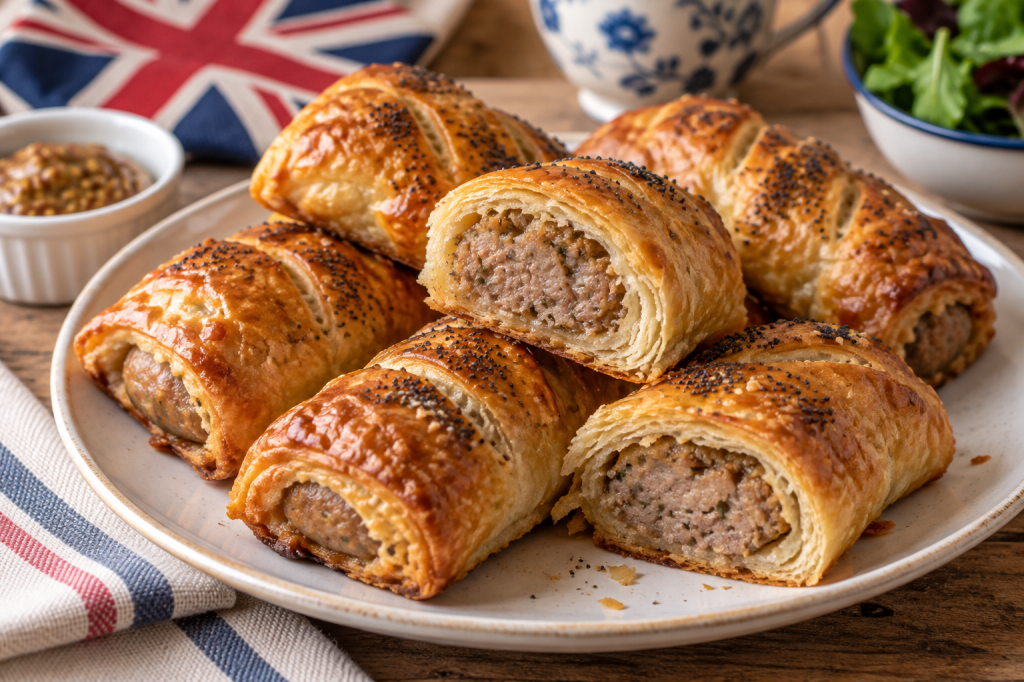
Few things disappear from a British party table quite as quickly as a plate of warm sausage rolls.
Flaky, golden pastry wrapped around a savoury sausage filling, they’re one of those wonderfully simple British foods that work for almost any occasion — parties, picnics, lunchboxes, afternoon snacks, or simply something warm to eat when you fancy a little taste of home.
And if you’re making British sausage rolls in America, there’s good news: you don’t need to make your own puff pastry or hunt down a long list of specialty ingredients.
Store-bought puff pastry works beautifully, and I’ll show you how to make a classic sausage filling using ingredients that are easy to find in an American grocery store. As always, you’ll get US measurements alongside metric weights.
The biggest difference American cooks may encounter is the sausage itself. British sausage meat isn’t quite the same as many strongly seasoned American breakfast sausages, so we’ll talk about what to look for — and how to get that familiar British-style flavour.
Brit & Skillet Tip: Keep your puff pastry cold until you’re ready to assemble the sausage rolls. Cold pastry hitting a hot oven is one of the secrets to getting those beautifully crisp, flaky layers.
What Are British Sausage Rolls?
A traditional British sausage roll is made by wrapping seasoned sausage meat in puff pastry, brushing the pastry with egg, and baking until beautifully puffed and golden.
They’re sold everywhere from bakeries to supermarkets in Britain and can be served warm or cold. You’ll find tiny versions on party tables, larger ones for lunch, and plenty of homemade versions with their own little twists.
Despite the name, there’s no bread roll involved. The “roll” is simply the pastry rolled around the sausage filling.
What Sausage Should I Use in America?
This is probably the most important question when recreating British sausage rolls in an American kitchen.
British sausage meat tends to have a fairly mild savoury flavour, often seasoned with herbs such as sage, along with salt and pepper. Some American breakfast sausages can be much sweeter or more heavily seasoned, which can change the flavour considerably.
For a more traditional result, look for plain ground pork and season it yourself. This gives you much more control over the flavour and is the approach we’ll use in this recipe.
If you’d rather use prepared sausage, choose a mild pork sausage without strong flavours such as maple, hot spices, Italian seasoning, or lots of fennel.
And if you happen to have access to proper British-style sausages, you can simply remove the meat from the casings and use that as your filling.
Do I Need to Make Puff Pastry?
Absolutely not.
Homemade puff pastry is wonderful, but sausage rolls are also exactly the sort of recipe where good-quality store-bought puff pastry makes life considerably easier.
In American supermarkets, puff pastry is usually sold frozen. Thaw it according to the package directions, but keep it chilled until you’re ready to assemble the sausage rolls.
The pastry should be flexible enough to unfold or roll without cracking, but still feel cold to the touch.
Brit & Skillet Tip: If your kitchen is warm and the pastry starts becoming soft or sticky while you’re assembling the rolls, pop it back into the refrigerator for 10–15 minutes. You’ll get much better puff from cold pastry.
Traditional British Sausage Rolls Recipe
Prep Time: 25 minutes
Chill Time: 15 minutes
Bake Time: 25–30 minutes
Yield: About 12 sausage rolls
Ingredients
For the Sausage Filling
- 1 lb (450g) ground pork
- ½ cup (50g) plain breadcrumbs
- 1 small onion, very finely chopped or grated
- 1 teaspoon dried sage
- ½ teaspoon dried thyme
- ¾ teaspoon salt
- ½ teaspoon black pepper
- ¼ teaspoon ground nutmeg
- 2 tablespoons (30ml) cold water
For the Pastry
- 1 package frozen puff pastry, about 17 oz (490g), thawed according to package directions but kept cold
- 1 large egg
- 1 tablespoon water, for the egg wash
Optional for the Top
- Sesame seeds or poppy seeds
Brit & Skillet Tip: Grating the onion rather than chopping it gives you very small pieces that disappear into the sausage filling as it cooks. You get the flavour without large pieces of onion breaking up the texture of the filling.
Perfect. ✅ Now we’ll assemble and bake them.
Step-by-Step Instructions
1. Prepare the Sausage Filling
Place the ground pork, breadcrumbs, grated onion, sage, thyme, salt, pepper, nutmeg and cold water in a large bowl.
Using clean hands or a fork, gently mix everything together until the seasonings are evenly distributed.
Try not to overwork the pork, as this can make the filling firmer than you want.
2. Prepare the Puff Pastry
Line a large baking sheet with parchment paper.
Unfold or gently roll the chilled puff pastry on a lightly floured surface.
Depending on the shape and number of pastry sheets in your package, divide the pastry into long rectangles approximately 4–5 inches (10–13cm) wide.
The exact dimensions aren’t critical — you simply need enough pastry to wrap comfortably around the sausage filling with a small overlap.
3. Add the Sausage Filling
Divide the sausage mixture evenly between the pastry rectangles.
Shape each portion into a long sausage about 1–1½ inches (2.5–4cm) thick and place it lengthwise near one edge of the pastry.
4. Roll and Seal
Beat the egg with 1 tablespoon of water to make an egg wash.
Brush a little egg wash along the opposite long edge of the pastry.
Roll the pastry snugly around the sausage filling so the edges overlap, then place the roll seam-side down.
Repeat with the remaining pastry and filling.
5. Cut and Chill
Using a sharp knife, cut the long rolls into pieces approximately 2 inches (5cm) wide. You should end up with about 12 sausage rolls.
Arrange them on the prepared baking sheet, leaving a little space between each one.
Brush the tops with egg wash and, if you like, sprinkle with sesame or poppy seeds.
Using the tip of a sharp knife, make 2 or 3 small slashes across the top of each sausage roll.
Refrigerate the assembled sausage rolls for about 15 minutes while the oven preheats.
6. Bake
Preheat the oven to 400°F (200°C).
Bake the sausage rolls for 25–30 minutes, or until the pastry is deeply golden and puffed and the pork filling is completely cooked.
For food safety, the centre of the sausage filling should reach 160°F (71°C) when checked with an instant-read thermometer.
Allow the sausage rolls to cool on the baking sheet for about 5 minutes before serving.
Brit & Skillet Tip: Don’t pull your sausage rolls from the oven when the pastry is merely pale gold. Giving puff pastry enough time to become properly golden helps create those crisp, flaky layers that make a good sausage roll so irresistible.
How to Serve British Sausage Rolls
British sausage rolls are delicious either warm or at room temperature, which is one reason they’re such a favourite for parties, picnics and packed lunches.
Serve them on their own or with a little mustard, ketchup, chutney or brown sauce on the side.
For something more substantial, pair warm sausage rolls with a simple salad, soup, or a few other British favourites for an easy lunch.
Can You Make Sausage Rolls Ahead of Time?
Yes. You can assemble the sausage rolls, place them on the prepared baking sheet, cover them well and refrigerate them for up to 24 hours before baking.
Keep them cold until you’re ready to put them into the oven, then brush with egg wash if you haven’t already done so and bake as directed.
How to Store Leftover Sausage Rolls
Because the filling contains cooked pork, leftover sausage rolls should be refrigerated.
Allow them to cool, then transfer them to an airtight container and refrigerate for up to 3 days.
To reheat, place them in a 350°F (175°C) oven for about 10–15 minutes, or until hot throughout and the pastry has crisped again.
The microwave will work in a hurry, but the pastry will be much softer.
Can You Freeze Sausage Rolls?
Absolutely. Sausage rolls are particularly handy to have in the freezer.
You can freeze them after baking by allowing them to cool completely and storing them in a freezer-safe container for up to 3 months.
Thaw overnight in the refrigerator and reheat in the oven until piping hot throughout.
You can also freeze assembled unbaked sausage rolls. Freeze them on a baking sheet until firm, then transfer them to a freezer-safe container or bag.
Bake from frozen, allowing a little additional baking time and checking that the pork filling reaches 160°F (71°C) in the centre before serving.
Why Is My Puff Pastry Soggy?
Make sure your pastry and sausage filling are kept cold before baking and that the oven is fully preheated.
Placing the sausage rolls seam-side down also helps keep them securely closed while they bake.
If your filling is particularly wet, excess moisture can soften the pastry. That’s another reason not to add too much liquid to the sausage mixture.
Why Did My Sausage Rolls Split Open?
A little movement in the pastry is normal as it puffs, but sausage rolls that completely unroll may not have been sealed firmly enough.
Brush the pastry edge lightly with egg wash, overlap the edges securely and bake the rolls with the seam underneath.
And don’t forget those little slashes across the top — they give steam somewhere to escape as the filling cooks.
Brit & Skillet Tip: Sausage rolls are at their best reheated in the oven rather than the microwave. A few extra minutes is worth it when the reward is crisp, flaky pastry.
Bring a British Favourite to Your American Kitchen
There’s something wonderfully satisfying about pulling a tray of homemade sausage rolls from the oven — especially when the pastry is crisp and golden and you can smell that savoury sausage filling underneath.
They may be a familiar sight in British bakeries and supermarkets, but making them at home is surprisingly straightforward. Store-bought puff pastry does most of the hard work, and seasoning plain ground pork yourself means you can create that classic British-style filling with ingredients from an American grocery store.
Serve them warm from the oven, tuck them into a picnic, or make a batch for your next party. And if a few find their way into the freezer for later, even better.
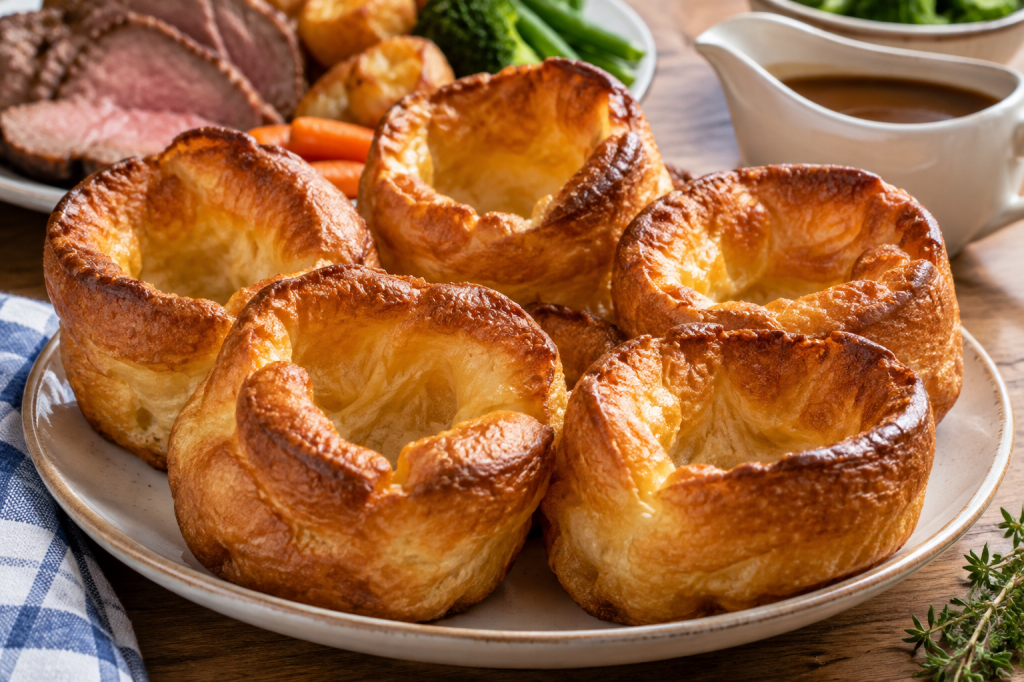
If you enjoyed making these, try our Traditional Yorkshire Puddings for another savoury British classic, or explore more of our traditional British recipes for plenty of ideas to bring a little taste of Britain to your American kitchen.
 Brit & Skillet