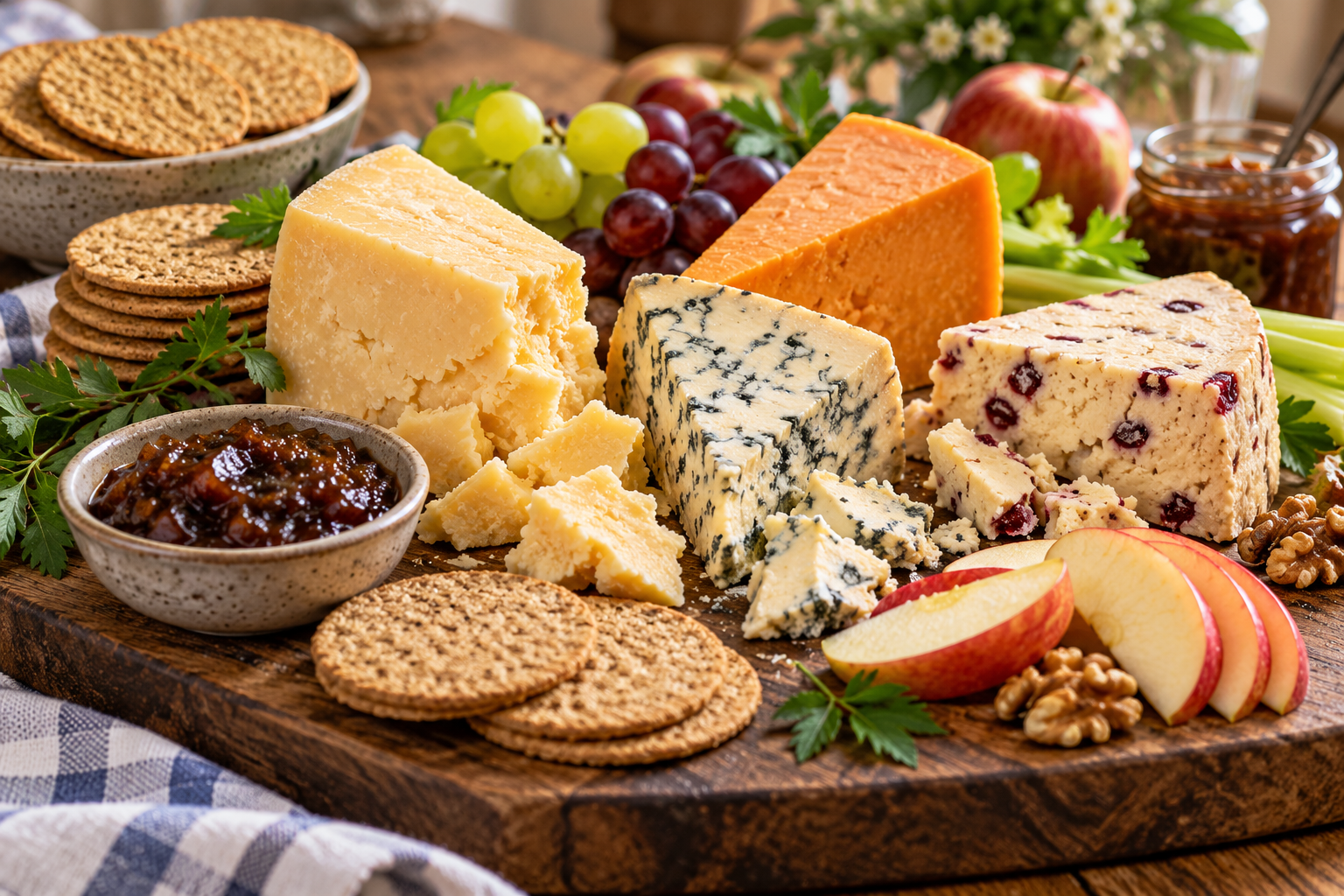
Britain has a wonderful tradition of cheesemaking, from sharp, mature Cheddar and rich Blue Stilton to crumbly Wensleydale and buttery Double Gloucester. Each cheese has its own character, and many have strong connections to the towns, counties and farming communities where they originated.
For Americans exploring British food, cheese is a particularly delicious place to start. Some varieties, such as Cheddar, are already household favourites. Others might be less familiar, but they are well worth discovering.
Whether you’re planning a traditional British cheeseboard, preparing an afternoon tea spread or simply looking for something different to serve with crackers and chutney, this guide explores some of Britain’s best-loved cheeses, their traditional pairings and how to enjoy them in an American kitchen.
What Makes British Cheese Special?
British cheesemaking has developed over centuries, shaped by regional farming traditions, local milk supplies and methods of aging and preserving cheese.
Many classic British cheeses are associated with particular places. Cheddar takes its name from a village in Somerset, Wensleydale from a Yorkshire dale, and Caerphilly from a town in Wales.
These regional connections are part of what makes British cheese so interesting. Even cheeses made from the same type of milk can taste remarkably different depending on how they are produced and matured.
Britain is particularly famous for its hard and crumbly cheeses, although its cheesemakers also produce excellent soft cheeses, blues and modern artisan varieties.
For American cooks, the good news is that many British cheeses are available through specialty cheese counters, imported food shops and some larger supermarkets.
9 Traditional British Cheeses Worth Trying
1. Cheddar — Somerset, England
Cheddar is probably Britain’s most famous cheese and certainly one of its most internationally recognised.
Originating in Somerset, traditional Cheddar is a firm cow’s milk cheese with a flavour that develops as it matures. Younger Cheddar tends to be mild and creamy, while mature varieties become sharper, richer and sometimes pleasantly crumbly.
In Britain, Cheddar is used in everything from sandwiches and cheese on toast to savoury pastries and traditional pub lunches.
Best pairings: Apple slices, onion chutney, crusty bread, oatcakes and pears.
American kitchen tip: Look for extra-sharp or aged Cheddar if you want a stronger British-style flavour. English farmhouse Cheddar is particularly worth trying when available.
Cheddar is also excellent in homemade British Cheese and Onion Pasties, where its rich flavour complements the sweet onions and buttery pastry.
2. Stilton — England’s Famous Blue Cheese
Stilton is one of Britain’s most distinctive cheeses, recognised for its blue veins, rich flavour and creamy yet slightly crumbly texture.
Traditional Blue Stilton is produced in Derbyshire, Leicestershire and Nottinghamshire. It has a strong, savoury flavour with a gentle sharpness that makes it particularly popular on Christmas cheeseboards.
Despite its bold appearance, good Stilton can be beautifully balanced rather than overwhelmingly strong.
Best pairings: Pears, figs, walnuts, honey, fruitcake and sweet fruit chutneys.
American kitchen tip: Imported Blue Stilton is often available at specialty cheese counters. If you cannot find it, a creamy blue cheese or Gorgonzola Dolce can provide a different but enjoyable alternative.
Stilton is especially delicious served with ripe pears and a few walnuts after a special dinner.
3. Wensleydale — Yorkshire, England
Wensleydale is a traditional Yorkshire cheese known for its pale colour, crumbly texture and fresh, slightly tangy flavour.
Unlike a mature Cheddar, Wensleydale is usually delicate and mildly sweet, making it particularly enjoyable with fruit.
One of Britain’s best-known combinations is Wensleydale with fruitcake or Christmas cake. The contrast between the crumbly cheese and rich, sweet cake might sound unusual to American readers, but it is a much-loved regional pairing.
Wensleydale with cranberries is another popular variation, especially around Christmas.
Best pairings: Apples, grapes, fruitcake, Christmas cake and cranberry chutney.
American kitchen tip: Look for Wensleydale in specialty cheese shops, particularly during the holiday season. Mild, crumbly fresh cheeses can provide some of the same contrast with fruit, although they will not taste identical.
4. Red Leicester — Leicestershire, England
Red Leicester is a traditional English cheese with a distinctive orange colour and a mellow, slightly nutty flavour.
Although its appearance can resemble orange American Cheddar, Red Leicester has its own character. It is generally smoother and less sharp than a mature Cheddar, with a rich, savoury taste.
Its beautiful colour also makes it a lovely addition to a cheeseboard.
Best pairings: Apples, pears, crackers, pickles and onion chutney.
American kitchen tip: If Red Leicester is unavailable, a mild-to-medium Cheddar is a practical substitute, although the flavour and texture will differ.
5. Double Gloucester — Gloucestershire, England
Double Gloucester is a traditional English cheese with a firm, smooth texture and a gentle, buttery flavour.
It is usually milder than mature Cheddar, making it an excellent choice for anyone who prefers cheese without too much sharpness.
Its rich golden colour looks especially attractive alongside paler cheeses and blue-veined varieties.
Best pairings: Fresh apples, grapes, crusty bread, mild chutneys and plain crackers.
American kitchen tip: Colby or a mild Cheddar can work as an accessible substitute when Double Gloucester is difficult to find.
6. Cheshire — Northwest England
Cheshire is one of Britain’s oldest recorded named cheeses and is particularly associated with the northwest of England.
It has a distinctive crumbly texture and a fresh, slightly salty tang. Compared with Cheddar, Cheshire often tastes lighter and more delicate.
Its crumbly character makes it lovely with simple accompaniments that allow the cheese itself to shine.
Best pairings: Apples, oatcakes, celery, crusty bread and mild chutney.
American kitchen tip: Cheshire can be harder to find in ordinary supermarkets. Look for it at specialist cheese counters or British food retailers.
7. Lancashire — Lancashire, England
Lancashire cheese comes in several traditional styles, including Creamy Lancashire, Tasty Lancashire and Crumbly Lancashire.
Creamy Lancashire is mild and buttery, while Tasty Lancashire is matured longer and develops a stronger, more savoury flavour.
Lancashire is particularly good for melting, making it useful in toasted sandwiches and comforting British dishes.
Best pairings: Crusty bread, apples, pickles, onion chutney and oatcakes.
American kitchen tip: For cooking, a mild Cheddar can often stand in for Lancashire, although it may melt and taste differently.
Lancashire’s rich culinary traditions also include dishes such as Traditional Lancashire Hotpot, another wonderful example of northern English comfort food.
8. Caerphilly — Wales
Caerphilly is a traditional Welsh cheese with a pale interior, crumbly texture and pleasantly fresh, slightly lemony flavour.
Some traditional versions develop a firmer rind and more complex flavour as they mature.
It makes a lovely contrast to stronger cheeses on a British cheeseboard.
Best pairings: Apples, pears, oatcakes, crusty bread and lightly sweetened chutneys.
American kitchen tip: Traditional Caerphilly can be difficult to find in the United States. A young, mildly tangy cheese may offer a similar role on a cheeseboard, even if its flavour is different.
9. Dunlop — Scotland
Dunlop is a traditional Scottish cow’s milk cheese associated with Ayrshire.
It is generally firm and smooth, with a mild, buttery flavour that becomes nuttier and more pronounced as it matures.
Although less internationally famous than Cheddar or Stilton, Dunlop is an excellent reminder that Britain’s cheesemaking heritage extends well beyond England.
Best pairings: Oatcakes, apples, pears, chutney and crusty bread.
American kitchen tip: Traditional Dunlop is not widely available in American supermarkets. A mild, firm Cheddar is a reasonable substitute for assembling a similar cheeseboard.
British Cheese Pairings at a Glance
| British Cheese | Flavour | Traditional Pairing | American Alternative |
|---|---|---|---|
| Mature Cheddar | Sharp and savoury | Apple and onion chutney | Extra-sharp Cheddar |
| Blue Stilton | Rich and tangy | Pears, walnuts and figs | Creamy blue cheese |
| Wensleydale | Mild and crumbly | Fruitcake and apples | Mild fresh crumbly cheese |
| Red Leicester | Mellow and nutty | Pickles and crackers | Mild Cheddar |
| Double Gloucester | Buttery and smooth | Grapes and bread | Colby |
| Cheshire | Fresh and tangy | Oatcakes and celery | Mild crumbly cheese |
| Lancashire | Buttery to savoury | Bread and chutney | Mild Cheddar |
| Caerphilly | Fresh and slightly lemony | Apples and oatcakes | Young tangy cheese |
| Dunlop | Mild and nutty | Scottish oatcakes | Mild firm Cheddar |
These alternatives are intended to provide similar serving options rather than exact copies of the original cheeses.
How to Build a Traditional British Cheeseboard
A British cheeseboard does not need to be elaborate. In fact, a simple selection of three to five cheeses can be far more enjoyable than a crowded platter with too many competing flavours.
The key is choosing different textures and strengths.
Choose a Variety of Cheeses
For a balanced cheeseboard, try combining a mature Cheddar, a crumbly Wensleydale, a mellow Red Leicester and a Blue Stilton.
If you prefer milder flavours, replace the Stilton with Double Gloucester or a soft cheese.
Three cheeses are perfectly sufficient for a small gathering, while five provide a little more variety for a special occasion.
Add Traditional British Accompaniments
A proper British cheeseboard often includes a few simple additions:
- Plain crackers or Scottish oatcakes
- Fresh apple and pear slices
- Grapes or figs
- Onion chutney or pickle
- Crusty bread
- Walnuts
- Celery
- A little honey or fruit preserve
You do not need every accompaniment. Choose two or three that complement the cheeses you are serving.
Try a Classic Ploughman’s-Style Spread
For a more substantial lunch, take inspiration from a traditional British ploughman’s lunch.
Serve thick slices of mature Cheddar with crusty bread, butter, pickle, sliced apples and perhaps a few pickled onions.
It is simple, satisfying and a lovely way to introduce traditional British flavours to an American kitchen.
What Is the Difference Between a British Cheeseboard and an American Charcuterie Board?
Although the two can look similar, their traditional emphasis is often different.
A British cheeseboard typically places the cheeses at the centre, with crackers, bread, fruit and chutney served as accompaniments.
American charcuterie boards frequently feature a wider selection of cured meats, cheeses, nuts, fruit and other snacks arranged together.
There is no reason you cannot combine the two approaches, but a traditional British cheeseboard is often simpler, allowing the flavours of individual cheeses to stand out.
Where to Buy British Cheese in America
Finding authentic British cheese in the United States is easier than it once was, although availability varies considerably by region.
Large supermarkets with specialty cheese departments sometimes carry imported Cheddar, Stilton and Wensleydale.
Independent cheesemongers and international food shops may offer a wider selection, including regional varieties that are harder to find elsewhere.
British food shops can also be useful, particularly around Christmas, when traditional cheeses become more popular.
When shopping, look carefully at the label. A cheese described as British-style is not necessarily imported from Britain, and some regional names are used for cheeses produced elsewhere.
That does not mean an American-made version cannot be delicious. It simply helps to know what you are buying.
British Cheese and Afternoon Tea
Although afternoon tea is best known for finger sandwiches, scones and cakes, cheese can also make a wonderful addition to a savoury tea menu.
Small Cheddar sandwiches, cheese scones and miniature savoury pastries are particularly suitable.
For a more substantial afternoon tea, a small cheeseboard with crackers, grapes and chutney can be served alongside traditional sandwiches.
If you’re planning a British-inspired gathering, explore more ideas in our All Recipes collection.
British Cheese at Christmas
Cheese has a special place in many British Christmas celebrations.
After a large Christmas dinner, families may bring out a cheeseboard later in the evening, often with crackers, chutney and leftover festive treats.
Blue Stilton is a particularly familiar Christmas favourite, while Wensleydale with cranberries adds a seasonal touch.
One of the most interesting traditional pairings is cheese with Christmas cake. A slice of crumbly Wensleydale alongside rich fruitcake is a combination worth trying at least once.
For an easy festive cheeseboard, combine mature Cheddar, Stilton, Wensleydale and Red Leicester with grapes, crackers, chutney and a few walnuts.
How to Serve and Store British Cheese
Serving Temperature
Most cheeses taste better when they are not refrigerator-cold.
Remove the amount you intend to serve shortly before eating, allowing approximately 20–30 minutes for the flavours and textures to become more noticeable.
Avoid leaving perishable cheese unrefrigerated for more than two hours, or one hour when temperatures exceed 90°F (32°C).
Cutting and Serving
Use separate knives for strongly flavoured cheeses, particularly blue cheese, to prevent their flavours from spreading to milder varieties.
Cut firm cheeses into wedges or slices, while crumbly cheeses can be served in rustic pieces.
Storage
Keep cheese refrigerated and follow the storage guidance on its packaging.
Wrap firm cheeses in suitable cheese paper or parchment with an outer protective covering, while keeping softer cheeses in appropriate food-safe containers.
If a cheese has been sold in protective packaging, follow the producer’s recommendations once it has been opened.
Frequently Asked Questions About British Cheese
What is the most popular British cheese?
Cheddar is Britain’s best-known cheese and one of the most widely enjoyed varieties internationally. It is available in styles ranging from mild and creamy to mature and sharply flavoured.
What is the best British cheese for beginners?
Mature Cheddar, Red Leicester and Double Gloucester are excellent starting points. They offer different flavours without the intensity of a strong blue cheese.
Is British Cheddar different from American Cheddar?
Both can be excellent, but traditional British farmhouse Cheddar often has a distinctive savoury depth and firmer, sometimes crumbly texture. American Cheddar varies widely, so the differences depend on the particular cheeses being compared.
Why do British people eat cheese with Christmas cake?
In parts of northern England, particularly Yorkshire, cheese with rich fruitcake is a longstanding tradition. The savoury, crumbly cheese provides a delicious contrast to the sweetness of the fruit.
What is a good substitute for Wensleydale in America?
There is no perfect substitute, but a mild, fresh, crumbly cheese can provide a similar contrast with fruit and crackers. If you can find imported Wensleydale, it is worth trying the original.
Can I make a British cheeseboard without imported cheese?
Absolutely. Use good-quality American cheeses that provide a mixture of firm, crumbly, creamy and strong flavours. Pair them with British-style accompaniments such as oatcakes, onion chutney, apples and crusty bread.
Bringing a Taste of Britain to Your American Kitchen
Exploring British cheese is about much more than finding something to put on a cracker. Each variety offers a small connection to Britain’s regional food traditions, from Somerset’s mature Cheddar to Yorkshire’s crumbly Wensleydale and Scotland’s traditional Dunlop.
You do not need to find every authentic variety to enjoy the experience. Start with two or three cheeses, add a little chutney, some fresh fruit and good crackers, and discover which combinations you enjoy most.
A simple British cheeseboard can make a lovely addition to a family gathering, an afternoon tea or a cosy evening at home.
And if you discover that Wensleydale really does taste wonderful with fruitcake, you might just find yourself adopting another very British tradition.
Leave a Reply