
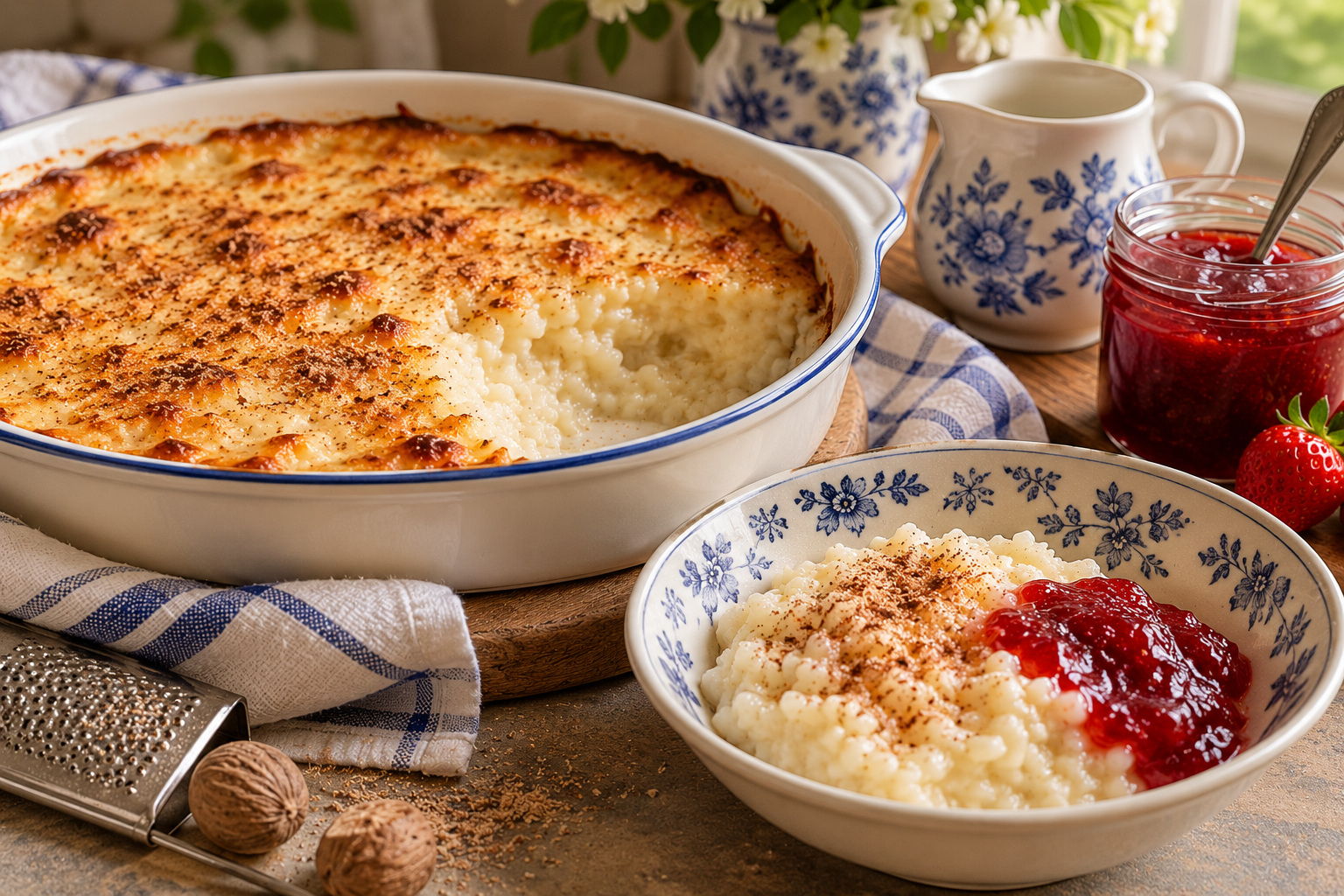
Few British puddings are as simple—or as comforting—as a traditional baked rice pudding.
This is the old-fashioned kind: rice slowly baked in milk until it becomes wonderfully soft and creamy, with a lightly golden top and just enough sweetness to make it feel like pudding rather than breakfast.
It isn’t the thick stovetop rice pudding you may be familiar with in America, and it certainly doesn’t need a packet of instant pudding mix. Traditional British rice pudding is wonderfully uncomplicated. A handful of ingredients, a baking dish and a little patience are really all you need.
Serve it warm from the oven with a spoonful of Homemade British Strawberry Jam, or enjoy it exactly as it is.
Affiliate disclosure: Brit & Skillet may earn a commission from qualifying purchases made through links on this page, at no additional cost to you.
What Is British Rice Pudding?
British rice pudding is traditionally made by slowly baking short-grain rice with milk and sugar.
During its long, gentle bake, the rice absorbs the milk and releases starch, creating a creamy pudding without needing eggs or cornstarch to thicken it.
A little butter and nutmeg on top give it that unmistakably old-fashioned British character.
The surface develops a golden skin as it bakes, while underneath you’ll find tender rice surrounded by creamy milk.
It’s simple nursery-food comfort—and that’s exactly the appeal.
Is British Rice Pudding Different From American Rice Pudding?
It can be.
There are many versions of rice pudding on both sides of the Atlantic, but American recipes are often prepared on the stovetop and may contain eggs, vanilla, cinnamon or raisins.
Traditional British rice pudding is usually much plainer.
The classic baked version relies on rice, milk, sugar and slow cooking for its texture, with butter and nutmeg providing the finishing touches.
And no raisins here.
What Rice Should I Use for British Rice Pudding?
In Britain, supermarkets commonly sell bags simply labeled pudding rice.
That isn’t something you’re likely to see in every American grocery store.
Pudding rice is a short-grain rice that becomes tender and creamy during slow cooking.
For an American kitchen, Arborio rice is a convenient substitute and is widely available. Short-grain white rice can also work.
Don’t use instant or quick-cooking rice for this recipe.

Traditional British Rice Pudding
Ingredients
Equipment
Method
- Preheat the oven to 300°F (150°C).
- Lightly butter a 2-quart baking dish.
- Add the rice, granulated sugar and a small pinch of salt to the prepared baking dish.
- Stir to distribute the rice evenly across the bottom.
- Pour the whole milk into the baking dish. Stir gently so the rice is evenly distributed. The mixture will look very liquid at this stage. This is normal.
- Dot the unsalted butter over the surface and sprinkle lightly with ground or freshly grated nutmeg.
- Place the baking dish in the preheated oven and bake for 30 minutes.
- After 30 minutes, carefully stir the pudding once to redistribute any rice that has settled or begun sticking together. Return the dish to the oven.
- Continue baking for approximately 1 1/2 to 2 hours more, for a total baking time of about 2 to 2 1/2 hours.
- The pudding is ready when the rice is completely tender and the mixture underneath the golden surface is still creamy. Do not wait until all of the liquid has disappeared.
- Remove the pudding from the oven and allow it to rest for 15–20 minutes.
- It will continue to thicken as it rests.
- Spoon the rice pudding into bowls and serve warm.
- Enjoy it plain, with a little additional nutmeg, fresh berries or a spoonful of homemade strawberry jam.
Notes
What Is the Skin on Rice Pudding?
That golden skin on top isn’t a mistake.
For many people, it’s one of the defining features of an old-fashioned British baked rice pudding.
Milk proteins and sugars brown during the long bake, creating a soft golden layer across the surface.
Some families fight over it.
Others carefully avoid it.
Both traditions appear to have survived.
If you’re firmly in the no skin, please camp, stirring the pudding more frequently during baking will prevent such a pronounced layer from developing—although you’ll lose some of the classic baked appearance.
Why Is My Rice Pudding Still Runny?
First, remember that traditional British rice pudding is supposed to be creamy.
It shouldn’t emerge from the oven as a solid mass.
If the rice is completely tender but there is still some creamy milk surrounding it, that’s usually exactly what you want.
Allow the pudding to rest for 15–20 minutes before serving. The rice will continue absorbing liquid and the pudding will thicken as it cools.
If the rice itself is still firm, however, it needs more cooking time.
Why Is My Rice Pudding Dry?
The most likely culprit is simply overbaking.
Different baking dishes expose different amounts of surface area, and ovens don’t all cook at precisely the same rate.
Start checking the pudding around the 2-hour mark.
You’re looking for tender rice and a creamy consistency beneath the golden surface.
High-Altitude Note
This is one of those recipes where altitude can make a difference, although it isn’t as dramatic as it is with cakes or yeast breads.
At higher elevations, liquids evaporate more quickly and water boils at a lower temperature. A long-baked pudding can therefore lose moisture faster before the rice has become completely tender.
If you’re cooking at higher altitude and the pudding looks as though it’s becoming dry while the rice is still firm, gently stir in a little additional warm milk and continue baking.
Also expect that the rice may need a little longer to become completely tender.
The important thing is to judge this pudding by the rice and consistency rather than the clock.
Can I Add Vanilla?
You can, although it isn’t necessary for a traditional version.
If you’d like a slightly more fragrant pudding, add about 1 teaspoon vanilla extract to the milk.
But if you’re trying British baked rice pudding for the first time, I’d make the simple nutmeg version first.
There is something lovely about how understated it is.
What About Cinnamon?
Nutmeg is the flavor I’d choose for the classic British version.
If you prefer cinnamon, there’s nothing stopping you from using it, but the pudding will taste a little less traditionally British.
Does British Rice Pudding Have Raisins?
It doesn’t have to—and ours doesn’t.
Some rice pudding variations contain raisins or other dried fruit, but they’re certainly not essential.
For Brit & Skillet, we’re keeping this version smooth, creamy and simple.
What to Serve With British Rice Pudding
Traditional rice pudding needs very little accompaniment.
You can serve it:
- Plain and warm from the baking dish
- With a little extra nutmeg
- With a spoonful of Homemade British Strawberry Jam
- With another fruit preserve
- With fresh berries
The strawberry jam is particularly good because the sharp, fruity flavor cuts through the creamy pudding.
Can You Eat Rice Pudding Cold?
Absolutely.
Some people prefer it warm, while others happily eat leftovers straight from the refrigerator.
Once chilled, the pudding becomes considerably thicker.
If you’d like to reheat it, add a small splash of milk before warming to loosen the consistency again.
How to Store Rice Pudding
Allow leftover rice pudding to cool, then refrigerate it promptly in a covered container.
Because cooked rice requires careful handling, don’t leave the pudding sitting at room temperature for extended periods.
Refrigerate leftovers within 2 hours and use them within 3–4 days.
Reheat only the portion you’re planning to eat and make sure it’s heated thoroughly before serving.
Can You Freeze Rice Pudding?
You can, although the texture may change slightly after thawing.
Freeze cooled portions in airtight freezer-safe containers.
Thaw overnight in the refrigerator and reheat gently with a splash of milk to restore some of the creamy texture.
For the best texture, though, I’d choose freshly made or refrigerated rice pudding over frozen.
More Traditional British Comfort Food
If this is your kind of pudding, try Traditional British Treacle Sponge Pudding next for another wonderfully old-fashioned dessert.
Or make Traditional British Jam Roly-Poly with custard for something even more nostalgic.
For afternoon tea rather than pudding, you can’t go wrong with Traditional British Scones and our new Homemade British Strawberry Jam.
And if you’ve ever wondered why British recipes sometimes call ingredients by completely different names, British Baking Ingredients Americans Need to Know is a useful place to start.
A Proper Old-Fashioned British Pudding
Traditional rice pudding isn’t elaborate.
There are no complicated techniques, fancy decorations or long lists of ingredients.
But after a couple of hours in a low oven, those few simple ingredients become something remarkably comforting: tender rice, creamy milk, a little sweetness and that characteristic golden nutmeg-speckled top.
Sometimes the simplest British puddings are the ones worth keeping.
Leave a Reply