
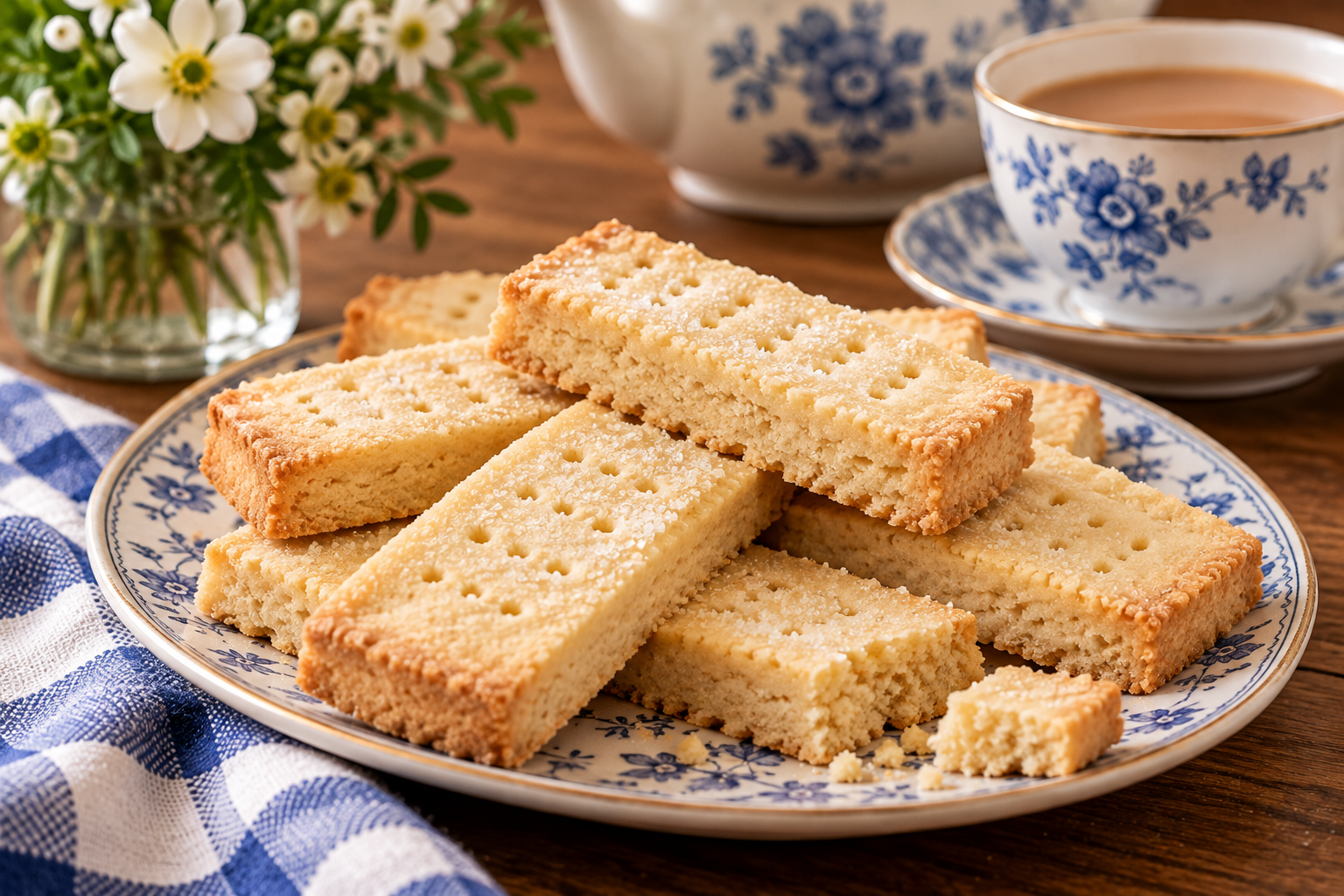
Few biscuits are as simple—or as unmistakably British—as a piece of good shortbread.
At its heart, traditional shortbread needs only three basic ingredients: butter, sugar and flour. There are no eggs, no baking powder and no elaborate decorations required.
What you get instead is something wonderfully buttery and delicate, with a tender, crumbly texture that almost melts in your mouth.
And while shortbread is particularly associated with Scotland, it has become a familiar part of British baking more broadly. It’s lovely alongside a cup of tea, makes an easy homemade gift, and is exactly the sort of recipe where good ingredients and a few small techniques make all the difference.
This version uses ingredients you’ll easily find in an American supermarket, with US measurements alongside grams—and I’ve included high-altitude guidance for those of us baking a little closer to the clouds.
Affiliate disclosure: Brit & Skillet may earn a commission from qualifying purchases made through links on this page, at no additional cost to you.
What Is Traditional Shortbread?
Shortbread is a rich, crumbly biscuit traditionally made from butter, sugar and flour.
Unlike many American cookies, traditional shortbread doesn’t rely on eggs or chemical leaveners such as baking powder or baking soda.
That simplicity is what gives it its characteristic texture.
Rather than being chewy or cakey, properly baked shortbread should be tender and crumbly with a rich butter flavor.
Is Shortbread Scottish or British?
Shortbread is particularly associated with Scotland, where it has a long history and remains one of the country’s most recognizable baked goods.
So although you’ll find shortbread throughout Britain, calling it Scottish shortbread is entirely appropriate.
For Brit & Skillet, it also fits perfectly into our collection of traditional British recipes—especially for anyone who wants something simple to serve with tea.
What Is the Traditional Shortbread Ratio?
A classic way of remembering shortbread is the basic ratio:
1 part sugar : 2 parts butter : 3 parts flour
Different recipes adjust that balance slightly, and some include rice flour or cornstarch for texture.
We’re keeping this version particularly straightforward with ingredients that are easy to find in an American kitchen.
Ingredients for British Shortbread
You’ll need:
- Unsalted butter
- Granulated sugar
- All-purpose flour
- A small pinch of salt
That’s it.
Because there are so few ingredients, the butter really matters.
Use a butter you genuinely enjoy the flavor of.
British Flour vs. American Flour
A British recipe will normally describe the flour here as plain flour.
In an American kitchen, use all-purpose flour.
If you’d like a more detailed explanation of the differences, see my guide to Plain Flour vs. All-Purpose Flour.
And don’t use American self-rising flour here. Traditional shortbread doesn’t need the added leavening.
Should I Use Granulated or Caster Sugar?
British recipes often use caster sugar, which has finer crystals than ordinary American granulated sugar.
For this recipe, ordinary granulated sugar works perfectly well.
If you’d like to understand the difference—and how to make a finer sugar when a British recipe really benefits from it—see Caster Sugar vs. Granulated Sugar.

Traditional British Shortbread
Ingredients
Equipment
Method
- Preheat the oven to 325°F (165°C).
- Lightly butter an 8-inch square baking pan and line the bottom with parchment paper, leaving enough overhang to help lift the shortbread from the pan after cooling.
- Place the softened butter and granulated sugar in a large mixing bowl. Beat together until smooth and creamy.
- There is no need to whip lots of air into the mixture. Mix only until well combined and creamy.
- Add the all-purpose flour and salt and mix on low speed or stir with a wooden spoon until the mixture begins forming soft, crumbly clumps.
- Use your hands to gently bring the mixture together into a soft dough. Avoid kneading or excessively working the dough.
- Transfer the dough to the prepared baking pan and gently press it into an even layer, making sure the dough reaches the corners.
- Smooth the surface lightly without compressing the dough too firmly.
- Use a sharp knife to lightly score the dough into 16 rectangular or square pieces.
- Do not cut completely through the dough.
- Prick each piece several times with the tines of a fork.
- Place the pan in the refrigerator for 20–30 minutes to firm the butter before baking.
- Bake for approximately 30–35 minutes.
- The shortbread is ready when the surface looks set and remains relatively pale, with only a little light golden color beginning around the edges. Do not wait for the entire surface to become golden brown.
- Remove the pan from the oven.
- If desired, lightly sprinkle the surface with 1 tablespoon granulated sugar.
- While the shortbread is still warm, carefully cut along the previously scored lines.
- Allow the shortbread to cool in the pan.
- Once completely cool, lift it from the pan using the parchment paper and separate it into individual pieces.
- Serve with tea or coffee, fresh strawberries or homemade strawberry jam.
Notes
How Do I Know When Shortbread Is Done?
This is one of the most important parts of making shortbread.
Don’t wait for it to become golden brown all over.
By that point, you’ve probably gone too far.
The center should look set and dry rather than wet, while the edges should only be beginning to turn pale gold.
Shortbread continues firming as it cools.
Why Is My Shortbread Hard?
Several things can make shortbread harder than intended.
The dough may have been overmixed, too much flour may have been added, or the shortbread may simply have baked too long.
This is one of those recipes where weighing your flour makes a real difference.
Scooping flour directly from the bag with an American measuring cup can compact it and give you considerably more flour than intended.
For the most consistent result, use 240g all-purpose flour.
Why Is My Shortbread Crumbly?
Some crumbliness is exactly what you want.
Shortbread is supposed to be short—a baking term referring to a tender, crumbly texture created when fat interferes with gluten development.
But it should still hold together when you pick it up.
If the raw dough absolutely refuses to come together, first make sure your butter was properly softened and that your flour wasn’t overmeasured.
Resist immediately adding liquid.
Why Did My Shortbread Spread?
Butter that became too warm before baking can cause the dough to lose definition.
That’s why we’re giving the pressed dough 20–30 minutes in the refrigerator before it goes into the oven.
If your kitchen is particularly warm, don’t skip that step.
High-Altitude Shortbread Tips
Shortbread is more forgiving at altitude than a delicate sponge cake because it contains no chemical leavener, but elevation can still affect baking.
The biggest issue is often moisture. Flour can be drier in a high-altitude climate, and baked goods may lose moisture more quickly in the oven.
If you’re baking at higher elevation:
- Weigh the flour rather than relying on cups.
- Be especially careful not to add extra flour if the dough initially looks crumbly.
- Begin checking the shortbread a few minutes earlier than the stated baking time because dry air can encourage faster moisture loss.
- If the correctly measured dough genuinely won’t hold together after being gently worked, add only a very small amount of softened butter rather than automatically pouring in water.
You shouldn’t need dramatic recipe adjustments for this particular bake.
The goal is simply to avoid accidentally making an already crumbly biscuit too dry.
Can I Make Shortbread Without a Mixer?
Absolutely.
A wooden spoon and a little patience work perfectly well.
Make sure the butter is properly softened before you begin, then work the sugar into it until smooth before adding the flour.
Shortbread existed long before electric mixers did.
Can I Use Salted Butter?
Yes.
If salted butter is what you have, omit the additional ¼ teaspoon salt.
The precise salt level varies between butter brands, but shortbread is forgiving enough for this substitution.
Can I Add Vanilla?
You can add about 1 teaspoon vanilla extract if you’d like.
It tastes lovely.
But if you want the simplest traditional version, leave it out and let the butter be the main flavor.
Can I Dip Shortbread in Chocolate?
Definitely—and it makes a lovely variation.
Allow the shortbread to cool completely, then dip one end into melted dark or milk chocolate and let it set.
I wouldn’t call chocolate-dipped shortbread the plain traditional version we’re making here, but that doesn’t make it any less delicious.
What to Serve With Shortbread
Shortbread is practically asking for a cup of tea.
Serve it alongside:
- Black tea
- Earl Grey
- Coffee
- Fresh strawberries
- Homemade British Strawberry Jam
- Other biscuits and cakes as part of an afternoon tea spread
You could even sandwich two smaller shortbread biscuits together with a little jam for a less traditional variation.
How to Store Homemade Shortbread
Once completely cool, store the shortbread in an airtight container at room temperature.
It should keep well for about one week, although the texture is usually at its best during the first several days.
Keep it away from moisture, which can soften that lovely crumbly texture.
Can You Freeze Shortbread?
Yes.
Cool the baked shortbread completely, then place it in an airtight freezer-safe container with parchment between layers.
Freeze for up to 3 months.
Allow it to thaw at room temperature before serving.
You can also freeze the unbaked dough. Wrap it well, thaw it in the refrigerator and proceed with shaping and baking.
More British Baking to Try
If you’ve got the kettle on already, make a batch of Traditional British Scones to go with your shortbread.
For something a little more elaborate, Victoria Sponge Cake is another classic British teatime bake.
And our Homemade British Strawberry Jam works beautifully alongside all three.
If you’re baking from British recipes in an American kitchen, my British Baking Ingredients Americans Need to Know guide will help translate some of the ingredients you’re likely to encounter.
Simple British Baking at Its Best
Shortbread is proof that a recipe doesn’t need a long ingredient list to be special.
Butter, sugar and flour become something completely different when they’re combined carefully and baked just until pale and tender.
Put a few pieces on a plate, make a cup of tea, and you’ve got one of Britain’s simplest—and most satisfying—bakes.
Leave a Reply