
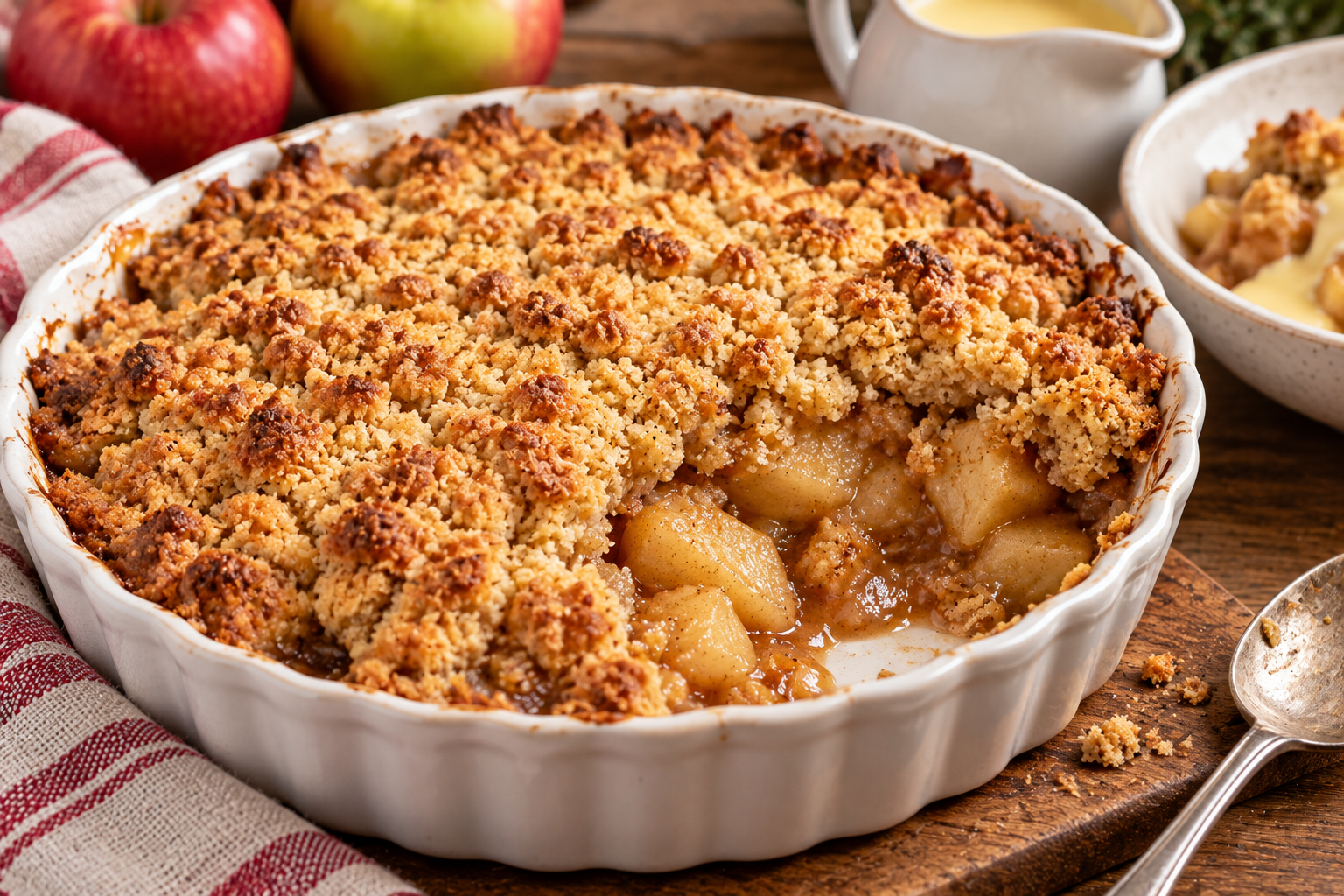
Few British desserts are as comforting as a warm apple crumble. Soft, slightly tart apples bubble beneath a buttery golden topping, filling the kitchen with the smell of baked fruit, brown sugar and cinnamon.
It’s the sort of pudding that appears on British family tables throughout autumn and winter, and it’s wonderfully uncomplicated. There’s no pastry to roll, no complicated decorating and no unusual ingredients to hunt down.
Serve it warm with vanilla ice cream, pouring cream or — for the full British experience — plenty of hot custard.
If you’re baking in the United States, this recipe uses familiar American ingredients while keeping the character of a traditional British apple crumble.
What Is a British Apple Crumble?
A traditional apple crumble consists of cooked or baked apples covered with a crumbly mixture of flour, butter and sugar.
As it bakes, the fruit becomes tender and juicy while the topping turns golden and crisp around the edges.
British crumbles became particularly popular during the Second World War, when rationing made traditional pastry pies more difficult to prepare. A simple flour, fat and sugar topping required fewer ingredients than a full pastry crust.
Today, crumble remains one of Britain’s best-loved home desserts.
British Apple Crumble vs. American Apple Crisp
The two desserts are very similar, but there is a traditional difference.
A classic British crumble topping is usually based on:
- Flour
- Butter
- Sugar
American apple crisp often includes rolled oats and sometimes nuts in the topping.
Modern recipes blur that distinction considerably, and you’ll find British crumbles containing oats too. But for this recipe, we’re keeping the topping simple and traditional.
If you’d like to explore another classic British dessert built around a buttery flour mixture, Traditional Treacle Tart is another wonderfully old-fashioned option.
Traditional British Apple Crumble Recipe
Prep Time: 20 minutes
Bake Time: 40–45 minutes
Total Time: About 1 hour
Serves: 6–8
Ingredients
For the Apple Filling
- 2 lb (900g) apples, about 5–6 medium apples
- 2 tablespoons (30ml) fresh lemon juice
- 1/3 cup (65g) granulated sugar
- 1 tablespoon (15g) light brown sugar
- 1 tablespoon (8g) all-purpose flour
- 1/2 teaspoon ground cinnamon
- 1/8 teaspoon ground nutmeg, optional
- Pinch of salt
- 1 teaspoon vanilla extract
For the Crumble Topping
- 1 1/2 cups (190g) all-purpose flour
- 1/2 cup (100g) light brown sugar
- 2 tablespoons (25g) granulated sugar
- Pinch of salt
- 1/2 cup (113g) cold unsalted butter, cut into small pieces
Instructions
1. Preheat the Oven
Preheat the oven to 375°F (190°C).
Lightly butter an approximately 8 x 8-inch (20 x 20cm) baking dish or a similar 2-quart baking dish.
2. Prepare the Apples
Peel and core the apples.
Cut them into irregular slices or chunks approximately 1/2 inch (1–1.5cm) thick.
Don’t worry about making every piece identical. A little variation gives the finished crumble a much more natural homemade texture.
Place the apples in a large mixing bowl.
3. Season the Filling
Add the lemon juice, granulated sugar, brown sugar, flour, cinnamon, optional nutmeg, salt and vanilla.
Toss gently until the apples are evenly coated.
Transfer the apple mixture to the prepared baking dish and spread it into an even layer.
4. Make the Crumble Topping
Place the flour, brown sugar, granulated sugar and salt in a large bowl.
Add the cold butter.
Using your fingertips, rub the butter into the flour mixture until you have a mixture resembling coarse breadcrumbs with some larger buttery pieces remaining.
Don’t work it until completely uniform. Those irregular pieces create the lovely crumbly texture we’re looking for.
5. Add the Topping
Scatter the crumble mixture loosely over the apples.
Avoid pressing it down firmly. A loose topping allows the surface to become crisper and more textured as it bakes.
It’s perfectly fine if a few small patches of apple remain visible.
6. Bake
Bake for 40–45 minutes, or until the crumble topping is golden brown and the apple juices are bubbling around the edges.
If the topping is browning too quickly, loosely cover the dish with foil during the final part of baking.
7. Rest
Allow the crumble to rest for about 10–15 minutes before serving.
This gives the bubbling apple juices a chance to thicken slightly.
Serve warm.
Brit & Skillet Tip
Keep the butter cold when making the crumble topping.
If the butter becomes too warm and is completely blended into the flour, the topping can become dense rather than beautifully crumbly.
You want a mixture of fine crumbs and slightly larger pieces.
Which Apples Are Best for Apple Crumble?
In Britain, Bramley apples are the classic choice for cooking.
Bramleys are large, sharply flavored cooking apples that soften beautifully when baked. Unfortunately, they’re much harder to find in ordinary American supermarkets.
Fortunately, several American apple varieties work very well.
Granny Smith
Granny Smith apples are probably the easiest substitute. They’re tart, widely available and hold enough structure during baking.
Braeburn
Braeburn apples have a nice balance of sweetness and acidity and make an excellent crumble.
Pink Lady
Pink Lady apples hold their shape well and have a pleasant sweet-tart flavor.
Honeycrisp
Honeycrisp apples are sweeter but still work well, particularly when combined with a more tart variety.
For the best flavor, try combining two different varieties.
If British ingredient names ever leave you wondering what to buy at an American supermarket, our British Baking Ingredients Americans Need to Know guide explains many of the common differences.
Should I Peel the Apples?
For a traditional smooth apple filling, yes.
Leaving the peel on isn’t necessarily wrong, but the texture is noticeably different.
For this recipe, peeling the apples gives the soft, comforting filling most associated with traditional British crumble.
Do I Need to Cook the Apples First?
No.
Cutting the apples into moderately thin pieces allows them to cook completely during the 40–45 minute baking time.
Some traditional recipes cook the fruit briefly before adding the topping, particularly when using very firm cooking apples.
If your apples are unusually hard, you can cook them gently in a saucepan with the sugar and a splash of water for about 5 minutes before assembling the crumble.
Why Is My Apple Crumble Watery?
Apples naturally release liquid as they bake.
The small amount of flour in the filling helps thicken those juices.
Allowing the finished crumble to rest for 10–15 minutes is also important. The filling will look much more liquid immediately after coming out of the oven.
If you’re using particularly juicy apples, you can add another teaspoon or two of flour to the filling.
Why Isn’t My Crumble Topping Crispy?
There are a few possible reasons.
The Butter Was Too Warm
Cold butter creates a better crumbly texture.
The Topping Was Packed Down
Scatter the topping over the fruit rather than pressing it into a solid layer.
The Dish Was Too Deep
A very deep, narrow dish creates more steam and less exposed topping.
A moderately shallow baking dish gives you more golden crumble surface.
Can I Add Oats?
Absolutely.
Although a simple flour, butter and sugar topping is particularly traditional, adding oats is a popular variation.
Replace approximately 1/2 cup (45g) of the flour with old-fashioned rolled oats.
Avoid instant oatmeal, which doesn’t provide the same texture.
Apple Crumble Variations
Once you know the basic method, crumble is wonderfully adaptable.
Apple and Blackberry Crumble
Add about 1 1/2 cups (200g) blackberries to the apples.
Apple and blackberry is an especially traditional British combination.
Apple and Pear Crumble
Replace approximately one-third of the apples with ripe but firm pears.
Apple and Raspberry Crumble
Add fresh or frozen raspberries for a slightly sharper, brighter filling.
Cinnamon Apple Crumble
Increase the cinnamon to 1 teaspoon if you prefer a stronger spice flavor.
British apple crumble is often less heavily spiced than American apple desserts, so the amount is entirely a matter of preference.
What Should I Serve With Apple Crumble?
Warm apple crumble is wonderful with vanilla ice cream, but traditional British accompaniments include:
- Hot custard
- Pouring cream
- Whipped cream
- Clotted cream
If you enjoyed the baked custard in our Traditional British Custard Tart, you’ll understand why warm custard and apple crumble are such a comforting combination.
For me, a bowl of hot apple crumble with custard running down into the fruit is very difficult to beat.
Can I Make Apple Crumble Ahead of Time?
Yes.
You can assemble the crumble several hours before baking and keep it covered in the refrigerator.
For longer preparation, it’s better to keep the apple filling and crumble topping separate. Refrigerate both, then assemble shortly before baking.
The topping can also be made a day or two in advance and stored in an airtight container in the refrigerator.
How to Store Apple Crumble
Allow leftover crumble to cool completely.
Cover the baking dish or transfer leftovers to an airtight container and refrigerate for up to 4 days.
How to Reheat Apple Crumble
For the best texture, reheat apple crumble in a 350°F (175°C) oven for approximately 15–20 minutes, or until hot.
The microwave is faster, but the crumble topping will become softer.
Can You Freeze Apple Crumble?
Yes.
Apple crumble can be frozen either before or after baking.
Freezing Unbaked Crumble
Assemble the crumble in a freezer-safe baking dish, wrap it thoroughly and freeze for up to 3 months.
Thaw overnight in the refrigerator before baking.
Freezing Baked Crumble
Cool completely before wrapping or transferring to a freezer-safe container.
Freeze for up to 3 months.
Thaw in the refrigerator and reheat in the oven until piping hot.
Brit & Skillet Tip
Apple crumble is a perfect recipe for using apples that aren’t quite attractive enough for a fruit bowl.
A bruise or oddly shaped apple doesn’t matter once it’s peeled and baked beneath that golden topping.
Just cut away any genuinely damaged portions before using it.
A Proper British Comfort Pudding
Apple crumble isn’t elaborate, and that’s precisely why it has remained such a favorite.
Tender apples, buttery crumbs and a generous helping of custard create the kind of simple pudding that feels right on a cold evening.
It’s also an excellent starting point if you’re new to British baking because the recipe is forgiving, inexpensive and made almost entirely from ingredients already familiar to American cooks.
For another warm British pudding that’s particularly good during the colder months, try Sticky Toffee Pudding.
And if you’re building a British Christmas menu, our Traditional British Rum Truffles make an easy make-ahead treat alongside more traditional baked puddings.
For plenty more traditional dishes adapted for an American kitchen, explore our British Recipes at Brit & Skillet.