
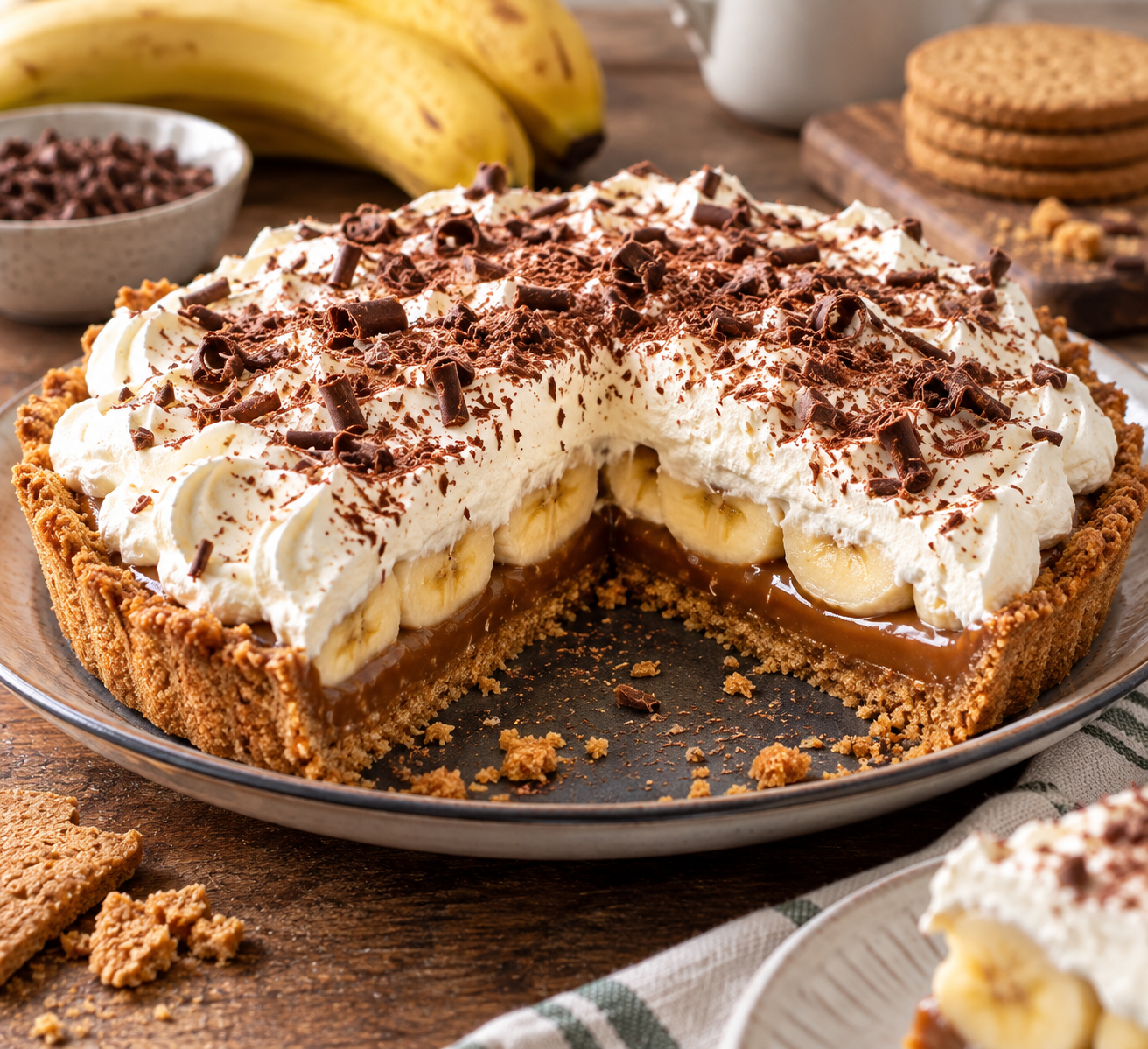
Banoffee pie sounds as though it ought to have been invented in an American diner, but this glorious combination of bananas, toffee and whipped cream actually comes from a restaurant in Sussex, England.
Created in the 1970s, it’s practically a newcomer compared with Britain’s centuries-old puddings. But it didn’t take long for banoffee pie to become a firm favourite, and it’s not difficult to understand why.
Underneath that generous layer of softly whipped cream are fresh banana slices, thick golden toffee and a buttery biscuit base. A little grated chocolate on top finishes everything off. And the name? Simply banana plus toffee. Banoffee!
The best part is that you don’t need complicated pastry skills to make it. This version uses ingredients familiar to American bakers, including graham crackers in place of British digestive biscuits, and there’s even a shortcut using prepared dulce de leche if you’d rather skip making the toffee from scratch.
Affiliate disclosure: Brit & Skillet may earn a commission from qualifying purchases made through links on this page, at no additional cost to you.
What Is Banoffee Pie?
Banoffee pie is a British dessert traditionally made with four main layers:
- A biscuit or pastry base
- Thick caramel or toffee
- Fresh bananas
- Whipped cream
It’s usually finished with grated chocolate, chocolate curls or a light dusting of cocoa powder.
The combination is rich, creamy and sweet, but fresh bananas keep it from feeling like nothing but caramel and cream.
Where Was Banoffee Pie Invented?
Banoffee pie has a much more recent history than desserts such as Traditional British Custard Tart.
The dessert is generally credited to Nigel Mackenzie and chef Ian Dowding at The Hungry Monk restaurant in Jevington, East Sussex, England, in the early 1970s.
The original dessert was called Banoffi Pie.
Its popularity spread far beyond the restaurant, and variations of the dessert eventually appeared throughout Britain and internationally.
That makes banoffee pie an interesting reminder that a food doesn’t need to be hundreds of years old to become a British classic.
Is Banoffee Pie the Same as Banana Cream Pie?
No.
American banana cream pie normally contains sliced bananas with a vanilla custard or pudding filling inside a pastry or crumb crust.
Banoffee pie uses toffee or caramel instead of vanilla custard.
The flavor is therefore considerably richer and more caramel-forward.
Both are topped with cream, but they’re distinctly different desserts.
Digestive Biscuits vs. Graham Crackers
Modern British banoffee pies are frequently made with crushed digestive biscuits.
Digestives are mildly sweet, wheaty biscuits with a crumbly texture.
If you can find British digestive biscuits in the United States, they’re an excellent choice.
But ordinary American graham crackers make a very good substitute and create a crust that will be familiar to American bakers.
Our British Baking Ingredients Americans Need to Know guide explains several other British baking ingredients and their closest American equivalents.

Traditional British Banoffee Pie Recipe
Ingredients
Equipment
Method
- Lightly grease a 9-inch (23cm) tart pan with a removable bottom or a 9-inch springform pan. A removable-bottom pan makes the finished pie considerably easier to serve.
- Crush the digestive biscuits in a food processor and pulse until they resemble fine crumbs. Alternatively, place them in a sturdy zip-top bag and crush them with a rolling pin. If you're using prepared graham cracker crumbs, simply measure them into a bowl.
- Mix the crumbs with the melted butter until evenly moistened. Press firmly across the bottom and approximately 1 inch (2.5cm) up the sides of the pan. The bottom of a measuring cup works well for pressing the crust evenly without compacting it excessively.
- Refrigerate the crust for at least 30 minutes while you prepare the toffee.
- Place the butter and brown sugar in a medium heavy-bottomed saucepan over medium-low heat. Cook gently, stirring, until the butter has melted and the sugar has mostly dissolved.
- Add the sweetened condensed milk and bring the mixture to a gentle boil, stirring continuously. Once bubbling, cook for approximately 2–3 minutes, continuing to stir constantly. The mixture should become slightly darker and noticeably thicker. Remove from the heat and stir in the vanilla and salt.
- Allow the toffee to cool for approximately 5 minutes and pour it into the chilled biscuit crust and spread it into an even layer. Refrigerate for at least 3 hours, or until the toffee is completely chilled and firm.
- Shortly before serving, peel the bananas and slice them into rounds approximately 1/4 inch (6mm) thick. Arrange the banana slices over the chilled toffee.
- Pour the cold heavy whipping cream into a large bowl. Add the powdered sugar and vanilla. Whip until soft to medium peaks form.
- Spoon the whipped cream over the bananas. Spread it gently with the back of a spoon, leaving natural swirls and peaks rather than creating a perfectly smooth surface.
- Finish with finely grated chocolate, chocolate curls or a light dusting of cocoa powder. Keep refrigerated until ready to serve.
Notes
Can I Use Dulce de Leche?
Yes.
Prepared dulce de leche is an excellent shortcut and is readily available in many American supermarkets.
You’ll need approximately 1 1/2 cups (about 400g).
Spread it directly over the chilled crust and continue with the recipe.
The flavor won’t be exactly identical to every traditional British banoffee filling, but it makes an extremely good pie and eliminates the stovetop toffee step.
Can I Boil a Can of Condensed Milk?
Older banoffee recipes sometimes instruct cooks to boil an unopened can of sweetened condensed milk for several hours to create caramel.
I don’t recommend doing that.
Heating a sealed can creates unnecessary risk if it’s allowed to boil dry or handled incorrectly.
Making the toffee in an open saucepan — or simply using prepared dulce de leche — is easier and safer.
Why Is My Toffee Runny?
The filling probably wasn’t cooked long enough.
Once the condensed milk is added, the mixture needs to reach a gentle bubbling boil and cook for a couple of minutes while being stirred constantly.
It will also become considerably firmer as it chills.
Don’t judge the final consistency while the toffee is still hot.
Why Is My Toffee Grainy?
Brown sugar that hasn’t properly dissolved can sometimes create a grainy texture.
Heat the butter and sugar gently at the beginning and stir until they’re well combined before adding the condensed milk.
Avoid extremely high heat, which can scorch the sugar or milk.
British Double Cream vs. American Heavy Cream
British banoffee recipes commonly use double cream.
American heavy whipping cream is an excellent substitute.
British double cream contains more fat, so it whips particularly thickly, but American cream containing around 36% milk fat works beautifully.
Don’t use half-and-half because it won’t whip.
This is the same substitution we use in our Traditional British Lemon Posset, where the fat content of the cream is especially important.
How Ripe Should the Bananas Be?
Use bananas that are ripe and sweet but still firm.
A few small brown spots on the peel are fine.
Avoid extremely overripe bananas that have become very soft. They’re excellent for banana bread but can turn mushy inside banoffee pie.
You want clean slices that still have some texture.
How Do I Stop the Bananas Turning Brown?
The easiest solution is to assemble the banana layer reasonably close to serving time.
If you need to prepare it a little earlier, you can brush the slices very lightly with lemon juice.
Don’t use too much, because you don’t want the lemon flavor competing with the caramel.
Once covered with whipped cream, the bananas are also somewhat protected from the air.
Can I Make Banoffee Pie Without Digestive Biscuits?
Absolutely.
Use:
- Graham crackers
- Vanilla wafers
- Shortbread cookies
- Another mildly sweet, crisp biscuit
Graham crackers are the simplest American substitution.
The flavor is slightly different, but the basic crumb-crust principle is exactly the same.
Can I Use a Pastry Crust?
Yes.
Earlier versions of banoffee pie used pastry, and you can absolutely make the dessert inside a baked shortcrust pastry shell.
A biscuit crumb base is simply easier and has become extremely common.
If you enjoy making pastry from scratch, the shortcrust technique used for our Traditional British Mince Pies is a good starting point.
Banoffee Pie Variations
Chocolate Banoffee Pie
Spread a thin layer of melted chocolate over the chilled biscuit crust before adding the toffee.
Allow it to set before continuing.
Salted Caramel Banoffee Pie
Add a little extra flaky sea salt to the caramel layer.
Don’t overdo it — you still want the banana and cream to come through.
Mini Banoffee Pies
Make individual pies in small tart pans, dessert glasses or sturdy cupcake liners.
Brit & Skillet Tip: If you’d like to make individual banoffee tarts, Fat Daddio’s Anodized Aluminum Tart & Quiche Pans are available in several sizes with removable bottoms, which makes releasing small pastry shells much easier.
These are particularly useful for parties.
Banoffee Cups
Skip the pan entirely.
Layer biscuit crumbs, toffee, bananas and whipped cream in individual dessert glasses.
This is also a great option if you’re worried about getting perfectly neat slices.
Chocolate-Banana Banoffee
Add finely grated dark chocolate between the banana and whipped cream layers as well as over the top.
Can I Make Banoffee Pie Ahead?
Most of it, yes.
The biscuit crust and toffee layer can be assembled the day before serving.
Cover and refrigerate overnight.
For the best result, add the bananas and whipped cream on the day you’re serving the pie.
This makes banoffee pie a convenient dessert for entertaining because the time-consuming portion is already finished.
How Long Does Banoffee Pie Keep?
Keep the pie covered in the refrigerator.
It’s best within 1–2 days once the bananas have been added.
The bananas gradually soften and darken, so this isn’t a dessert that improves after several days.
Can You Freeze Banoffee Pie?
I don’t recommend freezing the fully assembled pie.
Bananas can become watery or mushy after freezing, and whipped cream may lose its texture.
However, you can freeze the biscuit crust and toffee layer without the bananas and cream.
Wrap it carefully and freeze for up to 1 month.
Thaw overnight in the refrigerator before finishing the pie.
How Do You Get Clean Slices?
Banoffee pie is naturally a little messy, and that’s part of its charm.
But for cleaner slices:
- Chill the toffee thoroughly.
- Use firm-ripe rather than very soft bananas.
- Don’t overwhip the cream.
- Use a sharp knife.
- Wipe the blade between cuts.
Even then, don’t expect every slice to look geometrically perfect.
A little caramel escaping around the edges is a feature, not a disaster.
What Do You Serve With Banoffee Pie?
Honestly, very little.
It already contains biscuit, caramel, fruit and cream.
A cup of strong tea or coffee alongside it is more than enough.
If you’re creating a larger British dessert table, something lighter such as Traditional Eton Mess provides a nice contrast to the rich caramel flavors.
Is Banoffee Pie Good for Christmas?
It isn’t specifically a Christmas dessert, but it’s an excellent holiday option.
Because the crust and toffee can be prepared ahead, it works well when the oven is already occupied with other dishes.
It also gives guests an alternative to dried-fruit-heavy Christmas desserts.
That’s particularly useful alongside more traditional seasonal treats such as Traditional British Mince Pies and Traditional British Rum Truffles.
A Modern British Classic
Banoffee pie may not have the centuries of history associated with some British puddings, but it hardly needs them.
Biscuit, toffee, bananas and cream are a combination that simply works.
It’s indulgent without being complicated, impressive without requiring advanced baking skills, and incredibly easy to adapt to ingredients found in an American supermarket.
And if you’ve never made one before, there’s something very satisfying about cutting through that fluffy cream and fresh banana into the thick caramel layer underneath.
For more traditional and modern British dishes adapted for an American kitchen, explore our British Recipes at Brit & Skillet.
Leave a Reply