
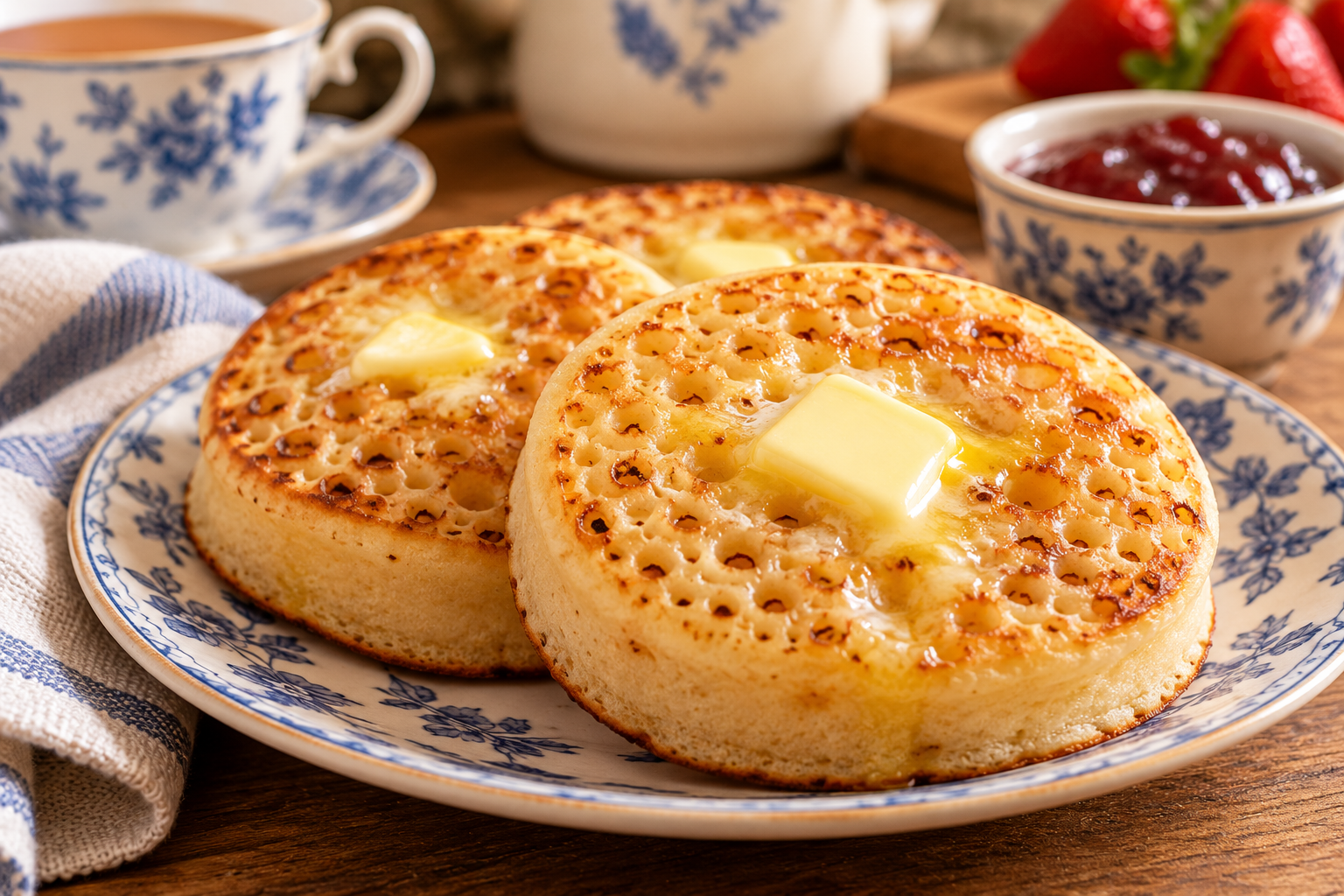
There are few things more British than a warm crumpet covered in melting butter.
Golden on the outside, soft and slightly chewy in the middle, and filled with those unmistakable little holes that soak up whatever you spread over the top, crumpets are a classic British breakfast and teatime favorite.
And although you can occasionally find packaged crumpets in American grocery stores, homemade crumpets are surprisingly achievable.
The ingredients are simple, but crumpets are a little different from ordinary pancakes or English muffins. The secret is a loose, yeasted batter and a slow cook that gives those characteristic bubbles time to rise through the surface.
This recipe uses familiar American ingredients and US measurements, so you can make proper British crumpets without having to translate the recipe first.
Affiliate disclosure: Brit & Skillet may earn a commission from qualifying purchases made through links on this page, at no additional cost to you.
What Is a Crumpet?
A crumpet is a small, round British griddle bread made from a yeasted batter.
Unlike bread dough, crumpet batter is loose enough to pour. It’s cooked inside metal rings on a griddle or skillet, which gives crumpets their characteristic round shape and relatively tall sides.
As they cook, bubbles rise through the batter and burst at the surface, creating the network of holes that makes a crumpet instantly recognizable.
Those holes aren’t just for looks.
They’re there to catch butter.
And jam.
And honey.
And anything else you decide belongs on a crumpet.
Are Crumpets the Same as English Muffins?
No—and this is one British-American food distinction worth knowing.
American English muffins are made from a much firmer dough and are usually split horizontally before being toasted.
Crumpets are made from a wetter batter and are generally cooked only until the top has set before being toasted later.
An English muffin has its famous nooks and crannies inside.
A crumpet has its holes running through the top.
The finished textures are different too. Crumpets are soft, springy and slightly chewy, with an almost honeycomb-like interior that absorbs melted butter beautifully.
What Do British Crumpets Taste Like?
Crumpets themselves aren’t particularly sweet.
They have a mild, slightly yeasty flavor, which is why they work with both sweet and savory toppings.
What really makes them special is their texture.
A freshly toasted crumpet should be crisp and golden around the outside while remaining soft and springy inside.
Add butter while it’s still hot and it disappears into all those little holes.
That’s the good part.

Traditional British Crumpets
Ingredients
Equipment
Method
- Add the all-purpose flour, sugar, instant yeast and salt to a large mixing bowl. Whisk briefly to combine.
- Gradually pour in the warm milk and 1/2 cup (120ml) warm water while whisking until you have a smooth batter.
- The batter should be considerably looser than bread dough but thicker than ordinary pancake batter.
- Cover the bowl with a clean kitchen towel or plastic wrap.
- Leave in a warm place for 45–60 minutes, or until the batter looks noticeably bubbly and slightly risen.
- Mix the baking soda with 1 tablespoon warm water.
- Stir the mixture thoroughly into the risen batter.
- Allow the batter to rest for another 10 minutes.
- Place a large skillet or griddle over low to medium-low heat.
- Lightly grease the cooking surface.
- Generously grease the inside of the crumpet rings or English muffin rings.
- Place the rings in the skillet and allow them to warm for 1–2 minutes.
- Spoon or pour batter into each ring until approximately 1/2 inch deep.
- Do not overfill the rings because the crumpets will rise as they cook.
- Cook for approximately 6–9 minutes over low to medium-low heat.
- Bubbles should gradually rise through the batter and burst across the surface, leaving the characteristic crumpet holes.
- Continue cooking until the surface is mostly set and no longer looks like wet batter.
- Carefully remove the hot crumpet rings using tongs or an oven mitt.
- If a crumpet sticks to its ring, gently loosen the edge with a thin knife before lifting the ring away.
- Flip each crumpet and cook for another 1–2 minutes, just until the top is very lightly golden.
- Transfer the finished crumpets to a wire cooling rack.
- Repeat with the remaining batter, greasing the rings again as necessary.
- For the best texture, toast the crumpets until the outside is crisp and golden.
- Serve warm with plenty of butter so it melts into the holes.
- Add strawberry jam, honey or golden syrup if desired.
Notes
Why Don’t My Crumpets Have Holes?
This is probably the biggest homemade-crumpet question.
There are several possible causes.
Your Heat Is Too High
If the bottom cooks too quickly, the top doesn’t have enough time to develop its bubbles.
Crumpets need patience.
Reduce the heat and cook them more slowly.
The Batter Is Too Thick
A very thick batter makes it harder for bubbles to travel through to the surface.
Crumpet batter should be loose enough to spoon or pour into the rings.
If yours seems unusually stiff, add a tablespoon or two of warm water.
The Yeast Wasn’t Active Enough
Give the batter enough time during its first rise.
You should see obvious bubbling before moving on.
You’re Overfilling the Rings
A very deep crumpet takes much longer for the bubbles to reach the top.
About 1/2 inch of batter is plenty.
Do You Toast Crumpets?
Yes!
You can certainly eat one immediately after cooking, but crumpets are particularly good once they’ve cooled and then been toasted.
Toast until the outside is crisp and golden, then spread generously with butter while the crumpet is still hot.
The butter melts straight into the holes.
What Do British People Put on Crumpets?
Butter is the essential starting point.
After that, there’s plenty of room for personal preference.
Try:
- Butter and strawberry jam
- Butter and honey
- Golden syrup
- Marmalade
- Lemon curd
- Peanut butter
- Cheese
- Marmite, if you’re feeling particularly British
And very soon you’ll be able to top them with our own homemade strawberry jam too.
Can I Make Crumpets Without Crumpet Rings?
You can improvise, but proper rings make the process considerably easier.
English muffin rings are an excellent alternative if you already own them.
Some cooks use thoroughly cleaned metal food cans with both ends removed, but make sure there are no sharp edges before considering this option.
For consistent results, inexpensive metal crumpet or English muffin rings are the simplest solution.
Can I Make Crumpets Ahead of Time?
Absolutely.
In fact, crumpets are ideal for making ahead because they’re so good reheated in the toaster.
Let freshly cooked crumpets cool completely, then store them in an airtight container.
They’ll keep at room temperature for about 2 days or in the refrigerator for up to 4 days.
Toast before serving.
Can You Freeze Crumpets?
Yes.
Allow the crumpets to cool completely, then freeze them in a freezer-safe container or bag with parchment between the layers.
Freeze for up to 3 months.
You can thaw them first or toast them carefully from frozen.
That makes a batch of homemade crumpets particularly useful for easy breakfasts.
What to Serve With British Crumpets
For the simplest version, all you need is a hot crumpet and plenty of butter.
For a proper afternoon treat, add jam and a cup of tea.
If you’d like to continue exploring classic British baking, try my Traditional British Scones or Traditional Victoria Sponge Cake.
My Traditional British Jam Tarts are another great choice if you’ve got a jar of strawberry jam open.
And for something warm and comforting, Traditional British Treacle Sponge Pudding is hard to beat.
More Help for American Bakers
If you’re working through British recipes in an American kitchen, you may encounter ingredients and terminology that aren’t immediately familiar.
My British Baking Ingredients Americans Need to Know guide explains many of the most common differences.
You may also find Plain Flour vs. All-Purpose Flour useful, since British recipes frequently call for plain flour where an American recipe would use all-purpose flour.
And if your next British recipe contains an ingredient you’ve never encountered before, my new What Is Suet in America? guide explains another particularly confusing British ingredient.
A Little Taste of Britain at Home
There’s something particularly satisfying about watching the first little holes appear in a homemade crumpet.
They may take a little more patience than opening a supermarket packet, but once they’re toasted, covered in melting butter and topped with jam, you’ll understand why crumpets have remained such a beloved British staple.
And since we’re making British food for an American kitchen, there’s really only one logical thing to make next:
Leave a Reply