A proper Bakewell tart is one of those British bakes that looks rather impressive on the table but is surprisingly manageable once you break it down into layers.
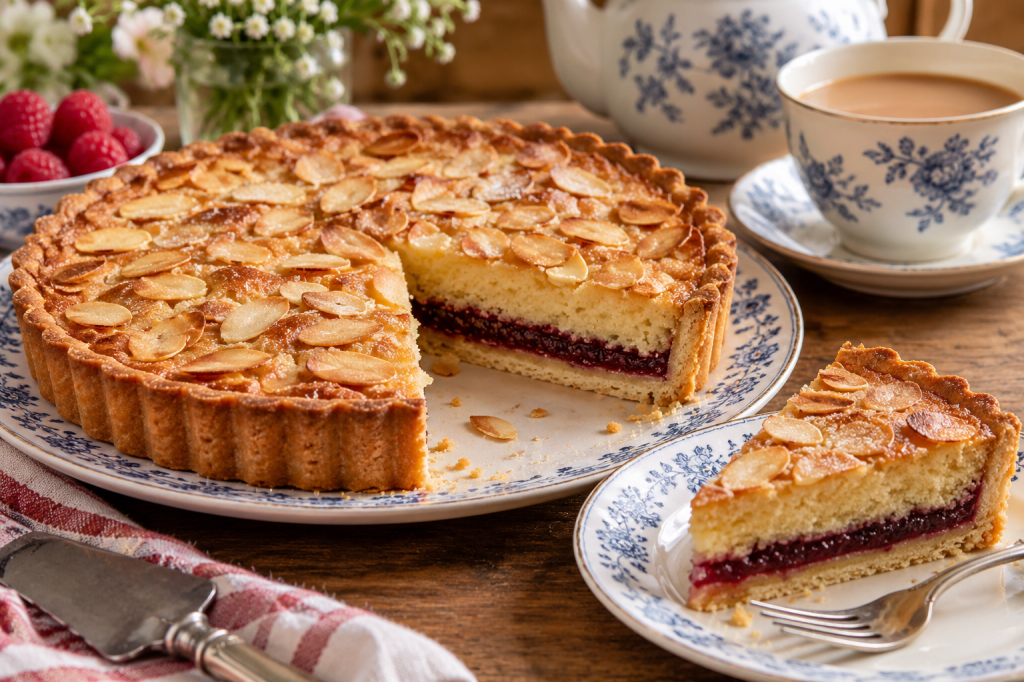
At the bottom is a crisp, buttery shortcrust pastry case. Next comes a layer of fruity jam, followed by soft almond frangipane and a scattering of flaked almonds that become beautifully golden in the oven.
Cut into a slice and you get a little of everything — crisp pastry, sweet raspberry jam and that wonderfully soft almond filling.
If you’re baking in America, some traditional British recipes can make Bakewell tart sound more complicated than it needs to be. You may see ingredients such as caster sugar, plain flour and ground almonds, along with tart-tin measurements in centimetres.
We’ll translate all of that as we go, with US measurements alongside metric weights and ingredients you can find in an American kitchen or supermarket.
And one thing worth clearing up before we begin: a traditional Bakewell tart isn’t quite the same thing as the little iced Cherry Bakewells you may remember from Britain. We’ll explain that difference too.
Brit & Skillet Tip: Don’t be too generous with the jam. A thin, even layer gives you that lovely raspberry flavour without making the bottom of the tart overly wet or allowing jam to bubble up around the frangipane.
What Is a Bakewell Tart?
A Bakewell tart is a classic British bake made with a shortcrust pastry case, a layer of jam and a soft almond filling known as frangipane.
Frangipane may sound rather fancy, but it’s actually very simple. It’s a soft almond filling made primarily from butter, sugar, eggs and finely ground almonds. As the tart bakes, the frangipane rises slightly and becomes tender and cake-like while remaining wonderfully moist.
Raspberry jam is one of the most traditional choices for the layer underneath, and the tart is often finished with flaked almonds before baking.
The result is a lovely combination of crisp pastry, fruity jam and soft almond filling.
Bakewell Tart vs. Cherry Bakewell
If you grew up in Britain, you may also be familiar with Cherry Bakewells — those small individual tarts topped with white icing and a bright red glacé cherry.
They’re related, but they aren’t quite the same thing.
A traditional Bakewell tart is usually made as one larger tart with pastry, jam and frangipane, often topped with flaked almonds.
A Cherry Bakewell is typically an individual version finished with icing and a glacé cherry instead of the simple almond topping we’re using here.
Both are delicious, but today we’re making the classic larger Bakewell tart.
British Baking Terms for American Bakers
A few ingredients in British Bakewell tart recipes may have different names in an American supermarket.
Plain flour: Use regular American all-purpose flour.
Caster sugar: American superfine sugar is the closest equivalent, although regular granulated sugar works perfectly well in this recipe.
Ground almonds: In an American grocery store, look for finely ground almond flour or almond meal. A fine almond flour will give the frangipane the smoothest texture.
Flaked almonds: These are generally sold as sliced almonds in the United States.
Brit & Skillet Tip: Almond flour isn’t being used as a substitute for wheat flour here — it’s actually what gives frangipane its characteristic almond flavour and soft texture.
Traditional British Bakewell Tart Recipe
Prep Time: 35 minutes
Chill Time: 30 minutes
Bake Time: 35–40 minutes
Yield: 8–10 slices
Pan: 9-inch (23cm) tart pan with removable bottom
Ingredients
For the Shortcrust Pastry
- 1½ cups (180g) all-purpose flour
- ⅓ cup (75g) cold unsalted butter, cut into small cubes
- 2 tablespoons (25g) granulated or caster sugar
- Pinch of salt
- 3–4 tablespoons (45–60ml) ice-cold water
For the Raspberry Layer
- ⅓ cup (110g) raspberry jam
For the Almond Frangipane
- ½ cup (113g) unsalted butter, softened
- ½ cup (100g) granulated or caster sugar
- 2 large eggs
- 1 cup (100g) finely ground almond flour
- 2 tablespoons (15g) all-purpose flour
- ½ teaspoon almond extract
For the Top
- ⅓ cup (30g) sliced almonds
Brit & Skillet Tip: Almond extract is powerful stuff! ½ teaspoon is plenty here. We want the tart to taste naturally almondy rather than overpowering the raspberry jam and buttery pastry underneath.
Make the Shortcrust Pastry
1. Combine the Flour and Butter
Place the all-purpose flour, sugar and salt in a large mixing bowl.
Add the cold cubed butter and rub it into the flour using your fingertips until the mixture resembles coarse breadcrumbs with a few small pieces of butter remaining.
2. Add the Water
Add the ice-cold water 1 tablespoon at a time, gently mixing after each addition.
Stop as soon as the dough begins to come together. You may not need all of the water.
Gather the dough into a disc, wrap it and refrigerate for 30 minutes.
Brit & Skillet Tip: Try not to knead shortcrust pastry like bread dough. Handle it only enough to bring everything together — keeping the pastry cold and avoiding overworking it helps give you a tender, crisp crust.
Prepare the Tart Shell
Preheat the oven to 375°F (190°C).
Lightly grease a 9-inch (23cm) tart pan with a removable bottom.
On a lightly floured surface, roll the chilled pastry into a circle large enough to cover the bottom and sides of the pan.
Carefully transfer the pastry to the tart pan and gently press it into the corners and up the sides. Trim away the excess pastry around the top edge.
Prick the bottom lightly with a fork.
Place the pastry-lined pan in the refrigerator for another 10 minutes while the oven finishes heating.
Blind-Bake the Pastry
Line the pastry shell with parchment paper and fill it with pie weights, dried beans or uncooked rice.
Bake for 12 minutes.
Carefully remove the parchment and weights, then return the pastry shell to the oven for another 5 minutes.
The pastry should look dry and lightly set but doesn’t need to be deeply golden yet, as it will continue baking once the filling is added.
Remove from the oven and allow it to cool for about 10 minutes.
Reduce the oven temperature to 350°F (175°C).
Make the Frangipane Filling
1. Cream the Butter and Sugar
Place the softened butter and sugar in a mixing bowl and beat together until pale and creamy.
2. Add the Eggs
Add the eggs one at a time, beating well after each addition.
Don’t worry if the mixture looks slightly curdled after adding the eggs — it will come together once the dry ingredients are added.
3. Add the Almonds
Add the almond flour, all-purpose flour and almond extract.
Gently mix until everything is evenly combined and you have a soft, thick almond filling.
Assemble the Bakewell Tart
1. Add the Raspberry Jam
Spread the raspberry jam in a thin, even layer across the bottom of the partially baked pastry shell.
Try to take the jam almost to the edges without getting it up the sides of the pastry.
2. Add the Frangipane
Carefully spoon the frangipane over the raspberry jam.
Rather than dropping all of the filling into the centre and spreading it aggressively, add it in several spoonfuls across the tart. This makes it easier to spread without disturbing the jam underneath.
Gently smooth the top.
3. Add the Almonds
Scatter the sliced almonds evenly over the frangipane.
Bake the Bakewell Tart
Bake at 350°F (175°C) for 35–40 minutes, or until the frangipane is risen, golden and set in the centre.
A toothpick inserted into the almond filling should come out clean or with a few moist crumbs rather than wet batter.
If the almonds or pastry edges begin browning too quickly, loosely cover the tart with foil for the remainder of the baking time.
Allow the tart to cool in the pan for at least 20–30 minutes before carefully removing the outer ring.
For the neatest slices, allow it to cool further before cutting.
Brit & Skillet Tip: Don’t worry if a little raspberry jam peeks through around the edges as the frangipane rises. That’s part of the charm — and a rather good preview of what’s hiding underneath!
How to Serve Bakewell Tart
Bakewell tart can be served slightly warm or at room temperature.
For a simple afternoon treat, slice it and serve it just as it is with tea or coffee. You can also serve it as a dessert with a little cream, custard or a scoop of vanilla ice cream.
The almond filling is quite rich, so you don’t need enormous slices — although whether anyone actually follows that advice is another matter!
How to Store Bakewell Tart
Once completely cool, store the tart in an airtight container at room temperature for up to 2 days.
For longer storage, refrigerate it for up to 4 days. Bring individual slices back toward room temperature before serving for the best flavour and texture.
Can You Freeze Bakewell Tart?
Yes. Bakewell tart freezes well.
Allow the baked tart to cool completely, then wrap it securely and freeze it whole or in individual slices for up to 3 months.
Thaw overnight in the refrigerator or for several hours at room temperature before serving.
Freezing individual slices makes it particularly easy to rescue a piece whenever a Bakewell emergency occurs.
Why Is the Bottom of My Bakewell Tart Soggy?
A soggy pastry base usually means there was too much moisture between the pastry and filling or the pastry didn’t have enough time to bake before the filling was added.
That’s why we blind-bake the pastry shell before adding the raspberry jam and frangipane.
Also keep the jam layer fairly thin. More jam might sound tempting, but too much can add unnecessary moisture to the base.
Why Did My Frangipane Sink?
Frangipane will settle a little as it cools, but it shouldn’t collapse dramatically.
Make sure the centre is fully baked before removing the tart from the oven. It should look set and golden rather than wet or wobbly.
Opening the oven repeatedly during baking can also cause the filling to lose heat before its structure has properly set.
Why Is My Frangipane Dry?
Overbaking is the most likely culprit.
Begin checking the tart around 35 minutes. The filling should be golden and set, but it should still remain soft and moist inside once cooled.
Can I Use a Different Jam?
Absolutely. Raspberry is a classic choice, but you can experiment with other fruit preserves.
Strawberry, cherry or apricot can all pair nicely with almond, although they’ll give you a slightly different tart from the traditional raspberry version.
Brit & Skillet Tip: If you love the combination of buttery shortcrust pastry and fruit jam, try our Traditional British Jam Tarts next. They’re simpler than a Bakewell tart but have that same lovely pastry-and-jam combination.
A Classic British Bake Worth Making at Home
Bakewell tart is a lovely example of what makes traditional British baking so satisfying. None of the individual components are particularly complicated, but together they create something that feels rather special.
The crisp shortcrust pastry, fruity raspberry jam and soft almond frangipane make a wonderful combination — and now that you know what frangipane actually is, you can casually drop the word into conversation as though you’ve been making it for years. 😂
If you’re building up your British baking equipment, our British Baking Equipment Guide can help translate traditional British bakeware into practical choices for an American kitchen.
And if this tart has put you in the mood for another bake, explore more of our traditional British recipes for cakes, pastries, desserts and savoury British favourites you can make at home.
 Brit & Skillet
Leave a comment