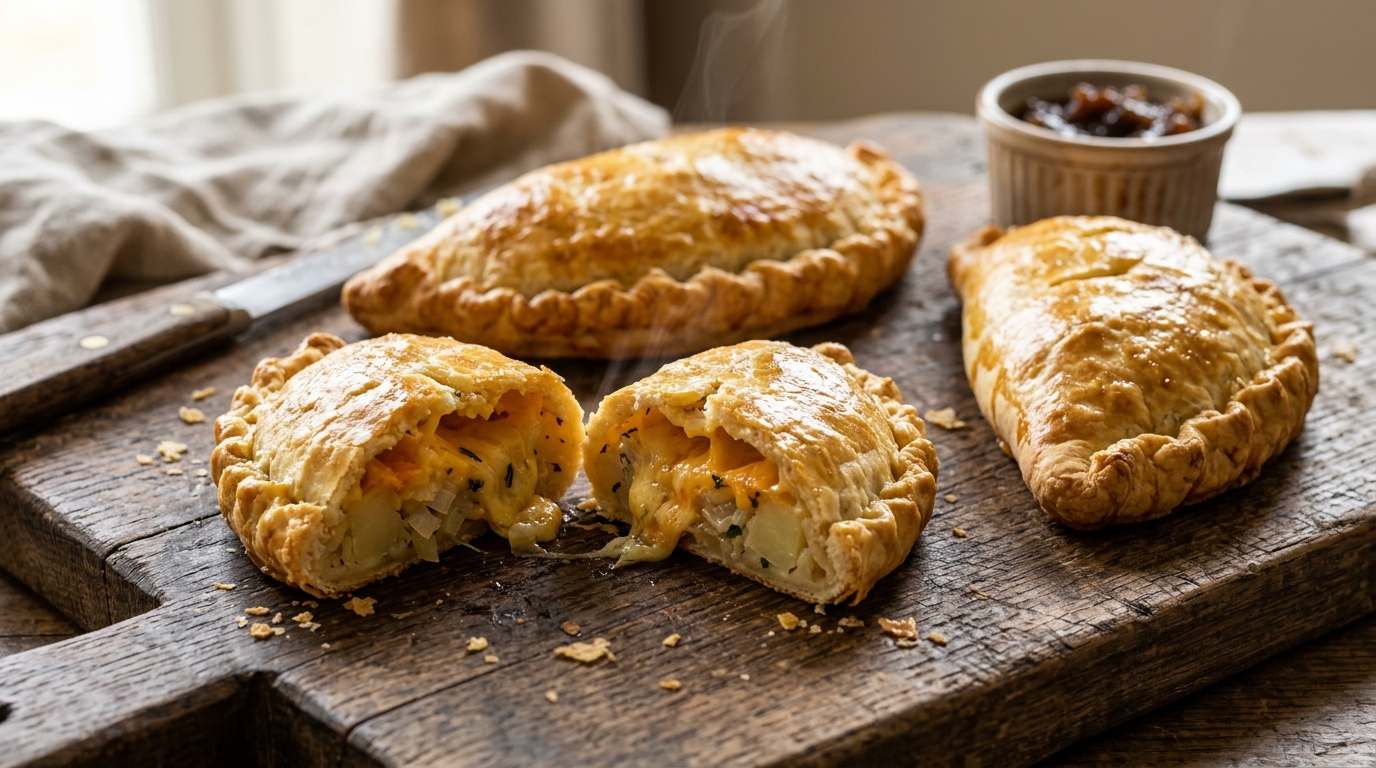
There’s something wonderfully comforting about a proper British cheese and onion pasty. Golden, buttery pastry wrapped around a savoury filling of tender potatoes, sweet onions and mature Cheddar cheese — simple ingredients that come together to make one of Britain’s favourite bakery treats.
Walk into a British bakery and you’ll often find cheese and onion pasties sitting alongside sausage rolls, meat pies and other savoury pastries. They’re the sort of thing you might pick up for lunch, take on a picnic or enjoy warm from the oven on a chilly afternoon.
Here in America, cheese and onion pasties aren’t quite as familiar, but they’re surprisingly easy to recreate using everyday supermarket ingredients.
Whether you’re missing a taste of home or discovering British food for the first time, these traditional-style cheese and onion pasties are a lovely introduction to British savoury baking.
Affiliate disclosure: Brit & Skillet may earn a commission from qualifying purchases made through links on this page, at no additional cost to you.
What Are British Cheese and Onion Pasties?
A cheese and onion pasty is a savoury pastry turnover traditionally associated with British bakeries and home cooking.
The filling usually contains Cheddar cheese and onions, often with potatoes to give it a more substantial texture. Everything is enclosed in pastry, creating a convenient handheld meal.
Cheese and onion pasties are particularly popular as a vegetarian alternative to meat-filled pastries.
They’re similar in appearance to traditional Cornish pasties, but the filling is quite different.
A genuine Cornish pasty traditionally contains beef, potato, swede and onion. If you’d like to explore that version, take a look at my Traditional Cornish Pasties recipe, which explains the British ingredients and their American equivalents.
Why Cheese and Onion Pasties Are So Popular in Britain
One of the lovely things about British food is how many familiar dishes began with inexpensive, everyday ingredients.
Cheese and onion is a classic British flavour combination. You’ll find it in sandwiches, pies, crisps (potato chips in America) and, of course, pasties.
It’s a combination that works particularly well in pastry because the sharpness of mature Cheddar balances the sweetness of the onions.
Adding potatoes makes the filling more substantial without overwhelming the cheese.
And because these pasties are individually portioned, they’re convenient for lunches, picnics and casual family meals.
They’re also a good example of how traditional British comfort food can be made with ingredients that are readily available in American kitchens.
What Cheese Should You Use for Cheese and Onion Pasties?
The cheese makes a real difference to the finished flavour.
In Britain, mature Cheddar is a natural choice. It has a stronger, tangier flavour than mild Cheddar and stands up well to the potatoes and onions.
In American supermarkets, look for sharp or extra-sharp Cheddar.
Extra-sharp Cheddar is particularly good if you enjoy a pronounced cheese flavour.
You can use white or orange Cheddar; the colour is much less important than the flavour.
I recommend grating the cheese yourself rather than using pre-shredded cheese when possible.
Can You Use Other British Cheeses?
Absolutely.
Red Leicester can add a slightly sweeter, nuttier flavour, while Double Gloucester provides a rich, creamy character.
For a more traditional cheese and onion pasty, however, mature Cheddar remains my first choice.
We’ll be exploring these cheeses in more detail in our upcoming British cheese and pairing guide.
British Potatoes vs. American Potatoes
Potatoes are another ingredient where British and American varieties can cause a little confusion.
In Britain, you might use a general-purpose potato such as Maris Piper or King Edward.
In America, Yukon Gold potatoes are an excellent choice for cheese and onion pasties.
They have a naturally creamy texture and hold their shape reasonably well, giving the filling a lovely balance between soft and slightly chunky.
Russet potatoes can also work, although their flourier texture means they tend to break down more easily.
The important thing is avoiding an excessively wet filling, which can make the pastry soggy.
Brit & Skillet Tip: Potatoes retain moisture after boiling. Allowing them to steam-dry before they’re incorporated into a filling helps prevent excess moisture from softening the pastry.
What Pastry Is Best for Cheese and Onion Pasties?
There are two particularly good options: shortcrust pastry and puff pastry.
Traditional Shortcrust Pastry
Shortcrust pastry is my preferred choice for this homemade version.
It creates a sturdy, buttery casing that holds the filling well and is easy to eat by hand.
British shortcrust pastry is similar to American pie dough, although individual recipes vary.
If you’re making your own pastry, all-purpose flour works perfectly well. There’s no need to search for a special British flour.
Puff Pastry
Puff pastry is another popular choice, particularly for bakery-style cheese and onion turnovers.
It produces a lighter, flakier result with plenty of crisp layers.
Store-bought puff pastry is widely available in American supermarkets and makes an excellent shortcut.
For this Brit & Skillet recipe, we’ll use homemade shortcrust pastry as the main version, with store-bought pastry as an alternative.
Equipment for Making British Pasties
You don’t need a kitchen full of specialized equipment to make homemade pasties.
A good rolling pin, large mixing bowl, baking sheet and pastry brush are the most useful basics.
For rolling pastry evenly, the King Arthur Straight Rolling Pin is a straightforward option for British-style baking.
If you’re choosing equipment for pastry making, you might also enjoy my Guide to the Best Rolling Pins for British Baking.
For baking, a sturdy metal sheet pan helps support the pasties and promotes even browning.
The Fat Daddio’s Natural Aluminum Baking Sheet Pans are a practical option for pastries, biscuits and other baked goods.
I also recommend lining the baking sheet with parchment paper to prevent sticking and make cleanup easier. King Arthur Half-Sheet Baking Parchment Paper is one suitable option already included in our Affiliate Hub.
Brit & Skillet Tip: A little extra space between the pasties on the baking sheet allows hot air to circulate around them, helping the pastry bake evenly.
How to Avoid Soggy Cheese and Onion Pasties
One of the most common problems with filled pastries is a soggy bottom.
Cheese and onion pasties contain ingredients that naturally release moisture, so getting the balance right is important.
Keep the Filling From Becoming Too Wet
Potatoes and onions can both contribute moisture.
A filling that contains too much liquid may soften the pastry before it has a chance to bake properly.
The filling should be moist and flavourful without being watery.
Keep the Pastry Cold
Cold pastry is easier to handle and generally produces a better texture.
If homemade pastry becomes very soft or sticky, chilling it briefly can make it easier to work with.
Don’t Overfill the Pasties
It’s tempting to squeeze in as much cheese filling as possible, but overfilled pasties are more likely to split or leak during baking.
A secure seal is more important than an enormous filling.
Bake Until Properly Golden
Pale pastry can sometimes be underbaked, particularly underneath.
Look for a well-browned exterior and a firm, cooked pastry base rather than relying on the colour of the top alone.

Traditional British Cheese and Onion Pasties
Ingredients
Equipment
Method
- In a large mixing bowl, combine the all-purpose flour and salt. Stir briefly to distribute the salt evenly.
- Add the cold, cubed butter. Using a pastry blender or your fingertips, work the butter into the flour until the mixture resembles coarse breadcrumbs, with a few pea-sized pieces of butter remaining.
- Add 6 tablespoons (90 ml) of ice-cold water and mix gently. Add the remaining water a little at a time, only if needed, until the dough just holds together when pressed. Avoid overworking it.
- Gather the dough into a disc, wrap it and refrigerate for at least 30 minutes. This allows the flour to hydrate and helps the butter remain cold before rolling.
- Place the diced potatoes in a saucepan of lightly salted water. Bring to a boil and simmer for approximately 10 to 12 minutes, until just tender. Drain thoroughly and allow to steam-dry for a few minutes.
- While the potatoes cook, melt the butter in a frying pan over medium-low heat. Add the chopped onions and cook gently for approximately 10 to 12 minutes, stirring occasionally, until soft and translucent but not deeply browned.
- Transfer the drained potatoes to a large bowl and lightly crush some of them with a fork, leaving plenty of small pieces intact. Add the softened onions, grated Cheddar, mustard powder if using, salt and black pepper. Mix gently until evenly combined.
- Taste and adjust the seasoning if necessary. Spread the filling out in a shallow dish and allow it to cool completely before assembling the pasties. Refrigerate briefly if needed.
- Preheat the oven to 400°F (200°C). Line a large baking sheet with parchment paper.
- Divide the chilled pastry into 6 equal portions. On a lightly floured surface, roll each portion into a circle approximately 7 inches (18 cm) in diameter and about ⅛ inch (3 mm) thick. Use a plate as a guide if desired.
- Divide the cooled cheese and onion filling evenly between the pastry circles, placing it on one half of each circle. Leave a border of approximately ¾ inch (2 cm) around the edge to allow for sealing.
- Lightly brush the pastry edges with water. Fold the empty half of each pastry circle over the filling to form a half-moon shape. Press the edges together firmly, then crimp with your fingers or the tines of a fork to create a secure seal.
- Beat the egg with 1 tablespoon (15 ml) of water. Transfer the pasties to the prepared baking sheet, leaving space between them. Brush the tops evenly with the egg wash and cut a small steam vent in each pasty.
- Bake in the preheated oven for approximately 30 to 35 minutes, until the pastry is deeply golden and the bottoms are cooked through. If the tops begin to brown too quickly, loosely cover with foil for the final few minutes.
- Remove the pasties from the oven and allow them to rest on the baking sheet for 5 to 10 minutes before serving. The cheese filling will be extremely hot immediately after baking.
Notes
What to Serve with Cheese and Onion Pasties
Cheese and onion pasties are wonderfully versatile.
For a simple British-style lunch, serve one warm with baked beans or a crisp green salad.
They’re also delicious with tomato chutney, pickled onions or a little Branston-style pickle.
For a more substantial meal, add peas or roasted vegetables.
And if you’re putting together a traditional British picnic, cheese and onion pasties fit beautifully alongside Traditional British Sausage Rolls and Traditional Cornish Pasties.
They’re particularly convenient because they can be enjoyed warm or cold, provided they’ve been stored safely.
Can You Make Cheese and Onion Pasties Ahead?
Yes, and that’s one of the reasons they’re so useful for busy families.
The pastry and filling can be prepared in advance and kept separately in the refrigerator until you’re ready to assemble the pasties.
You can also refrigerate assembled, unbaked pasties for a short period before baking.
Keeping the pastry chilled helps it hold its shape.
Can You Freeze Cheese and Onion Pasties?
Yes. Cheese and onion pasties are suitable for freezing, either before or after baking.
Freezing unbaked pasties can be particularly convenient because you can bake them when needed.
For the best results, freeze them individually before transferring them to a suitable freezer container.
Make sure the filling is completely cool before freezing assembled pasties.
How to Store and Reheat Leftovers
Leftover cheese and onion pasties should be cooled promptly and stored in an airtight container in the refrigerator.
They’re generally best eaten within three to four days.
To reheat, an oven or air fryer is preferable to a microwave because dry heat helps restore the pastry’s crispness.
Reheat until thoroughly hot throughout.
Although pasties are often eaten cold in Britain, cheese-filled pasties should not be left at room temperature for extended periods.
Frequently Asked Questions
Are Cheese and Onion Pasties Vegetarian?
They can be. The basic filling contains cheese, onions and potatoes rather than meat.
However, not all cheeses are vegetarian. Some traditional cheeses contain animal-derived rennet, so check the packaging if you’re cooking for someone who follows a vegetarian diet.
Can I Use Ready-Made Pie Crust?
Yes. Refrigerated American pie crust is a convenient substitute for homemade shortcrust pastry.
It may produce a slightly different texture, but it’s a useful shortcut for busy days.
Can I Make Them Without Potatoes?
Yes. Cheese and onion pasties can be made without potatoes, although the filling will have a different texture and may be richer.
Potatoes help give the filling body and balance the cheese.
What’s the Difference Between a Cheese and Onion Pasty and a Cornish Pasty?
A traditional Cornish pasty contains beef, potato, swede and onion, enclosed in pastry.
A cheese and onion pasty uses a cheese-based filling and is a separate British bakery favourite.
Can I Use American Cheddar?
Absolutely. Sharp or extra-sharp American Cheddar is one of the easiest substitutes for mature British Cheddar.
A Little Taste of a British Bakery
Cheese and onion pasties are proof that some of Britain’s most comforting foods are also among the simplest.
You don’t need unusual ingredients, expensive equipment or complicated techniques to enjoy a traditional-style British savoury bake at home.
Whether you’re making them for lunch, packing them for a picnic or serving them as part of a family supper, these golden little pasties are a lovely way to bring a taste of Britain into an American kitchen.
And once you’ve mastered homemade pasties, there’s a whole collection of British pies, pastries and savoury favourites waiting to be discovered.
Explore more in my Brit & Skillet Recipe Collection.
Leave a Reply