
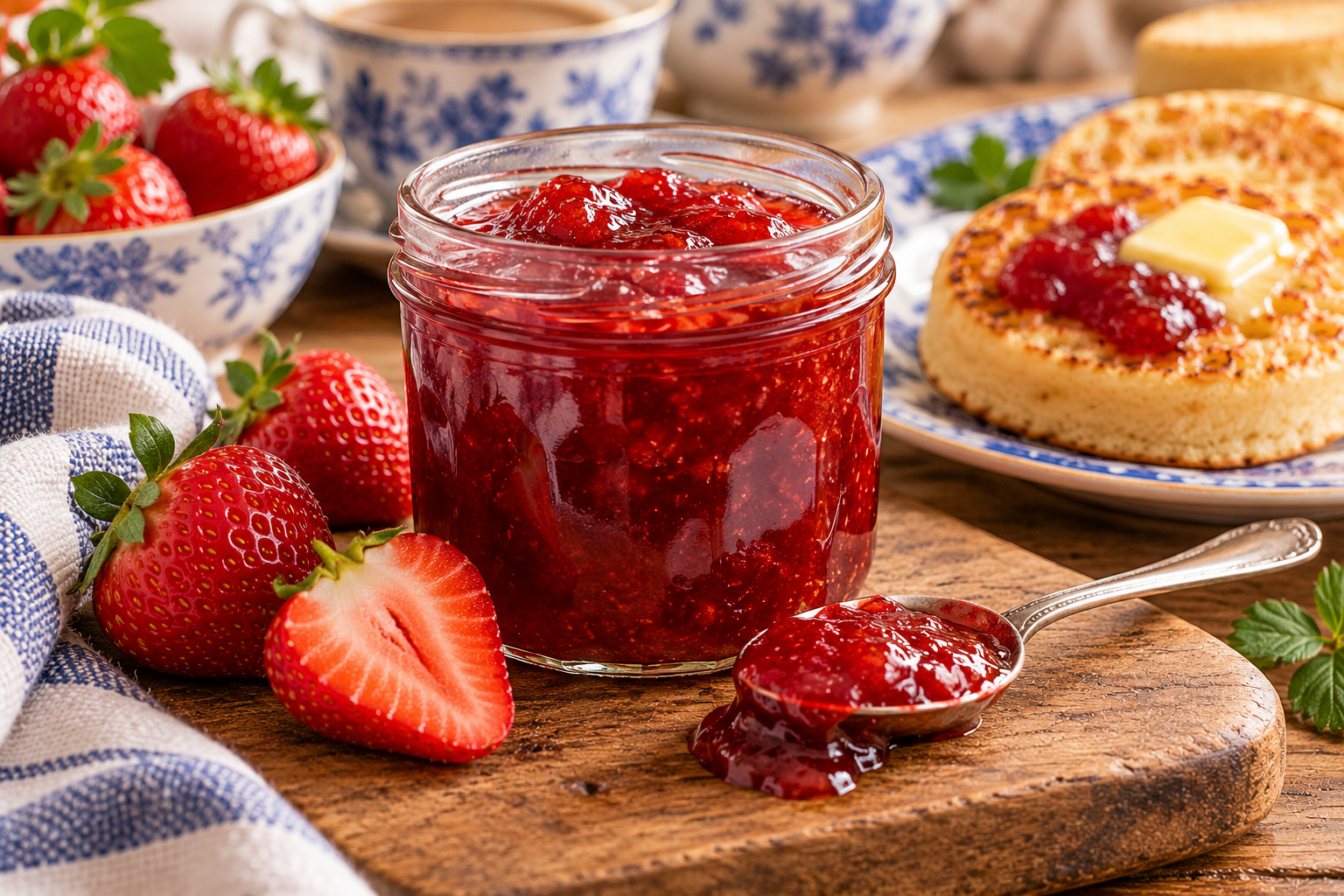
There is something wonderfully satisfying about making your own strawberry jam.
Fresh strawberries, sugar and a little lemon juice transform into a glossy, deeply fruity jam that tastes completely different from many supermarket versions—and you don’t need to make twelve jars or spend the afternoon setting up a complicated canning operation.
This small-batch strawberry jam is designed for exactly the sort of baking we do here at Brit & Skillet. Make a jar, keep it in the refrigerator, and use it with warm Traditional British Crumpets, freshly baked Traditional British Scones, a classic Victoria Sponge Cake, or even as the filling for Traditional British Jam Tarts.
It’s also a lovely introduction to one of the simplest forms of traditional preserve-making.
Affiliate disclosure: Brit & Skillet may earn a commission from qualifying purchases made through links on this page, at no additional cost to you.
Is Strawberry Jam British?
Strawberry jam certainly isn’t exclusive to Britain, but jam has a long-standing place in British baking and teatime.
Think of a warm scone with jam, the layer running through a Victoria sponge, jam tarts, or the bright spiral inside Traditional British Jam Roly-Poly.
It’s one of those ingredients that quietly connects an enormous number of British classics.
For this recipe, we’re keeping things particularly simple: strawberries, granulated sugar and lemon juice.
No commercial pectin is required.
Why Make Small-Batch Strawberry Jam?
Traditional preserving recipes can produce a considerable amount of jam.
That’s useful if you’ve just harvested a garden full of strawberries, but not necessarily if you simply want homemade jam for Saturday morning crumpets.
This recipe makes approximately 1½ cups of jam, depending on how far you cook it down.
That’s enough to enjoy over several breakfasts and use in your baking without filling the pantry with jars.
And because we’re treating this as a refrigerator jam, we don’t need to get into water-bath canning or shelf-stable preservation.
That distinction is important: this recipe is intended to be kept refrigerated, not stored unopened at room temperature.
Do You Need Pectin to Make Strawberry Jam?
Not necessarily.
Strawberries contain some natural pectin, but they’re not among the highest-pectin fruits. Lemon juice helps provide acidity, while cooking the fruit with enough sugar concentrates the mixture until it reaches a jam-like consistency.
The result can be slightly softer than a commercial jam made with added pectin—and for Brit & Skillet, that’s actually rather nice.
A softer homemade jam spreads beautifully across crumpets and scones and works wonderfully in many British bakes.

Homemade British Strawberry Jam
Ingredients
Equipment
Method
- Wash the strawberries thoroughly and remove the green tops.
- Cut larger strawberries into halves or quarters and place them in a medium heavy-bottomed saucepan.
- Use a potato masher or the back of a sturdy spoon to crush the strawberries. Leave some small pieces of fruit for texture rather than turning the berries into a completely smooth puree.
- Add the granulated sugar and fresh lemon juice to the strawberries.
- Stir everything together and allow the mixture to stand for about 10 minutes. The sugar will begin drawing juice from the strawberries.
- Place the saucepan over medium-low heat. Cook gently, stirring regularly, until the sugar has completely dissolved.
- Avoid bringing the mixture to a full boil before the sugar crystals have dissolved.
- Increase the heat and bring the strawberry mixture to a lively boil. Cook for approximately 15–20 minutes, stirring frequently to prevent the jam from scorching on the bottom of the saucepan.
- The mixture should gradually become darker, glossier and thicker. If foam collects on the surface, skim it away with a spoon if desired.
- Place a small plate in the freezer before you begin cooking the jam.
- When the jam appears thickened, spoon a small amount onto the cold plate and wait approximately 30 seconds. Gently push the jam with your fingertip.
- If the surface wrinkles slightly and the jam does not immediately flood back into place, it is ready. If it is still very runny, continue cooking for another 1–2 minutes and test again.
- If using a candy or instant-read thermometer, jam generally reaches its setting point around 220°F (104–105°C) at sea level.
- At higher elevations, the setting temperature will be lower, so use the cold-plate test alongside temperature rather than relying only on a single number.
- Remove the saucepan from the heat.
- Allow the jam to cool for several minutes before carefully transferring it to a clean glass jar or refrigerator-safe container.
- Allow it to cool further before covering and refrigerating. The jam will continue to thicken as it cools.
- Serve the completely cooled strawberry jam with crumpets, scones or toast, or use it as a filling for British cakes and puddings.
Notes
How Thick Should Homemade Strawberry Jam Be?
Don’t expect this small-batch jam to have quite the stiff, perfectly uniform consistency of every commercial jar.
It should be thick enough to spread without immediately running off your toast or crumpet, but still soft and spoonable.
That’s particularly useful for British baking.
For a Victoria sponge, for example, you want a jam that spreads easily without tearing the cake.
Can I Use Frozen Strawberries?
Yes.
Frozen strawberries can be used, although they’ll release more liquid as they thaw and may require a little additional cooking time.
Thaw them first and include their juices in the saucepan.
For the prettiest color and freshest flavor, however, ripe fresh strawberries are my first choice when they’re in season.
Can I Reduce the Sugar?
I wouldn’t significantly reduce the sugar in this particular recipe.
Sugar isn’t only there for sweetness. It also contributes to the consistency and preservation of traditional jam.
Changing the amount substantially can alter how the jam sets and how long it keeps.
If you specifically want a low-sugar jam, it’s better to use a recipe developed and tested for that purpose rather than simply removing sugar from a traditional formulation.
Why Didn’t My Strawberry Jam Set?
First, make sure it’s actually cold.
Warm jam can look alarmingly runny.
If it has completely cooled and is still much thinner than you’d like, it may simply have needed a little longer on the stove.
Other possible causes include unusually juicy berries or inaccurate ingredient measurements.
This is one reason I strongly recommend using a kitchen scale when making preserves. Measuring the fruit and sugar by weight gives you much more consistent results.
What If My Jam Is Too Thick?
It probably cooked a little too long.
If the jam is only slightly thicker than you’d intended, don’t worry. It’ll still taste lovely.
For future batches, start performing the cold-plate test a little earlier.
Jam can move from not quite ready to very firmly set surprisingly quickly near the end of cooking.
How to Store Homemade Strawberry Jam
This recipe is designed as refrigerator jam.
Once completely cooled, cover the jar and store it in the refrigerator.
For best quality, I’d use it within about 2–3 weeks and always use a clean spoon when serving it.
If you see mold, fermentation, unusual bubbling or anything else suggesting spoilage, discard the entire jar.
This recipe has not been written or tested as a shelf-stable canning recipe, so don’t store the finished jar at room temperature.
Can You Freeze Strawberry Jam?
Yes.
Transfer cooled jam to a freezer-safe container, leaving some space for expansion.
Freeze for up to about 3 months.
Thaw it in the refrigerator before using.
What to Eat With Homemade Strawberry Jam
Now we get to the best part.
Start with the recipe we just made: Traditional British Crumpets.
Toast one until the edges are golden, add plenty of butter and spoon this strawberry jam over the top.
Then there’s Traditional British Scones. Whether the cream or jam goes on first is a debate I’m quite happy to leave to Cornwall and Devon!
Strawberry jam is also perfect with:
And once you have homemade jam in the refrigerator, you’ll find plenty of less traditional excuses to eat it too.
Toast counts.
Can I Use This Jam in a Victoria Sponge?
Absolutely.
Let the jam cool completely before assembling the cake.
If your batch is particularly soft, use a slightly thinner layer so it doesn’t squeeze excessively from the sides when you sandwich the cakes together.
Homemade strawberry jam and Victoria sponge are a particularly lovely combination because the fresh berry flavor really comes through.
Can I Use This Jam for Jam Roly-Poly?
Yes.
Again, make sure the jam is completely cold before spreading it over the pastry.
My Traditional British Jam Roly-Poly works beautifully with strawberry jam, so this gives us a completely homemade version of the pudding from beginning to end.
Homemade Jam for an American Kitchen
Making jam doesn’t have to mean spending an entire day preserving fruit.
A pound of strawberries, some sugar and a lemon are enough to make a small jar of something that can transform a simple piece of toast—or become part of several classic British recipes.
And now that we’ve made both Traditional British Crumpets and homemade strawberry jam, I think we’ve earned the right to put the kettle on.
Leave a Reply