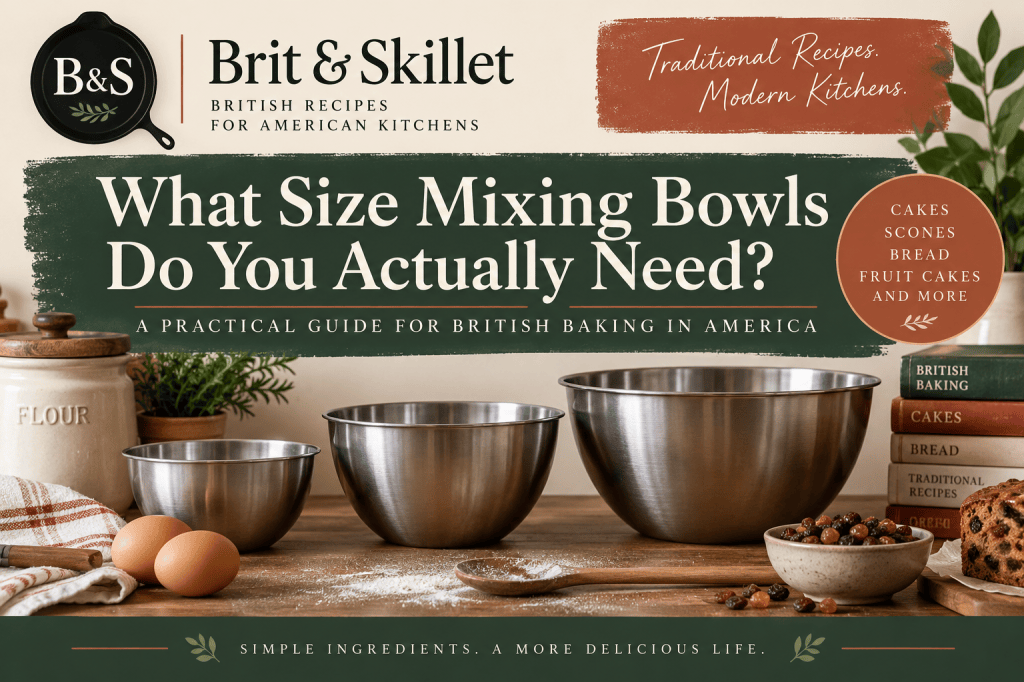
A mixing bowl might seem like one of the simplest pieces of baking equipment, but having the right sizes and materials can make British baking much easier.
From rubbing butter into flour for scones to mixing a Christmas cake packed with dried fruit, British recipes can ask very different things of a bowl. Some jobs need plenty of room for folding and mixing, while others are easier in a smaller bowl that keeps ingredients contained.
American bakers may also encounter British recipes that simply tell you to use a “large mixing bowl” without giving a capacity. That leaves an obvious question: how large is large enough?
The good news is that you don’t need an enormous collection of bowls. A few well-chosen sizes can handle almost everything from Victoria sponge and flapjacks to scones, puddings, and bread dough.
In this guide, we’ll look at the most useful mixing bowl sizes for British baking, compare stainless steel, glass, ceramic, and plastic, and help you choose a practical set for your American kitchen.
Affiliate disclosure: Brit & Skillet may earn a commission from qualifying purchases made through links on this page, at no additional cost to you.
What Size Mixing Bowls Do You Need for British Baking?
Mixing bowls are usually described as small, medium, or large, but those labels aren’t particularly helpful because manufacturers don’t always use them consistently. Looking at the actual capacity gives you a much better idea of what a bowl can handle.
For most British baking, three general sizes are especially useful:
Small bowl — about 1 to 2 quarts: Handy for whisking eggs, mixing icing, combining spices, measuring dry ingredients, or preparing smaller components of a recipe.
Medium bowl — about 3 to 4 quarts: Useful for everyday cake batters, biscuit and scone mixtures, crumble toppings, and many smaller baking jobs.
Large bowl — about 5 to 6 quarts: Gives you plenty of room for bread dough, larger cake mixtures, Christmas cakes, fruit cakes, and recipes where ingredients need to be folded together without spilling over the sides.
You don’t have to match these capacities exactly. The important thing is having enough room to mix comfortably. A bowl that’s technically large enough to hold the ingredients can still be frustrating if it’s so full that flour flies over the edge every time you stir.
Brit & Skillet tip: When in doubt, use a bowl that’s slightly larger than you think you’ll need. Extra mixing space rarely causes problems, while a bowl that’s too small certainly can.
What Is the Best Mixing Bowl Material for Baking?
Mixing bowls come in several materials, and each has advantages. There isn’t one material that’s automatically best for every British recipe—the right choice depends on what you’re making and how you like to work.
Stainless Steel
Stainless steel is our favorite all-purpose choice for a practical British-baking kitchen.
It’s lightweight, durable, easy to lift when folding ingredients, and particularly convenient when you’re working with larger mixtures. Stainless steel also doesn’t retain odors or stains easily, and good-quality bowls can last for years.
If you’re buying your first proper set of baking bowls, this is the material we’d start with.
Glass
Glass bowls are heavier, but their transparency makes it easy to see whether ingredients at the bottom have been incorporated properly. Many bakers also like their stability on the counter.
Always follow the manufacturer’s instructions regarding heat and sudden temperature changes.
Ceramic
Ceramic bowls can be beautiful enough to go from mixing to serving, and their weight helps keep them stable while you work.
The tradeoff is that they’re heavier to lift and can chip or break, so a very large ceramic bowl filled with fruit-cake mixture may not be the easiest thing to maneuver.
Plastic or Melamine
Plastic and melamine bowls are lightweight and practical for everyday mixing. Some sets also incorporate useful features such as nonslip bases, handles and pouring spouts.
Look for sturdy bowls that don’t flex excessively, and follow the manufacturer’s care instructions.
Brit & Skillet tip: You don’t need every bowl in your kitchen to be made from the same material. Choose the bowls that make the jobs you do most often easier.
Our Mixing Bowl Picks for British Baking
You don’t need special “British” mixing bowls to bake British recipes successfully. What matters is having useful sizes, enough working room, and a bowl that’s comfortable to use.
If you’re buying a set rather than assembling individual bowls, these are the two styles we’d consider first.
Best Overall: King Arthur Stainless Steel Mixing Bowls
For most American bakers building a practical British-baking kitchen, our first choice is the King Arthur Stainless Steel Mixing Bowls.
This three-bowl nesting set fits particularly well with the way we bake at Brit & Skillet: several useful bowl sizes without filling an entire cupboard with equipment.
The stainless steel construction keeps the bowls relatively lightweight while still being durable enough for everyday baking. The wide bases add stability on the counter, while the flared rims make pouring easier. The bowls also nest together for storage and are dishwasher-safe.
That combination makes them useful for the kinds of jobs British bakers encounter constantly: cake mixtures, scones, crumble toppings, bread dough, icing, and larger mixtures that need plenty of room for folding.
Why we like them for British baking:
- Stainless steel is lightweight and versatile.
- Three nesting bowls provide useful flexibility without taking up unnecessary cupboard space.
- Wide bases help with stability while mixing.
- Flared rims make pouring batters and other mixtures easier.
- They’re dishwasher-safe and designed for regular use.
If you want one straightforward set that can handle most of your everyday baking, this is the option we’d choose first.
Premium Convenience Pick: King Arthur Complete Lightweight Mixing Bowl Set
If ease of handling and extra convenience features matter more to you than stainless steel construction, the King Arthur Complete Lightweight Mixing Bowl Set is another strong option.
These lightweight melamine bowls have anti-slip rings underneath to help keep them from sliding across the work surface. They also have handles and pouring spouts, which can be particularly useful when you’re holding the bowl with one hand while scraping cake batter into a tin with the other.
They’re designed for jobs including mixing batters and doughs, making them a useful choice for a busy baking kitchen.
The main reason we’d choose these over a traditional stainless set is convenience. If you particularly value a nonslip base, an easy-to-grip handle, and a pouring spout, those features may justify spending more.
Why we like them:
- Lightweight construction makes the bowls easy to handle.
- Anti-slip bases help keep them steady.
- Handles provide an additional grip while mixing or pouring.
- Pouring spouts are useful for cake batters, custards and similar mixtures.
- Multiple bowls give you flexibility for different baking jobs.
For pure all-purpose versatility, we’d still choose stainless steel first. But for a baker who values stability and easy handling, this set has some genuinely useful advantages.
Which Mixing Bowl Set Should You Choose?
For most people, we’d choose the King Arthur Stainless Steel Mixing Bowls. They’re simple, durable and versatile, and stainless steel is an excellent material for the wide variety of jobs involved in British baking.
Choose the Complete Lightweight Mixing Bowl Set instead if nonslip bases, handles and pouring spouts are particularly important to you.
You don’t need both sets. The better choice is simply the one that matches how you prefer to work in the kitchen.
What Kind of Mixing Bowl Is Best for Making Scones?
Traditional British scones don’t require a specialized mixing bowl, but a wide, medium-to-large bowl makes the process much easier.
Many scone recipes begin by rubbing cold butter into flour with your fingertips until the mixture resembles fine breadcrumbs. A bowl with a reasonably wide opening gives your hands plenty of room to work without sending flour over the sides.
Once the liquid is added, scone dough should generally be handled gently rather than vigorously mixed. Having enough space in the bowl makes it easier to bring the mixture together without overworking it.
Stainless steel is particularly practical for scones because it’s lightweight and easy to handle. Glass, ceramic and sturdy lightweight bowls can work perfectly well too, provided they’re large enough to give you comfortable working space.
A bowl around 3 to 5 quarts will be comfortable for many ordinary home batches, although the amount of dough in the particular recipe should always guide your choice.
Brit & Skillet tip: The bowl won’t make great scones by itself. Once the dough starts coming together, resist the temptation to keep mixing until it’s perfectly smooth. Gentle handling is generally much more important than having a specialized piece of equipment.
What Size Mixing Bowl Is Best for Cakes and Fruit Cakes?
For everyday British cakes such as Victoria sponge, a medium mixing bowl of around 3 to 4 quarts will often provide enough room for comfortably combining the ingredients.
Larger fruit cakes are a different story.
Traditional British fruit cakes can contain substantial quantities of dried fruit in addition to the cake mixture, so a bowl that seemed enormous at the beginning can become surprisingly full by the time everything is combined.
For Christmas cakes, rich fruit cakes, and other large mixtures, a 5- to 6-quart bowl or larger can make folding the ingredients together much easier.
Why Extra Room Matters
Fruit needs to be distributed throughout the mixture without batter, flour or dried fruit escaping over the edge. A generously sized bowl lets you use broad folding motions rather than trying to stir everything inside an overcrowded space.
Stainless steel is particularly convenient for large mixtures because a big stainless bowl remains relatively lightweight. A large glass or ceramic bowl can work too, but remember that the bowl itself may become quite heavy before you’ve even added the ingredients.
Brit & Skillet tip: Read through the ingredient quantities before choosing your bowl. It’s much easier to start with an oversized bowl than to transfer a half-mixed fruit cake into another one halfway through.
What Size Mixing Bowl Is Best for Bread Dough?
Bread dough needs more room than its ingredients initially suggest.
Once flour, water, yeast and the other ingredients come together, the dough may need space to expand considerably while it rises.
For many everyday home bread recipes, a large bowl of around 5 to 6 quarts provides a useful amount of working and rising space. Larger batches may require something bigger.
Shape matters too. A bowl with a wide enough opening makes it easier to mix and handle sticky dough, while gently curved sides make it easier to scrape down the bowl and bring ingredients together.
Stainless steel, glass and sturdy lightweight bowls can all work for bread dough. Stainless steel is easy to handle, while a heavier glass bowl can feel particularly stable on the counter.
If you’re leaving dough to rise in the mixing bowl, make sure there’s plenty of empty space above it and cover the bowl as directed by the recipe.
Brit & Skillet tip: Don’t choose your bread bowl based only on the size of the freshly mixed dough. Think about how much room it may need after it rises.
Features to Look for When Buying Mixing Bowls
Once you’ve decided on the sizes and materials you prefer, a few design features can make mixing bowls noticeably easier to use.
A nonslip base: A rubber or silicone base can help keep a bowl from sliding across the counter while you’re whisking or mixing.
A pouring spout: Particularly convenient for batters, custards, icing and other mixtures that need to be poured neatly from the bowl.
A comfortable handle: A handle or grip can make it easier to steady the bowl while mixing or hold it while scraping batter into a tin.
Nesting: If cupboard space is limited, look for bowls designed to fit neatly inside one another. A nesting set can provide several useful capacities without taking up much more room than the largest bowl.
Lids: Lids aren’t essential for baking, but they can be convenient when dough needs to rest or when you want to refrigerate a mixture without transferring it.
Easy-to-read capacity markings: These can be useful for general reference, although they shouldn’t replace proper measuring equipment when a recipe requires precise quantities.
Putting together your British baking kitchen? See our guide to 10 Essential Kitchen Tools for British Baking in America.
Brit & Skillet tip: Don’t let a long list of extra features distract you from the basics. A sturdy bowl in a useful size with a comfortable shape will usually be more valuable than a complicated bowl with features you rarely use.
The Three Mixing Bowls Most British Bakers Actually Need
If you’re building a British baking setup from scratch, you don’t need a cupboard overflowing with mixing bowls. Three well-chosen sizes will handle most everyday recipes.
1. A Small 1- to 2-Quart Bowl
Use this for whisking eggs, mixing icing, combining spices, melting small quantities of ingredients, or keeping measured ingredients ready before you begin.
2. A Medium 3- to 4-Quart Bowl
This will probably become your everyday baking bowl. It’s a useful size for Victoria sponge mixtures, scones, biscuits, crumble toppings, and many ordinary cake batters.
3. A Large 5- to 6-Quart Bowl
Use this when you need plenty of working room—for bread dough, large batches, rich fruit cakes, Christmas cakes, or anything that needs generous space for folding.
For many American bakers, a nesting set containing a useful range of sizes is the simplest way to get started.
If you’re choosing just one bowl initially, a versatile medium-to-large bowl gives you the widest range of uses.
Our practical choice: For an everyday British-baking setup, we’d prioritize sturdy stainless steel bowls in several nesting sizes. They’re lightweight, durable, easy to store, and suitable for nearly all of the mixing jobs we’ve covered in this guide.
Building your British baking equipment collection? Read our guide to Best Baking Tins for British Recipes: What American Bakers Should Buy.
Brit & Skillet tip: Buy for usefulness rather than quantity. Three bowls you reach for constantly are a better investment than a huge set filled with sizes you rarely use.
Mixing Bowl Size Cheat Sheet
Need a quick reminder? These three sizes will cover most everyday British baking:
1–2 quarts → Small bowl
Eggs, icing, spices and small prep jobs.
3–4 quarts → Medium bowl
Victoria sponge, scones, biscuits, crumbles and everyday cake mixtures.
5–6 quarts → Large bowl
Bread dough, fruit cakes, Christmas cakes, larger batches and mixtures that need plenty of folding room.
If you’re buying a set: Look for nesting bowls that give you a useful range of capacities rather than worrying about matching these numbers exactly.
If you’re buying only one: A bowl around 4 to 5 quarts is a versatile compromise for many everyday baking jobs, although particularly large fruit cakes or bread batches may benefit from something bigger.
Brit & Skillet tip: Capacity matters more than whether the manufacturer calls a bowl small, medium or large. Always check the actual capacity when comparing bowls.
The Right Mixing Bowls Make British Baking Easier
Mixing bowls aren’t the most complicated tools in a baker’s kitchen, but choosing the right sizes can make everything from scones to Christmas cake considerably easier.
You don’t need a huge collection. A small bowl for prep work, a medium bowl for everyday cakes and scones, and a large bowl for bread dough and bigger mixtures will cover most British baking projects.
For a straightforward all-purpose setup, stainless steel is our preferred starting point because it combines durability, light weight and versatility. Glass, ceramic and lightweight plastic or melamine bowls can all be useful depending on how you like to bake.
More than anything, give yourself enough room to work. A generously sized bowl makes folding, whisking, rubbing in butter and mixing dough easier—and keeps considerably more flour in the bowl rather than on the floor.
Start with a few useful sizes, learn which ones you naturally reach for, and expand your collection only when your baking actually calls for it.
 Brit & Skillet
Leave a comment