Tag: baking tools

  • British Baking Equipment Guide: Everything an American Kitchen Needs.

    British Baking Equipment Guide: Everything an American Kitchen Needs.

    Baking from a British recipe in an American kitchen can feel like following instructions from someone who knows your kitchen—but calls everything by a different name.

    They mention sandwich tins. You look at your cake pans. They ask for a pudding basin. You wonder whether a cereal bowl counts.

    The good news? You may already own much of what you need.

    This guide will help you work out which equipment deserves cupboard space, which specialist pieces suit the recipes you want to make, and what can wait. We’ll also point you toward our detailed Brit & Skillet guides when you need help choosing a particular tool or understanding British measurements.

    Whether you’re starting with scones, planning a Victoria sponge, or contemplating your first steamed pudding, let’s get your kitchen ready—without buying half a baking shop.

    Affiliate Disclosure: This post contains affiliate links. If you purchase through one of these links, Brit & Skillet may earn a small commission at no additional cost to you. I only recommend products that are relevant to the recipes and information shared here.

    Start With What You Already Own

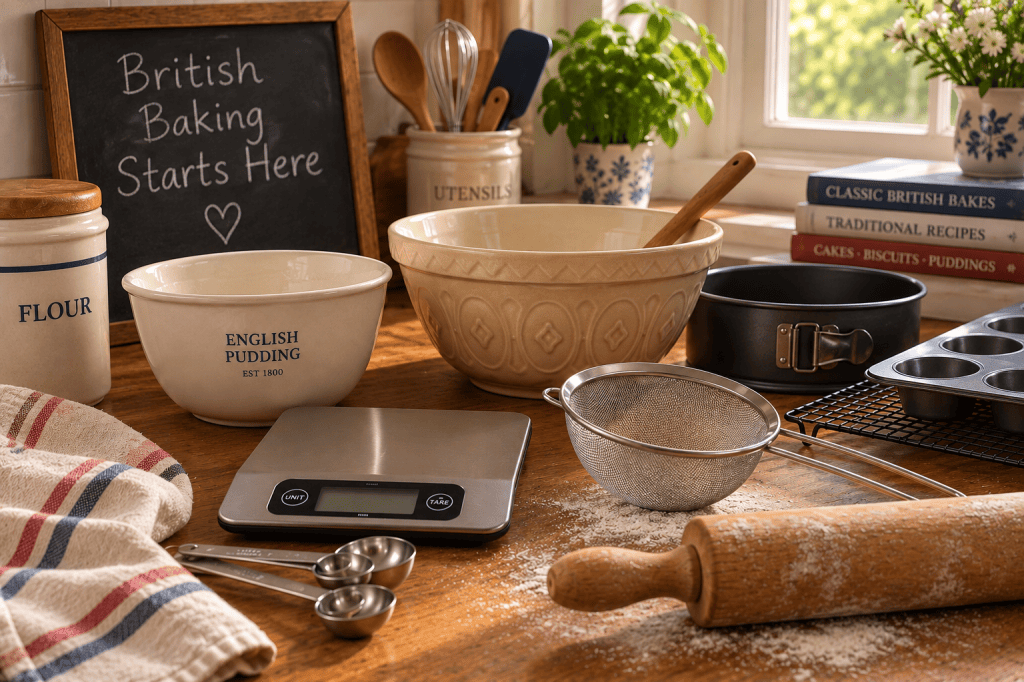
    Before buying anything, take a look through your kitchen cupboards. Mixing bowls, wooden spoons, a whisk, a spatula, and a rolling pin can all earn their keep in British baking.

    Start with the recipe you want to make, then check what it actually requires. A batch of scones calls for a different setup from a steamed Christmas pudding, and neither automatically requires an electric mixer.

    Some British equipment names may sound unfamiliar even when the item itself looks familiar. A “sandwich tin,” for example, is a shallow round cake pan used to bake layers for cakes such as Victoria sponge.

    Before substituting a pan you already own, compare its diameter, depth, and shape with the recipe’s instructions. A different pan can change the depth of the batter and how quickly it bakes.

    Choose a few recipes you’re excited to bake and let those guide your purchases. You’ll soon discover which tools you reach for regularly and which specialist pieces can wait.

    There’s no need to buy a pudding basin before you’ve decided whether steamed pudding is something you actually want to make.

    Although, after our pudding-basin guide, we understand if you’ve already become emotionally attached to a bowl.


    A Digital Kitchen Scale

    One of the first differences you’ll notice in British baking recipes is the use of grams for ingredients such as flour, sugar, and butter.

    A digital kitchen scale lets you follow those measurements directly, without converting each ingredient into cups.

    A cup of flour can contain different amounts depending on how it’s filled. Scooping directly from the bag can pack flour into the cup, while spooning it in more lightly may give you less.

    Weighing ingredients removes that particular source of variation. If your recipe asks for 225 grams of flour, you can measure 225 grams without wondering how firmly someone else filled a cup.

    It also makes British butter measurements easier. You can weigh the amount the recipe requests instead of working out fractions of an American stick.

    Brit & Skillet Tip: If you’re going to buy one piece of equipment specifically to make British recipes easier in an American kitchen, a digital scale is a very good place to start. Working directly in grams removes a whole layer of conversion and guesswork.

    For a scale that can handle the everyday measuring jobs involved in British baking, the King Arthur Volume & Weight Scale is one option worth considering.

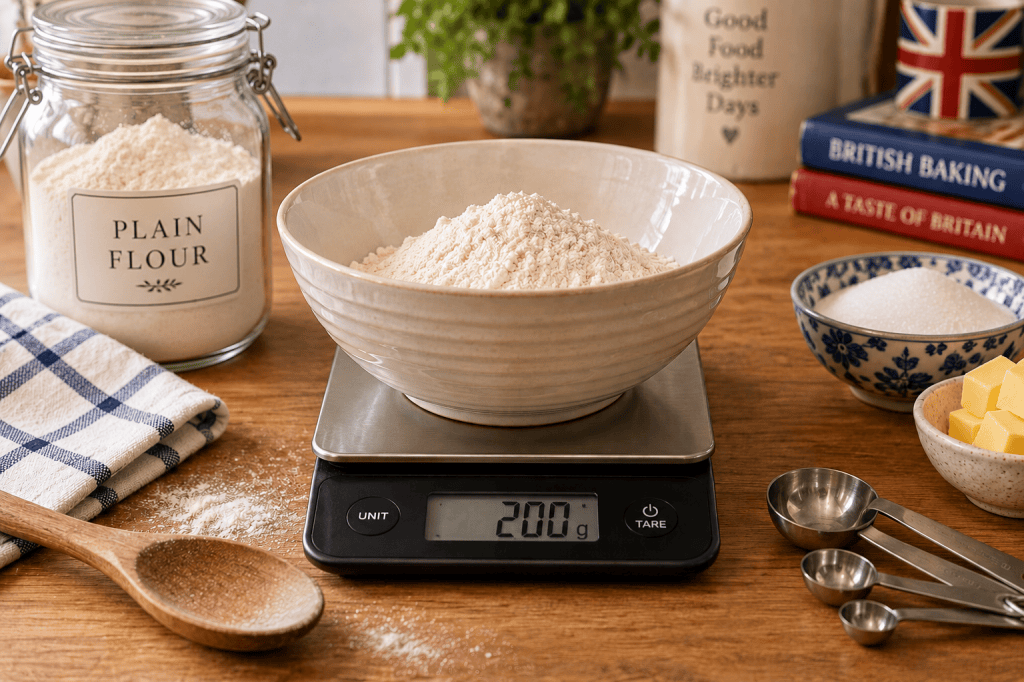
    Place your mixing bowl on the scale, then press the tare—or zero—button. This resets the display so you’re measuring the ingredient rather than the bowl.

    You can reset it again before adding another ingredient, provided the recipe calls for those ingredients to go into the same bowl.

    Add slowly as you approach the target weight. Taking extra sugar out of a bowl of flour is considerably less convenient than putting it in.

    Measuring cups and spoons still have a place in your kitchen, especially when you’re following American recipes. A scale simply gives you another way to measure.

    When a British recipe provides weights, use those original measurements where possible. If you need help interpreting the alternatives, see our guide to British baking measurements for American recipes.


    British Baking Tins and American Baking Pans

    British recipes usually call baking pans “tins,” even when they’re made from another material. The name may be different, but the job is familiar.

    What matters most is choosing the size and shape specified in your recipe.

    Sandwich Tins

    Sandwich tins are shallow round cake pans used to bake separate layers for cakes such as Victoria sponge.

    Check both the diameter and depth before using a pan you already own. Two shallow sandwich tins and one deep cake pan aren’t automatically interchangeable: changing the depth of the batter can affect baking time.

    Brit & Skillet Tip: Want to see sandwich tins doing the job they were made for? Our Classic Victoria Sponge Cake uses those separate sponge layers to make one of Britain’s best-loved cakes.

    For a sturdy American option, Fat Daddio’s Anodized Aluminum Round Cake Pans are available in multiple sizes, including an 8-inch pan that’s a useful match for many British recipes calling for a 20cm round or sandwich tin.

    Loaf Tins

    Loaf tins are useful for loaf cakes and bread. British recipes sometimes describe them by a pound size, such as a “2 lb loaf tin.”

    Those labels aren’t a reliable guide to exact dimensions across every manufacturer. If the recipe provides measurements or capacity, compare those with your own pan before filling it.

    For a dependable American option, Fat Daddio’s Anodized Aluminum Bread & Loaf Pans come in a range of sizes, making it easier to choose a pan that closely matches the dimensions called for in a British recipe.

    Baking Trays

    A baking tray is the British equivalent of a baking sheet. You may already have one suitable for scones, biscuits, and other everyday bakes.

    Check whether the recipe needs a flat sheet, a rimmed tray, or a deeper pan. A shallow baking sheet cannot substitute for a deep traybake tin holding cake batter.

    Start with the pans required for your first few recipes. Add specialist shapes when you have a use for them.

    A cupboard full of lovely tins is enjoyable. Being able to open that cupboard without a small metal avalanche is also enjoyable.

    For more help choosing suitable pans, see our guide to British baking tins and their uses.

    For a sturdy everyday option, Fat Daddio’s Natural Aluminum Baking Sheet Pans are available in several sizes and work well for the kinds of biscuits, scones, and tray bakes you’ll come across in British baking.


    Mixing Bowls and Everyday Utensils

    Not every British bake needs an electrical appliance. Mixing bowls and a few familiar utensils can handle plenty of everyday preparation.

    Before adding anything to your shopping basket, check what’s already in your kitchen drawer.

    Choose a bowl with enough space to stir or fold without sending flour over the sides. A larger bowl is useful for cake mixtures and dough, while a smaller one comes in handy for beating eggs or combining dry ingredients.

    A stable base helps keep the bowl steady as you work. If yours slides around the counter, placing a damp kitchen towel underneath can help.

    If you’re building a baking setup from scratch, the King Arthur Complete Lightweight Mixing Bowl Set gives you several sizes for different jobs.

    If you prefer the durability and simplicity of metal bowls, the King Arthur Stainless Steel Mixing Bowls are another option.

    Brit & Skillet Tip: You don’t necessarily need both types. Choose the bowl set that suits the way you bake and the storage space you have. A useful bowl earns its cupboard space; a beautiful stack you never reach for does not.

    A wooden spoon is useful for stirring mixtures and beating softened ingredients together by hand.

    A flexible spatula helps scrape the sides of the bowl and fold ingredients together. It also gets more batter into the tin, although this does slightly reduce the amount available for the traditional bowl inspection.

    A balloon whisk is useful for beating eggs, blending liquids, and whisking small amounts of cream.

    For mixtures that need prolonged beating, an electric mixer can reduce the effort. But you don’t need to bring one out every time a recipe asks you to mix something.

    A sieve is useful when a recipe calls for sifted ingredients, particularly if flour, cocoa powder, or icing sugar contains lumps.

    “Icing sugar” is the British name you’ll commonly encounter for powdered or confectioners’ sugar. Your sieve doesn’t mind which name is on the bag.

    For a closer look at choosing a bowl, read our guide to Best Mixing Bowls for British Baking: What Size and Material Do You Need?


    Hand Mixers and Stand Mixers

    An electric mixer can make some baking jobs easier, particularly when a recipe calls for creaming butter and sugar or whisking a mixture for several minutes.

    Whether you need one depends on what you bake and how often you bake it.

    Hand Mixers

    A hand mixer is useful for many cake mixtures, whipped cream, and beaten egg whites. It also takes up relatively little cupboard space.

    You’ll still need to hold and move it through the mixture, but it can take much of the effort out of prolonged beating.

    Start at a low speed when incorporating loose ingredients. A cloud of icing sugar is rarely the kitchen decoration anyone intended.

    Stand Mixers

    A stand mixer holds the bowl and mixing attachment in place, leaving your hands free while it runs.

    That can be convenient for frequent baking or recipes requiring longer mixing. However, it takes up more space, and you don’t need one simply because you’re baking from a British recipe.

    Use the attachment, speed, and batch size recommended for your machine and recipe.

    An electric mixer doesn’t replace every mixing technique. If a recipe asks you to gently fold in an ingredient, switch to a spatula or suitable spoon rather than continuing to beat.

    The aim is to combine the ingredients while preserving as much of the mixture’s air as possible.

    Brit & Skillet Tip: Start with the equipment you own. If mixing by hand becomes the part that puts you off baking, that’s a useful sign that an electric helper might actually earn its place.

    If you’re considering one, explore our guide to electric hand mixers for British baking.


    Rolling Pins and Pastry Tools

    If pies, tarts, or scones are on your baking list, a rolling pin and a clear work surface will come in handy.

    You can add specialist pastry tools as you discover which recipes you enjoy making.

    A simple straight rolling pin gives you direct control over the pressure you’re applying to pastry or dough. If you need one, the King Arthur Straight Rolling Pin is an option that fits neatly into this basic British-baking toolkit.

    Follow your recipe’s instructions for flouring the surface. Too little flour can leave dough sticking, while repeatedly adding more can change the dough.

    Some recipes suggest rolling between sheets of baking parchment to help prevent sticking.

    Round cutters are useful for shaping scones and cutting pastry for small pies or tarts. In British recipes, “biscuit cutters” generally means what American bakers call cookie cutters.

    Buy shapes and sizes that suit your recipes. A small set of round cutters can cover several jobs without taking over a drawer.

    A pastry brush helps apply egg wash, milk, or other glazes evenly.

    Use a light touch and follow the recipe’s directions about where to brush. For layered pastry, coating the cut edges can interfere with how those layers rise.

    A dough scraper can help lift sticky dough and gather scraps from the work surface. Pastry guides can help you roll to a consistent thickness.

    Both can be convenient, but start with the tools your chosen recipe requires. You don’t need a miniature hardware department to make your first jam tart.


    Pudding Basins

    If you want to make Christmas pudding or a steamed treacle sponge, you may encounter a piece of equipment less familiar in American kitchens: the pudding basin.

    This deep, rounded bowl holds the mixture while the pudding steams. Traditional basins often have a pronounced rim that helps secure the covering.

    Check the basin capacity in the recipe before buying. Its width alone won’t tell you how much mixture it holds.

    You’ll also need a steaming pot large enough to accommodate the basin and any support specified in the recipe, with room for the lid to close.

    Use a basin that its manufacturer identifies as suitable for steaming. A bowl’s appearance—or a microwave-safe label alone—doesn’t establish that it’s suitable for this cooking method.

    Follow the recipe and manufacturer’s instructions for covering, positioning, and handling the basin.

    A pudding basin can wait until you’re ready to try a steamed-pudding recipe. It isn’t necessary for every British dessert, and many cakes and baked puddings use ordinary baking tins or dishes.

    For a closer look at materials, capacities, and what to consider before buying, see our guide to the best pudding basins for traditional British desserts.

    Brit & Skillet Tip: Yes, this is the bowl we devoted an entire article to. It has earned its moment.


    Cooling Racks, Parchment and Finishing Tools

    Getting a bake out of the oven is only part of the job. Cooling it properly and preparing it for serving deserve a little attention, too.

    A few simple tools can help with these final steps.

    A cooling rack allows air to circulate underneath your baking. It helps steam escape instead of collecting against a solid surface.

    Brit & Skillet Tip: If you need a sturdy rack for cooling cakes, biscuits, and other bakes, the Fat Daddio’s Stainless Steel Cooling & Baking Racks are a practical option that can also be used for baking when a recipe calls for a rack.

    Follow your recipe’s instructions about when to transfer the bake to a rack. Some cakes need time to firm up in their tins first, while delicate bakes can break if moved too soon.

    British recipes often call for “baking parchment,” which American bakers know as parchment paper. It’s useful for lining tins and baking sheets when the recipe calls for it.

    Use parchment rated for your baking temperature. Wax paper is a different product and should not be used as an oven-lining substitute.

    A palette knife or offset spatula can help spread icing and fillings. A small one is handy for working around the edges of a cake without dragging your knuckles through your efforts.

    For a simple cake, an ordinary spatula or the back of a spoon may be all you need. Decorative swirls are perfectly respectable.

    Unless your recipe says otherwise, let cakes cool before adding buttercream or another heat-sensitive topping.

    After all that measuring and mixing, the final challenge is sometimes simply leaving the cake alone.


    Do You Need a Food Processor?

    A food processor can help with tasks such as chopping nuts, making breadcrumbs, and preparing pastry using a recipe written for that method.

    Whether it deserves space in your kitchen depends on how often you’ll use those functions.

    For pastry recipes that specify a food processor, short pulses can help combine the fat and flour. Follow the recipe’s cues for texture and when to stop.

    A processor can also make quick work of crushing biscuits for a cheesecake base. In an American kitchen, those biscuits might be cookies or graham crackers, depending on the recipe.

    Check your machine’s instructions for suitable ingredients, attachments, and quantities.

    A food processor and an electric mixer work differently. Don’t assume a recipe’s whisking, beating, or folding instructions can be transferred directly to a processor.

    Use the method the recipe specifies, particularly when the mixture depends on incorporating or preserving air.

    If you regularly make pastry, crumb bases, or recipes requiring chopped ingredients, a processor may be useful.

    If those jobs only come up occasionally, hand methods may suit you perfectly well. Biscuits can be crushed in a sturdy food bag with a rolling pin, and many pastry recipes include instructions for mixing by hand.

    Brit & Skillet Tip: Choose equipment that makes your usual baking easier. Cupboard space deserves a say in the matter, too.

    For more help deciding whether one suits your kitchen, read our guide to food processors for British baking.


    British Baking Equipment Checklist

    You don’t need everything in this guide before you start. Use this checklist to take stock of what you own, then fill the gaps for your chosen recipe.

    • Digital kitchen scale for recipes measured in grams
    • Mixing bowls
    • Measuring spoons and a liquid measuring jug
    • Wooden spoon, flexible spatula and whisk
    • Baking tin or tray in the size your recipe specifies
    • Oven gloves
    • Wire cooling rack
    • Baking parchment when needed
    • Scones, biscuits and pastry: rolling pin and suitable cutters
    • Glazed pastry: pastry brush
    • Steamed puddings: a basin suitable for steaming and a pot that accommodates it
    • Iced cakes: palette knife or offset spatula
    • Recipes requiring prolonged beating: an electric mixer can reduce the effort
    • Processor-method pastry or crumb bases: a food processor can be convenient

    Read the whole recipe, check the equipment you already own, and compare pan dimensions or basin capacities carefully.

    The best-equipped kitchen is one that supports the baking you actually enjoy.

    Start with a recipe that makes you want to put the kettle on. Let the collection grow from there.


    Ready to Start British Baking?

    You don’t need a completely different kitchen to bake British recipes in America.

    Start with familiar tools, pay attention to measurements and tin sizes, and add specialist equipment when a recipe actually calls for it.

    For more help, explore our guides to British baking measurements for American recipes, British baking tins and their uses, and the best pudding basins for traditional British desserts.

    Or put some of that equipment to work with our Classic Victoria Sponge Cake.

    Choose a recipe, clear a little counter space, and see what you enjoy making.

    British food. American kitchens. Something good in the oven.
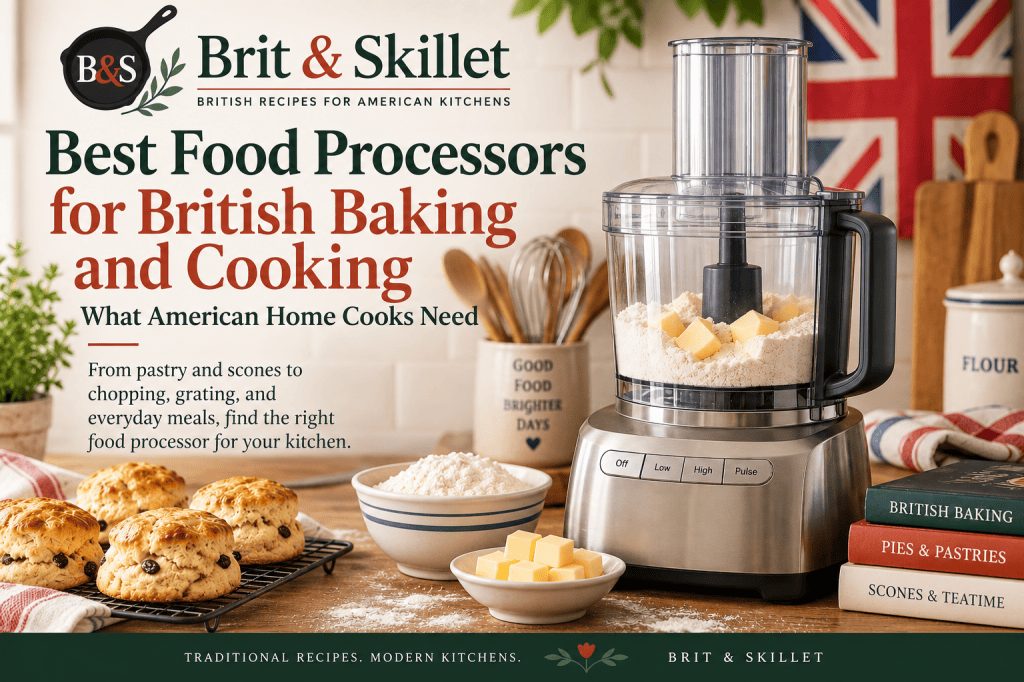

  • Best Food Processors for British Baking and Cooking: What American Home Cooks Need

    Best Food Processors for British Baking and Cooking: What American Home Cooks Need

    British cooking has plenty of recipes that can be made with little more than a good knife, a wooden spoon, and a mixing bowl. But a food processor can make some of the more time-consuming jobs considerably easier.

    From rubbing cold butter into flour for pastry and scones to chopping vegetables, making breadcrumbs, grating cheese, and preparing fillings, a food processor can quickly become one of the most useful appliances in a busy kitchen.

    For American cooks exploring British recipes, it can be particularly handy. Classic dishes such as sausage rolls, savory pies, shortcrust pastry, scones, crumbles, and homemade breadcrumbs often involve preparation jobs that a food processor can handle in seconds.

    The challenge is choosing the right one.

    Food processors vary considerably in bowl capacity, attachments, power, storage requirements, and price. A large premium machine may be wonderful for someone who cooks every day, while a smaller and simpler processor may make far more sense in an occasional baker’s kitchen.

    In this guide, we’ll explain what to look for in a food processor for British baking and cooking and compare several strong options available to American home cooks. Our recommendations are based on current independent testing and manufacturer information rather than personal testing by Brit & Skillet.

    Current independent testing supports that general use case: Food Network’s 2026 testing included chopping vegetables, shredding cheese, making pesto and making pie dough, while Bon Appétit describes food processors as useful for chopping, slicing, grating, kneading and preparing pie crusts.

    Do You Need a Food Processor for British Baking and Cooking?

    You certainly don’t need a food processor to make British food. Pastry, scones, breadcrumbs, and chopped vegetables were being prepared long before food processors arrived on kitchen counters.

    But a food processor can make some of those jobs considerably quicker.

    One of its biggest advantages for baking is working cold butter into flour. Shortcrust pastry and scones depend on handling the mixture carefully, and a food processor can cut cold butter into flour very quickly. The key is using short pulses rather than letting the machine run continuously. King Arthur Baking’s food-processor pie crust method, for example, uses very brief pulses to incorporate chilled butter while deliberately leaving pieces of butter visible in the dough. King Arthur Baking

    The same technique can work particularly well for scones. British recipes from Good Food use a food processor to pulse cold butter into flour before the wet ingredients are added. BBC Good Food

    Beyond baking, a food processor can also be useful for everyday kitchen jobs such as chopping vegetables, grating cheese, making breadcrumbs, preparing pastry, and creating fillings for savory pies and other dishes.

    There is one important limitation: a food processor can make it very easy to over-process a mixture. Scones and pastry generally benefit from gentle handling, so once the machine has done the hard work of cutting in the butter, it’s often better to finish the dough by hand. King Arthur similarly cautions against over-handling scone dough because it can produce tougher results. King Arthur Baking

    For someone who only bakes occasionally, a food processor isn’t essential. But if you regularly make pastry, scones, savory pies, breadcrumbs, or recipes involving lots of chopping and grating, it can be one of the most useful multipurpose appliances in the kitchen.

    What to Look for in a Food Processor for British Baking and Cooking

    Choosing a food processor isn’t simply a matter of buying the biggest or most powerful machine. The best choice depends on what you cook, how much food you normally prepare, and how much kitchen space you’re willing to give the appliance.

    Bowl Capacity

    Capacity is one of the first things to consider. Small processors are convenient for chopping herbs, nuts, or small quantities of ingredients, but they can become restrictive when you’re making pastry, scones, pie fillings, or larger family meals.

    For many home cooks, a medium-sized processor in roughly the 8- to 12-cup range provides a useful balance between capacity and storage. Cuisinart similarly positions its 8- to 11-cup machines for larger meals and bulkier jobs such as dough preparation. Cuisinart

    A larger 14- or 16-cup processor can be worthwhile for frequent cooks or large batches, but it also requires considerably more cupboard or counter space.

    A Good Pulse Control

    For British baking, a reliable pulse button is particularly important.

    Pastry and scone mixtures often need short bursts of processing rather than continuous mixing. Pulsing gives you greater control and makes it easier to stop before the ingredients become overworked.

    It’s a simple feature, but for the kinds of recipes we’re interested in, it’s one we’d consider essential.

    Useful Blades and Discs

    Most full-size food processors include an S-shaped chopping blade, but additional discs can make the appliance considerably more versatile.

    A slicing disc can quickly prepare vegetables or fruit for pies and other dishes, while a shredding disc is useful for cheese, carrots, potatoes, and similar ingredients. Some machines also include a dedicated dough blade.

    Cuisinart notes that food-processor blades and discs can cover chopping, mixing, dough preparation, slicing and shredding, depending on the model. Cuisinart

    Dough and Pastry Capability

    If British baking is one of the main reasons you’re buying a processor, look carefully at its dough capabilities.

    Some processors include a dedicated dough blade, while others use their main blade for certain doughs. Breville, for example, provides instructions for preparing pastry by processing chilled cubed butter with flour before gradually adding liquid. Breville

    That can be useful for shortcrust pastry and similar recipes, but remember that more processing isn’t necessarily better. You still want control over the mixture rather than simply running the machine until everything is completely smooth.

    Storage and Counter Space

    Food processors can come with a surprising collection of blades, discs, pushers, and accessories. Before buying one, consider where all of those pieces will actually live.

    Some models provide in-bowl storage, while larger premium processors may include a separate accessory box. Cuisinart currently offers processors with attachments that nest inside the work bowl, while Breville’s larger Sous Chef models include dedicated accessory storage. Cuisinart

    If your kitchen is short on storage space, this can matter just as much as another attachment.

    Easy Cleaning

    A food processor that takes forever to clean has a remarkable ability to remain permanently inside the cupboard. 😂

    Look for a bowl, lid, and accessories that are straightforward to remove and wash. It’s also worth checking the manufacturer’s instructions rather than assuming every component can go in the dishwasher. For example, Cuisinart identifies the removable components of many current models as dishwasher safe, while cleaning recommendations can differ between manufacturers and models. Cuisinart

    Don’t Choose by Wattage Alone

    As with hand mixers, wattage isn’t the only indication of how useful a food processor will be.

    Motor strength becomes more important for demanding jobs and larger machines, but blade design, bowl capacity, controls, attachments, and overall construction also affect how useful the processor is in everyday cooking. Cuisinart’s own buying guidance recommends considering power alongside size, capacity, attachments, price, and the foods you plan to prepare. Cuisinart

    For most Brit & Skillet readers, a practical bowl size, good pulse control, useful slicing and shredding attachments, and easy cleanup are more important than simply choosing the machine with the largest wattage number.

    Our Food Processor Picks for British Baking and Cooking

    All right — recommendation time. 😄 One important update from the research: Breville’s older BFP660 Sous Chef 12 has been discontinued, but Breville now sells a newer Sous Chef 12 (BFP710). So we’re going to avoid accidentally recommending the discontinued version. Breville

    Add this H2:

    Our Food Processor Picks for British Baking and Cooking

    Then paste:

    There isn’t one food processor that’s right for every kitchen. A frequent baker may appreciate a premium machine with an adjustable slicing system and dough blade, while someone who mainly makes pastry, scones, and occasional family meals may be happier with a simpler processor.

    For our recommendations, we considered current independent testing, manufacturer specifications, bowl capacity, attachments, storage, and how useful each machine would be for the kinds of British recipes featured on Brit & Skillet. These recommendations are based on research rather than personal testing.

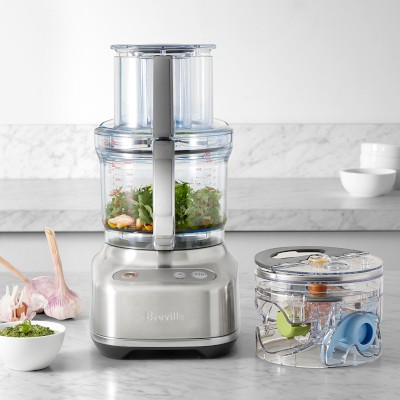
    Best Overall: Breville Sous Chef 12

    For home cooks who expect to use a food processor regularly, the current Breville Sous Chef 12 is our premium overall choice.

    Breville’s current 12-cup model includes an S-blade, reversible shredder, adjustable slicer, and dedicated dough blade. One particularly useful improvement is its onboard storage caddy, which keeps those accessories inside the bowl rather than requiring a separate box in the cupboard. It also has a wide feed chute and a heavy-duty induction motor. Breville

    Those features translate particularly well to British cooking. The dough blade adds versatility for baking projects, while the chopping, shredding, and slicing accessories can handle everything from breadcrumbs and grated cheese to vegetables for savory pies.

    Independent testing also gives the Breville line a strong showing. Food Network’s 2026 tests named the Sous Chef 12-Cup its best overall processor after evaluating tasks including puréeing, slicing, grating, and dough making. One caveat is that Food Network tested the earlier 12-cup version, rather than the newly updated model we’re recommending here. Food Network

    The biggest drawback is cost. This is a premium food processor, so it makes the most sense for someone who cooks or bakes frequently enough to take advantage of its capabilities.

    Best for: Frequent bakers and home cooks who want a versatile premium food processor for both baking and everyday meal preparation.

    Breville Sous Chef 12-Cup Food Processor

    Breville Sous Chef 12-Cup Food Processor

    $449.95Williams-Sonoma

    Best Classic Workhorse: Cuisinart Custom 14-Cup

    The Cuisinart Custom 14-Cup Food Processor takes a somewhat different approach. Instead of loading the machine with complicated controls, Cuisinart has kept the design relatively straightforward while providing a generous 14-cup work bowl.

    The current model has a 720-watt motor and includes a stainless-steel chopping and mixing blade, 4mm slicing disc, medium shredding disc, and extra-large feed tube. Cuisinart also lists kneading dough among the machine’s capabilities. Cuisinart

    That large bowl can be particularly useful for cooks preparing bigger batches of pastry, breadcrumbs, grated cheese, vegetables, or fillings. It may be more capacity than a very occasional baker needs, but families and frequent cooks may appreciate the additional room.

    The Cuisinart also performed extremely well in current independent testing. Tom’s Guide named the Custom 14-Cup its best food processor overall for 2026, praising its performance, relatively quiet operation, and ability to complete preparation tasks with little mess. Bon Appétit also lists the Custom 14-Cup as a runner-up among its current food-processor recommendations. Tom’s Guide

    Best for: Home cooks who want a large, proven food processor with straightforward controls and plenty of capacity.

    Cuisinart Custom 14-Cup Food Processor

    Cuisinart Custom 14-Cup Food Processor

    $299.99Target

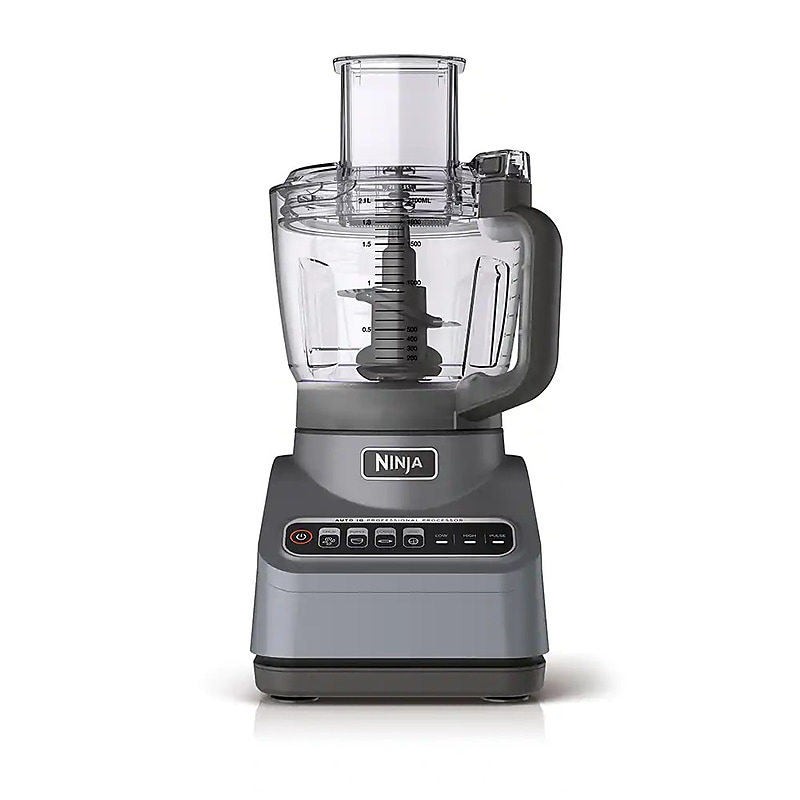
    Best Value: Ninja Professional Plus Food Processor

    For someone who wants useful food-processing capability without spending as much as the premium machines, the Ninja Professional Plus is worth considering.

    It has a 9-cup bowl and is designed for chopping, slicing, puréeing, shredding, and dough preparation. That capacity should be sufficient for many everyday baking and cooking jobs without requiring as much storage space as a 14-cup processor.

    Food Network selected the Ninja Professional Plus as its Best Value food processor in its 2026 testing, making it an appealing option for someone who wants a capable multipurpose processor while keeping the budget under control. Food Network

    For British baking, that makes it particularly attractive to beginners. It provides the functionality needed for jobs such as pastry preparation, breadcrumbs, grated cheese, and everyday chopping without requiring the investment of a premium processor.

    Best for: Beginners and occasional bakers who want a capable food processor at a more approachable price.

    Ninja Professional Plus Food Processor

    Ninja Professional Plus Food Processor

    $129.99Staples

    Food Processor Comparison at a Glance

    Food ProcessorBest ForCapacityStandout FeaturesPrice Level
    Breville Sous Chef 12Best overall12 cupsAdjustable slicer, reversable shredder, dough blade, onboard accessory storage$$$
    Cuisinart Custom 14-CupClassic workhorse14 cupsLarge bowl, 720W motor, slicing and shredding discs, simple controls$$-$$$
    Ninja Professional PlusBest value9 cupsPreset programs, slicing/shredding, dough capability, compact size$

    Which Food Processor Should You Choose?

    For most home cooks, the right food processor depends on how often you’ll use it and how much food you normally prepare.

    Choose the Breville Sous Chef 12 if you want the most versatile premium option. Its adjustable slicing system, reversible shredding disc, dough blade, and onboard accessory storage make it particularly appealing for someone who expects to use a food processor for both British baking and everyday cooking.

    Choose the Cuisinart Custom 14-Cup if you want a large, straightforward workhorse. Its generous bowl is useful for bigger batches, while the chopping blade and slicing and shredding discs cover most everyday food-processing jobs. Cuisinart also specifically lists chopping, shredding cheese and kneading dough among its capabilities. Cuisinart

    Choose the Ninja Professional Plus if budget and kitchen space are bigger considerations. Its 9-cup bowl is smaller, but that may actually be an advantage for someone who doesn’t routinely cook large batches. Current shopping results show the BN601 with a 9-cup bowl and dough functionality at a much lower price than our two premium choices.

    For many Brit & Skillet readers, the Cuisinart is probably the sweet spot if you regularly cook for a family or make larger batches. The Ninja makes more sense for beginners trying to keep costs down, while the Breville is the splurge option for someone who expects their food processor to earn a permanent place in the kitchen.

    Food Processor vs. Blender: Which Do You Need?

    A food processor and blender may look as though they perform similar jobs, but they’re designed for different kinds of kitchen tasks.

    A blender is generally better for liquids. Smoothies, soups, sauces, and other mixtures that need to become very smooth are where a blender is most at home.

    A food processor is better suited to chopping, slicing, shredding, and working with thicker or relatively dry mixtures. Depending on the attachments, it can grate cheese, slice vegetables, make breadcrumbs, chop nuts, and prepare certain types of dough and pastry. Food Network

    That distinction makes the food processor particularly useful for British baking and cooking. If you’re making shortcrust pastry, for example, a processor can quickly pulse cold butter into flour while leaving small pieces of butter in the mixture. King Arthur Baking uses precisely this technique for its food-processor pastry method and cautions against overworking the finished dough. King Arthur Baking

    If your kitchen revolves around smoothies and blended soups, buy a blender first. But if you’re more interested in pastry, scones, breadcrumbs, grated cheese, chopped vegetables, and savory cooking, a food processor will probably be the more useful appliance.

    The Bottom Line

    A food processor isn’t essential for making British food, but it can remove a surprising amount of repetitive preparation from both baking and everyday cooking.

    The Breville Sous Chef 12 is our overall choice for frequent cooks who want a premium, versatile machine.

    The Cuisinart Custom 14-Cup is a strong choice for home cooks who value a large capacity and straightforward design, particularly if they’ll regularly prepare bigger batches.

    And the Ninja Professional Plus offers a more approachable option for beginners who want useful food-processing capabilities without making the same investment as the premium machines.

    Whichever model you choose, think about the jobs you’ll actually ask it to perform. Bowl capacity, pulse control, useful blades and discs, storage, and easy cleaning will usually matter more in everyday cooking than simply choosing the machine with the longest specification sheet. Cuisinart’s buying guidance similarly emphasizes capacity, attachments, power, price, kitchen space, and intended use when choosing a processor. Cuisinart

    For British baking in particular, the humble pulse button may end up being one of your favorite features. A few quick pulses can take much of the work out of preparing pastry—while still leaving you in control of the final dough.

    And anything that gets a homemade pie onto the table a little faster sounds like a worthwhile kitchen assistant to us.


    This article may contain affiliate links. If you make a purchase through one of these links, Brit & Skillet may earn a commission at no additional cost to you. Our recommendations are based on independent research and product information; we do not claim to have personally tested products unless explicitly stated.

  • Best Electric Hand Mixers for British Baking: What American Bakers Should Look For

    Best Electric Hand Mixers for British Baking: What American Bakers Should Look For

    British baking doesn’t require a kitchen full of expensive equipment, but a good electric hand mixer can make some classic recipes much easier.

    From creaming butter and caster sugar for a Victoria sponge to whipping cream, beating buttercream and whisking egg whites for meringue, an electric hand mixer handles many jobs that would otherwise require a fair amount of elbow grease.

    If caster sugar is unfamiliar, our guide to caster sugar vs. granulated sugar explains the difference and what American bakers can use instead.

    For American bakers exploring British recipes, the good news is that you don’t necessarily need a large stand mixer. A hand mixer is compact, easier to store and well suited to everyday jobs such as cake batters, frosting, whipped cream and creaming butter and sugar.

    But hand mixers aren’t all the same. Speed control, attachments, weight, low-speed performance and storage can make a noticeable difference—especially when you’re working with everything from delicate whipped cream to thicker cake mixtures.

    In this guide, we’ll explain what to look for in an electric hand mixer for British baking and compare three strong options for American home bakers.

    Affiliate disclosure: Brit & Skillet may earn a commission from qualifying purchases made through links on this page, at no additional cost to you. Our recommendations are based on independent research and manufacturer information; we do not claim to have personally tested these products unless explicitly stated.

    Do You Need an Electric Hand Mixer for British Baking?

    You don’t need an electric hand mixer to make British cakes and desserts. Generations of home bakers managed perfectly well with a wooden spoon, whisk and a little determination.

    But an electric hand mixer can make several common baking jobs considerably faster and easier.

    One of the best examples is a classic Victoria sponge. Creaming softened butter and caster sugar until the mixture becomes pale and fluffy incorporates air and helps create the light texture associated with a good sponge.

    A hand mixer is also useful for:

    • Creaming butter and sugar
    • Making smooth buttercream
    • Whipping double cream — heavy cream in the US
    • Whisking egg whites for meringues
    • Mixing ordinary cake and cupcake batters
    • Beating eggs and other light mixtures

    For many home bakers, a hand mixer also makes more sense than a full-size stand mixer. It takes up very little cupboard space, works with the mixing bowls you already own and usually costs considerably less.

    If you’re building your British baking setup, take a look at our guide to the best mixing bowls for British baking, including the most useful sizes and materials for an American kitchen.

    There are limits, though. A hand mixer isn’t necessarily the best tool for frequent bread making or particularly heavy doughs. If you regularly make bread, enriched doughs or very large batches, a stand mixer may eventually be the better investment.

    For most beginners exploring British baking, however, a good electric hand mixer is more than enough to get started.

    What to Look for in a Hand Mixer for British Baking

    A hand mixer doesn’t need dozens of complicated features to be useful. For British baking, the most important qualities are good speed control, comfortable handling and attachments that suit the cakes and desserts you actually make.

    A Gentle Low Speed

    One of the most useful features is a genuinely low starting speed.

    Starting too quickly can send flour, icing sugar or cocoa powder flying out of the bowl. A controlled low speed makes it easier to begin combining ingredients before increasing the speed.

    This is particularly useful for cake batters, buttercream and other mixtures containing dry ingredients.

    Several Useful Speeds

    You don’t necessarily need the mixer with the highest number of speeds, but having a good range makes it easier to move between different baking jobs.

    Lower speeds are useful for combining ingredients, while higher speeds work well for whipping cream, beating egg whites and creating light buttercream.

    The important thing isn’t simply the number printed on the box—it’s having useful control across that range.

    Comfortable Weight and Handle

    Unlike a stand mixer, you’ll be holding a hand mixer throughout much of the mixing process.

    A comfortable handle and manageable weight therefore matter more than you might expect, particularly when creaming butter and sugar or whipping a mixture for several minutes.

    Look for a mixer that’s comfortable to hold and easy to maneuver around your mixing bowl.

    The Right Attachments

    Standard beaters will handle most everyday British baking jobs, including sponge cakes, traybakes, buttercream and many biscuit mixtures.

    A whisk attachment is particularly useful for whipped cream and egg whites.

    Some hand mixers also include dough hooks. These can add versatility, but they’re better considered an occasional extra rather than a substitute for a stand mixer if you regularly make heavy bread dough.

    Easy Storage

    Hand mixers are popular partly because they don’t require much kitchen space, but loose beaters and whisks have an impressive ability to disappear into the back of a drawer.

    A storage case or attachment bag can therefore be genuinely useful, particularly in a smaller kitchen.

    Don’t Choose by Wattage Alone

    A larger wattage number doesn’t automatically mean a mixer will perform better for your baking.

    Design, gearing, attachments, speed control and how efficiently the mixer delivers its power all matter.

    For the average Brit & Skillet reader, good low-speed control, comfortable handling and useful attachments are more important than simply buying the mixer with the biggest number printed on the box.

    Our Hand Mixer Picks for British Baking

    There are plenty of electric hand mixers available in the United States, but you don’t need the most expensive model to make a good Victoria sponge or bowl of buttercream.

    For this guide, we considered manufacturer specifications, attachments, speed control, storage and how well each mixer suits the everyday jobs involved in British-style home baking.

    These recommendations are based on research rather than personal testing by Brit & Skillet.

    Best Premium Pick: Breville Handy Mix Scraper

    For frequent bakers who want a feature-rich hand mixer, the Breville Handy Mix Scraper is our premium pick.

    Breville gives the mixer nine speed settings plus a boost function. Its Beater IQ technology detects the attachment being used and adjusts the speed range accordingly.

    It comes with scraper beaters, balloon whisks and dough hooks, along with a detachable storage compartment that keeps the attachments and cord together.

    For British baking, that versatility is particularly appealing. The scraper beaters are useful for cake mixtures and creaming, while the balloon whisks suit jobs such as whipped cream and egg whites.

    The biggest drawback is price. At the time of this update, Breville lists it at around $160, making it considerably more expensive than many conventional hand mixers.

    Best for: Frequent bakers who want premium features and don’t mind paying more for them.

    Best Value for Serious Home Bakers: Cuisinart Power Advantage Plus 9-Speed

    The Cuisinart Power Advantage Plus 9-Speed Hand Mixer offers an appealing middle ground between inexpensive basic mixers and premium models.

    It has nine speeds and three low starting speeds designed to reduce splattering. Its 220-watt motor uses automatic feedback, and the set includes beaters, a chef’s whisk and dough hooks.

    The attachments fit into a storage case beneath the mixer, which is particularly useful if you’re trying to keep a small kitchen organized.

    That combination makes the Cuisinart particularly well suited to someone building a British baking toolkit. You get lower speeds for bringing flour into a cake mixture, higher speeds for whipping, and several useful attachments without needing to store a large stand mixer.

    At the time of this update, Cuisinart lists the model at around $100.

    Best for: Home bakers who want plenty of useful features and attachments without moving into premium pricing.

    Best Versatile Alternative: KitchenAid 9-Speed Hand Mixer

    The KitchenAid 9-Speed Hand Mixer is another strong option for bakers who want plenty of control without giving up countertop or cupboard space to a stand mixer.

    Its nine speeds cover everything from gently incorporating chunky ingredients at the lower end to whipping egg whites at the highest setting.

    The current model includes stainless steel Turbo Beaters, a Pro Whisk, dough hooks and a blending rod, along with a storage bag to keep the accessories together.

    That makes it particularly versatile for a baker who wants one compact appliance capable of handling cake mixtures, buttercream, whipped cream and other everyday baking jobs.

    At the time of this update, KitchenAid’s U.S. site lists this model around the $100 mark, although prices and promotions can change.

    Best for: Bakers who want a familiar, versatile mixer with a particularly useful selection of attachments.

    Hand Mixer Comparison at a Glance

    MixerBest ForSpeedsStandout Features
    Breville Handy Mix ScraperPremium / frequent baking9 + BoostBeater IQ, scraper beaters, whisks, dough hooks
    Cuisinart Power Advantage Plus 9-SpeedBest value9Low-start speeds, whisk, dough hooks, storage case
    KitchenAid 9-Speed Hand MixerVersatile alternative9Turbo Beaters, whisk, dough hooks, blending rod

    Which Hand Mixer Should You Choose?

    For most American home bakers interested in British recipes, you don’t need to buy the most expensive hand mixer available.

    The right choice depends on how frequently you bake and which features matter most to you.

    Choose the Breville Handy Mix Scraper if you bake frequently and want the premium option. Its scraper beaters, balloon whisks, dough hooks, nine speeds and attachment-sensing system give it an unusually broad set of capabilities for a hand mixer.

    Choose the Cuisinart Power Advantage Plus 9-Speed if value is your priority. Its nine speeds, low-start mixing capability and storage case give you many of the practical features a home baker needs without moving into Breville’s premium price range.

    Consider the KitchenAid 9-Speed Hand Mixer if you want versatility and a particularly useful attachment selection. Its whisk, dough hooks and blending rod expand what you can do beyond ordinary cake batter.

    Our recommendation: If you’re buying your first electric hand mixer specifically for British baking, the Cuisinart is probably the sweet spot for many home bakers. It offers plenty of speed control and useful attachments without requiring the premium investment of the Breville.

    Frequent bakers who want more sophisticated features may find the Breville worth the extra cost, while KitchenAid offers another compelling all-purpose alternative.

    Hand Mixer vs. Stand Mixer for British Baking

    If you’re just getting started with British baking, you may wonder whether it makes more sense to buy a hand mixer or invest in a stand mixer.

    For many everyday British bakes, a hand mixer is perfectly capable.

    Victoria sponge, buttercream, whipped cream, meringues, cupcakes and many traybakes involve relatively light mixtures that suit a hand mixer well.

    A stand mixer becomes more useful when you regularly work with heavy doughs, large batches or recipes requiring longer mixing times. It also has the advantage of working hands-free while you prepare other ingredients.

    There’s also the question of space.

    A hand mixer can usually be stored in a cupboard or drawer, while a stand mixer takes up considerably more room and may end up living permanently on the countertop.

    If your baking plans mainly involve cakes, buttercream, whipped cream and other traditional British treats, start with a good hand mixer.

    If you later find yourself regularly making bread, enriched doughs or large batches, that may be the point when a stand mixer becomes worth the investment.

    If you’d like help putting together the rest of your baking setup, see our British Baking Equipment Guide for the essential tools an American kitchen needs for British recipes.

    The Bottom Line

    You don’t need an elaborate collection of appliances to start baking British recipes in an American kitchen.

    For many home bakers, a reliable electric hand mixer provides the right balance of convenience, versatility and easy storage.

    The Breville Handy Mix Scraper is our premium choice for frequent bakers who want additional features and a versatile attachment set.

    The Cuisinart Power Advantage Plus 9-Speed is our choice for many home bakers looking for a strong balance of features and value.

    And the KitchenAid 9-Speed Hand Mixer is a strong alternative for bakers who value versatility and a broad attachment selection.

    Whichever model you choose, the most important thing is finding a mixer that suits the recipes you actually make.

    A good hand mixer should make British baking easier—not make your kitchen more complicated.

    And once you have one, a Victoria sponge seems like a very good place to start.

  • Best Mixing Bowls for British Baking: What Size and Material Do You Need?

    Best Mixing Bowls for British Baking: What Size and Material Do You Need?

    A mixing bowl might seem like one of the simplest pieces of baking equipment, but having the right sizes and materials can make British baking much easier.

    From rubbing butter into flour for scones to mixing a Christmas cake packed with dried fruit, British recipes can ask very different things of a bowl. Some jobs need plenty of room for folding and mixing, while others are easier in a smaller bowl that keeps ingredients contained.

    American bakers may also encounter British recipes that simply tell you to use a “large mixing bowl” without giving a capacity. That leaves an obvious question: how large is large enough?

    The good news is that you don’t need an enormous collection of bowls. A few well-chosen sizes can handle almost everything from Victoria sponge and flapjacks to scones, puddings, and bread dough.

    In this guide, we’ll look at the most useful mixing bowl sizes for British baking, compare stainless steel, glass, ceramic, and plastic, and help you choose a practical set for your American kitchen.

    Affiliate disclosure: Brit & Skillet may earn a commission from qualifying purchases made through links on this page, at no additional cost to you.

    What Size Mixing Bowls Do You Need for British Baking?

    Mixing bowls are usually described as small, medium, or large, but those labels aren’t particularly helpful because manufacturers don’t always use them consistently. Looking at the actual capacity gives you a much better idea of what a bowl can handle.

    For most British baking, three general sizes are especially useful:

    Small bowl — about 1 to 2 quarts: Handy for whisking eggs, mixing icing, combining spices, measuring dry ingredients, or preparing smaller components of a recipe.

    Medium bowl — about 3 to 4 quarts: Useful for everyday cake batters, biscuit and scone mixtures, crumble toppings, and many smaller baking jobs.

    Large bowl — about 5 to 6 quarts: Gives you plenty of room for bread dough, larger cake mixtures, Christmas cakes, fruit cakes, and recipes where ingredients need to be folded together without spilling over the sides.

    You don’t have to match these capacities exactly. The important thing is having enough room to mix comfortably. A bowl that’s technically large enough to hold the ingredients can still be frustrating if it’s so full that flour flies over the edge every time you stir.

    Brit & Skillet tip: When in doubt, use a bowl that’s slightly larger than you think you’ll need. Extra mixing space rarely causes problems, while a bowl that’s too small certainly can.

    What Is the Best Mixing Bowl Material for Baking?

    Mixing bowls come in several materials, and each has advantages. There isn’t one material that’s automatically best for every British recipe—the right choice depends on what you’re making and how you like to work.

    Stainless Steel

    Stainless steel is our favorite all-purpose choice for a practical British-baking kitchen.

    It’s lightweight, durable, easy to lift when folding ingredients, and particularly convenient when you’re working with larger mixtures. Stainless steel also doesn’t retain odors or stains easily, and good-quality bowls can last for years.

    If you’re buying your first proper set of baking bowls, this is the material we’d start with.

    Glass

    Glass bowls are heavier, but their transparency makes it easy to see whether ingredients at the bottom have been incorporated properly. Many bakers also like their stability on the counter.

    Always follow the manufacturer’s instructions regarding heat and sudden temperature changes.

    Ceramic

    Ceramic bowls can be beautiful enough to go from mixing to serving, and their weight helps keep them stable while you work.

    The tradeoff is that they’re heavier to lift and can chip or break, so a very large ceramic bowl filled with fruit-cake mixture may not be the easiest thing to maneuver.

    Plastic or Melamine

    Plastic and melamine bowls are lightweight and practical for everyday mixing. Some sets also incorporate useful features such as nonslip bases, handles and pouring spouts.

    Look for sturdy bowls that don’t flex excessively, and follow the manufacturer’s care instructions.

    Brit & Skillet tip: You don’t need every bowl in your kitchen to be made from the same material. Choose the bowls that make the jobs you do most often easier.

    Our Mixing Bowl Picks for British Baking

    You don’t need special “British” mixing bowls to bake British recipes successfully. What matters is having useful sizes, enough working room, and a bowl that’s comfortable to use.

    If you’re buying a set rather than assembling individual bowls, these are the two styles we’d consider first.

    Best Overall: King Arthur Stainless Steel Mixing Bowls

    For most American bakers building a practical British-baking kitchen, our first choice is the King Arthur Stainless Steel Mixing Bowls.

    This three-bowl nesting set fits particularly well with the way we bake at Brit & Skillet: several useful bowl sizes without filling an entire cupboard with equipment.

    The stainless steel construction keeps the bowls relatively lightweight while still being durable enough for everyday baking. The wide bases add stability on the counter, while the flared rims make pouring easier. The bowls also nest together for storage and are dishwasher-safe.

    That combination makes them useful for the kinds of jobs British bakers encounter constantly: cake mixtures, scones, crumble toppings, bread dough, icing, and larger mixtures that need plenty of room for folding.

    Why we like them for British baking:

    • Stainless steel is lightweight and versatile.
    • Three nesting bowls provide useful flexibility without taking up unnecessary cupboard space.
    • Wide bases help with stability while mixing.
    • Flared rims make pouring batters and other mixtures easier.
    • They’re dishwasher-safe and designed for regular use.

    If you want one straightforward set that can handle most of your everyday baking, this is the option we’d choose first.

    Premium Convenience Pick: King Arthur Complete Lightweight Mixing Bowl Set

    If ease of handling and extra convenience features matter more to you than stainless steel construction, the King Arthur Complete Lightweight Mixing Bowl Set is another strong option.

    These lightweight melamine bowls have anti-slip rings underneath to help keep them from sliding across the work surface. They also have handles and pouring spouts, which can be particularly useful when you’re holding the bowl with one hand while scraping cake batter into a tin with the other.

    They’re designed for jobs including mixing batters and doughs, making them a useful choice for a busy baking kitchen.

    The main reason we’d choose these over a traditional stainless set is convenience. If you particularly value a nonslip base, an easy-to-grip handle, and a pouring spout, those features may justify spending more.

    Why we like them:

    • Lightweight construction makes the bowls easy to handle.
    • Anti-slip bases help keep them steady.
    • Handles provide an additional grip while mixing or pouring.
    • Pouring spouts are useful for cake batters, custards and similar mixtures.
    • Multiple bowls give you flexibility for different baking jobs.

    For pure all-purpose versatility, we’d still choose stainless steel first. But for a baker who values stability and easy handling, this set has some genuinely useful advantages.

    Which Mixing Bowl Set Should You Choose?

    For most people, we’d choose the King Arthur Stainless Steel Mixing Bowls. They’re simple, durable and versatile, and stainless steel is an excellent material for the wide variety of jobs involved in British baking.

    Choose the Complete Lightweight Mixing Bowl Set instead if nonslip bases, handles and pouring spouts are particularly important to you.

    You don’t need both sets. The better choice is simply the one that matches how you prefer to work in the kitchen.

    What Kind of Mixing Bowl Is Best for Making Scones?

    Traditional British scones don’t require a specialized mixing bowl, but a wide, medium-to-large bowl makes the process much easier.

    Many scone recipes begin by rubbing cold butter into flour with your fingertips until the mixture resembles fine breadcrumbs. A bowl with a reasonably wide opening gives your hands plenty of room to work without sending flour over the sides.

    Once the liquid is added, scone dough should generally be handled gently rather than vigorously mixed. Having enough space in the bowl makes it easier to bring the mixture together without overworking it.

    Stainless steel is particularly practical for scones because it’s lightweight and easy to handle. Glass, ceramic and sturdy lightweight bowls can work perfectly well too, provided they’re large enough to give you comfortable working space.

    A bowl around 3 to 5 quarts will be comfortable for many ordinary home batches, although the amount of dough in the particular recipe should always guide your choice.

    Brit & Skillet tip: The bowl won’t make great scones by itself. Once the dough starts coming together, resist the temptation to keep mixing until it’s perfectly smooth. Gentle handling is generally much more important than having a specialized piece of equipment.

    What Size Mixing Bowl Is Best for Cakes and Fruit Cakes?

    For everyday British cakes such as Victoria sponge, a medium mixing bowl of around 3 to 4 quarts will often provide enough room for comfortably combining the ingredients.

    Larger fruit cakes are a different story.

    Traditional British fruit cakes can contain substantial quantities of dried fruit in addition to the cake mixture, so a bowl that seemed enormous at the beginning can become surprisingly full by the time everything is combined.

    For Christmas cakes, rich fruit cakes, and other large mixtures, a 5- to 6-quart bowl or larger can make folding the ingredients together much easier.

    Why Extra Room Matters

    Fruit needs to be distributed throughout the mixture without batter, flour or dried fruit escaping over the edge. A generously sized bowl lets you use broad folding motions rather than trying to stir everything inside an overcrowded space.

    Stainless steel is particularly convenient for large mixtures because a big stainless bowl remains relatively lightweight. A large glass or ceramic bowl can work too, but remember that the bowl itself may become quite heavy before you’ve even added the ingredients.

    Brit & Skillet tip: Read through the ingredient quantities before choosing your bowl. It’s much easier to start with an oversized bowl than to transfer a half-mixed fruit cake into another one halfway through.

    What Size Mixing Bowl Is Best for Bread Dough?

    Bread dough needs more room than its ingredients initially suggest.

    Once flour, water, yeast and the other ingredients come together, the dough may need space to expand considerably while it rises.

    For many everyday home bread recipes, a large bowl of around 5 to 6 quarts provides a useful amount of working and rising space. Larger batches may require something bigger.

    Shape matters too. A bowl with a wide enough opening makes it easier to mix and handle sticky dough, while gently curved sides make it easier to scrape down the bowl and bring ingredients together.

    Stainless steel, glass and sturdy lightweight bowls can all work for bread dough. Stainless steel is easy to handle, while a heavier glass bowl can feel particularly stable on the counter.

    If you’re leaving dough to rise in the mixing bowl, make sure there’s plenty of empty space above it and cover the bowl as directed by the recipe.

    Brit & Skillet tip: Don’t choose your bread bowl based only on the size of the freshly mixed dough. Think about how much room it may need after it rises.

    Features to Look for When Buying Mixing Bowls

    Once you’ve decided on the sizes and materials you prefer, a few design features can make mixing bowls noticeably easier to use.

    A nonslip base: A rubber or silicone base can help keep a bowl from sliding across the counter while you’re whisking or mixing.

    A pouring spout: Particularly convenient for batters, custards, icing and other mixtures that need to be poured neatly from the bowl.

    A comfortable handle: A handle or grip can make it easier to steady the bowl while mixing or hold it while scraping batter into a tin.

    Nesting: If cupboard space is limited, look for bowls designed to fit neatly inside one another. A nesting set can provide several useful capacities without taking up much more room than the largest bowl.

    Lids: Lids aren’t essential for baking, but they can be convenient when dough needs to rest or when you want to refrigerate a mixture without transferring it.

    Easy-to-read capacity markings: These can be useful for general reference, although they shouldn’t replace proper measuring equipment when a recipe requires precise quantities.

    Putting together your British baking kitchen? See our guide to 10 Essential Kitchen Tools for British Baking in America.

    Brit & Skillet tip: Don’t let a long list of extra features distract you from the basics. A sturdy bowl in a useful size with a comfortable shape will usually be more valuable than a complicated bowl with features you rarely use.

    The Three Mixing Bowls Most British Bakers Actually Need

    If you’re building a British baking setup from scratch, you don’t need a cupboard overflowing with mixing bowls. Three well-chosen sizes will handle most everyday recipes.

    1. A Small 1- to 2-Quart Bowl

    Use this for whisking eggs, mixing icing, combining spices, melting small quantities of ingredients, or keeping measured ingredients ready before you begin.

    2. A Medium 3- to 4-Quart Bowl

    This will probably become your everyday baking bowl. It’s a useful size for Victoria sponge mixtures, scones, biscuits, crumble toppings, and many ordinary cake batters.

    3. A Large 5- to 6-Quart Bowl

    Use this when you need plenty of working room—for bread dough, large batches, rich fruit cakes, Christmas cakes, or anything that needs generous space for folding.

    For many American bakers, a nesting set containing a useful range of sizes is the simplest way to get started.

    If you’re choosing just one bowl initially, a versatile medium-to-large bowl gives you the widest range of uses.

    Our practical choice: For an everyday British-baking setup, we’d prioritize sturdy stainless steel bowls in several nesting sizes. They’re lightweight, durable, easy to store, and suitable for nearly all of the mixing jobs we’ve covered in this guide.

    Building your British baking equipment collection? Read our guide to Best Baking Tins for British Recipes: What American Bakers Should Buy.

    Brit & Skillet tip: Buy for usefulness rather than quantity. Three bowls you reach for constantly are a better investment than a huge set filled with sizes you rarely use.

    Mixing Bowl Size Cheat Sheet

    Need a quick reminder? These three sizes will cover most everyday British baking:

    1–2 quarts → Small bowl
    Eggs, icing, spices and small prep jobs.

    3–4 quarts → Medium bowl
    Victoria sponge, scones, biscuits, crumbles and everyday cake mixtures.

    5–6 quarts → Large bowl
    Bread dough, fruit cakes, Christmas cakes, larger batches and mixtures that need plenty of folding room.

    If you’re buying a set: Look for nesting bowls that give you a useful range of capacities rather than worrying about matching these numbers exactly.

    If you’re buying only one: A bowl around 4 to 5 quarts is a versatile compromise for many everyday baking jobs, although particularly large fruit cakes or bread batches may benefit from something bigger.

    Brit & Skillet tip: Capacity matters more than whether the manufacturer calls a bowl small, medium or large. Always check the actual capacity when comparing bowls.

    The Right Mixing Bowls Make British Baking Easier

    Mixing bowls aren’t the most complicated tools in a baker’s kitchen, but choosing the right sizes can make everything from scones to Christmas cake considerably easier.

    You don’t need a huge collection. A small bowl for prep work, a medium bowl for everyday cakes and scones, and a large bowl for bread dough and bigger mixtures will cover most British baking projects.

    For a straightforward all-purpose setup, stainless steel is our preferred starting point because it combines durability, light weight and versatility. Glass, ceramic and lightweight plastic or melamine bowls can all be useful depending on how you like to bake.

    More than anything, give yourself enough room to work. A generously sized bowl makes folding, whisking, rubbing in butter and mixing dough easier—and keeps considerably more flour in the bowl rather than on the floor.

    Start with a few useful sizes, learn which ones you naturally reach for, and expand your collection only when your baking actually calls for it.


  • Best Kitchen Scales for British Recipes: A Guide for American Bakers

    Best Kitchen Scales for British Recipes: A Guide for American Bakers

    If you’ve ever opened a British recipe and wondered why the flour, sugar, and butter are listed in grams instead of cups, you’re not alone. For American bakers, one of the simplest ways to make British recipes easier to follow is to use a digital kitchen scale.

    Weighing ingredients lets you follow the recipe as it was originally written instead of converting every measurement into cups and tablespoons. It can also give you more consistent results, particularly with ingredients such as flour, where the amount that fits into a measuring cup can vary.

    The good news is that you don’t need an expensive professional scale. For many home bakers, a simple digital model with the right features is all you need. But if you frequently switch between British metric recipes and American volume measurements, some premium scales offer additional features that can be genuinely useful.

    Affiliate disclosure: Brit & Skillet may earn a commission from qualifying purchases made through links on this page, at no additional cost to you.

    In this guide, we’ll explain what to look for in a kitchen scale for British recipes, which features actually matter, and how to choose the right one for your kitchen.

    Why British Recipes Use Grams

    British recipes commonly measure ingredients by weight rather than volume. That means you’ll often see flour, sugar, butter, and other ingredients listed in grams instead of American cups.

    There’s a practical reason for this: weight is generally more consistent. A cup of flour can contain different amounts depending on how the flour is scooped, packed, or leveled, while 120 grams is 120 grams regardless of how it gets into the bowl.

    Using a scale also makes British recipes much easier for American bakers. Instead of stopping to convert grams into cups, you can place your bowl on the scale, select grams, and weigh the amount shown in the original recipe.

    This is particularly useful for baking, where relatively small differences in ingredient quantities can affect the texture and consistency of cakes, biscuits, pastry, and bread.

    Brit & Skillet tip: When a British recipe provides measurements in both grams and cups, try using the gram measurements. It removes one more variable from the baking process and helps you follow the recipe closer to the way its author intended.

    What to Look for in a Kitchen Scale

    Kitchen scales can range from very simple models to more elaborate devices with features most home bakers will rarely use. For British baking, the basics matter much more than having lots of extras.

    A good scale should be accurate, easy to read, simple to clean, and capable of switching between the measurement units you’re most likely to encounter in British and American recipes.

    Measures in Grams and Ounces

    At a minimum, choose a scale that can display both grams and ounces. Grams will be your main setting for British recipes, while ounces can still be useful for American recipes and everyday kitchen tasks.

    A Tare Function

    The tare button resets the displayed weight to zero after you place a bowl or container on the scale. It also lets you weigh several ingredients into the same bowl by resetting the scale between additions.

    An Easy-to-Read Display

    Look for a display that remains visible when a reasonably large mixing bowl is sitting on the weighing platform. A scale isn’t very convenient if your favorite bowl covers the numbers every time you use it.

    A Practical Capacity

    Most home bakers don’t need an industrial-capacity scale, but the scale should comfortably handle the weight of your mixing bowl plus the ingredients inside it. This becomes particularly important when you’re making larger batches of bread dough, cakes, or puddings.

    Brit & Skillet tip: Don’t choose a kitchen scale based on the number of features printed on the box. For British baking, reliable gram measurements, a tare button, and a display you can actually see are more valuable than a long list of functions you’ll never use.

    How Accurate Does a Baking Scale Need to Be?

    For everyday British baking, a kitchen scale that measures in 1-gram increments is generally suitable for ingredients such as flour, sugar, butter, dried fruit, and chocolate.

    Very small quantities are a little different. Ingredients such as yeast, salt, baking powder, and spices may be used in amounts that are too small for an ordinary kitchen scale to measure reliably. In those cases, measuring spoons are often the simpler choice when the recipe provides spoon measurements.

    You may see specialized precision scales that measure fractions of a gram, but most home bakers don’t need one for everyday cakes, biscuits, scones, and puddings.

    What’s more important is consistency. Place your scale on a firm, level surface, make sure it reads zero before you begin, and avoid weighing ingredients while the scale is sitting on a soft tea towel or uneven countertop.

    Brit & Skillet tip: Your kitchen scale and measuring spoons make a great team. Use the scale for larger ingredients measured in grams and measuring spoons for the tiny quantities specified that way in the recipe.

    Our Kitchen Scale Picks for British Baking

    You don’t need a specialized British kitchen scale to follow British recipes. A reliable digital scale that measures accurately in grams is usually all an American home baker needs.

    However, different scales make sense for different bakers. Some people simply want an inexpensive way to start weighing flour in grams, while others regularly switch between British metric recipes and American volume measurements.

    We’ve divided our recommendations into four practical categories so you can choose the scale that best fits the way you bake.

    Quick Picks for American Bakers

    Best Premium Pick: King Arthur Volume and Weight Scale — A particularly useful choice for frequent bakers who regularly move between British metric recipes and American volume measurements.

    Best Everyday Pick: Escali Primo Digital Kitchen Scale — A straightforward choice for everyday British baking when you primarily want reliable gram measurements without lots of extras.

    Best for Large Mixing Bowls: OXO Good Grips 11 lb Food Scale with Pull-Out Display — A useful choice when large bowls or plates would otherwise block the scale’s display.

    Best Budget Pick: Amazon Basics Digital Kitchen Scale — A simple option for bakers who are just getting started with weighing ingredients in grams.

    For frequent Brit & Skillet bakers who work with both British and American recipes, the King Arthur scale offers the most interesting additional functionality. If you simply need a dependable everyday scale for weighing ingredients in grams, the Escali Primo keeps things simpler.

    Best Premium Pick: King Arthur Volume and Weight Scale

    For American bakers who frequently follow British recipes, the King Arthur Volume and Weight Scale offers an unusual combination of features that fits particularly well with the kind of baking we do at Brit & Skillet.

    The scale was developed by Escali with King Arthur’s test bakers and can work with both weight and volume. In addition to weighing ingredients, it includes hundreds of commonly used ingredients programmed into the scale so it can provide corresponding volume measurements.

    It can display weight in grams, ounces, and pounds and ounces, while volume measurements include cups, tablespoons, fluid ounces, and milliliters.

    That combination can be especially useful in an American kitchen where one recipe may call for 250 grams of flour while another gives ingredients in cups. Rather than being designed solely as a basic weighing scale, it provides additional tools for moving between the measurement systems American and British bakers commonly encounter.

    The trade-off is price. This is a premium scale, and someone who only needs to weigh ingredients in grams certainly doesn’t need to spend this much. Its extra functionality makes the most sense for frequent bakers who will actually use it.

    Best for: Frequent bakers who regularly switch between British metric recipes and American volume measurements.

    Keep in mind: The additional measurement functionality comes at a higher price than a basic digital kitchen scale.

    Best Everyday Pick: Escali Primo Digital Kitchen Scale

    For American home bakers who primarily want a straightforward way to follow British recipes in grams, the Escali Primo Digital Kitchen Scale is our everyday pick.

    The Primo measures in grams as well as ounces and pounds, has an 11-pound capacity, measures in 1-gram increments, and includes the tare function you’ll use constantly when weighing several ingredients into the same mixing bowl.

    Its simple design is part of its appeal. If your main goal is to put a bowl on the scale, press tare, and weigh 250 grams of flour, you don’t necessarily need the additional functionality of a premium model.

    Its raised weighing platform can also help keep the display visible when you’re using a reasonably large mixing bowl.

    Best for: Home bakers who want a simple, dependable scale for following British recipes in grams.

    Keep in mind: It doesn’t offer the more advanced weight-and-volume functionality of the King Arthur premium pick, but many bakers won’t need those additional features.

    Best for Large Mixing Bowls: OXO Good Grips 11 lb Food Scale with Pull-Out Display

    If you frequently weigh ingredients directly into large mixing bowls, the OXO Good Grips 11 lb Food Scale with Pull-Out Display is an especially practical choice.

    Its standout feature is the display, which pulls forward from the base of the scale. That means a large mixing bowl or plate can sit on the weighing platform without blocking your view of the measurement — a surprisingly useful feature when you’re weighing several ingredients into the same bowl.

    The scale has an 11-pound capacity, measures metric weights in 1-gram increments, and includes a zero function for taring your bowl between ingredients.

    Best for: Bakers who regularly use large mixing bowls, make bigger batches, or simply want an easier-to-see display.

    Keep in mind: The extra cost makes the most sense if you’ll actually benefit from the pull-out display.

    Best Budget Pick: Amazon Basics Digital Kitchen Scale

    If you’re new to weighing ingredients and want an inexpensive way to start following British recipes in grams, the Amazon Basics Digital Kitchen Scale is our budget pick.

    It offers the basic functionality needed to get started with weighing ingredients, including gram measurements and a tare function.

    Its simple design also makes it a sensible choice if you’re not yet sure how often you’ll use a kitchen scale and don’t want to spend much on your first one.

    Best for: Beginners and occasional bakers who want an inexpensive introduction to weighing British recipes in grams.

    Keep in mind: If you begin baking frequently, you may eventually appreciate the design or additional functionality offered by one of the other choices.

    Which Kitchen Scale Should You Choose?

    Choose the King Arthur Volume and Weight Scale if you bake frequently and regularly move between British metric recipes and American recipes using cups and other volume measurements. Its ability to work with both weight and volume makes it our premium choice for that particular kind of baking.

    Choose the Escali Primo if you don’t need those additional features and simply want a straightforward everyday scale for weighing British recipes in grams.

    Choose the OXO Good Grips 11 lb Food Scale with Pull-Out Display if you frequently weigh ingredients in large mixing bowls and want a display that won’t disappear underneath them.

    Choose the Amazon Basics Digital Kitchen Scale if you’re new to weighing ingredients and keeping the initial cost as low as possible is your priority.

    Whichever model you choose, prioritize gram measurements, a tare function, sufficient capacity for your mixing bowl and ingredients, and a design that’s easy for you to use.

    Kitchen Scale Comparison at a Glance

    ScaleBest ForKey Advantage
    King Arthur Volume and Weight ScaleFrequent British & American bakingWeight and volume measurements
    Escali PrimoEveryday bakingSimple gram weighing
    OXO Good Grips 11 lbLarge mixing bowlsPull-out display
    Amazon Basics Digital Kitchen ScaleBudget-conscious beginnersLow-cost way to start

    Our recommendation: If you frequently bake from both British and American recipes and want the additional measurement functionality, the King Arthur Volume and Weight Scale is our premium pick. For straightforward everyday weighing in grams, the Escali Primo remains the simpler choice. Choose the OXO if large bowls frequently block your scale display, or consider the Amazon Basics model if keeping the initial cost as low as possible is your priority.

    How to Use a Kitchen Scale with a British Recipe

    Once you get used to weighing ingredients, following a British recipe can actually feel simpler than measuring everything with cups.

    Start by placing your scale on a firm, level countertop and switching the measurement unit to grams.

    Put your empty mixing bowl on the scale and press the tare or zero button. The display should return to zero even though the bowl is still sitting on the platform.

    Add your first ingredient until the display reaches the weight specified in the recipe. If the next ingredient can go into the same bowl, press tare again to return the display to zero and then add the next ingredient.

    For example, if a cake recipe calls for 200 grams of flour and 200 grams of sugar, you can weigh the flour, press tare, and then weigh the sugar without having to calculate the combined weight yourself.

    Continue this process for ingredients that can safely be combined in the same bowl. For small quantities listed in teaspoons or tablespoons, simply use your measuring spoons as directed by the recipe.

    Brit & Skillet tip: Before adding an ingredient, glance at the scale and make sure it still says g for grams. Accidentally switching measurement units halfway through a recipe can produce a very unexpected cake!

    Do You Really Need a Kitchen Scale for British Baking?

    Technically, no. Many British recipes can be converted into American volume measurements, and some recipe writers provide both grams and cups.

    But if you plan to make British recipes regularly, a digital kitchen scale is one of the simplest and most useful additions you can make to your kitchen.

    Instead of searching for conversions every time you encounter 225 grams of flour or 100 grams of butter, you can simply weigh the amount the recipe calls for. It keeps you closer to the original recipe and eliminates much of the uncertainty that comes with converting ingredients by volume.

    You also don’t need to spend a fortune. For straightforward everyday weighing, the Escali Primo provides the basic functionality many home bakers need.

    If you frequently switch between British and American recipes and want the additional convenience of working with both weight and volume measurements, the King Arthur Volume and Weight Scale is our premium choice.

    The OXO is particularly useful if large mixing bowls tend to block your scale’s display, while the Amazon Basics model provides an inexpensive way to get started with baking by weight.

    The right choice ultimately depends on how often you bake and which features you’ll genuinely use.

    Once you start weighing ingredients, you may discover that British recipes aren’t harder to follow at all — they’re just measured a little differently.

    Happy baking!

    — Jane at Brit & Skillet


  • 10 Essential Kitchen Tools for British Baking in America

    10 Essential Kitchen Tools for British Baking in America

    British baking doesn’t require a completely different kitchen, but having the right tools can make traditional recipes much easier to follow—especially when you’re baking from a British recipe in an American kitchen.

    From weighing flour in grams to finding the right tin for a Victoria sponge, a few simple pieces of equipment can help take the guesswork out of converting British recipes.

    Here are 10 useful kitchen tools for anyone who wants to make British cakes, biscuits, breads, puddings, and other classic bakes at home in the United States.

    1. A Digital Kitchen Scale

    If you buy only one tool specifically for British baking, make it a digital kitchen scale. British recipes commonly list ingredients by weight in grams rather than relying primarily on cups.

    Weighing ingredients is especially helpful with flour, sugar, butter, and other ingredients where measuring by volume can produce inconsistent results. It also means you can follow a British recipe without constantly converting grams into American cups.

    Look for a digital scale that can switch between grams and ounces, has an easy-to-read display, and includes a tare function so you can place a bowl on the scale and reset the display to zero before adding your ingredients.

    Brit & Skillet tip: Keep the recipe in grams whenever possible instead of converting everything to cups. It’s usually simpler—and you’ll be following the measurements the recipe was originally designed around.

    2. The Right Baking Tins

    In British recipes, you’ll often see the word “tin” where an American recipe might say “pan.” A cake tin is simply a cake pan, a loaf tin is a loaf pan, and a roasting tin is what Americans would usually call a roasting pan.

    The important thing is the size. British recipes frequently specify tins in centimeters, so check the dimensions before choosing an American pan. Even a small difference in the size or depth of a tin can affect how quickly a cake bakes and how thick the finished layers are.

    If you plan to make classic British cakes, a pair of round cake tins is particularly useful. They’re ideal for layered bakes such as Victoria sponge and many other traditional cakes.

    Brit & Skillet tip: Don’t worry if your American pan isn’t an exact metric match. Choose the closest size available and start checking the bake a little earlier if your pan is wider or shallower than the one specified in the recipe.

    3. A Good Set of Measuring Spoons

    Even though British baking relies heavily on weighing ingredients, measuring spoons are still essential for smaller quantities such as baking powder, baking soda, spices, vanilla, and salt.

    British recipes generally use familiar teaspoon and tablespoon measurements, but there is one important difference to watch for: an Australian tablespoon is traditionally larger than the British and American tablespoon. If you’re following a British recipe, a standard American tablespoon is generally the appropriate equivalent.

    A set with clearly marked tablespoon, teaspoon, 1/2 teaspoon, and 1/4 teaspoon measurements will handle most British recipes without any trouble.

    Brit & Skillet tip: When a recipe calls for a level teaspoon or tablespoon, run the back of a knife across the top of the spoon rather than using a heaping spoonful. Small differences can matter with ingredients such as baking powder and baking soda.

    4. A Reliable Set of Mixing Bowls

    A good set of mixing bowls is one of those simple kitchen essentials you’ll use for almost every British bake. From scones and biscuits to sponge cakes and bread dough, having several bowl sizes makes preparing ingredients much easier.

    Stainless steel, glass, and sturdy ceramic bowls can all work well. A larger bowl is useful for mixing cake batters and doughs, while smaller bowls are handy for weighing ingredients separately before combining them.

    If you use a digital kitchen scale, choose bowls that sit comfortably on the weighing platform without covering the scale’s display. Lightweight bowls are particularly convenient when you’re weighing several ingredients directly into the same bowl.

    Brit & Skillet tip: Try the “weigh as you go” method. Place your mixing bowl on the scale, press tare to return it to zero, add the first ingredient, then tare the scale again before adding the next. It saves dishes and makes British recipes surprisingly easy to follow.

    5. A Pudding Basin

    If you want to venture beyond cakes and biscuits into traditional British puddings, a pudding basin is a useful addition to your kitchen. These deep, rounded bowls are traditionally used for steamed puddings such as Christmas pudding, sticky toffee-style puddings, and other classic recipes.

    Pudding basins are commonly made from ceramic, stoneware, or heat-resistant plastic. The rounded shape helps a steamed pudding cook evenly and gives it the traditional domed appearance when turned out onto a plate.

    British recipes may specify the size of a pudding basin in pints rather than cups or quarts. Before buying one, check the capacity called for in the recipe rather than judging the size by appearance alone.

    Brit & Skillet tip: You don’t need a cupboard full of pudding basins. Start with one versatile medium-sized basin, and add another size only if you find yourself making steamed puddings regularly.

    6. A Fine-Mesh Sieve

    British baking recipes often tell you to “sift” flour, icing sugar, cocoa powder, or other dry ingredients. A fine-mesh sieve makes this quick and easy while helping break up lumps before the ingredients go into your mixture.

    A sieve is particularly useful when working with icing sugar—called powdered or confectioners’ sugar in the United States—or when dusting the top of a finished cake or bake.

    You don’t need anything elaborate. A medium-sized fine-mesh sieve with a comfortable handle is versatile enough for most home baking jobs and can also be used for everyday cooking.

    Brit & Skillet tip: If a British recipe tells you to sift flour together with baking powder or another dry ingredient, put them into the sieve at the same time. This helps distribute the ingredients throughout the flour before you begin mixing.

    7. A Good Rolling Pin

    A rolling pin is essential for many British bakes, especially when you start making pastry, biscuits, pies, tarts, and other traditional favorites.

    You don’t need an expensive rolling pin. A simple wooden or silicone model works perfectly well for most home bakers. The most important thing is that it feels comfortable to use and gives you enough length to roll dough evenly.

    When rolling pastry or biscuit dough, use only enough flour on your work surface to prevent sticking. Adding too much extra flour can make the finished bake tougher or drier than intended.

    Brit & Skillet tip: When a British recipe tells you to roll something to a thickness measured in millimeters, don’t worry about getting out a ruler every time. After a little practice, you’ll become surprisingly good at judging the thickness by sight.

    8. A Wire Cooling Rack

    A wire cooling rack may not seem particularly exciting, but it makes a noticeable difference when cooling cakes, biscuits, scones, and other British bakes.

    The raised wire surface allows air to circulate underneath your bake instead of trapping steam against the bottom. This is especially useful for biscuits and pastry, where trapped moisture can make the bottoms softer than intended.

    Choose a sturdy rack that’s large enough to hold one of your usual baking tins or a batch of biscuits. If you have limited kitchen storage, a rectangular rack that fits inside one of your baking trays can be particularly convenient.

    Brit & Skillet tip: Let cakes cool in their tins for the amount of time specified in the recipe before turning them onto the rack. Removing a delicate sponge too soon can cause it to crack or break apart.

    9. An Electric Hand Mixer

    You can make plenty of British bakes with nothing more than a wooden spoon and a little determination, but an electric hand mixer makes many recipes considerably easier.

    It’s particularly useful for creaming butter and sugar together, whipping cream, beating eggs, and preparing light cake batters. For classic British sponge cakes, properly creamed butter and sugar can help create the light, tender texture you’re looking for.

    A basic hand mixer is sufficient for most home bakers. Look for several speed settings, comfortable controls, and removable beaters that are easy to clean. You don’t necessarily need a large stand mixer unless you bake frequently or regularly work with heavier mixtures and doughs.

    Brit & Skillet tip: When creaming butter and sugar, start with properly softened butter rather than trying to compensate with a higher mixer speed. The butter should be soft enough to mix easily but not melted.

    10. A Food Processor

    A food processor isn’t essential for every British recipe, but it can become one of the most useful tools in your kitchen once you start making pastry, breadcrumbs, scones, and other traditional bakes.

    For pastry in particular, a food processor can quickly combine cold butter and flour while helping you avoid overworking the mixture with warm hands. It can also make quick work of chopping nuts, preparing breadcrumbs, and mixing certain doughs and fillings.

    You don’t need the largest or most powerful model available. For most home cooks, a reliable food processor with a standard blade and a reasonably sized bowl will handle everyday baking and cooking jobs perfectly well.

    Brit & Skillet tip: When using a food processor for pastry, use short pulses rather than running the machine continuously. Stop once the mixture reaches the texture described in your recipe—you don’t want to overwork the dough.

    Start Your British Baking Kitchen

    You don’t need to replace everything in your kitchen to start baking British recipes. In fact, you probably already own several of the tools on this list.

    If you’re just getting started, begin with a digital kitchen scale and the baking tins you need for the recipes you want to make. From there, you can gradually add tools such as a pudding basin, sieve, mixer, or food processor as your British baking adventures expand.

    The most important thing is having equipment that helps you follow the original recipe confidently—without turning every bake into a complicated exercise in conversions.

    With a few dependable tools and a willingness to try something new, an American kitchen can be perfectly equipped for everything from a Victoria sponge to a proper British pudding.

    Happy baking!

    — Jane at Brit & Skillet


    Affiliate Disclosure: Brit & Skillet may earn a commission from qualifying purchases made through links on this page, at no additional cost to you. We only recommend products that we believe are relevant and useful to our readers.