
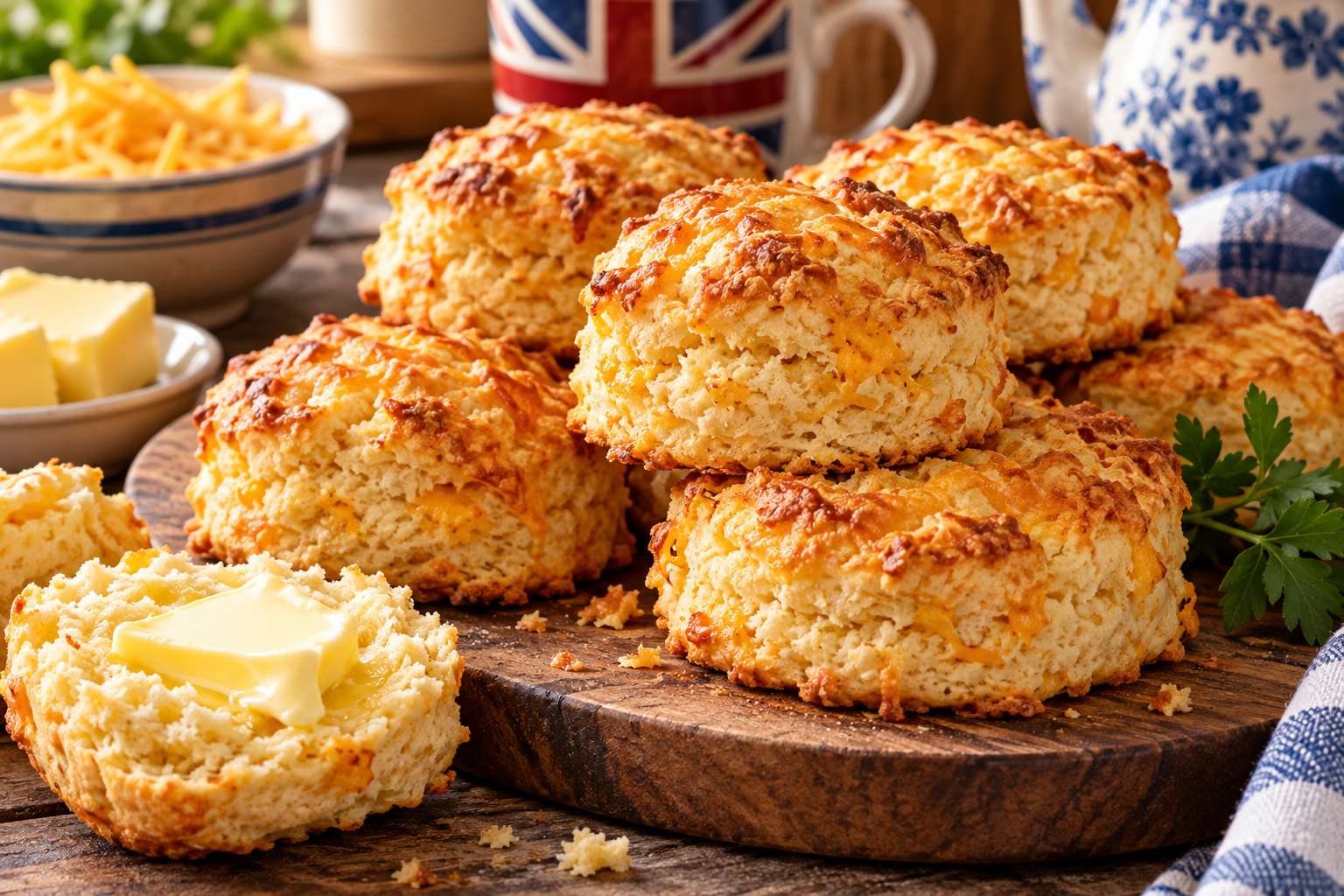
There are few things better than a freshly baked British scone still warm from the oven.
Unless, perhaps, you add cheese.
Traditional British cheese scones are savory, tender and wonderfully cheesy, with a golden top and a soft, light interior. They’re delicious warm with butter, excellent alongside soup, and perfectly at home as part of an afternoon tea spread when you want something savory among all the cakes and sandwiches.
If you’ve already made our Classic British Scones, you’ll recognize much of the technique. The biggest difference, of course, is plenty of mature Cheddar folded into the dough.
For American bakers, there are a few ingredient differences worth understanding—particularly the flour and the cheese—but there’s nothing complicated about making a proper British cheese scone in an American kitchen.
Affiliate Disclosure: Brit & Skillet may earn a commission from qualifying purchases made through links on this page, at no additional cost to you.
What Are British Cheese Scones?
Cheese scones are a savory variation of the classic British scone.
They’re generally made from flour, a raising agent, butter, milk and grated cheese, producing a tender dough that’s rolled or gently patted out, cut into rounds and baked until risen and golden.
Unlike American biscuits, cheese scones aren’t usually built around dramatic flaky layers.
The goal is a light, tender crumb with plenty of cheese flavor.
They’re also much less sweet than the large flavored scones commonly found in American coffee shops.
In fact, these aren’t sweet at all.
What Do British Cheese Scones Taste Like?
Think buttery, savory and distinctly cheesy, with a lightly crisp golden exterior and soft interior.
A good cheese scone shouldn’t taste primarily of flour.
The cheese needs to be strong enough to come through after baking, which is why the type you choose matters.
They’re particularly good when eaten warm, when the cheese flavor is at its strongest and a little butter can melt straight into the crumb.
What Cheese Is Best for British Cheese Scones?
A mature Cheddar is the traditional choice.
In an American supermarket, look for sharp or extra-sharp Cheddar.
Mild Cheddar will work structurally, but its flavor can disappear into the dough once baked.
A good sharp Cheddar gives you much more of the savory flavor you’re expecting from a British cheese scone.
I prefer to grate the cheese myself rather than use pre-shredded cheese.
Pre-shredded cheeses often contain anti-caking ingredients, and freshly grated Cheddar generally incorporates into the dough more naturally.
Is British Cheddar Different From American Cheddar?
There can be differences, but you don’t need imported British cheese to make good cheese scones.
British mature Cheddar tends to be firm and strongly flavored. A good-quality American sharp or extra-sharp Cheddar is an excellent substitute.
And despite the orange Cheddar Americans commonly encounter, Cheddar doesn’t naturally need to be orange.
White sharp Cheddar is particularly nice here if you want something visually closer to many traditional British cheese scones.
The important thing is flavor, not color.
What Flour Should I Use for Cheese Scones?
For this American-kitchen version, we’ll use all-purpose flour with baking powder added separately.
Many British recipes use self-raising flour, but British self-raising flour and American self-rising flour aren’t necessarily identical.
If you’ve ever wondered why, our Self-Raising Flour vs. Self-Rising Flour: What American Bakers Need to Know guide explains the difference.
You can also read Plain Flour vs. All-Purpose Flour: What’s the Difference? for a closer look at British and American flour terminology.
Using all-purpose flour and controlling the baking powder ourselves makes the recipe more predictable for an American kitchen.
Do I Need Mustard Powder?
Mustard powder is a classic addition to cheese scones because it enhances the savory cheese flavor without making the finished scone taste strongly of mustard.
It’s not there to turn these into mustard scones.
A relatively small amount simply gives the Cheddar a little more depth.
If you don’t have it, you can leave it out, but I think it’s worth including.
A little black pepper also works beautifully with mature Cheddar.
Should the Butter Be Cold?
Yes.
Keep your butter cold until you’re ready to use it.
Rub or cut it into the flour until the mixture resembles coarse breadcrumbs, then add the cheese.
You don’t want to melt the butter into the flour with warm hands.
Keeping everything relatively cool helps produce a better scone texture.
A pastry blender can be useful here, particularly if you tend to have warm hands.
Should I Grate or Cube the Butter?
For traditional cheese scones, either rubbing small cubes of cold butter into the flour or using a pastry blender works very well.
You don’t need to create the large pieces of butter associated with highly laminated American-style biscuits.
We’re aiming for an even, tender crumb rather than pronounced flaky layers.
Brit & Skillet Tip
Don’t roll your cheese-scone dough too thin.
One of the easiest ways to end up with disappointing, flat scones is to start with dough that’s already too shallow.
Gently pat the dough to roughly 1 inch thick before cutting.
And when you use the cutter, press straight down and lift straight back up.
Don’t twist it.
Twisting the cutter can seal the edges and interfere with an even rise.
How Much Should I Handle Scone Dough?
As little as reasonably possible.
Once liquid meets flour, gluten begins developing.
The more aggressively you knead and work the dough, the tougher your finished scones can become.
Bring the mixture together gently until it forms a cohesive dough.
A slightly rustic-looking dough is much better than one that’s been kneaded until perfectly smooth.
This is baking, not Play-Doh.
Why Are My Cheese Scones Dry?
There are several common reasons.
Too much flour is a big one, particularly if you’re measuring with cups rather than a scale.
Overworking the dough can also make the texture tougher.
Then there’s overbaking.
Scones don’t need to spend half their lives in the oven. Once they’ve risen, become golden and are cooked through, take them out.
If you’re baking at elevation, faster moisture loss can make this even more noticeable.
Our High-Altitude British Baking: A Guide for American Bakers explains why that happens and how to approach adjustments without changing everything at once.
Why Didn’t My Cheese Scones Rise?
First, check your baking powder.
Old baking powder can lose its effectiveness.
Also make sure you haven’t rolled the dough too thin, overworked it, or twisted your cutter while cutting the rounds.
Your oven should be fully preheated before the scones go in.
Scones rely on a good initial burst of heat, so putting them into an oven that’s still slowly warming isn’t ideal.
What Size Cutter Should I Use?
A round cutter approximately 2½ inches across produces a nicely sized cheese scone.
A slightly larger or smaller cutter is perfectly fine; you’ll simply get a different number of scones.
A proper round pastry or biscuit cutter gives you neat edges and makes it easy to press straight down through the dough.
If you already bake our Classic British Scones, the same cutter can do double duty here.
Should I Brush the Tops?
Yes.
A little milk or beaten egg brushed over the tops encourages attractive browning.
Be careful not to let too much wash run down the cut sides.
Keeping the sides relatively clean helps the scones rise freely.
We’ll also scatter a little extra grated Cheddar over the top before baking.
Those crisp, browned pieces of cheese are absolutely not an accident.

Traditional British Cheese Scones
Ingredients
Equipment
Method
- Preheat the oven to 425°F (220°C). Line a baking sheet with parchment paper.
- Combine the Dry Ingredients
- In a large mixing bowl, whisk together the flour, baking powder, salt, mustard powder and black pepper. Add the cold cubed butter and use a pastry blender or your fingertips to work it into the flour until the mixture resembles coarse breadcrumbs.
- Reserve about ¼ cup (30g) of the grated Cheddar for topping. Stir the remaining cheese through the flour mixture until evenly distributed.
- In a small bowl or measuring jug, whisk the egg with the milk. Reserve about 2 tablespoons of this mixture for brushing the tops. Gradually add the remainder to the flour mixture, stirring gently until a soft dough begins to form. If necessary, add a small splash of additional milk. The dough should be soft and slightly tacky rather than dry.
- Shape and Cut the Scones
- Turn the dough onto a lightly floured surface and bring it together gently with your hands. Avoid kneading it more than necessary. Pat or very lightly roll the dough to approximately 1 inch thick. Cut rounds with a 2½-inch cutter, pressing straight down without twisting. Gently bring the scraps together and cut the remaining scones.
- Arrange the scones on the prepared baking sheet. Brush the tops lightly with the reserved egg-and-milk mixture, avoiding the cut sides. Sprinkle the reserved Cheddar over the tops.
- Bake for approximately 13–16 minutes, until the scones are well risen and golden brown on top. Transfer to a cooling rack and allow them to cool for a few minutes. Serve warm, preferably with butter.
Notes
How Do I Know When Cheese Scones Are Done?
They should be well risen with golden tops and lightly browned edges.
The bottoms should also have taken on some color rather than remaining pale and doughy.
If you’re unsure, lift one and check underneath.
Because ovens vary, use the stated baking time as a guide rather than waiting for a timer to give you permission to look at them.
How Should I Serve Cheese Scones?
My first choice is wonderfully uncomplicated:
Warm, with butter.
Split the scone and let the butter soften into the crumb.
They’re also excellent alongside:
- tomato soup
- vegetable soup
- a ploughman’s-style lunch
- salad
- chutney
- pickles
- afternoon tea sandwiches
You can also split them and add a little more cheese or chutney for a simple savory snack.
Are Cheese Scones Served With Clotted Cream and Jam?
Generally, no.
Save the clotted cream and jam for our Classic British Scones.
Cheese scones belong firmly on the savory side of the table.
Butter is the simplest accompaniment, while chutney or pickle works particularly well if you’re serving them as part of lunch.
Jam isn’t forbidden by international law, obviously.
But we’re not recommending it. 😂
Can I Add Other Ingredients?
Once you’ve mastered the basic cheese scone, there are plenty of possibilities.
Chopped chives work beautifully.
A small amount of finely chopped spring onion can be good too.
You could experiment with different strong cheeses or add a touch of cayenne for gentle heat.
But for your first batch, I’d keep them simple.
A proper sharp-Cheddar cheese scone doesn’t need much help.
Can I Make Cheese Scones Ahead of Time?
You can, but scones are at their best when freshly baked.
If you’re serving them for lunch or afternoon tea, baking them earlier the same day works well.
Once completely cool, keep them in an airtight container.
A brief reheat can bring some of that freshly baked character back before serving.
How to Store Cheese Scones
Allow the scones to cool completely before storing them in an airtight container.
They’re best within the first 1–2 days, although they’ll remain edible a little longer.
Because homemade scones don’t contain the preservatives found in many commercial baked goods, their texture naturally deteriorates fairly quickly.
That’s an excellent reason to eat another one.
Can You Freeze Cheese Scones?
Yes, and they freeze very well.
Allow the baked scones to cool completely, then freeze them in an airtight container or freezer bag.
For best quality, use them within about 3 months.
Thaw at room temperature or overnight in the refrigerator, then warm briefly before serving.
Can I Freeze Cheese Scones Before Baking?
Yes.
Cut the scones and arrange them on a baking sheet, then freeze until firm.
Transfer the frozen unbaked scones to a freezer-safe container.
They can then be baked from frozen, although they’ll generally need a little additional baking time.
This is a handy way to have freshly baked cheese scones without making a complete batch every time.
Cheese Scones at High Altitude
If you live at higher elevation, don’t automatically change the recipe before you’ve tried it.
Pay particular attention to dough consistency and baking time.
High-altitude environments can encourage faster moisture loss, so avoid adding unnecessary flour while shaping the dough and begin checking the scones promptly toward the end of their baking time.
If you’re regularly baking British recipes at elevation, our High-Altitude British Baking Guide goes into the reasons and troubleshooting in much more detail.
More British Baking for Your American Kitchen
If you enjoyed these savory scones, try our Classic British Scones for the traditional sweet version served with jam and clotted cream.
You might also enjoy Traditional Welsh Cakes, Traditional British Sausage Rolls, or Traditional Yorkshire Puddings when you’re in the mood for something savory.
And for help translating British ingredients and equipment, explore:
British Baking Ingredients Americans Need to Know
British Baking Equipment Guide: Everything an American Kitchen Needs
Self-Raising Flour vs. Self-Rising Flour
Plain Flour vs. All-Purpose Flour
High-Altitude British Baking: A Guide for American Bakers
A Proper Savory British Bake
Cheese scones aren’t complicated or flashy.
They’re simply one of those British bakes that manages to turn a handful of everyday ingredients into something disproportionately good.
A warm, tender scone. Plenty of sharp Cheddar. A little butter melting through the middle.
And unlike a full afternoon tea, you don’t need an occasion to make them.
Although putting the kettle on certainly wouldn’t hurt.
Leave a Reply