
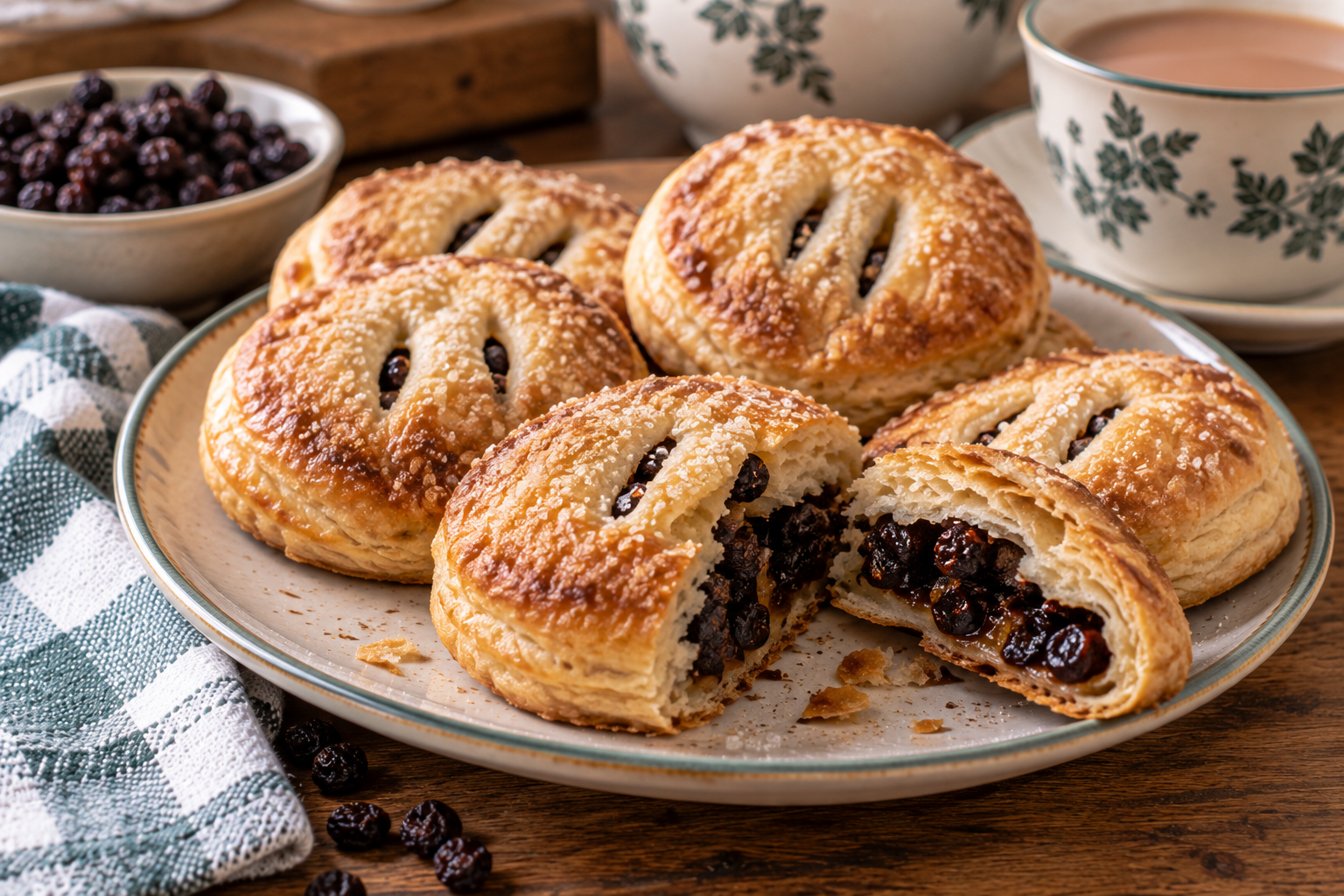
Eccles cakes are one of those wonderfully old-fashioned British treats that deserve to be much better known outside the UK.
Underneath their crisp, flaky pastry is a rich filling of currants, brown sugar, butter and warm spice. The tops are traditionally cut with a few small slits, brushed with egg and sprinkled with sugar before baking until beautifully golden.
Despite the name, Eccles cakes aren’t really cakes at all.
They’re individual pastries originating from the town of Eccles in Lancashire, England — making them a perfect sweet companion to our Traditional Lancashire Hotpot.
And they’re surprisingly easy to make in an American kitchen, especially if you use good-quality store-bought puff pastry.
What Are Eccles Cakes?
Eccles cakes are traditional English pastries made from flaky pastry wrapped around a sweet, buttery currant filling.
They’re usually round and fairly flat, with the fruit filling completely enclosed inside the pastry.
Before baking, the tops are traditionally cut with several small slits. These allow steam to escape and give Eccles cakes their characteristic appearance.
A sprinkling of sugar over the pastry creates a wonderfully crisp finish.
Where Do Eccles Cakes Come From?
Eccles cakes take their name from Eccles, a town in Greater Manchester that was historically part of Lancashire.
They’ve been associated with the area for centuries.
Commercial production of Eccles cakes dates back to at least the late 18th century, although similar currant-filled pastries were likely being made before then.
Today they’re one of the best-known traditional foods associated with Lancashire and northwest England.
Are Eccles Cakes Actually Cakes?
Not in the way Americans would normally understand the word cake.
There’s no cake batter involved.
An Eccles cake is much closer to a small filled pastry or turnover, although its round shape and completely enclosed filling make it distinctive.
British food names aren’t always terribly literal — which is part of the fun.
What Are Currants?
British recipes frequently use currants, and these aren’t the fresh black or red currants you might be imagining.
The currants used in Eccles cakes are dried currants, usually Zante currants.
They’re tiny dried grapes with a concentrated sweet-tart flavour.
In American grocery stores, look for dried currants near raisins and other dried fruits.
If you can’t find them, raisins can be substituted, although it’s best to chop them roughly because they’re considerably larger.
Can I Use Store-Bought Puff Pastry?
Absolutely.
Traditional Eccles cakes can be made with homemade flaky pastry, but good-quality frozen puff pastry makes them far more approachable for everyday baking.
American frozen puff pastry works perfectly well.
Follow the package directions for thawing it, but keep the pastry cool while you’re working.
Warm puff pastry becomes soft and difficult to handle, and the butter layers won’t puff as effectively in the oven.
Traditional Eccles Cakes Recipe
Prep Time: 25 minutes
Chill Time: 15 minutes
Bake Time: 18–22 minutes
Makes: 8 Eccles cakes
Equipment
- Baking sheet
- Parchment paper
- Rolling pin
- Approximately 4½-inch round cutter or small bowl
- Mixing bowl
- Pastry brush
- Sharp knife
Ingredients
For the Filling
- 1½ cups (225 g) dried currants
- ¼ cup (50 g) packed light brown sugar
- 3 tablespoons (42 g) unsalted butter, melted
- ½ teaspoon ground cinnamon
- ¼ teaspoon ground nutmeg
- ¼ teaspoon ground allspice
- 1 teaspoon finely grated lemon zest
- Pinch of salt
For the Pastry
- Approximately 17 ounces (490 g) frozen puff pastry, thawed according to package directions
- All-purpose flour, for dusting
For the Top
- 1 large egg, beaten with 1 teaspoon water
- 2 tablespoons granulated sugar
Instructions
1. Prepare the Filling
Place the dried currants, brown sugar, cinnamon, nutmeg, allspice, lemon zest and salt in a mixing bowl.
Pour over the melted butter.
Stir until the currants are evenly coated and the sugar and spices are distributed throughout.
Set the filling aside while you prepare the pastry.
Brit & Skillet Tip
The filling should be moist and buttery but shouldn’t contain a pool of liquid.
If your melted butter is very hot, allow it to cool slightly before mixing it with the currants.
2. Prepare the Baking Sheet
Line a large baking sheet with parchment paper.
Set aside.
3. Roll the Puff Pastry
Lightly flour your work surface.
Unfold or unroll the thawed puff pastry.
Depending on the brand you’re using, gently roll it to approximately ⅛ inch (3 mm) thick.
Don’t roll aggressively — you want to preserve those layers that create the flaky texture.
4. Cut the Pastry
Cut eight circles approximately 4½ inches (11–12 cm) in diameter.
A large round cutter works well, but you can also trace around a small bowl with a sharp knife.
If you need to reroll scraps, stack them gently rather than kneading them together.
5. Add the Filling
Place approximately 2 generous tablespoons of currant filling in the centre of each pastry circle.
Leave a clear border around the edge.
Try not to overfill the pastries. Too much filling can make them difficult to seal and may cause them to burst during baking.
6. Seal the Eccles Cakes
Bring the edges of each pastry circle up and over the filling toward the centre.
Pinch the edges firmly together to completely enclose the currants.
Turn the pastry over so the seam is underneath.
Gently flatten it with your palm until you have a round pastry approximately 3½–4 inches wide.
You should be able to see the shape of the currants beneath the pastry without tearing through it.
Brit & Skillet Tip
Make sure the seam is well sealed before turning the Eccles cake over.
A loose seam can open in the oven and allow the buttery currant filling to escape.
7. Chill
Transfer the assembled Eccles cakes to the prepared baking sheet.
Refrigerate them for approximately 15 minutes.
Meanwhile, preheat the oven to 400°F (200°C).
This short chill helps firm the pastry before it hits the hot oven.
8. Cut the Traditional Slits
Remove the Eccles cakes from the refrigerator.
Using a sharp knife, cut three small parallel slits across the top of each pastry.
Cut through the top layer of pastry so steam can escape, but don’t slice deeply through the entire cake.
9. Add the Egg Wash and Sugar
Brush the tops lightly with the beaten egg wash.
Sprinkle generously with granulated sugar.
The sugar will create the characteristic crisp, slightly sparkling top.
10. Bake
Bake for approximately 18–22 minutes, until the pastry is puffed and deeply golden.
A little caramelized currant juice may escape from one or two pastries. That’s completely normal.
11. Cool
Allow the Eccles cakes to cool on the baking sheet for approximately 5 minutes.
Transfer them carefully to a wire rack.
The filling will be extremely hot straight from the oven, so give them a little time before eating.
What Should an Eccles Cake Look Like?
A good Eccles cake should be round and fairly flat rather than tall.
The pastry should be crisp, flaky and deeply golden.
You’ll often be able to see the dark currants beneath the thin pastry.
The traditional slits should open slightly during baking, and the sugar on top should give the pastry a lightly crunchy finish.
Inside, the currants should be sticky, buttery and warmly spiced.
Can I Use Raisins Instead of Currants?
Yes.
Dried currants give Eccles cakes their traditional texture because they’re much smaller than raisins, but raisins are an acceptable substitute if currants aren’t available.
Chop the raisins roughly before using them so the pieces are closer to the size of currants.
Golden raisins can also be used, although the flavour and appearance will be slightly different.
What Is Allspice?
Despite its name, allspice isn’t a mixture of several spices.
It’s a spice made from the dried berries of the allspice tree.
Its flavour has notes reminiscent of cinnamon, nutmeg and cloves, which makes it particularly good in warm British baking recipes.
Ground allspice is readily available in most American grocery stores.
Can I Add Candied Peel?
Yes.
Some Eccles cake recipes include finely chopped candied citrus peel.
If you enjoy it, add approximately 2 tablespoons of finely chopped mixed candied peel to the currant filling.
We’ve left it optional because mixed peel isn’t always as easy to find in American supermarkets and the Eccles cakes are delicious without it.
What to Serve with Eccles Cakes
Eccles cakes are wonderful on their own with a cup of tea.
Traditionally, they’re also famously paired with Lancashire cheese.
The combination of sweet, spiced currants and crumbly, slightly tangy cheese might sound unusual if you’ve never tried it, but sweet fruit and cheese are natural partners.
Lancashire cheese can be difficult to find in the United States, so a crumbly mature cheddar makes a practical alternative.
For a simple afternoon treat, though, you need nothing more than an Eccles cake and a good cup of tea.
Are Eccles Cakes Served Warm or Cold?
Either.
They’re particularly delicious slightly warm, when the pastry is crisp and the currant filling is soft.
But Eccles cakes are traditionally portable pastries and are also excellent at room temperature.
If you’re reheating one, a few minutes in a low oven will restore the pastry much better than a microwave.
Why Did My Eccles Cakes Leak?
A small amount of caramelized filling escaping during baking isn’t unusual.
If a lot of filling leaks out, there are several possible causes.
The pastry may have been overfilled, the seam may not have been completely sealed, or the top slits may have been cut too deeply.
Keep the filling concentrated in the centre and pinch the seam securely before turning and flattening each cake.
Why Isn’t My Puff Pastry Flaky?
Puff pastry needs to stay cold.
If it becomes warm while you’re assembling the Eccles cakes, the butter layers can soften and blend into the dough rather than producing distinct flaky layers.
If the pastry begins feeling very soft or sticky at any stage, put it in the refrigerator for 10–15 minutes before continuing.
The oven should also be fully preheated before the pastries go in.
Can I Make Eccles Cakes Ahead?
Yes.
You can assemble the Eccles cakes several hours ahead and refrigerate them on the baking sheet.
Wait to add the egg wash and sugar until just before baking.
Then bake directly from the refrigerator.
You may need to add a minute or two to the baking time.
How to Store Eccles Cakes
Allow the Eccles cakes to cool completely.
Store them in an airtight container at room temperature for approximately 2 days.
For longer storage, refrigerate them for up to 5 days.
To refresh the pastry, warm them in a 325°F (165°C) oven for approximately 5–8 minutes.
Can You Freeze Eccles Cakes?
Yes.
Baked Eccles cakes can be frozen once completely cooled.
Wrap them individually or place parchment between them in a freezer-safe container.
Freeze for up to 3 months.
Thaw at room temperature and warm briefly in the oven before serving.
You can also freeze assembled unbaked Eccles cakes. Freeze them on a baking sheet until firm, then transfer them to a freezer-safe container.
Bake from frozen, adding a few extra minutes to the baking time.
Another Taste of Lancashire
Lancashire may be famous for its hearty savoury food, but Eccles cakes show the sweeter side of northwest England.
Crisp pastry, buttery currants, warm spice and crunchy sugar make these little pastries remarkably satisfying — particularly considering how simple they are to make.
And using frozen puff pastry means you can recreate one of England’s classic regional treats without spending the afternoon making pastry from scratch.
Pair them with our Traditional Lancashire Hotpot for two very different tastes of the region, or try our Traditional Welsh Cakes and Classic British Scones for more British tea-time favourites.
You can also browse all of the Brit & Skillet Recipes for more traditional British food made approachable for American kitchens.
Leave a Reply