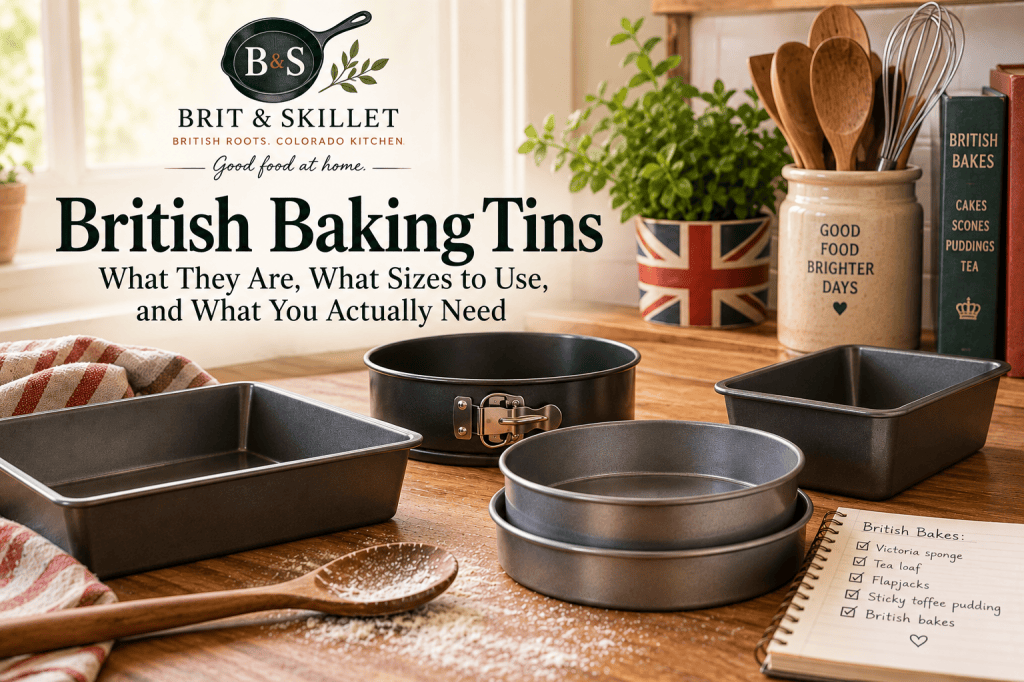
If you’ve ever opened a British baking recipe and wondered what on earth a “20cm sandwich tin” or “2lb loaf tin” is supposed to mean in an American kitchen, you’re not alone.
British and American bakeware isn’t always described in the same way. British recipes commonly use centimeters, refer to baking pans as tins, and sometimes specify traditional sizes that don’t have an obvious American name.
Choosing the wrong pan can affect more than the appearance of your bake. It can change its depth, baking time and even how evenly it cooks.
Fortunately, you don’t need an entirely separate collection of British bakeware to follow recipes from across the pond. A few versatile tins and pans will handle most classic British cakes, loaves, traybakes and puddings.
In this guide, we’ll explain the British baking tins American bakers are most likely to encounter, how their sizes translate to familiar American bakeware and what to consider when choosing pans for British recipes.
Affiliate disclosure: Brit & Skillet may earn a commission from qualifying purchases made through links on this page, at no additional cost to you. We only recommend products and resources we believe may be useful to our readers.
What Does “Baking Tin” Mean in a British Recipe?
In British recipes, the word tin generally means what American bakers would call a baking pan.
A cake tin is a cake pan, a loaf tin is a loaf pan, and a roasting tin is essentially a roasting pan.
The terminology is different, but the basic equipment is usually very familiar.
The bigger challenge is size.
British recipes commonly give tin dimensions in centimeters, while American bakeware is normally labeled in inches. A British recipe might call for a 20cm round cake tin, for example, while an American store is much more likely to sell an 8-inch or 9-inch round cake pan.
Those differences may sound small, but pan size affects the depth of the batter. Put the same amount of batter into a larger pan and it will be shallower and may bake more quickly. Use a substantially smaller pan and the batter will be deeper, potentially requiring a longer baking time or risking overflow.
If British measurements are causing confusion beyond bakeware, our guide to How British and American Measuring Cups Differ explains another common difference American bakers encounter.
Brit & Skillet tip: Don’t worry about finding a pan with an absolutely identical measurement every time. For many recipes, a close American equivalent works perfectly well—you simply need to understand how changing the size may affect the bake.
British-to-American Baking Tin Size Guide
British tin measurements don’t always have an exact American equivalent, but these common conversions will get you very close for most everyday baking.
| British Recipe Calls For | Approximate Size in Inches | American Pan to Look For |
| 18cm round tin | 7 inches | 7-inch round cake pan |
| 20cm round tin | 8 inches | 8-inch round cake pan |
| 23cm round tin | 9 inches | 9-inch round cake pan |
| 20cm square tin | 8 inches | 8-inch square baking pan |
| 23cm square tin | 9 inches | 9-inch square baking pan |
| 20 x 30cm rectangular tin | About 8 x 12 inches | Similar-size rectangular baking pan |
Important: These are practical size equivalents rather than guarantees that every British and American pan will have exactly the same capacity. Pan depth and shape matter too, so always check the recipe for any additional instructions.
What Is a Sandwich Tin?
A sandwich tin is a shallow, round cake pan traditionally used to bake the separate layers of British sandwich cakes.
The classic example is a Victoria sponge, where two round cakes are baked separately and then “sandwiched” together with jam and, depending on the recipe, buttercream or another filling.
If a British recipe asks for two 20cm sandwich tins, an American baker should generally look for two 8-inch round cake pans of a similar depth.
Sandwich tins tend to be shallower than some of the deeper round cake pans sold in the United States. That doesn’t necessarily mean you need to buy special British pans, but it does mean you should pay attention to the depth of the pans you already own.
Our Pick for British Sandwich Cakes: Fat Daddio’s Anodized Aluminum Round Cake Pans
For American bakers who need round pans for British cakes, Fat Daddio’s Anodized Aluminum Round Cake Pans are a particularly useful option because the range is available in multiple sizes.
For a British recipe calling for a 20cm round or sandwich tin, look for an 8-inch option and then compare the depth with the dimensions specified by your recipe.
Fat Daddio’s uses anodized aluminum for these pans. The light-colored aluminum construction makes them a practical choice for cakes where even baking and controlled browning are important.
Because the pans are available in multiple dimensions, the same product range can also be useful when a British recipe specifies a less familiar tin size.
What to look for: A pair of sturdy 8-inch round cake pans is one of the most useful purchases for anyone who regularly makes British cakes. Straight sides help produce neat layers, and having two matching pans means both halves of a sandwich cake can bake at the same time.
Brit & Skillet tip: If you’re buying round cake pans specifically for British baking, buy two matching pans rather than one. Victoria sponge and many other British layer cakes are designed around two separately baked layers, so you’ll use the pair surprisingly often.
What Is a 2lb Loaf Tin?
British recipes frequently call for a 1lb or 2lb loaf tin, particularly for loaf cakes, tea breads, fruit loaves and traditional breads.
The “2lb” description comes from the traditional size of loaf the tin was designed to hold—it doesn’t mean you need to put exactly two pounds of cake batter into it.
For American bakers, a typical 2lb loaf tin is broadly comparable to a standard 9 × 5-inch loaf pan, although dimensions and capacity can vary between manufacturers.
What to look for: A sturdy 9 × 5-inch loaf pan is a practical choice for an American kitchen and can handle many British loaf recipes as well as familiar American breads and cakes.
If a recipe specifies the exact dimensions or capacity of its loaf tin, use those measurements as your best guide rather than relying only on the “1lb” or “2lb” description.
Brit & Skillet tip: Pay attention to how full the recipe expects the tin to be. If your American loaf pan is noticeably smaller than the one intended by the recipe, don’t force all the batter into it. Leaving adequate room for the bake to rise is much better than cleaning overflow from the bottom of your oven.
Square Tins and Traybake Tins
Square and rectangular tins are common in British baking, particularly for flapjacks, brownies, millionaire’s shortbread, traybakes and cakes designed to be cut into individual squares or slices.
A British recipe calling for a 20cm square tin is generally asking for something very close to an 8-inch square baking pan in the United States. Likewise, a 23cm square tin is approximately equivalent to a 9-inch square pan.
The term traybake tin can be a little less precise. British recipes may use rectangular tins of different dimensions and depths, so it’s particularly important to check the measurements given in the individual recipe rather than assuming every traybake uses the same pan.
Our Pick for Flapjacks and Square Bakes: Fat Daddio’s Anodized Aluminum Square Cake Pans
Fat Daddio’s Anodized Aluminum Square Cake Pans are available in multiple dimensions, making the range useful for translating British square-tin measurements into American bakeware.
An 8-inch square option is a practical match for many recipes calling for a 20cm square tin. That makes this size especially useful for flapjacks, brownies, millionaire’s shortbread and smaller traybakes.
As with the round pans, check the depth as well as the width before assuming two pans are interchangeable.
What to look for: An 8-inch square pan is an especially versatile addition to a British baking setup. For rectangular traybakes, choose a sturdy pan with straight sides and compare its dimensions with the recipe before you begin.
If you’d like to put that square tin to work immediately, our British Flapjacks recipe is an easy place to start.
Brit & Skillet tip: Don’t automatically reach for a large American sheet pan when a British recipe says “traybake.” Many British traybakes are baked in a smaller, deeper rectangular tin rather than on a wide, shallow baking sheet.
Springform and Loose-Bottomed Tins
British recipes sometimes call for a loose-bottomed tin, especially when making cheesecakes, tarts and cakes that would be difficult to remove neatly from an ordinary pan.
A loose-bottomed tin has a removable base that allows the finished bake to be pushed upward and lifted away from the sides.
In American kitchens, a springform pan is often the more familiar option. Instead of pushing out the base, the side of a springform pan releases with a clasp and expands away from the bake.
The two styles aren’t identical, but they serve a similar purpose: making delicate or presentation-focused bakes easier to remove without turning them upside down.
What to look for: If a British recipe specifies a round loose-bottomed tin, check its diameter and depth before choosing an American springform pan. An 8-inch or 9-inch springform pan is useful for many cakes and cheesecakes, but the recipe’s dimensions should always take priority.
Brit & Skillet tip: Removable-bottom pans aren’t always completely leakproof. If you’re working with a particularly thin batter or using a water bath, check the recipe’s instructions carefully and protect against leaks where appropriate.
What Is a Pudding Basin?
A pudding basin is a deep, round bowl traditionally used for steamed British puddings.
Classics such as Christmas pudding and various steamed sponge puddings may be cooked in one rather than in an ordinary cake tin.
Traditional pudding basins are often made from ceramic, although heat-safe versions made from other materials are also available. Their rounded shape helps give a steamed pudding its characteristic domed appearance when it’s turned out onto a serving plate.
Where American bakers may get confused is that British recipes often specify pudding basins by capacity rather than just diameter. If a recipe calls for a particular size, comparing the volume or capacity is usually more useful than trying to match the diameter alone.
What to look for: Choose a heat-safe basin intended for cooking and make sure its capacity is reasonably close to the one specified by the recipe. A rim around the top can also be useful when securing parchment and foil over a pudding before steaming.
If steamed puddings are on your baking list, our guide to the Best Pudding Basins for Traditional British Desserts explains the sizes and styles American bakers should look for.
Brit & Skillet tip: Don’t substitute an ordinary decorative serving bowl unless you know it’s suitable for the cooking method being used. Steamed puddings can spend a long time exposed to heat, so the bowl needs to be designed to handle it safely.
What Material Is Best for British Baking Tins?
Once you’ve found the right size and shape, the material of your baking tin is worth considering too.
Different materials conduct heat differently, which can affect browning and how evenly a cake or loaf bakes.
Aluminum
Lightweight aluminum pans conduct heat efficiently and are a popular choice for cakes.
A good-quality light-colored aluminum pan can provide even baking without encouraging the outside of a cake to brown too quickly.
Anodized Aluminum
Anodized aluminum starts with aluminum that has undergone an electrochemical process that changes and hardens its surface.
Fat Daddio’s uses anodized aluminum extensively across its bakeware range. According to the manufacturer, its anodized surface is not a separate coating.
As with any bakeware, follow the manufacturer’s cleaning and care instructions.
Aluminized or Coated Steel
Steel pans are sturdy and durable, and many are coated to improve release or resist corrosion.
Because construction and finishes vary considerably between brands, follow the manufacturer’s care instructions.
Nonstick
Nonstick bakeware can make cakes and traybakes easier to release and clean up afterward.
Darker nonstick surfaces, however, may brown the edges and bottom of some bakes more quickly than lighter-colored pans.
What Matters Most
For everyday British baking, prioritize the correct size, appropriate depth, sturdy construction and even heat distribution rather than choosing a pan simply because it has a particular coating.
Brit & Skillet tip: Even when you’re using a pan designed for easy release, don’t automatically skip greasing or lining it. If a British recipe tells you to grease the tin or line it with baking parchment, follow those instructions—they’re there to help your bake release cleanly.
Which Baking Tins Do You Actually Need?
You don’t need to replace all your American bakeware before you start making British recipes.
A small collection of versatile pans will cover a surprisingly large number of traditional bakes.
For most American home bakers interested in British baking, a practical starter collection would include:
- Two 8-inch round cake pans — useful for Victoria sponge and other British sandwich cakes.
- One 9 × 5-inch loaf pan — a practical American option for many recipes calling for a 2lb loaf tin.
- One 8-inch square baking pan — useful for flapjacks, brownies, millionaire’s shortbread and smaller traybakes.
- One 8- or 9-inch springform pan — useful for cheesecakes and other bakes that benefit from removable sides.
- One pudding basin — worth adding if you plan to make traditional steamed British puddings regularly.
If you already own the first four, you may have nearly everything you need.
The important thing is to compare your pan’s dimensions and depth with the recipe rather than assuming that British and American bakeware labels always mean exactly the same thing.
If you’re building the rest of your British baking setup too, see our guide to 10 Essential Kitchen Tools for British Baking in America.
Brit & Skillet tip: Build your collection around the recipes you actually want to make. There’s little reason to buy a specialty pudding basin immediately if you’re mainly interested in Victoria sponges, loaf cakes and flapjacks.
How to Choose a Baking Tin for British Recipes
When you’re shopping for bakeware to use with British recipes, don’t choose a pan based on its name alone.
A few simple checks can help you find something that will work well in both British and American recipes.
Check the dimensions. Convert centimeters to inches when necessary and look for the closest practical equivalent. A 20cm round tin, for example, is approximately an 8-inch round pan.
Check the depth. Two pans can have the same diameter but very different capacities. A deep cake pan isn’t necessarily interchangeable with a shallow sandwich tin simply because both are 8 inches across.
Consider the shape. Straight-sided pans are particularly useful for layer cakes and traybakes because they produce neat edges and consistent layers.
Choose sturdy construction. A pan that feels reasonably substantial and sits flat is preferable to very thin bakeware that can warp or heat unevenly.
Think about release and cleanup. Removable bottoms and nonstick surfaces can be convenient, but they’re not essential for every bake. Proper greasing and parchment lining can make a simple pan extremely versatile.
Don’t buy a complete set just for one recipe. Start with the pans you’ll use repeatedly and add specialty pieces only when your baking interests justify them.
Brit & Skillet tip: When comparing bakeware online, look at the actual dimensions listed by the manufacturer rather than relying only on descriptions such as “medium,” “standard,” or “2lb.” Exact measurements make it much easier to compare a pan with the British recipe you’re planning to bake.
British Baking Tin Cheat Sheet
When you’re standing in an American kitchen with a British recipe in front of you, these are some of the most useful equivalents to remember:
- 18cm round tin → about 7 inches
- 20cm round tin → about 8 inches
- 23cm round tin → about 9 inches
- 20cm square tin → about 8 inches
- 23cm square tin → about 9 inches
- 2lb loaf tin → often similar to a 9 × 5-inch loaf pan
- Sandwich tin → shallow round cake pan
- Loose-bottomed tin → removable-bottom pan; a springform pan may work for some recipes
- Baking parchment → parchment paper
Brit & Skillet tip: Save the measurements from the pans you already own somewhere handy. Once you know their diameter, depth and approximate capacity, translating British recipes becomes much easier.
You Don’t Need British Bakeware to Bake British Recipes
British baking terminology can make familiar equipment sound more complicated than it really is.
A cake tin is still a cake pan, a loaf tin is still a loaf pan, and many of the centimeter measurements used in British recipes have close American equivalents.
The key is to pay attention to more than the name on the pan. Diameter, length, width, depth and capacity can all affect how a recipe bakes, so compare those measurements whenever you’re adapting a British recipe to the bakeware you already own.
For most American bakers, a pair of 8-inch round cake pans, a 9 × 5-inch loaf pan, an 8-inch square pan and a springform pan will cover an impressive range of British recipes.
Specialty pieces can always be added later as you discover the bakes you enjoy making most.
Once you understand the terminology and a handful of common size conversions, British baking tins stop feeling particularly British at all—and you can get back to the important part:
deciding what to bake next.
 Brit & Skillet
Leave a comment