If you’re an American baker following a British recipe, one ingredient can cause confusion before you’ve even cracked an egg: self-raising flour.
At first glance, it seems easy enough. American supermarkets sell something called self-rising flour, so surely that’s simply the American name for the same ingredient.
Almost—but not quite.
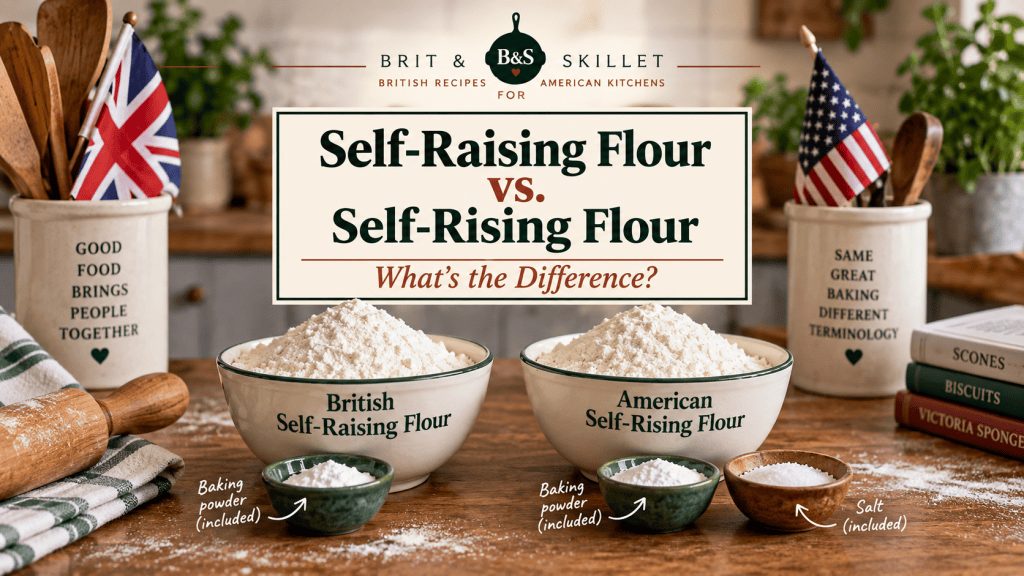
Both products are designed to make baking easier by combining flour with a chemical raising agent. But depending on the brand and country, the exact formulation can differ. American self-rising flour commonly contains flour, baking powder, and salt, while British self-raising flour is generally understood as flour with a raising agent already incorporated.
There can also be differences in the flour itself. For example, King Arthur’s American self-rising flour is made from soft wheat and has a protein content around 8.5%, which helps produce tender baked goods. That’s quite different from simply adding baking powder to every type of American all-purpose flour and assuming the result will behave identically.
Does that mean you need to import British flour every time you want to make a Victoria sponge or a batch of scones?
Thankfully, no.
For most home baking, an American baker can work with ingredients readily available in the United States—you just need to understand what’s already in your flour and what the original British recipe expects you to add separately.
In this guide, we’ll explain the difference between British self-raising flour and American self-rising flour, how they compare with plain and all-purpose flour, how to make a useful substitute at home, and what to watch for when adapting British recipes for an American kitchen.
Because flour already caused enough international confusion in our guide to plain flour and all-purpose flour.
Apparently we needed a sequel.
And here we are. 😂
Affiliate disclosure: Brit & Skillet may earn a commission from qualifying purchases made through links on this page, at no additional cost to you.
What Is British Self-Raising Flour?
British self-raising flour is wheat flour that already contains a chemical raising agent, usually baking powder. That built-in raising power is why British cake recipes can sometimes contain self-raising flour without listing baking powder separately. Collins Dictionary
You’ll see it frequently in British baking, particularly in cakes, scones, muffins, and other recipes where a light, risen texture is wanted.
Self-Raising Flour vs. Plain Flour
The easiest way to understand self-raising flour is to compare it with plain flour.
Plain flour does not normally contain a raising agent. If a recipe made with plain flour needs chemical leavening, ingredients such as baking powder or bicarbonate of soda are usually added separately.
Self-raising flour already has raising power incorporated into it. Good Food
So if a British recipe says:
200g self-raising flour
don’t automatically use 200g plain flour and carry on with the recipe unchanged. You would be removing some of the leavening the recipe expects.
This is also why our guide to Plain Flour vs. All-Purpose Flour is useful alongside this one. Plain flour and self-raising flour aren’t simply two different names for the same ingredient.
Can You Make British Self-Raising Flour Yourself?
Yes—and this is particularly useful for American bakers who don’t want to keep another bag of flour in the pantry.
A common British home-baking method is to combine plain flour with baking powder. Good Food, for example, gives a rule of thumb of:
150g plain flour + 2 teaspoons baking powder
to make a self-raising-flour substitute.
You’ll encounter slightly different ratios from different sources and recipes, so don’t be surprised if another British recipe gives somewhat different instructions. Even Good Food’s own guidance varies depending on the particular recipe or reference page. BBC Good Food
That’s one reason we prefer to follow the conversion recommended by the specific recipe you’re baking whenever it provides one.
Why Do Some British Recipes Add Baking Powder Anyway?
Here’s something that can look particularly strange:
A recipe may call for self-raising flour and additional baking powder.
That isn’t necessarily a mistake.
Some recipes need more lifting power than the flour alone provides. Good Food notes that additional raising agent may be used when a batter or dough is heavier and needs extra help achieving a lighter texture. Good Food
So don’t see self-raising flour in the ingredient list and automatically decide that any additional baking powder must be redundant.
Follow the recipe.
One Important Detail for American Bakers
The words self-raising and self-rising are largely the British and American names for the same general category of flour. Dictionaries even give American self-rising flour as the regional equivalent of British self-raising flour. Cambridge Dictionary
But that does not guarantee that a bag of British self-raising flour and a bag of American self-rising flour have exactly the same formulation.
And that’s where things get interesting.
Because American self-rising flour commonly brings another ingredient to the party:
Salt.
What Is American Self-Rising Flour?
American self-rising flour follows the same basic idea as British self-raising flour: the raising agent is already mixed into the flour.
But there’s an important difference American bakers need to know.
In the United States, self-rising flour typically contains flour, baking powder, and salt. King Arthur, for example, describes its self-rising flour as soft wheat flour combined with baking powder and salt. King Arthur Baking
That means substituting American self-rising flour directly into a British recipe may introduce salt that wasn’t present in the British flour the recipe was written for.
American Self-Rising Flour Is Often Softer, Too
The difference isn’t only about raising agents and salt.
Some American self-rising flours are milled from soft, lower-protein wheat, which produces less gluten and can create a more tender texture.
King Arthur’s self-rising flour, for example, has a protein content of approximately 8.5%, compared with 11.7% for its all-purpose flour. King Arthur Baking
That’s one reason self-rising flour is particularly popular for tender American baked goods such as biscuits, pancakes, cakes, and scones.
So when you’re adapting a British recipe, you’re potentially dealing with three variables:
the flour itself, the amount of raising agent, and the salt.
What’s Actually Inside American Self-Rising Flour?
A typical American formulation looks something like this:
Soft wheat flour + baking powder + salt
King Arthur’s current product ingredient list, for example, contains soft wheat flour, leavening ingredients that make up its baking powder system, and salt.
If you want to make an American-style self-rising flour substitute yourself, King Arthur recommends combining:
1 cup (120g) all-purpose flour
1½ teaspoons baking powder
¼ teaspoon table salt
Whisk everything together thoroughly before using it.
So Is American Self-Rising Flour the Same as British Self-Raising Flour?
Not exactly.
They’re close relatives and perform the same general job, but you shouldn’t assume that every bag sold in Britain and America has precisely the same flour strength, leavening level, or salt content.
For many everyday recipes, the differences may not cause a dramatic problem.
But British baking—especially sponge cakes—can depend heavily on ingredient ratios. That’s why we prefer understanding what the original recipe expects rather than automatically replacing one ingredient based solely on a similar name.
And don’t worry: this doesn’t mean we’re about to tell American bakers they need imported flour shipped across the Atlantic every time they fancy a Victoria sponge.
There is a much easier solution.
British Self-Raising Flour vs. American Self-Rising Flour
British self-raising flour and American self-rising flour are designed to accomplish the same basic job: provide flour and chemical leavening in one convenient ingredient.
But they’re not necessarily identical products.
The biggest practical difference for an American baker following a British recipe is that American self-rising flour commonly contains added salt, while traditional British self-raising flour generally does not. Nigella Lawson’s guidance specifically notes this UK-versus-US distinction. Nigella.com
Here’s the comparison:
| Feature | British Self-Raising Flour | American Self-Rising Flour |
|---|---|---|
| Flour | Wheat flour | Commonly soft wheat flour |
| Baking powder/raising agent | Yes | Yes |
| Salt already added | Generally no | Commonly yes |
| Typical spelling | Self-raising | Self-rising |
| Common uses | Cakes, scones and other baking | Biscuits, pancakes, cakes and other baking |
| Can formulations vary? | Yes | Yes |
American products can also differ in protein content from ordinary all-purpose flour. King Arthur’s self-rising flour, for example, contains 8.5% protein, compared with 11.7% in its all-purpose flour. Lower-protein flour generally produces less gluten and a softer, more tender result. King Arthur Baking
Can You Use American Self-Rising Flour in a British Recipe?
Often, yes—but check the recipe first.
If a British recipe calls for self-raising flour, American self-rising flour already supplies flour and leavening, so it’s much closer to what the recipe needs than ordinary all-purpose flour used by itself.
But check whether the British recipe also contains salt or additional baking powder.
Because American self-rising flour may already contain salt, using it and then adding all the salt specified by the recipe could increase the total amount.
Likewise, don’t automatically omit additional baking powder simply because you’re using self-rising flour. Some British recipes intentionally combine self-raising flour with extra raising agent when additional lift is needed. Good Food specifically notes that recipes sometimes do this for heavier batters or doughs. Good Food
The safest approach is to consider the whole ingredient list, rather than treating the flour name as an isolated substitution.
What Would Brit & Skillet Use?
For an American baker following a British recipe, we’d use this order of preference:
- Use the British self-raising flour specified by the recipe if you already have it.
- Make a British-style substitute from all-purpose flour and baking powder if you don’t.
- Use American self-rising flour when appropriate, but account for the salt and any additional raising agents already present in the recipe.
We particularly like option two because it gives you more control over what goes into the flour—and it means you don’t have to buy another bag of something you’ll use twice before discovering it hiding at the back of the pantry in 2029.
British-Style Self-Raising Flour Substitute
For a British recipe, Good Food gives a useful rule of thumb of:
150g plain flour + 2 teaspoons baking powder
for homemade self-raising flour. Good Food
For an American kitchen, all-purpose flour can stand in for the plain flour in this sort of homemade substitution, although flour protein levels vary and the finished texture may not be exactly identical to one made with British flour.
Notice what we haven’t added:
Salt.
That’s intentional when we’re trying to approximate the British ingredient rather than making American-style self-rising flour. Nigella’s guidance similarly recommends baking powder without added salt when replacing the self-raising flour used in her UK recipes. Nigella.com
American-Style Self-Rising Flour Substitute
If you’re following an American recipe that specifically calls for self-rising flour, that’s different.
King Arthur’s homemade version uses:
1 cup (120g) all-purpose flour + 1½ teaspoons baking powder + ¼ teaspoon table salt. King Arthur Baking
So the recipe’s country of origin actually matters.
Brit & Skillet rule: British recipe? Think self-raising flour. American recipe? Think self-rising flour. They’re close cousins—but check what’s already included before assuming they’re twins.
Which is an extraordinary amount of international diplomacy for a bag of flour. 😂
How to Substitute Self-Raising Flour in a British Recipe
If you’re in an American kitchen and a British recipe calls for self-raising flour, you usually have several workable options.
The simplest is to use the self-raising flour specified by the recipe if you already have it. But there’s generally no need to import a bag of British flour just to bake one cake.
For most home baking, you can make a useful substitute with American all-purpose flour and baking powder.
Option 1: Make a British-Style Substitute
Good Food gives this straightforward rule of thumb:
150g all-purpose flour + 2 teaspoons baking powder
In Britain, the original instruction uses plain flour. For an American kitchen, all-purpose flour is generally the practical counterpart for this substitution. Good Food
Whisk the flour and baking powder together thoroughly before adding them to the recipe. You want the raising agent distributed evenly rather than concentrated in one part of your cake.
Notice that we’re not adding salt to this British-style version.
That’s intentional.
Option 2: Use American Self-Rising Flour
If you already have American self-rising flour, you may be able to use it.
But remember that American self-rising flour commonly contains both baking powder and salt. King Arthur’s homemade version, for example, combines 120g all-purpose flour with 1½ teaspoons baking powder and ¼ teaspoon table salt. King Arthur Baking
So check the rest of your British recipe before making the substitution.
If the recipe contains additional salt or baking powder, don’t automatically remove or add ingredients without considering what your particular flour already contains and what the recipe requires.
Option 3: Follow a Conversion Provided by the Recipe
This is actually our favorite option when it’s available.
Some British recipes tell you exactly what to do if you don’t have self-raising flour. One Good Food muffin recipe, for example, gives 400g self-raising flour or 400g plain flour plus 3 teaspoons baking powder. BBC Good Food
If the recipe author has already provided an alternative, use that rather than applying a generic formula.
Should You Convert the Grams to Cups Too?
We wouldn’t.
If the British recipe says 225g self-raising flour, keep the 225g measurement and weigh your substitute on a digital kitchen scale.
Cup measurements for flour can vary depending on how the flour is filled into the cup. King Arthur recommends weighing ingredients when possible and uses 120g as its standard weight for one cup of its all-purpose flour. King Arthur Baking
This is a perfect place to use our guide How to Convert British Baking Measurements for American Recipes.
How to Convert British Baking Measurements for American Recipes.
What About Plain Flour and All-Purpose Flour?
If you’re wondering why we’re casually replacing British plain flour with American all-purpose flour here, we’ve already gone much deeper into that particular transatlantic rabbit hole.
See Plain Flour vs. All-Purpose Flour: A Guide for American Bakers.
The short version is that they’re generally the closest everyday counterparts, but flour protein levels and brands can differ. That’s another reason weighing the flour and following the original recipe as closely as practical gives you a better starting point.
Don’t “Improve” the Recipe With Extra Baking Powder
More baking powder does not automatically mean a taller, fluffier cake.
Use the amount specified by the recipe or the substitution you’re following. Good Food specifically advises measuring ingredients carefully and using the flour type stated rather than casually changing plain and self-raising flour. BBC Good Food
And if the British recipe already calls for self-raising flour plus additional baking powder, don’t assume the author made a mistake. Some recipes deliberately use both.
Brit & Skillet rule: When adapting a British recipe, change as little as necessary. Keep the gram measurements, reproduce the intended raising power, and then get the cake into the oven before we create another international flour incident. 😂
Common Questions About Self-Raising Flour
Once you understand what’s inside self-raising flour, using it becomes much less mysterious. But a few questions come up repeatedly when American bakers start working with British recipes.
Does Self-Raising Flour Expire?
Yes—although the issue isn’t only the flour itself.
Self-raising flour contains baking powder, and that raising agent gradually loses potency over time. King Arthur notes that while older self-rising flour may still be usable, baked goods made with it may not rise as well once the baking powder has lost strength. King Arthur Baking
Check the best-by date, store the flour properly, and if a very old bag has been sitting in the pantry since nobody remembers buying it, replacing it is probably preferable to sacrificing a Victoria sponge in the name of science.
Can I Use Baking Soda Instead of Baking Powder?
Not as a simple one-for-one replacement.
Baking soda and baking powder work differently. Baking soda generally needs sufficient acid in the recipe to produce its leavening reaction, whereas baking powder contains the components needed for its own acid-base reaction.
King Arthur’s guidance specifically says that when self-rising flour replaces all-purpose flour in a suitable recipe, you omit the recipe’s baking powder and salt—but leave baking soda in the recipe when it’s called for. King Arthur Baking
So if you’re making a British-style self-raising flour substitute, use baking powder, not an equal quantity of baking soda.
What Should I Use for a Victoria Sponge?
Follow the particular Victoria sponge recipe you’re using.
Many traditional-style British versions call directly for self-raising flour. One Good Food Victoria sponge uses 200g self-raising flour with no separate baking powder, while another uses 225g self-raising flour plus an additional ½ teaspoon baking powder. BBC Good Food
That’s a perfect example of why we shouldn’t create a universal rule saying:
“Self-raising flour means never add baking powder.”
Sometimes the recipe deliberately asks for both.
If you’re making a British Victoria sponge in America and don’t have British self-raising flour, make an appropriate British-style substitute or follow any substitution supplied by the recipe itself. Keep the flour measurement in grams whenever possible.
Is Self-Raising Flour the Same as Cake Flour?
No.
Cake flour is generally a low-protein flour designed to produce tender cakes, but it does not automatically contain the baking powder required to make it self-raising.
Likewise, American self-rising flour may be made from relatively soft, low-protein wheat, but that doesn’t make the terms cake flour and self-rising flour interchangeable. King Arthur’s self-rising flour, for example, is about 8.5% protein and already contains baking powder and salt. King Arthur Baking
Always check what the bag actually contains.
Can I Use All-Purpose Flour Instead?
Yes—but not by itself when the recipe depends on self-raising flour for leavening.
American all-purpose flour doesn’t normally have baking powder incorporated into it. You’ll need to add the appropriate raising agent according to the recipe or a reliable self-raising-flour substitution.
For more about how American all-purpose flour compares with British plain flour, see Plain Flour vs. All-Purpose Flour: A Guide for American Bakers.
Should I Buy Self-Rising Flour or Make My Own?
If you regularly bake recipes specifically designed for American self-rising flour, keeping a bag in the pantry can be convenient.
Prefer to buy it ready-made? King Arthur Self-Rising Flour is a convenient option for American recipes that specifically call for self-rising flour. Keep in mind that American self-rising flour isn’t necessarily identical to traditional British self-raising flour, so check the recipe before substituting it directly.
But if your main reason for needing it is an occasional British recipe calling for self-raising flour, making a British-style substitute from flour and baking powder gives you more control and avoids the added salt commonly found in American self-rising flour.
A good flour to start with: King Arthur Unbleached All-Purpose Flour is a practical choice for making a homemade self-raising flour substitute, since you can add the raising agent separately according to your recipe.
If other British baking terminology has you scratching your head, our British Baking Terms Explained: A Guide for American Bakers translates many of the most common terms.
It also prevents another half-used bag of flour from joining the archaeological excavation at the back of your pantry.
Brit & Skillet tip: Read the entire ingredient list before substituting anything. Flour, baking powder, baking soda, and salt work as part of a recipe—not as four strangers who happened to arrive at the same cake.
The Bottom Line
British self-raising flour and American self-rising flour are close relatives, but they’re not necessarily identical.
Both combine flour with chemical leavening, but American self-rising flour commonly includes salt as well, and the underlying flour can differ in protein content.
For American bakers following British recipes, the easiest solution is often to keep the recipe’s original gram measurements and make a British-style self-raising flour substitute with all-purpose flour and baking powder when necessary.
If you use American self-rising flour instead, check the rest of the recipe for additional salt and raising agents before making changes.
And remember that the recipe itself always wins. If it calls for self-raising flour and additional baking powder, there’s usually a reason.
Once you understand that distinction, another piece of British baking vocabulary becomes considerably less intimidating.
We’ve now translated caster sugar, plain flour, and self-raising flour.
At this rate, Britain is rapidly running out of ingredients with which to confuse us. 😂🇬🇧🇺🇸

 Brit & Skillet