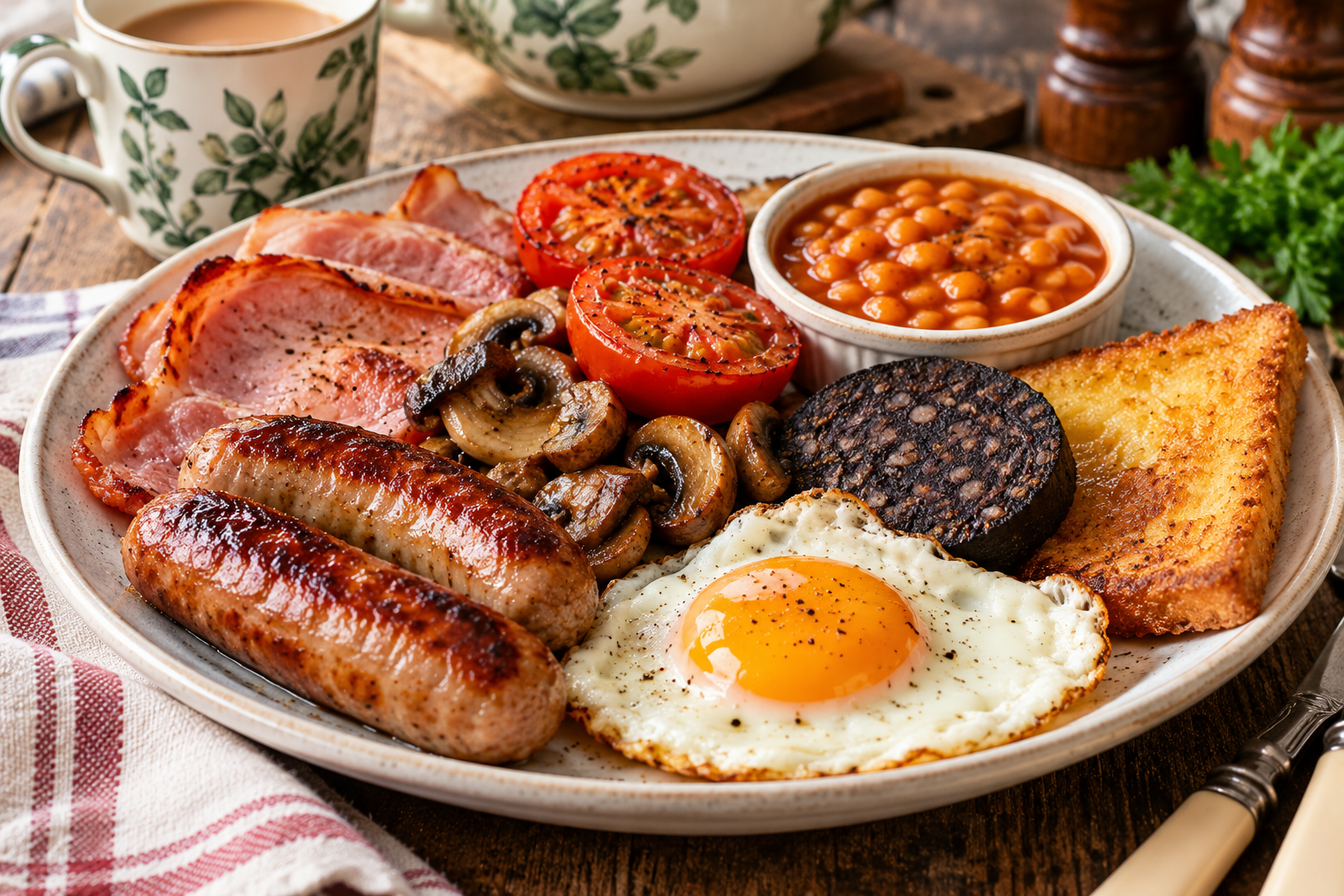
There’s nothing quite like a proper Full English breakfast.
A plate piled high with sizzling bacon, juicy sausages, fried eggs, baked beans, mushrooms, and grilled tomatoes is one of Britain’s most recognisable meals. Add a slice of fried bread and a strong cup of tea, and you’ve got a breakfast that’s practically a British institution.
Growing up in England, a Full English was never just an ordinary bowl-of-cereal kind of breakfast. It was something to look forward to, especially on a leisurely weekend morning, during a holiday, or when stopping at a traditional British café.
Now that I live in America, I’ve discovered that recreating an authentic English breakfast requires a few adjustments. American bacon isn’t quite the same as British back bacon, British sausages have their own distinctive texture, and even baked beans taste different on opposite sides of the Atlantic.
Fortunately, you can make a wonderful Full English breakfast in an American kitchen without having to import every ingredient.
Here’s what makes a traditional English fry-up special, what belongs on the plate, and how to get as close as possible to the real thing.
Affiliate Disclosure: Brit & Skillet may earn a commission from qualifying purchases made through links on this page, at no additional cost to you.

Traditional Full English Breakfast
Ingredients
Equipment
Method
- Slice the mushrooms, halve the tomato, and have all the remaining ingredients ready. If desired, set the oven to its lowest warming setting, around 200°F (95°C), and place an oven-safe baking sheet inside for holding cooked sausages and bacon. Keep food hot rather than leaving it at room temperature.
- Heat a large frying pan over medium-low heat with a little of the measured oil. Add the sausages and cook for approximately 15–20 minutes, turning regularly, until evenly browned and cooked through. Pork sausages should reach an internal temperature of 160°F (71°C). Transfer to a warm plate or baking sheet.
- In the same pan, cook the back bacon over medium heat for approximately 3–5 minutes per side, depending on thickness, until cooked through and lightly browned. Canadian bacon or American bacon may require different cooking times; follow the package directions. Keep warm with the sausages.
- Add some of the butter to the pan. Cook the mushrooms for 5–7 minutes until golden and tender. Season lightly. Place the tomato halves cut-side down in the pan and cook for approximately 4–5 minutes, then turn and cook for another 2–3 minutes until softened. Use a second pan if needed. Keep warm.
- Pour the baked beans into a small saucepan. Warm over medium-low heat for approximately 5 minutes, stirring occasionally, until piping hot. Avoid boiling vigorously.
- Cook prepared black pudding slices according to the package instructions, typically a few minutes per side in a lightly oiled pan, until heated thoroughly and lightly crisp on the outside.
- Heat the additional butter or oil in a frying pan over medium heat. Add the bread and cook for approximately 2–3 minutes per side, until golden brown and crisp. Add a little more fat only if necessary.
- Melt the remaining butter or heat the remaining oil in a nonstick frying pan over medium-low heat. Crack in the eggs and cook for approximately 3–4 minutes, or until the whites are set and the yolks reach your preferred doneness. For fully cooked eggs, cook until both whites and yolks are firm.
- Arrange the sausages, bacon, eggs, mushrooms, tomatoes, baked beans, and fried bread on two warm plates. Add the black pudding if using. Serve immediately with brown sauce or ketchup and a hot cup of tea.
Notes
What Is a Traditional Full English Breakfast?
A Full English breakfast, often called a fry-up, is a substantial cooked breakfast traditionally featuring bacon, sausages, eggs, baked beans, tomatoes, mushrooms, and toast or fried bread.
Black pudding is another traditional addition, although not everyone includes it.
It’s a hearty meal that’s been associated with British households, cafés, hotels, and bed-and-breakfast establishments for generations.
There’s no single official recipe, and the exact combination varies between families and regions.
Some people insist that hash browns have no place on a traditional Full English, while others happily include them. Some prefer fried bread, others toast. And whether baked beans should touch the egg is practically a national debate!
But whatever your preferences, a proper Full English should be generous, satisfying, and served hot.
A Brief History of the Full English Breakfast
The Full English breakfast has roots in Britain’s long tradition of substantial morning meals.
Large cooked breakfasts were associated with wealthy households in earlier centuries, and Victorian and Edwardian dining helped establish the familiar idea of a breakfast featuring several hot dishes.
Over time, the cooked breakfast became popular across different parts of British society.
By the twentieth century, bacon, eggs, sausages, and other familiar ingredients had become staples of the British breakfast table.
Traditional cafés, often affectionately known as greasy spoons, helped turn the Full English into an everyday British classic.
Today, you’ll find versions served everywhere from little neighbourhood cafés to country hotels and family kitchens.
And although many people don’t eat a Full English every morning, it remains one of Britain’s best-loved comfort meals.
What Goes Into a Proper Full English Breakfast?
Let’s look at the traditional ingredients and, most importantly, how to find suitable alternatives in the United States.
British Back Bacon
Bacon is one of the defining ingredients of a Full English breakfast.
But here’s something American readers might not realise: British bacon is different from typical American bacon.
In Britain, back bacon is commonly used. It’s cut from the pork loin with some belly attached, giving it a meatier texture and a leaner, rounded section.
American streaky bacon comes primarily from pork belly and has a much higher proportion of fat.
Both are delicious, but they aren’t quite interchangeable in flavour or texture.
American kitchen tip: Look for British-style back bacon at a specialty butcher or British food supplier. Canadian bacon can be a practical alternative, although it’s generally leaner and prepared differently from traditional British back bacon.
Regular American bacon works too, but the finished breakfast will taste a little different.
British-Style Sausages
A proper Full English traditionally includes British pork sausages.
British sausages are often seasoned with herbs and spices and may contain rusk or breadcrumbs, which contribute to their distinctive texture.
Cumberland and Lincolnshire sausages are popular examples, although many everyday British pork sausages work beautifully.
American breakfast sausage links tend to be smaller and often have a different seasoning profile.
American kitchen tip: Look for British-style pork sausages if available. Otherwise, choose mild pork sausages rather than strongly flavoured Italian sausages or heavily maple-sweetened breakfast links.
The aim is a savoury sausage that complements the other ingredients without overpowering them.
Fried Eggs
For me, a Full English just wouldn’t be complete without a fried egg.
Sunny-side-up eggs are particularly popular because the yolks make a lovely sauce for dipping toast or fried bread.
Of course, you can cook your eggs however you prefer.
Some people like the yolks runny, while others prefer them completely set.
British Baked Beans
This is another ingredient where British and American versions can be surprisingly different.
British baked beans are typically served in a mildly sweet tomato sauce.
American baked beans often have a sweeter, smokier flavour and may contain molasses, brown sugar, or bacon.
For the most authentic result, look for Heinz Beanz in tomato sauce, which are widely associated with British breakfasts.
American kitchen tip: Heinz Beanz can sometimes be found in international food sections or British specialty shops. If unavailable, choose a tomato-based baked bean product rather than a strongly barbecue-flavoured variety.
Grilled Tomatoes
Grilled or pan-fried tomatoes add freshness and acidity to an otherwise rich breakfast.
In Britain, large tomatoes are often halved and cooked until softened and lightly browned.
They help balance the richness of the bacon and sausages beautifully.
American beefsteak or other large ripe tomatoes work perfectly.
Fried Mushrooms
Mushrooms are another classic part of a Full English.
They’re usually sautéed in a little butter or oil until tender and golden.
Ordinary white button mushrooms or cremini mushrooms work well in American kitchens.
Their earthy flavour complements the sausages and bacon.
Black Pudding
Black pudding is a traditional British blood sausage made with pork blood, fat, and grains such as oatmeal or barley.
It’s sliced and fried until heated through and lightly crisp on the outside.
Black pudding is particularly associated with traditional cooked breakfasts, although plenty of British households leave it off the plate.
American kitchen tip: Black pudding can be difficult to find in ordinary American supermarkets. Look for it at a specialist butcher or British food supplier, and use a properly prepared, ready-to-cook product.
If you can’t find it, simply leave it out. You can still make a wonderful Full English breakfast.
Fried Bread or Toast
Fried bread is one of those traditional British breakfast additions that deserves more attention!
It’s simply bread fried in a little fat until golden and crisp.
It’s particularly good for soaking up egg yolk and baked bean sauce.
Toast is another perfectly acceptable option, especially if you’d prefer something a little lighter.
What About Hash Browns?
Now here’s a question that can cause a surprisingly lively debate among British breakfast enthusiasts!
Hash browns are common on many modern Full English breakfast plates, particularly in cafés and hotels.
However, they aren’t generally considered one of the older traditional components.
If you enjoy them, there’s absolutely nothing wrong with adding a couple.
But if you’re aiming for a more old-fashioned British fry-up, fried bread is a particularly traditional choice.
Full English Breakfast vs American Breakfast
Although both countries enjoy bacon, eggs, and sausages, there are some interesting differences between a traditional English breakfast and a typical American cooked breakfast.
| Full English Breakfast | Typical American Breakfast |
|---|---|
| British back bacon | Streaky bacon |
| British pork sausages | Breakfast sausage links or patties |
| Tomato-based baked beans | Hash browns or breakfast potatoes |
| Grilled tomatoes | Often absent |
| Sautéed mushrooms | Less commonly included |
| Fried bread or toast | Toast, biscuits, or pancakes |
| Black pudding, sometimes | Usually absent |
Of course, breakfasts vary enormously in both countries, but these are some of the differences you’ll notice when trying to recreate a British fry-up in America.
How to Serve a Traditional Full English Breakfast
One of the challenges of making a Full English is getting everything ready at approximately the same time.
There are several different components, and nobody wants cold eggs while the sausages are still cooking!
The key is to plan ahead and keep the slower-cooking ingredients warm while finishing the quicker ones.
A warm serving plate also helps.
Traditionally, everything is arranged together on one generous plate, with the baked beans served alongside the other ingredients.
Some people prefer to keep the beans separate from the eggs and fried bread. Others don’t mind everything mixing together.
Personally, I think that’s part of the fun of a proper fry-up!
Serve with a mug of strong British tea and, if you like, a little brown sauce or tomato ketchup.
More British Breakfast Favourites
If you enjoy traditional British breakfast dishes, there are plenty of other recipes worth exploring.
My Traditional British Bubble and Squeak is another wonderful breakfast favourite, made by frying leftover potatoes and cabbage until golden and crispy. It’s especially good with a fried egg.
And if you love British sausages, you might also enjoy my Traditional British Sausage Rolls, made with savoury sausage filling wrapped in flaky pastry.
For another classic British egg dish, try my Traditional Scotch Eggs, featuring eggs wrapped in sausage meat and coated in crispy breadcrumbs.
These recipes are all part of the wonderful variety of British comfort food.
A good skillet is particularly useful when preparing a Full English breakfast, especially for cooking sausages, mushrooms, and tomatoes. A sturdy option such as the Staub Traditional Deep Skillet provides a versatile pan for everyday cooking as well as traditional British recipes.
Brit & Skillet Tips for the Perfect Full English Breakfast
Use British-style bacon if possible. Back bacon gives the breakfast a more authentic flavour and texture than American streaky bacon.
Choose savoury sausages. Mildly seasoned pork sausages work better than heavily sweetened breakfast links.
Look for British baked beans. Tomato-based Heinz Beanz are closer to the traditional flavour than American barbecue-style baked beans.
Don’t overcrowd your frying pan. Cooking everything in one pan may sound convenient, but it can prevent ingredients from browning properly.
Keep the plates warm. A Full English has several components, so warming your plates helps everything stay hot while you serve.
Cook the eggs last. They’re usually best served immediately, especially if you prefer soft yolks.
Make it your own. A Full English is a traditional dish, but there is plenty of room for personal preferences.
Frequently Asked Questions
What is included in a traditional Full English breakfast?
A typical Full English includes bacon, sausages, eggs, baked beans, grilled tomatoes, mushrooms, and toast or fried bread. Black pudding is another traditional addition.
Is a Full English breakfast eaten every day in Britain?
Not usually. Although some people enjoy cooked breakfasts regularly, a Full English is often associated with weekends, holidays, hotels, cafés, and special occasions.
Can I make a Full English breakfast without black pudding?
Absolutely. Black pudding is traditional but optional, and many British people prefer their breakfasts without it.
Can I make a vegetarian Full English breakfast?
Yes. Vegetarian sausages, eggs, beans, mushrooms, tomatoes, and toast make a delicious alternative. Check that the baked beans and other products are suitable for vegetarians.
What’s the difference between an English, Scottish, and Irish breakfast?
All three share ingredients such as bacon, sausages, and eggs, but regional variations are common.
A Scottish breakfast may include tattie scones, square sausage, or haggis, while an Irish breakfast may feature soda bread, potato farls, or white and black pudding.
There is considerable overlap, and the exact ingredients depend on the household or café.
Can I prepare a Full English breakfast ahead of time?
You can prepare some components in advance, such as cleaning and slicing mushrooms or preparing tomatoes.
However, the finished breakfast is best served freshly cooked, especially the eggs, bacon, and fried bread.
A Proper Taste of Britain
There’s something wonderfully comforting about sitting down to a proper Full English breakfast.
It’s generous, familiar, and full of the flavours that make traditional British cooking so enjoyable.
And while recreating one in America takes a little ingredient detective work, it’s absolutely possible to put together a breakfast that tastes remarkably close to the real thing.
Whether you’re making it for a leisurely weekend morning, a family brunch, or simply because you’re craving a taste of Britain, I hope this recipe brings a little British breakfast tradition into your kitchen.
Pop the kettle on, warm the plates, and enjoy!
Jane at Brit & Skillet
Leave a Reply