
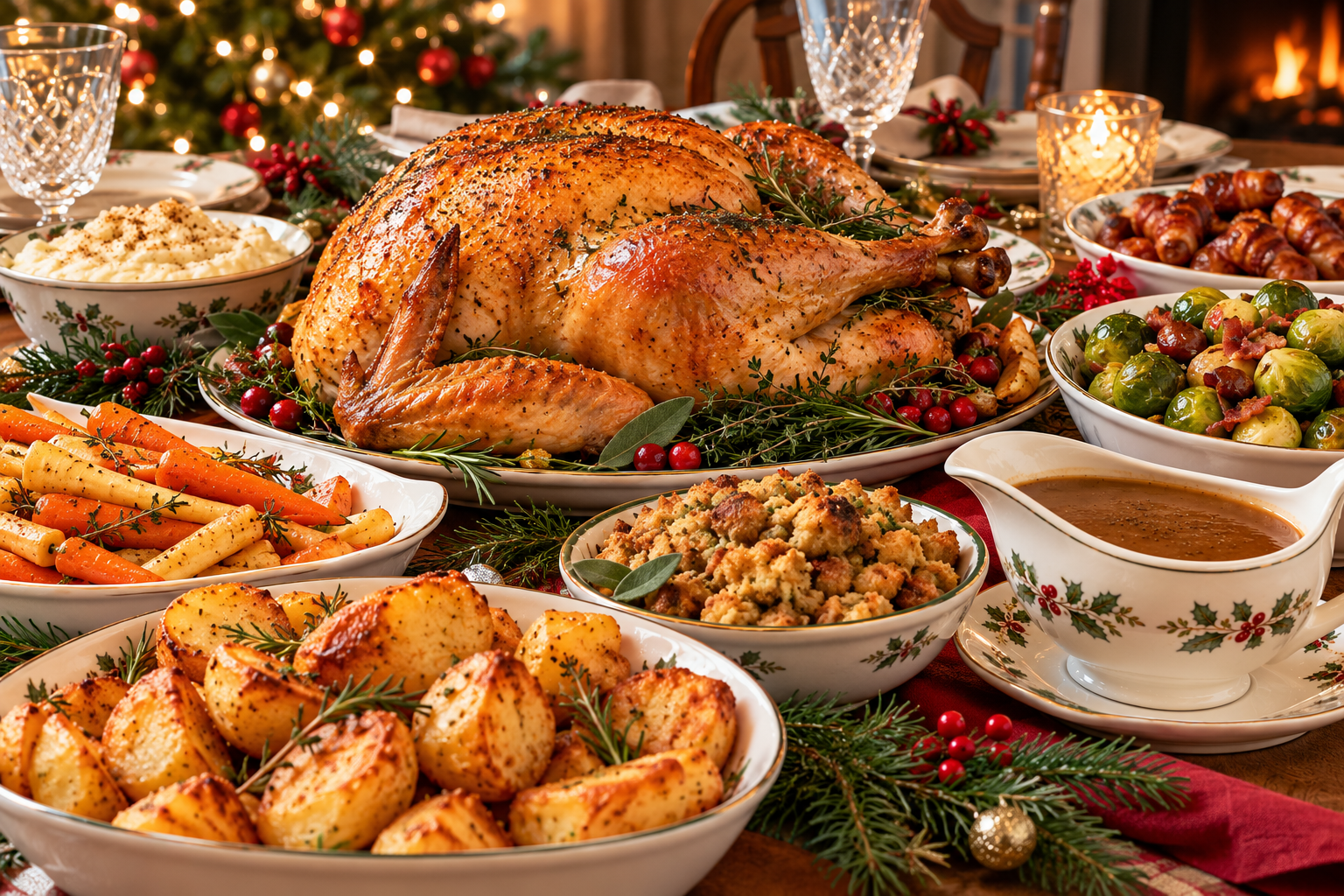
There’s something wonderfully special about a traditional British Christmas dinner.
The golden roast turkey, crispy roast potatoes, sage and onion stuffing, perfectly cooked vegetables, rich homemade gravy and all those delicious little extras make Christmas Day feel like a proper celebration.
But there’s one question that can make even an experienced home cook feel slightly nervous:
How on earth do you get everything ready at the same time?
The secret to a successful British Christmas dinner isn’t cooking everything at once. It’s knowing what can be prepared ahead, what needs the oven, and what should be left until the final few minutes.
With a little planning, you can serve a beautiful Christmas dinner without spending the entire day rushing between the oven, stove and refrigerator.
This practical British Christmas dinner cooking timeline is designed for a typical American kitchen with one oven, a stovetop and enough counter space to keep things organized.
And yes, you’ll even have time for a cup of tea. Hopefully. 😂
What Makes a Traditional British Christmas Dinner?
A classic British Christmas dinner usually centers around roast turkey, accompanied by a generous selection of savory side dishes.
A traditional menu might include:
- Roast turkey
- Crispy roast potatoes
- Sage and onion stuffing
- Pigs in blankets
- Honey-roasted parsnips and carrots
- Brussels sprouts with bacon and chestnuts
- Traditional bread sauce
- Rich homemade turkey gravy
Some families also serve Yorkshire puddings, mashed potatoes, red cabbage or additional vegetables.
And, of course, there are the Christmas desserts, including Christmas pudding, Christmas cake, mince pies and brandy butter.
The good news is that many of these dishes can be prepared or partially cooked before Christmas Day.
That means the final cooking session can be much more manageable than it first appears.
The Secret to a Stress-Free British Christmas Dinner
The most important thing to understand is that not every dish needs to come straight from the oven at the exact same moment.
In fact, trying to cook everything simultaneously is usually what makes Christmas dinner stressful.
Instead, organize the meal into three groups.
Dishes that can be made ahead: Bread sauce, prepared stuffing, desserts and some vegetable preparations can all be handled before Christmas Day.
Dishes that can rest or be kept warm: Roast turkey benefits from resting before carving, giving you valuable oven space for the potatoes and other side dishes.
Dishes that should be finished just before serving: Roast potatoes, gravy and certain vegetables are best served freshly finished.
Once you organize the meal this way, the cooking schedule becomes much easier.
Two Days Before Christmas: December 23
Christmas dinner preparations can begin well before Christmas Eve.
This is the ideal time to take care of jobs that don’t need to be done at the last minute.
Check Your Ingredients
Make sure you have everything needed for the main meal, including butter, flour, stock, herbs, vegetables and any ingredients for sauces or stuffing.
It’s also worth checking that you have enough roasting pans, baking sheets, saucepans and serving dishes.
Discovering that you only have one baking sheet when four dishes need roasting isn’t quite the Christmas surprise anyone hopes for.
Prepare Your Christmas Desserts
Traditional British Christmas pudding and Christmas cake are especially convenient because they’re normally made well ahead of the holiday.
If you’re serving a trifle, some components can also be prepared in advance.
Check the individual dessert recipes for their storage and assembly instructions.
Plan Your Turkey Thawing Time
If your turkey is frozen, it must be completely thawed before cooking.
As a general guide, allow approximately 24 hours of refrigerator thawing for every 4–5 pounds of turkey.
A large turkey may need several days, so check the weight and begin thawing early enough.
Always thaw turkey in the refrigerator or using another food-safe method, never on the kitchen counter.
Christmas Eve: December 24
Christmas Eve is where a little preparation can save an enormous amount of time the following day.
Prepare the Stuffing
Traditional sage and onion stuffing can be prepared ahead and refrigerated.
Keep it covered in the refrigerator until you’re ready to cook it.
For easier timing and food safety, cooking stuffing separately in a baking dish is often more convenient than placing it inside the turkey.
Prepare the Vegetables
Peel and cut the carrots and parsnips.
Trim the Brussels sprouts and prepare any chestnuts or bacon you’ll be using.
Store the prepared vegetables in suitable covered containers in the refrigerator.
You can also peel and cut the potatoes, then keep them completely submerged in cold water in the refrigerator overnight.
Drain them thoroughly before parboiling the following day.
Make the Bread Sauce
Traditional British bread sauce is an excellent make-ahead dish.
Prepare it according to the recipe, cool it promptly and refrigerate in a covered container.
Reheat gently on Christmas Day, adding a little milk if needed to loosen the consistency.
Prepare Your Serving Dishes
Set out your serving platters, gravy boat, carving board and utensils.
If possible, label dishes or decide which food will go into each one.
This small step makes serving much easier when several dishes are ready at once.
Check Your Cooking Schedule
Before going to bed, confirm the weight of your turkey, the recommended cooking time and your planned dinner time.
Your turkey’s size determines when the main cooking begins.
And remember: the turkey should be cooked according to its internal temperature, not simply the clock.
Christmas Day: A Complete Cooking Timeline
The following example is based on serving Christmas dinner at 2:00 p.m., a popular time for a traditional British Christmas meal.
It assumes a fully thawed, unstuffed turkey weighing approximately 12–14 pounds, cooked in a conventional oven.
This is an example rather than a guaranteed turkey cooking schedule. Your actual timing will depend on the bird’s weight, oven, recipe and the time needed to reach a safe internal temperature.
For a larger turkey or a different serving time, adjust the schedule accordingly.
8:00 a.m. — Prepare the Turkey
Remove the turkey from the refrigerator when you’re ready to prepare it for roasting.
Pat the skin dry, season according to your recipe and arrange it in the roasting pan.
Preheat the oven to the temperature specified in your turkey recipe.
Keep raw turkey and its juices away from ready-to-eat foods, and wash your hands and any contaminated equipment thoroughly.
8:30 a.m. — Put the Turkey in the Oven
Begin roasting the turkey according to its weight and your chosen recipe.
A 12–14-pound unstuffed turkey roasted at 325°F often takes approximately 3–3¾ hours, but cooking times vary.
Use a food thermometer to check the thickest part of the breast and the innermost thigh and wing areas, avoiding bone.
The turkey must reach 165°F (74°C) in all these locations.
Start checking before the estimated finishing time so you can adjust the rest of your schedule.
10:30 a.m. — Prepare the Potatoes
Drain the potatoes if you prepared them the night before.
Parboil them according to your roast potato recipe, then drain thoroughly.
Allow them to steam-dry and rough up the edges for that wonderful crispy finish.
Set them aside safely until the oven is available.
11:00 a.m. — Organize the Side Dishes
Take stock of everything that still needs cooking.
Have the prepared stuffing, pigs in blankets, carrots, parsnips and Brussels sprouts ready for their final cooking stages.
Keep perishable ingredients refrigerated until needed.
If using multiple baking trays, arrange the oven racks so you know which dishes will fit together.
12:00–12:30 p.m. — Check the Turkey
Begin checking the turkey’s internal temperature and monitor its progress.
Once the turkey reaches the required temperature, remove it from the oven.
Allow it to rest, loosely covered, before carving.
A rest of approximately 30–45 minutes is often useful for a turkey of this size, although the exact time depends on the bird and your serving schedule.
If the turkey finishes much earlier than expected, follow safe hot-holding practices rather than leaving it at room temperature for an extended period.
12:30 p.m. — Turn Up the Oven for the Roast Potatoes
With the turkey out of the oven, increase the oven temperature according to your crispy roast potato recipe.
Heat the roasting fat, then carefully add the prepared potatoes.
This is the moment when the oven becomes the busiest part of the kitchen.
If your oven has enough room, the carrots and parsnips can roast alongside the potatoes, provided their recipes use compatible temperatures.
Allow extra time if the oven is crowded, as multiple trays can slow browning.
12:45 p.m. — Cook the Stuffing and Pigs in Blankets
Add the stuffing and pigs in blankets to the oven when space and temperature allow.
Follow their individual cooking instructions and check that any poultry-based stuffing or stuffing containing raw meat reaches 165°F (74°C).
Pigs in blankets should be cooked thoroughly according to the sausage package or recipe directions.
If your oven cannot accommodate everything at once, cook the stuffing earlier and reheat it thoroughly before serving, or stagger the trays.
1:00 p.m. — Prepare the Gravy
Use the flavorful roasting juices from the turkey to make traditional British Christmas gravy.
If you’ve already prepared a gravy base, this is the perfect time to reheat it and add the fresh turkey juices.
Keep the gravy hot until serving.
1:15 p.m. — Cook the Brussels Sprouts
Prepare the Brussels sprouts with bacon and chestnuts on the stovetop.
Cooking these separately is particularly helpful because it keeps another baking dish out of the oven.
If you’re serving additional boiled or steamed vegetables, begin preparing them around this time.
1:30 p.m. — Reheat the Bread Sauce
Warm the bread sauce gently in a saucepan.
Stir regularly and add a splash of milk if it has thickened in the refrigerator.
Check the roast potatoes, carrots, parsnips and other oven dishes.
Rotate trays if necessary to encourage even browning.
1:40 p.m. — Final Checks
By now, most of the Christmas dinner should be ready or very close.
Check that:
- The roast potatoes are golden and crispy.
- The stuffing is cooked through.
- The pigs in blankets are thoroughly cooked.
- The vegetables are tender.
- The gravy is hot and smooth.
- The bread sauce is warmed through.
Warm your serving dishes if appropriate, and make sure the table is ready.
1:45 p.m. — Carve the Turkey
Carve the rested turkey and arrange it on a serving platter.
If the turkey has cooled too much during resting, reheat it safely before serving.
Transfer the vegetables and side dishes into their serving bowls.
Give the gravy one final stir and pour it into the gravy boat.
2:00 p.m. — Serve Christmas Dinner!
Bring everything to the table and enjoy your traditional British Christmas dinner.
And if one tray of potatoes takes five minutes longer than expected?
Don’t worry.
Nobody is going to remember that Christmas dinner was served at 2:05 instead of 2:00.
They’ll remember the food, the company and the wonderful atmosphere.
British Christmas Dinner Cooking Timeline at a Glance
| Time | What to Do |
|---|---|
| December 23 | Check ingredients, equipment and turkey thawing |
| Christmas Eve | Prepare stuffing, vegetables, potatoes and bread sauce |
| 8:00 a.m. | Prepare and season the turkey |
| 8:30 a.m. | Begin roasting the turkey |
| 10:30 a.m. | Parboil and prepare roast potatoes |
| 11:00 a.m. | Organize the side dishes |
| 12:00–12:30 p.m. | Check turkey temperature and remove when fully cooked |
| 12:30 p.m. | Roast potatoes and vegetables |
| 12:45 p.m. | Cook stuffing and pigs in blankets |
| 1:00 p.m. | Prepare Christmas gravy |
| 1:15 p.m. | Cook Brussels sprouts |
| 1:30 p.m. | Reheat bread sauce and check oven dishes |
| 1:40 p.m. | Complete final cooking checks |
| 1:45 p.m. | Carve turkey and arrange serving dishes |
| 2:00 p.m. | Serve Christmas dinner |
Important: This is an illustrative schedule, not a guarantee that every dish will finish at the listed time. Always adjust the turkey’s start time to its weight and actual cooking progress, and allow sufficient oven space and cooking time for your side dishes.
How to Adapt the Timeline for a Different Dinner Time
Not everyone serves Christmas dinner at 2:00 p.m.
Some British families eat earlier, while others prefer a late afternoon or evening meal.
Fortunately, the schedule is easy to adapt.
If you’re serving dinner at 4:00 p.m., move the cooking schedule approximately two hours later.
If you’re planning an earlier lunch, move the schedule forward.
The most important step is working backward from your intended serving time.
Start with the turkey, allowing enough time for roasting and resting, then schedule the roast potatoes and other oven dishes around it.
What If You Only Have One Oven?
A single oven is perfectly capable of producing a wonderful British Christmas dinner.
The trick is to use it strategically.
Roast the turkey first, then use the resting period for the potatoes and other dishes that need a higher oven temperature.
Prepare sauces and stovetop vegetables separately.
If space is tight, choose a smaller selection of side dishes rather than trying to fit everything into the oven at once.
And don’t be afraid to prepare some dishes ahead.
A delicious Christmas dinner doesn’t have to include every possible traditional accompaniment.
Having a couple of sturdy baking sheets makes it easier to prepare roast potatoes and vegetables in separate batches without overcrowding the oven.
Five Tips for Keeping Christmas Dinner on Schedule
1. Read Every Recipe Before Christmas Day
Check the cooking temperatures and estimated times for each dish.
Two recipes that require completely different oven temperatures may need to be cooked separately.
2. Use a Meat Thermometer
A reliable food thermometer takes much of the guesswork out of roasting turkey.
It also helps prevent undercooking or unnecessarily drying out the meat.
A reliable kitchen scale is also useful for measuring ingredients accurately when preparing Christmas recipes ahead of time.
3. Make the Sauces Ahead
Bread sauce and the base for your Christmas gravy are excellent candidates for advance preparation.
Reheat them safely on Christmas Day.
4. Don’t Overcrowd the Oven
Crowded baking trays can trap steam and prevent vegetables and potatoes from crisping properly.
Give food enough room to roast rather than steam.
5. Build in a Little Extra Time
Christmas cooking rarely follows the clock perfectly.
Allow some flexibility for a slower oven, a larger turkey or potatoes that need a few extra minutes to become beautifully golden.
A relaxed Christmas dinner is far more enjoyable than a perfectly timed but stressful one.
What About Christmas Pudding and Dessert?
Once the main meal is finished, there’s no need to rush straight into dessert.
Traditional British Christmas pudding can be prepared well ahead and reheated according to its recipe.
Serve it with brandy butter, custard or another favorite accompaniment.
Christmas cake, mince pies and trifle are also wonderful options that can be prepared before the big day.
In many British households, dessert comes after a leisurely break — which is often appreciated after such a generous dinner!
A Traditional British Christmas Dinner Without the Stress
A proper British Christmas dinner should feel like a celebration, not a race against the clock.
By preparing ingredients ahead, making good use of the turkey’s resting time and organizing the final cooking stages, you can bring together a delicious meal without trying to do everything at once.
The roast potatoes will be crispy, the turkey will be tender, the gravy will be ready for pouring and the table will be filled with all those wonderful Christmas favorites.
And most importantly, you’ll have time to sit down and enjoy it with everyone else.
Because Christmas dinner is about making memories — not spending the entire day worrying about the oven.
Happy Christmas from Brit & Skillet! 🇬🇧🎄
Leave a Reply