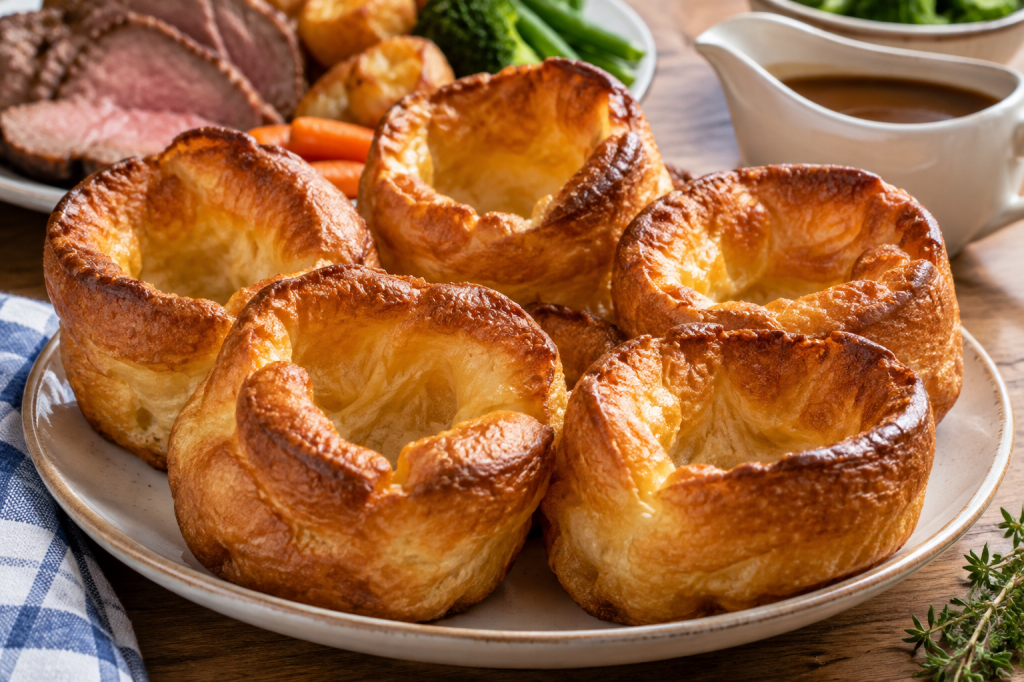
If you grew up in Britain, a Sunday roast without Yorkshire puddings can feel as though something rather important is missing from the plate.
Crisp and deeply golden around the edges, soft and slightly chewy inside, Yorkshire puddings are made from a surprisingly simple batter of flour, eggs and milk. The magic happens when that batter hits a very hot pan with hot fat, causing the puddings to puff dramatically in the oven.
And despite the name, these aren’t puddings in the way most Americans use the word. Yorkshire puddings are a savoury side dish, traditionally served as part of a roast dinner and particularly associated with roast beef and gravy.
The good news for American cooks is that you don’t need a special Yorkshire pudding tin to make them. A standard 12-cup muffin tin works beautifully, and I’ll give you both US and metric measurements throughout.
Brit & Skillet Tip: The two things Yorkshire puddings love most are heat and patience. Get the pan and fat properly hot before adding the batter — and once they’re in the oven, resist opening that door to have a peek!
What Are Yorkshire Puddings?
Yorkshire puddings are a traditional British side dish made from a simple batter of eggs, flour and milk. They’re baked in a very hot tin with a little hot fat, which causes the batter to rise dramatically and form those wonderfully crisp, golden edges and softer centres.
If you’re American, think of them as a close relative of a popover rather than anything resembling a dessert pudding.
Yorkshire puddings are most famously served with a traditional Sunday roast, where those crisp little hollows are particularly good at catching plenty of gravy.
Do I Need a Yorkshire Pudding Tin?
Not at all.
Traditional Yorkshire pudding tins tend to have shallower, wider wells than an American muffin tin, but a standard 12-cup muffin tin is a very practical substitute for an American kitchen.
Your Yorkshire puddings may come out a little taller and narrower than ones baked in a traditional tin, but they’ll still have the crisp exterior, puffed shape and hollow centre we’re looking for.
Brit & Skillet Tip: If you’ve seen photographs of Yorkshire puddings that look different from yours, the tin may be the reason. The shape can vary quite a bit depending on whether they’re baked in a traditional shallow Yorkshire pudding tin or a deeper American muffin tin.
Traditional Yorkshire Puddings Recipe
Prep Time: 10 minutes
Batter Resting Time: 30 minutes
Bake Time: 20–25 minutes
Yield: About 12 Yorkshire puddings
Pan: Standard 12-cup muffin tin
Ingredients
- 1 cup (120g) all-purpose flour
- ½ teaspoon salt
- 4 large eggs
- 1 cup (240ml) whole milk
- 2–3 tablespoons neutral cooking oil or beef drippings, for the tin
What Kind of Fat Should I Use?
Beef drippings give Yorkshire puddings a particularly traditional savoury flavour and are a lovely choice if you already have them from preparing a roast.
For an easier everyday option, use a neutral oil with a high smoke point, such as vegetable or canola oil.
Avoid butter for heating the muffin tin at high temperature. Its milk solids can burn before the Yorkshire puddings have finished baking.
Brit & Skillet Tip: You only need a small amount of fat in each muffin cup. The goal is to create a very hot surface for the batter to hit — not to deep-fry your Yorkshire puddings.
Step-by-Step Instructions
1. Make the Batter
Place the flour and salt in a large mixing bowl and whisk together.
In a separate bowl or measuring jug, whisk the eggs and milk until well combined.
Gradually pour the egg and milk mixture into the flour, whisking as you go, until you have a smooth, fairly thin batter with no obvious lumps.
Cover the bowl and let the batter rest at room temperature for about 30 minutes.
2. Heat the Oven and Muffin Tin
Preheat the oven to 425°F (220°C).
Add approximately ½ teaspoon of oil or beef drippings to each cup of a standard 12-cup muffin tin.
Place the tin in the hot oven for about 5–7 minutes, until the tin and fat are very hot.
Have your rested batter ready before removing the tin from the oven.
3. Fill the Tin
Carefully remove the hot muffin tin from the oven and place it on a heatproof surface.
Working quickly but carefully, divide the batter between the muffin cups, filling each approximately one-third to halfway full.
You should hear a little sizzle as the batter meets the hot fat.
Return the tin to the oven immediately.
4. Bake the Yorkshire Puddings
Bake for 20–25 minutes, until the Yorkshire puddings are well risen, crisp and deeply golden.
Do not open the oven door during the first 20 minutes of baking. A sudden drop in temperature can interfere with their rise.
Once they’re puffed and nicely browned, remove them from the oven and serve while hot.
Brit & Skillet Tip: Have everything ready before that hot muffin tin comes out of the oven. The less time the tin spends cooling on the counter, the better chance your Yorkshire puddings have of getting a lovely rise.
How to Serve Yorkshire Puddings
Yorkshire puddings are at their best served hot from the oven, when the edges are crisp and the centres are still soft.
The classic way to serve them is alongside a Sunday roast with plenty of gravy. Roast beef is the traditional pairing most people associate with Yorkshire pudding, but there’s absolutely no reason to save them only for beef — they’re lovely alongside other roast dinners too.
And whatever you serve them with, those hollow centres are practically asking to be filled with gravy.
Yorkshire Pudding Troubleshooting
Why Didn’t My Yorkshire Puddings Rise?
There are a few common culprits. The oven or muffin tin may not have been hot enough, the hot tin may have sat out too long while you added the batter, or the oven door may have been opened too early.
For the best rise, make sure the oven, tin and fat are properly hot before the batter goes in.
Why Did My Yorkshire Puddings Collapse?
A little settling after they leave the oven is normal. If they collapse dramatically, they may simply need a little longer in the oven to set and crisp.
Look for Yorkshire puddings that are deeply golden rather than pale before taking them out.
Can I Make Yorkshire Puddings Ahead of Time?
Yes. Although they’re particularly good fresh from the oven, Yorkshire puddings can be made ahead and reheated.
Allow them to cool completely, then store them in an airtight container in the refrigerator for up to 2 days.
To reheat, place them on a baking sheet in a 400°F (200°C) oven for about 5 minutes, or until hot and crisp again.
Can I Freeze Yorkshire Puddings?
Yes. Once completely cool, place them in a freezer-safe container or bag and freeze for up to 1 month.
Reheat them from frozen in a 400°F (200°C) oven for approximately 6–8 minutes, until heated through and crisp.
Brit & Skillet Tip: The microwave will warm a Yorkshire pudding, but it won’t do its crisp edges any favours. A few minutes in a hot oven is worth the extra wait.
Bring a British Sunday Roast to Your American Kitchen
Yorkshire puddings might look impressive when they come puffed and golden from the oven, but they’re made from some of the simplest ingredients in the kitchen.
Once you know the trick — a rested batter, a properly hot tin and no opening the oven door too soon — they’re surprisingly straightforward to make.
Serve them alongside your favourite roast, give them plenty of gravy, and you’ve got one of the most recognisable parts of a proper British Sunday dinner.
If you’d like to explore more dishes from across the pond, have a browse through our traditional British recipes for more British favourites adapted for an American kitchen.
Happy cooking!
 Brit & Skillet