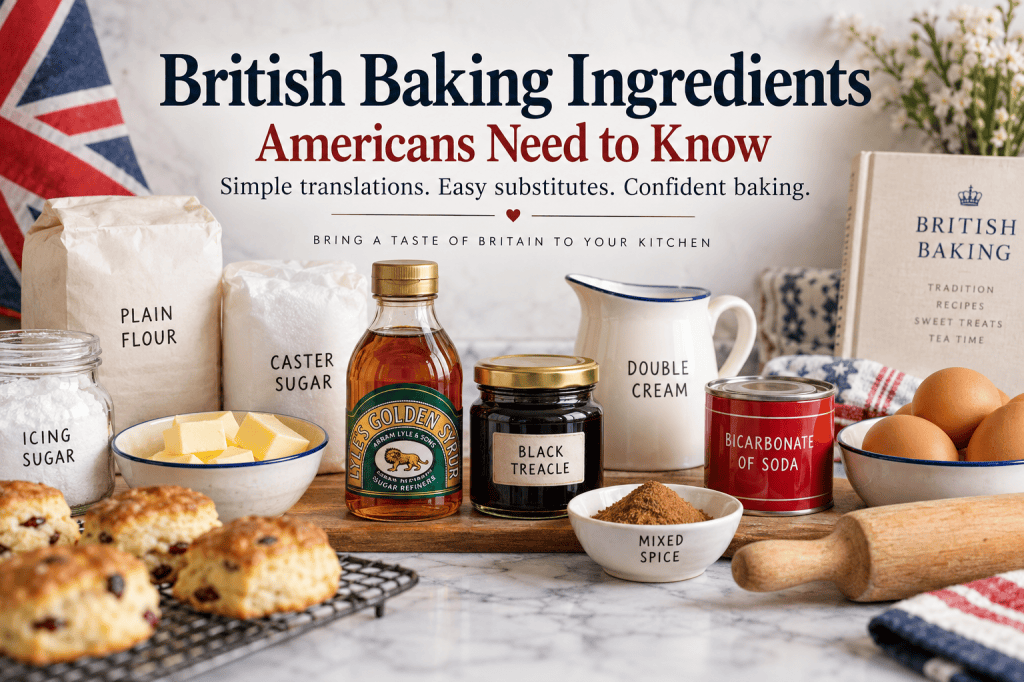
If you’re an American trying a British baking recipe for the first time, the ingredient list can sometimes feel like it was written in another language. What exactly is caster sugar? Is self-raising flour the same as American self-rising flour? And what are you supposed to do when a recipe calls for golden syrup, black treacle, or mixed spice?
British and American baking share plenty of similarities, but some ingredients have different names, formulations, or equivalents. Knowing those differences can save you from buying the wrong product—or wondering why a familiar recipe didn’t turn out quite as expected.
In this guide, we’ll look at some of the most common British baking ingredients American cooks are likely to encounter, what they are, and what you can use when the exact ingredient isn’t readily available in the United States.
Affiliate disclosure: This post may contain affiliate links. If you make a purchase through one of these links, I may earn a small commission at no additional cost to you.
What Is Caster Sugar?
Caster sugar is a very common ingredient in British baking. It is granulated white sugar with crystals that are finer than standard American granulated sugar but not as fine as powdered sugar.
Because the smaller crystals dissolve more quickly, caster sugar works particularly well in cakes, meringues, cookies, and other baked goods where a smooth texture is important.
In the United States, you may see a similar product sold as superfine sugar or baker’s sugar. If you can’t find it, regular granulated sugar will work in many recipes, although the finished texture may be slightly different.
You can also make a quick substitute by briefly pulsing regular granulated sugar in a food processor until the crystals become finer. Stop before it turns into powdered sugar.
Self-Raising Flour vs. American Self-Rising Flour
Self-raising flour is a staple in many British kitchens and is commonly used for cakes, scones, biscuits, and other baked goods. It already contains a raising agent, which saves the baker from having to add it separately.
American self-rising flour sounds like exactly the same thing, but the formulations can vary. American versions may contain salt as well as baking powder, while British self-raising flour may differ in the amount of raising agent it contains.
Because of this, substituting American self-rising flour directly into a British recipe can sometimes change the result slightly. Always check whether the recipe also calls for baking powder or salt before adding more.
Brit & Skillet Tip: If you’re in the U.S. and a recipe calls for self-rising flour, King Arthur Unbleached Self-Rising Flour is a convenient ready-made option. Just remember that American self-rising flour may not be formulated exactly the same as British self-raising flour, so check the rest of the recipe before making substitutions.
If you don’t have self-raising flour, you can often make a substitute using all-purpose flour and baking powder. The exact proportions can depend on the recipe, so for baking where precision matters, it’s best to follow a conversion specifically designed for that recipe.
Golden Syrup
Golden syrup is one of the most recognizable ingredients in British baking. It’s a thick, amber-colored sugar syrup with a smooth texture and a mild, buttery caramel flavor.
You’ll find it in classic British recipes such as flapjacks, treacle tart, biscuits, cakes, and puddings. It isn’t the same as American corn syrup, maple syrup, or honey, although those ingredients may sometimes work as substitutes depending on the recipe.
Lyle’s Golden Syrup is perhaps the best-known brand and can often be found in international food sections, British specialty shops, or online in the United States.
If you’re new to golden syrup, we have a complete guide to Golden Syrup in America: What to Buy and Where to Find It.
Black Treacle
Black treacle is a thick, dark syrup with a rich flavor that is less sweet and more robust than golden syrup. It’s a traditional British baking ingredient and is often used when a recipe needs deeper color and a stronger caramelized flavor.
You may come across black treacle in recipes for gingerbread, fruit cakes, sticky puddings, and other rich desserts.
For American bakers, regular dark molasses can sometimes work as a substitute for black treacle. However, the flavors aren’t identical, and blackstrap molasses is generally much stronger and more bitter.
If you’re wondering how these syrups compare, see our guide Treacle vs. Molasses vs. Golden Syrup: What’s the Difference?
What Is Mixed Spice?
Mixed spice is a traditional British spice blend commonly used in cakes, fruit breads, puddings, biscuits, and other baked treats. If you’re American, think of it as a British cousin to pumpkin pie spice—but the flavor combination isn’t exactly the same.
A typical mixed spice blend may include cinnamon, nutmeg, allspice, cloves, ginger, and coriander, although the exact mixture can vary between brands.
Mixed spice is especially common in traditional fruit cakes, Christmas baking, hot cross buns, and other warmly spiced British recipes.
If you can’t find British mixed spice in the United States, you can make your own blend from individual spices. Pumpkin pie spice may work in a pinch for some recipes, but it can produce a somewhat different flavor.
Double Cream
Double cream is a rich British cream with a higher fat content than the heavy cream typically sold in American supermarkets. Its thick, luxurious texture makes it popular for pouring over desserts, whipping, and using in rich sauces and fillings.
In the United States, heavy whipping cream is usually the easiest substitute for double cream. It isn’t exactly the same, but it works well in many recipes and is much easier to find.
If a British recipe relies heavily on the richness or thickness of double cream, the finished result may be slightly different when using American heavy cream. For everyday baking and desserts, though, heavy whipping cream is generally a practical alternative.
And one important warning for American cooks: British double cream does not mean “half-and-half.” Half-and-half has considerably less fat and usually isn’t a suitable replacement when a recipe needs rich cream.
Icing Sugar vs. Powdered Sugar
If a British recipe calls for icing sugar, American bakers can relax—this is essentially the ingredient commonly called powdered sugar or confectioners’ sugar in the United States.
It’s finely ground sugar used for frostings, glazes, buttercream, dusting cakes, and many other desserts. Unlike caster sugar, icing sugar has an extremely fine, powdery texture.
American powdered sugar commonly contains a small amount of starch to help prevent clumping. For most everyday British baking recipes, standard American powdered or confectioners’ sugar is a practical substitute for icing sugar.
Just remember: icing sugar is not the same as caster sugar. If a recipe calls for caster sugar, substituting powdered sugar can significantly change the texture and proportions of the recipe.
Plain Flour vs. All-Purpose Flour
British recipes often call for plain flour, which is generally the closest equivalent to all-purpose flour in the United States. Neither has a raising agent already added, making them useful for a wide range of cakes, biscuits, pastries, and sauces.
For most everyday British recipes, American all-purpose flour is a practical substitute when plain flour is listed.
Brit & Skillet Tip: If you’re baking a British recipe that calls for plain flour, King Arthur Unbleached All-Purpose Flour is a dependable American option and a good place to start.
However, flour can vary in protein content between brands and countries, so the texture of a finished bake may not always be identical. This can be particularly noticeable in recipes where flour choice has a big effect on tenderness or structure.
For most home baking, though, if you see plain flour in a British recipe, reaching for your American all-purpose flour is a good place to start.
Bicarbonate of Soda vs. Baking Soda
If a British recipe calls for bicarbonate of soda, American bakers already have the same ingredient in their pantry—it’s simply what Americans call baking soda.
Bicarbonate of soda is a raising agent that reacts with acidic ingredients such as buttermilk, yogurt, lemon juice, or certain syrups to help baked goods rise.
Don’t confuse it with baking powder. Baking powder contains additional ingredients that allow it to create its own leavening reaction, so baking soda and baking powder aren’t automatically interchangeable in a recipe.
The translation is an easy one to remember: British bicarbonate of soda = American baking soda.
British-to-American Baking Ingredient Quick Guide
Here’s a handy cheat sheet for some of the British baking terms you’re most likely to encounter:
Caster sugar → Superfine sugar or baker’s sugar
Icing sugar → Powdered sugar or confectioners’ sugar
Plain flour → All-purpose flour
Self-raising flour → Similar to self-rising flour, but check the recipe because formulations can differ
Bicarbonate of soda → Baking soda
Double cream → Heavy whipping cream is usually the easiest American substitute
Golden syrup → A distinctive British sugar syrup; use genuine golden syrup when possible
Black treacle → Regular dark molasses can sometimes be used as an alternative
Mixed spice → A British spice blend somewhat similar to, but not identical to, pumpkin pie spice
Ready to Start British Baking?
British baking becomes much easier once you learn a few ingredient translations. Many unfamiliar British ingredients either have an American equivalent or can be found in specialty shops and online.
If you’re just getting started, don’t feel like you need to stock an entirely new pantry. Begin with a recipe you’d genuinely like to try, find the ingredients it needs, and build your British baking collection from there.
Golden syrup is a particularly fun place to start. You can use it to make classic British flapjacks and then explore everything from treacle tart to sticky puddings and biscuits.
Before long, terms like caster sugar, black treacle, and bicarbonate of soda will feel just as familiar as the ingredients already sitting in your American pantry.
 Brit & Skillet