
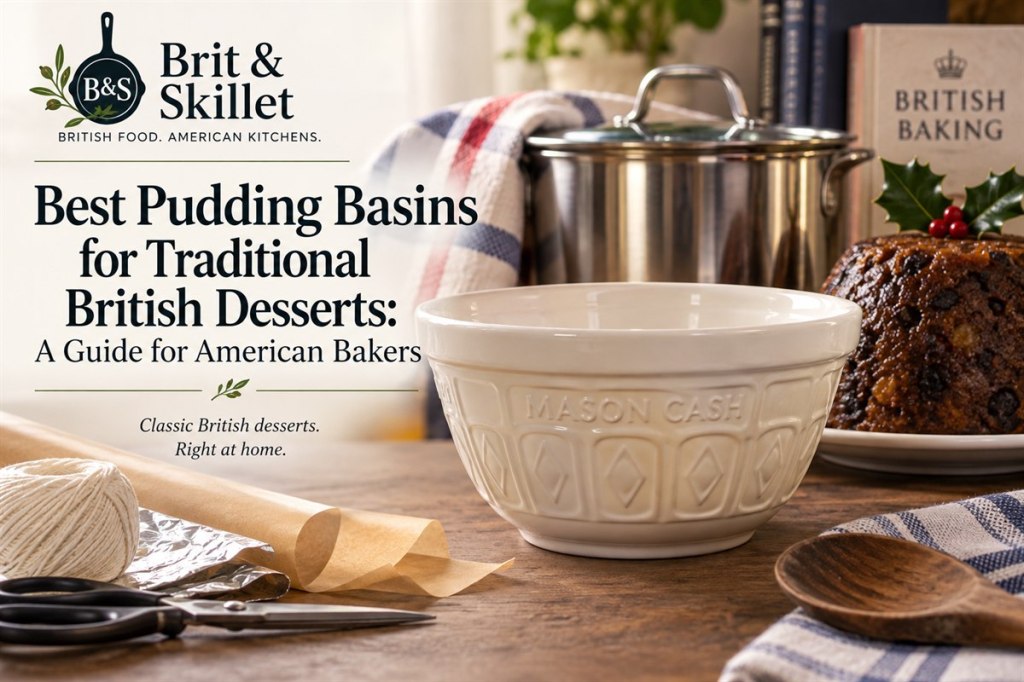
If you’re an American baker exploring traditional British desserts, sooner or later you’re likely to encounter a piece of equipment that doesn’t appear in many American kitchens: the pudding basin.
Despite the name, a pudding basin isn’t designed for the creamy custard-style dessert Americans usually associate with the word pudding. In British cooking, pudding can describe a much broader range of sweet—and sometimes savory—dishes.
Traditional steamed puddings such as Christmas pudding, treacle sponge, and steamed fruit or sponge puddings are commonly cooked inside a deep, rounded basin. The mixture is placed inside, the top is covered securely, and the basin is then steamed gently until the pudding is cooked through.
The shape isn’t merely decorative. Traditional pudding basins have deep sides and a pronounced rim that makes it easier to secure parchment, foil, or cloth around the top while the pudding steams. Some traditional designs also incorporate features that help the basin sit securely during steaming. CooksInfo
For American bakers, the confusing part is often figuring out which pudding basin to buy.
You’ll encounter ceramic, earthenware, plastic, and other heat-safe options, along with capacities described in milliliters, liters, cups, or British pints. And although a tiny individual basin might be perfect for one dessert, it won’t necessarily work for a full-size Christmas pudding.
In this guide, we’ll explain what a pudding basin is, what size is most useful, which materials and features to consider, and which options make sense for an American kitchen.
Our product recommendations will be based on current manufacturer information, recipe requirements, and independent research rather than personal testing by Brit & Skillet.
What Is a British Pudding Basin?
A British pudding basin is a deep, rounded bowl designed for steaming puddings.
Traditional versions are usually made from ceramic or earthenware and have a noticeably different shape from an ordinary mixing bowl. They tend to be deeper, with gently sloping sides and a pronounced rim around the top.
That rim has an important job.
When making a steamed pudding, the top of the basin is traditionally covered with baking parchment and foil and secured with kitchen string. The projecting rim gives the string somewhere to grip, helping keep the covering securely in place during a long steaming time. Mason Cash, one of the traditional manufacturers of pudding basins, specifically designs the rim of its basins for sealing puddings before steaming. Mason Cash
Why Is the Basin Rounded?
The classic rounded shape helps create the familiar domed appearance of a steamed British pudding once it’s turned out onto a serving plate.
It’s also designed to help the cooked pudding release from the bowl. Mason Cash describes the traditional shape of its basins as helping the pudding release after steaming while giving it its characteristic shape. Mason Cash
Some traditional basins also have a vented base. When the basin sits in a pan of simmering water, the vents allow bubbles trapped underneath to escape, helping prevent the bowl from wobbling or tipping during steaming. Mason Cash
What Do You Make in a Pudding Basin?
The classic use is a steamed pudding.
That includes desserts such as Christmas pudding, treacle sponge, steamed fruit puddings, and other steamed sponge puddings. Good Food, for example, specifies a 1.2-liter pudding basin for its steamed sponge recipe. BBC Good Food
The same basic method appears again and again: grease the basin, add the pudding mixture, cover the top securely, and place the basin into a pan or steamer containing simmering water.
And despite the name, pudding basins aren’t limited to sweet recipes. Traditional British cooking also uses them for savory steamed puddings.
Can You Use a Regular Bowl Instead?
Sometimes, yes.
If you already own a heat-safe bowl suitable for prolonged steaming, it may work for some recipes. The most important considerations are whether the bowl can safely withstand the cooking method, whether it fits comfortably inside your steaming pan, and whether you can securely cover it.
But an ordinary bowl may lack the pronounced rim that makes tying parchment and foil around a traditional pudding basin so convenient.
There’s also the shape to consider. A wide, shallow mixing bowl isn’t going to produce quite the same tall, rounded pudding as a purpose-made basin.
So if you’re only trying one steamed pudding, you may be able to improvise with suitable cookware you already own.
But if Christmas pudding, treacle sponge, or other steamed puddings are going to become regular visitors to your kitchen, a proper pudding basin is an inexpensive piece of traditional equipment that’s actually designed for the job.
And unlike some extremely specialized kitchen gadgets, it doesn’t necessarily have to sit around doing nothing between puddings. Traditional pudding basins can also serve as prep or serving bowls; Mason Cash explicitly markets its basins for those additional uses. Mason Cash
Brit & Skillet tip: Before buying one, check the largest pot you plan to use for steaming. The perfect pudding basin isn’t terribly useful if you discover it won’t fit inside the pot. 😂
What Size Pudding Basin Do You Need?
Pudding basins come in a surprisingly wide range of sizes, from small individual molds to large bowls capable of holding a substantial Christmas pudding.
For most American bakers who want to try traditional British recipes, you don’t need an entire cupboard full of them.
A 1- to 1.2-liter pudding basin is the most useful place to start.
The 1.2-liter size appears frequently in British steamed-pudding recipes. Good Food, for example, specifies a 1.2-liter basin for several traditional steamed sponge puddings. Good Food
Pudding Basin Size Conversion Guide
| British Basin Size | Approx. US Capacity | Best For |
|---|---|---|
| 400–500 mL | 1¾–2 cups | Small puddings or individual portions |
| 900 mL–1 L | About 4 cups | Medium steamed puddings |
| 1.2 L / about 2 British pints | About 5 US cups | Traditional family-size steamed puddings and Christmas pudding |
| 1.5 L | About 6⅓ cups | Larger puddings |
| 2 L | About 8½ cups | Large recipes or bigger gatherings |
These conversions are approximate. When a British recipe specifies the capacity of the basin, follow that capacity rather than relying only on its diameter.
Why We Recommend About 1.2 Liters
A basin around 1.2 liters (roughly 5 US cups) is an especially practical first purchase because it’s large enough for many classic family-size steamed puddings without becoming enormous.
It’s also a size you’ll encounter repeatedly in British recipes. One Good Food Christmas-style pudding recipe uses two 1.2-liter basins, while another traditional recipe specifies a 1.25-liter/2-pint basin. Good Food
That makes the traditional 2-pint basin a useful phrase for American bakers to recognize when reading older or British recipes.
One important warning, though:
A British pint is not the same size as an American pint.
So don’t see “2-pint pudding basin” and automatically reach for a 4-US-cup bowl. A traditional British 2-pint pudding basin is generally around 1.1 to 1.2 liters, or roughly 5 US cups.
What About Smaller Basins?
Smaller basins can be useful if you’re making individual puddings or dividing a recipe into several portions.
For example, Mason Cash currently makes traditional pudding basins in multiple sizes. Its 12.5 cm model holds 400 mL, while its 16 cm Cane basin holds 900 mL. Mason Cash
Smaller basins are charming—and dangerous if you’re the sort of person who suddenly decides every dinner guest requires their own tiny steamed pudding. 😂
But they’re optional for a beginner.
Don’t Forget the Size of Your Steaming Pot
Before buying a basin, measure the pot you’ll use for steaming.
The basin needs to sit comfortably inside with enough room for water around it, and you’ll need to be able to put the lid securely on the pot.
Some traditional steaming methods place the basin on an upturned heat-safe saucer or similar support rather than directly on the bottom of the pan. Good Food’s instructions for a 1.2-liter pudding, for example, place the basin on a small upturned plate and bring the water partway up the sides. Good Food
That means you should check both the diameter and height of your basin against your steaming pot.
Brit & Skillet recommendation: If you’re buying your first pudding basin, look for approximately 1 to 1.2 liters, with 1.2 liters / roughly 2 British pints being an especially versatile traditional size.
You can always acquire the adorable tiny ones later.
Because apparently that’s how pudding-basin collections begin. 😂
Ceramic vs. Plastic Pudding Basins: Which Is Better?
Traditional pudding basins are commonly made from ceramic or earthenware, but reusable plastic pudding basins are also available. Both can work well for steamed puddings, but they have different advantages.
Ceramic Pudding Basins
If you’re picturing the classic British pudding basin, you’re probably imagining ceramic.
Traditional ceramic or earthenware basins are sturdy, attractive, and particularly well suited to the long, gentle steaming used for Christmas puddings and steamed sponge puddings.
Purpose-made designs can also include useful details. Mason Cash’s traditional earthenware basins, for example, have a shaped rim for securing the pudding before steaming, a vented base designed to let trapped bubbles escape, and a rounded shape intended to help the finished pudding release cleanly. Mason Cash
Advantages of ceramic:
- Traditional look and feel
- Sturdy and stable during steaming
- Can double as a prep or serving bowl
- Many models are microwave, dishwasher, and freezer safe
- Some ceramic models can also be oven safe, depending on the manufacturer’s instructions
The main disadvantage is weight. Ceramic is heavier than plastic, and you need to handle it carefully when lifting a hot basin from a steamer.
There’s also the possibility of thermal shock, so always follow the manufacturer’s care instructions. Mason Cash, for example, warns against placing a hot basin directly into cold water. Mason Cash
Plastic Pudding Basins
Reusable plastic pudding basins are the practical alternative.
They’re lightweight, inexpensive, and often come with fitted lids, eliminating some of the parchment-and-string gymnastics associated with traditional basins.
Food-grade polypropylene pudding basins designed specifically for steaming can be reusable, microwave safe, freezer safe, and dishwasher safe. However, that does not automatically make them oven safe. Just Pudding Basins, for example, specifically states that its polypropylene basins can be steamed, microwaved, frozen, and washed in the dishwasher but must not be used in a conventional oven. Just Pudding Basins
That’s an important distinction because heat tolerances vary between products.
Never assume that a plastic bowl—or even a plastic pudding basin—can handle every cooking method. Follow the manufacturer’s temperature and cooking instructions for the specific basin you own.
Which Should an American Baker Buy?
For most Brit & Skillet readers buying their first traditional pudding basin, we’d lean toward ceramic or earthenware.
It gives you the traditional shape and rim, works beautifully for classic steamed puddings, and can often serve another purpose in the kitchen when you’re not making pudding.
If convenience matters more than tradition, however, a purpose-made reusable plastic basin with a fitted lid can be extremely handy—especially for batch-making Christmas puddings or when you want something lightweight.
There’s no requirement that your Christmas pudding be steamed in a bowl that looks as though your grandmother inherited it from her grandmother.
Although admittedly, that does add to the atmosphere. 😂
What to Look for in Any Pudding Basin
Whatever material you choose, concentrate on a few practical details:
Capacity: Around 1 to 1.2 liters is a useful starting point for many traditional recipes.
Shape: A deep, rounded basin produces the classic pudding shape and makes turning out the finished pudding easier.
Rim: A pronounced rim is particularly useful when securing parchment and foil with kitchen string.
Cooking compatibility: Make sure the manufacturer specifically approves the basin for the cooking method you intend to use.
Pot fit: Check the basin’s outside dimensions against your steaming pot—not just its stated capacity.
Ease of removal: Remember that you’ll eventually have to lift a very hot basin out of a pot containing very hot water. A design that’s easy to grip is worth considering.
Brit & Skillet recommendation: For someone beginning with British steamed puddings, a traditional ceramic basin around 1 to 1.2 liters is our favorite starting point. If you later become the sort of person producing six Christmas puddings at once, plastic basins with lids may suddenly start looking extremely sensible.
At that point, however, you have bigger problems.
You’ve become British. 🇬🇧😂
The Best Pudding Basins for British Desserts
You don’t need an expensive pudding basin to make a good steamed pudding. What matters most is choosing the right capacity, a practical shape, and a basin specifically suited to the cooking method you plan to use.
For American bakers starting with traditional British puddings, we’ve narrowed the choices down by use case rather than simply ranking a long list of similar bowls.
Our recommendations are based on manufacturer specifications, traditional pudding-basin design, recipe requirements, and current product research rather than personal testing by Brit & Skillet.
Best Overall: Mason Cash Original White 1-Liter Pudding Basin
If we were choosing one traditional pudding basin for an American kitchen, the Mason Cash Original White 1-Liter Pudding Basin would be our starting point.
Mason Cash has been making pudding basins since the early 1800s, and the company’s current traditional design retains several features specifically intended for steaming puddings. Mason Cash
The 1-liter model measures approximately 16.7 cm (6.6 inches) across and 10 cm (3.9 inches) high. That’s large enough to be useful for many family-size steamed puddings while still being manageable inside an ordinary large cooking pot. Mason Cash
The shaped rim provides somewhere to secure the covering before steaming, while the vented base allows bubbles underneath the basin to escape. Mason Cash says this helps prevent the basin from tipping in the pan. Its traditional rounded shape is also designed to help the cooked pudding release cleanly. Mason Cash
Why we like it:
- Traditional earthenware pudding-basin design
- Useful 1-liter capacity
- Shaped rim for securing the pudding covering
- Vented base for stability during steaming
- Rounded shape designed for easy pudding release
- Dishwasher, microwave, and freezer safe according to Mason Cash
- Can double as a preparation or serving bowl
For someone making their first treacle sponge, steamed fruit pudding, or Christmas pudding, this is about as traditionally British as you can get without somebody appearing in your kitchen and putting the kettle on.
Best for: The American baker who wants one traditional, versatile pudding basin.
Best Traditional Alternative: Mason Cash Original Cane 900 mL Pudding Basin
If you want something that looks even more like it wandered out of an old British kitchen, consider the Mason Cash Original Cane Pudding Basin.
The current Cane model has a capacity of 900 mL and measures approximately 16 cm across by 9 cm high. Mason Cash
It’s slightly smaller than our 1-liter overall pick, but that makes it useful for medium-size puddings and recipes that don’t require a full 1.2-liter basin.
The warm cane color also gives it the classic appearance associated with traditional Mason Cash kitchenware.
Best for: Bakers who want a smaller traditional basin with classic British styling.
Best Larger Option: Mason Cash Original White 1.75-Liter Pudding Basin
If you regularly make larger puddings—or simply believe Christmas pudding should be capable of feeding a small village—the 1.75-liter Original White Pudding Basin is worth considering.
The current Mason Cash range lists this larger basin at approximately 20 cm across and 11 cm high. Mason Cash
It uses the same traditional pudding-basin concept as the smaller versions but provides considerably more capacity.
That extra room can be useful for larger recipes, but don’t automatically assume bigger is better.
A pudding basin should correspond reasonably closely to the amount of mixture specified in the recipe. Using a basin that’s much larger than intended can change the depth of the pudding and potentially affect cooking time.
And remember our earlier warning: make sure this one fits inside your steaming pot before buying it.
Best for: Larger steamed puddings, bigger households, or bakers who already know they’ll use the extra capacity.
Which One Should You Buy?
For most beginners, we’d choose the 1-liter Mason Cash Original White basin.
It’s traditional, practical, and close to the roughly 1-to-1.2-liter capacity that appears frequently in British pudding recipes.
If your recipe specifically calls for a 1.2-liter or 2-British-pint basin, however, we’d prioritize finding a basin with that actual capacity rather than assuming the 1-liter model is automatically interchangeable.
Choose the 900 mL Cane basin if you generally make smaller puddings and prefer its traditional appearance.
Choose the 1.75-liter basin when you specifically need the extra room.
The important thing isn’t owning the fanciest bowl.
It’s owning a basin that fits your recipe and your steaming pot.
Brit & Skillet pick: For a first pudding basin, the Mason Cash Original White 1-Liter Pudding Basin gets our vote.
It’s practical, unmistakably British, and unlikely to lead to the discovery that you’ve accidentally bought a ceramic object too large to fit inside any saucepan you own.
Which would be a remarkably British way for Christmas pudding to defeat you. 😂
How to Use a Pudding Basin for Steaming
Using a pudding basin can look slightly intimidating the first time, but the basic method is surprisingly simple.
The exact cooking time and instructions will depend on your recipe, so always follow the recipe you’re making. However, traditional steamed puddings generally use the same basic technique.
1. Prepare the Pudding Basin
Grease the inside of the basin as directed by your recipe.
Some puddings also begin with golden syrup, jam, fruit, or another topping in the bottom of the basin. Once the pudding is turned out, that becomes the top.
Add your pudding mixture, leaving whatever space the recipe specifies for expansion during cooking.
2. Cover the Basin
Traditional steamed-pudding recipes commonly use baking parchment and aluminum foil to cover the basin.
Place a sheet of parchment with a sheet of foil over it and make a small pleat through the center. The pleat gives the pudding room to expand as it cooks.
Secure the covering tightly underneath the rim of the basin with kitchen string.
You can also use the string to create a handle over the top. That’s particularly useful when it’s time to lift a hot pudding basin out of a deep saucepan. Good Food’s steamed-pudding instructions use this same parchment, foil, string, and handle technique. Good Food
3. Prepare the Steaming Pot
Choose a large, deep saucepan with a tight-fitting lid.
Many traditional recipes place an upturned heat-safe saucer, small plate, or trivet in the bottom of the pan and sit the pudding basin on top rather than placing it directly against the bottom.
The saucepan needs to be large enough for the basin while still allowing the lid to close properly. Good Food
4. Add Hot Water
Carefully pour hot or boiling water into the saucepan around the basin.
A common instruction is to bring the water approximately halfway up the sides of the pudding basin, although some recipes specify a little more. Follow the recipe you’re using rather than treating one water level as universal. Good Food
The water should surround the basin without getting inside it.
5. Cover and Steam Gently
Put the lid on the saucepan and maintain a gentle simmer for the amount of time specified in your recipe.
And this is where British pudding making requires a little patience.
A steamed sponge might take around 1½ to 2½ hours, while some traditional Christmas puddings can steam for considerably longer. For example, Good Food’s treacle sponge steams for 1 hour 45 minutes, while one of its Christmas puddings steams for six hours. Good Food
6. Keep an Eye on the Water
This part is important:
Don’t let the saucepan boil dry.
Long steaming times mean some of the water will evaporate. Check the level periodically and add more boiling water when necessary.
Using boiling rather than cold water helps avoid dramatically lowering the temperature inside the steaming pot.
7. Check That the Pudding Is Cooked
Follow your individual recipe for doneness.
For many steamed sponge puddings, inserting a skewer into the center is a useful test. It should come out without raw cake mixture attached.
If the pudding isn’t ready, cover it again and continue steaming as directed. Good Food
8. Remove the Basin Carefully
Turn off the heat and carefully lift the basin from the saucepan.
Remember that the basin, water, steam, foil, and pan will all be extremely hot.
This is where that string handle can earn its keep, but you should still use appropriate heat protection and work carefully.
Remove the covering according to the recipe, place a serving plate over the basin, and invert the pudding onto the plate.
With a little luck, you lift the basin and discover a magnificent domed British pudding underneath.
With slightly less luck, you discover why custard was invented.
Custard hides many sins. 😂
A Few Steaming Tips for Beginners
Keep the simmer gentle rather than violently boiling the water.
Use a saucepan with a lid that fits properly so steam doesn’t escape unnecessarily.
Check the water level during long cooking times and top it up with boiling water when necessary.
And don’t improvise with cookware unless you know it’s suitable for prolonged exposure to the temperatures and cooking method involved.
Brit & Skillet tip: Read the entire pudding recipe before you start steaming. Discovering at 9 p.m. that your Christmas pudding requires another four hours is the sort of cultural immersion nobody requested.
Do You Really Need a Pudding Basin?
Not necessarily.
If you’re making a steamed pudding for the first time, you may already own a heat-safe bowl that’s suitable for steaming and fits comfortably inside a large saucepan. For an occasional pudding, that can be perfectly reasonable.
But a purpose-made pudding basin becomes much more useful if you plan to make traditional British puddings regularly.
The deep, rounded shape gives steamed puddings their familiar domed appearance, while the pronounced rim found on traditional basins makes it easier to secure parchment and foil with kitchen string. Some purpose-made basins also include design features intended specifically for steaming.
There’s also something to be said for having a piece of equipment that simply fits the recipe.
When a British cookbook tells you to use a pudding basin, you don’t have to stand in front of the kitchen cupboard holding three bowls and wondering which one the author would approve of.
When We’d Buy One
A pudding basin is worth adding to your kitchen if you want to make Christmas pudding, treacle sponge, steamed fruit puddings, or other traditional steamed desserts more than occasionally.
For most beginners, we’d start with one ceramic basin around 1 to 1.2 liters rather than buying several different sizes.
If you discover that steamed puddings are becoming a regular occurrence, you can always add smaller or larger basins later.
This is how it starts.
First you buy one innocent pudding basin.
Six months later you’re explaining to an American friend why you own four bowls specifically designed for boiling cake. 😂
When We’d Skip It
If you’re trying a single recipe and already have an appropriately sized, heat-safe bowl that your recipe or the bowl manufacturer confirms is suitable for the cooking method, we’d use what you have.
Brit & Skillet is supposed to help make British cooking more approachable, not convince you that every recipe requires another specialized gadget.
That’s especially important with traditional cooking, where perfectly good results were being produced long before kitchens contained seventeen different appliances and a drawer dedicated exclusively to silicone utensils.
Brit & Skillet verdict: A pudding basin isn’t essential for experimenting with your first steamed pudding, but for anyone who plans to make traditional British puddings regularly, a proper basin is inexpensive, practical, and genuinely useful rather than gimmicky.
The Bottom Line
A traditional pudding basin is one of those pieces of British kitchen equipment that looks mysterious until you understand what it’s designed to do.
For most American bakers, we’d recommend starting with a ceramic or earthenware basin around 1 to 1.2 liters. That’s a useful size for many family-style steamed puddings and gives you the traditional rounded shape and rim that make covering, steaming, and turning out a pudding easier.
Our overall starting pick is the Mason Cash Original White 1-Liter Pudding Basin, while smaller and larger basins make sense when a particular recipe calls for them.
But always let the recipe determine the basin size rather than assuming one bowl works for everything.
And before you buy anything, measure your steaming pot.
Because discovering that your beautiful new British pudding basin is half an inch too tall for the saucepan is precisely the sort of problem that can turn a peaceful Sunday afternoon into an international incident.
Once you’ve got the right basin, however, the process is wonderfully old-fashioned: fill it, cover it, steam it gently, turn it out—and preferably serve the result with an unreasonable quantity of custard.
Some British traditions do not require translation. 🇬🇧🍮
Yes — I would. 👍
Put a Separator block directly after the final sentence ending:
Some British traditions do not require translation. 🇬🇧🍮
Then put the affiliate disclosure under the separator in italics.
That gives a nice visual break between the actual article and the legal/affiliate information, and it’ll match the clean style we’ve been building across Brit & Skillet.
So the bottom will look like:
Some British traditions do not require translation. 🇬🇧🍮
Affiliate disclosure: Brit & Skillet may earn a commission from qualifying purchases made through links on this page, at no additional cost to you.
 Brit & Skillet