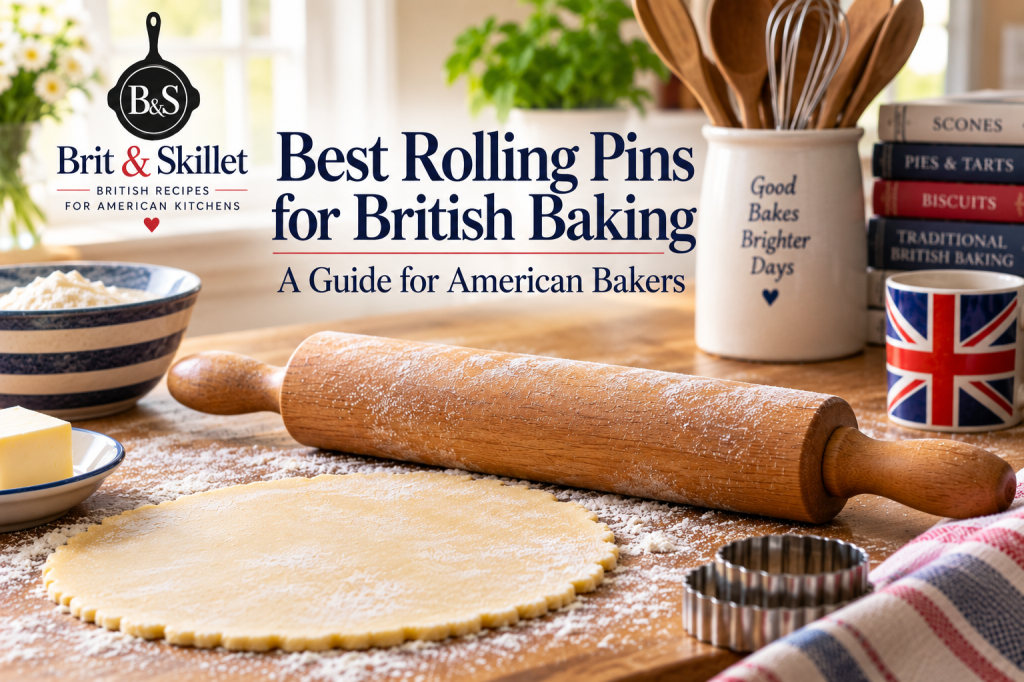
A rolling pin might be one of the simplest tools in the kitchen, but walk into the baking aisle and suddenly you’re choosing between handled pins, straight wooden dowels, tapered French pins, silicone rollers, stainless steel, marble, and adjustable designs with removable rings.
That’s rather a lot of engineering for something whose basic job is to make dough flatter.
For American bakers exploring British recipes, however, a good rolling pin earns its place in the kitchen.
If you’re building your baking kit from scratch, our 10 Essential Kitchen Tools for British Baking in America covers the other basics worth having on hand.
You’ll use one for everything from pastry and biscuits to sausage rolls, mince pies, shortcrust pastry, Eccles cakes, and plenty of other recipes where an evenly rolled piece of dough makes the rest of the job considerably easier.
The good news is that you don’t need a special “British” rolling pin.
What matters is choosing a design that gives you good control, even pressure, enough working length, and a surface that handles pastry well.
Different styles do have their strengths. In comparative testing, King Arthur Baking found a straight wooden rolling pin particularly versatile across pie dough, cookie dough, and puff pastry, while a tapered French-style pin provided excellent maneuverability when shaping pastry into a circle.
There are also adjustable rolling pins that use removable rings to control dough thickness—handy for recipes where consistency matters. Current models such as the Joseph Joseph PrecisionPin, for example, provide several thickness settings from approximately 2 mm to 10 mm.
So which style actually makes sense for British baking in an American kitchen?
In this guide, we’ll explain the major types of rolling pins, what materials and features are worth considering, and which current options we’d choose for different kinds of bakers.
Our recommendations are based on current manufacturer specifications, independent baking tests, and suitability for the job rather than personal testing by Brit & Skillet.
Because after nineteen articles explaining British baking to Americans, we’ve finally reached a piece of equipment whose operating instructions are essentially:
Push. Roll. Try not to drop it on your foot.
Progress. 😂
Affiliate disclosure: Brit & Skillet may earn a commission from qualifying purchases made through links on this page, at no additional cost to you.
What Type of Rolling Pin Is Best for British Baking?
For most British baking, you don’t need a specialized rolling pin. What you want is a pin that can comfortably handle shortcrust pastry, scones, biscuits, sausage rolls, mince pies, tarts, and other rolled doughs.
There are three main styles worth considering.
Straight or Dowel Rolling Pins
A straight rolling pin is essentially one long cylinder without handles.
The simple shape allows you to place your hands directly on the pin, making it easier to feel how much pressure you’re applying to the dough. It’s particularly useful when you want an even thickness across a larger piece of pastry.
In King Arthur Baking’s comparison, its 19-inch straight wooden pin performed especially well with cookie dough and puff pastry and was rated as the most versatile style they tested.
Best for:
Pastry, biscuits, cookies, puff pastry, sausage rolls, and general-purpose baking.
Advantages:
- Excellent control over pressure
- Easy to roll dough evenly
- Large working surface
- No handles or bearings to worry about
- Simple wooden designs can last for years
For an American baker who wants one rolling pin to handle almost everything, this is probably our favorite style.
French-Style Tapered Rolling Pins
A French rolling pin is also handle-free, but it becomes narrower toward each end.
That taper makes the pin particularly maneuverable. By changing the pressure from one hand to the other, you can steer the dough while you’re rolling it.
That’s especially useful when you’re trying to turn pastry into a neat circle for something like a tart or pie.
King Arthur’s testing found the tapered French pin produced the neatest circle of pie dough, while pastry expert Erin Jeanne McDowell also favors the style because it makes manipulating dough in different directions easier.
Best for:
Pie crusts, tart pastry, mince pies and bakers who like greater contact with the dough.
Advantages:
- Very responsive
- Excellent maneuverability
- Easy to change direction while rolling
- Lightweight and simple
- Particularly good for circular pastry
The only downside is that it can take a little practice to produce perfectly even thickness compared with a straight dowel.
Traditional Handled Rolling Pins
This is probably the rolling pin most Americans picture first: a central roller with a handle at either end.
There’s absolutely nothing wrong with this design.
In fact, if you’ve spent years using one and find it comfortable, there’s little reason to abandon it simply because you’ve started making British recipes. King Arthur’s handled maple pin performed well across pie dough, cookie dough, and puff pastry in its testing, although it required somewhat more effort when rolling back and forth.
Best for:
Beginners, everyday baking and anyone who simply prefers holding handles rather than the rolling surface.
Advantages:
- Familiar design
- Comfortable hand position
- Easy for beginners to understand
- Available almost everywhere
Ultimately, technique matters more than whether your rolling pin has handles.
Our Pick for Most American Bakers
If you’re buying one rolling pin specifically to build a versatile British baking kitchen, we’d choose a:
Long, straight wooden rolling pin.
It gives you plenty of working area, excellent control over dough thickness and enough versatility for nearly everything from shortcrust pastry to biscuits and sausage rolls.
A tapered French pin would be our second choice — and could easily become your favorite if you make lots of pies and tarts.
And if you already own Grandma’s handled wooden rolling pin?
Keep it.
Britain will allow it. 🇬🇧😂
The Best Rolling Pins for British Baking
You don’t need an expensive rolling pin to make excellent British pastry. For most home bakers, a well-made wooden pin is more than enough.
Based on current manufacturer specifications, independent baking tests, and suitability for common British baking tasks, these are the three styles we’d consider first.
Best Overall: King Arthur Straight Rolling Pin
For an American baker who wants one rolling pin capable of handling almost everything, the King Arthur Straight Rolling Pin is our best overall choice.
This 19-inch dowel-style pin has a lightly textured hardwood surface designed to hold a small amount of flour, helping prevent dough from sticking. Its straight shape also makes it easier to apply even pressure across pastry. King Arthur Baking Shop
King Arthur’s comparative testing found this style especially strong with cookie dough and puff pastry while still performing very well with pie dough. Their tester ultimately considered the straight pin the most versatile of the designs tested.
Why we like it for British baking:
- 19-inch working length
- Straight surface helps maintain even thickness
- Wooden surface holds a light dusting of flour
- Excellent for larger pieces of pastry
- Useful for shortcrust, biscuits, sausage rolls and puff pastry
- Simple construction without handles or complicated moving parts
Best for: The baker who wants one dependable, all-purpose rolling pin.
For most Brit & Skillet readers, this would be our first choice.
Best French-Style Pin: JK Adams French Tapered Rolling Pin
If you prefer greater maneuverability, the JK Adams French Tapered Rolling Pin is an excellent alternative.
It’s made in the USA from North American hardwood and measures 20½ inches long. The tapered design allows you to adjust pressure from side to side, which can make shaping circular pieces of pastry easier.
That makes this style particularly appealing for tarts, pies and individual pastry cases, including the sort you might use for mince pies.
JK Adams also uses a slightly textured wooden surface intended to retain a light dusting of flour rather than being completely slick.
Why we like it:
- Excellent control and maneuverability
- Long 20½-inch design
- Hardwood construction
- Lightweight French-style shape
- Particularly useful for circular pastry
Best for: Bakers who make lots of pies and tarts or prefer being able to feel and steer the dough while rolling.
Best for Consistent Thickness: Joseph Joseph PrecisionPin
Sometimes a British recipe tells you to roll pastry to a particular thickness and you find yourself staring at the dough thinking:
Does that look like 4 mm?
Unless your eyes came from the factory with built-in calipers, it’s not always obvious. 😂
The Joseph Joseph PrecisionPin solves that problem with removable guide rings.
Its beechwood pin includes five sets of rings that produce approximate dough thicknesses of 2, 4, 6, 8 or 10 mm. Remove the rings completely and it can also be used as a conventional rolling pin.
That feature can be particularly useful for biscuits, pastry and other recipes where consistent thickness helps everything bake evenly.
Why we like it:
- Five selectable thickness settings
- Beechwood construction
- Can be used with or without the rings
- Helpful for newer bakers
- Removes much of the guesswork from rolling evenly
One consideration is its length: at about 16½ inches, it’s shorter than the straight and French-style pins above, so we’d favor one of those longer pins for particularly large sheets of dough.
Best for: Beginners and anyone who regularly struggles to judge pastry thickness.
Which One Would We Buy?
For the typical American home baker learning British baking:
King Arthur Straight Rolling Pin — Best Overall
It offers the simplest combination of versatility, working length and control.
Choose the JK Adams French Tapered Rolling Pin instead if you particularly enjoy making pies and tarts and want greater maneuverability.
Choose the Joseph Joseph PrecisionPin if getting dough to an even specified thickness is usually the part that drives you round the bend.
And importantly, none of these recommendations requires pretending Brit & Skillet has personally tested a cupboard full of rolling pins. Our recommendations are based on published testing, manufacturer specifications and how well each design suits the British baking tasks discussed in this guide.
Wood vs. Marble vs. Stainless Steel vs. Silicone
The shape of a rolling pin matters, but so does the material.
For most home bakers, wood remains our preferred all-purpose choice. Independent testing has repeatedly favored wooden pins for their combination of control, durability and versatility. A lightly textured wooden surface can also hold a small dusting of flour, which helps prevent pastry from sticking.
Wood
Wood is the classic choice, and for British baking it’s difficult to beat.
It’s relatively lightweight, gives you good feedback from the dough and works well for everything from shortcrust pastry to biscuits and sausage rolls.
Best for: General British baking.
One thing to remember: wooden rolling pins normally require hand washing rather than soaking or putting them in the dishwasher.
Marble
Marble rolling pins are heavy and can be chilled, which makes them useful when working with buttery doughs that need to remain cool.
That can be helpful for puff pastry and other temperature-sensitive pastry. The trade-off is weight: marble can be considerably heavier and more cumbersome than wood, and it’s vulnerable to damage if dropped.
Best for: Bakers who frequently work with buttery pastry and don’t mind a heavier pin.
For most beginners, though, we wouldn’t consider marble necessary.
Stainless Steel
Stainless steel provides another smooth surface that can be chilled before rolling pastry.
It’s durable and easy to clean, although the slick surface doesn’t hold flour in quite the same way as lightly textured wood. Some bakers also prefer the warmer, more tactile feel of a wooden pin.
Best for: Bakers who value easy cleaning or frequently work with chilled pastry.
Silicone
Silicone rolling pins are generally marketed for their low-stick surface and easy cleanup.
They can be convenient, particularly with sticky doughs, but they’re not automatically superior to wood. Testing and expert opinions on their nonstick performance are somewhat mixed, and wooden pins continue to perform extremely well as versatile everyday tools.
Best for: Bakers who prioritize easy cleanup and prefer a smoother rolling surface.
Our Material Recommendation
For a first rolling pin:
Choose wood.
It’s affordable, versatile and suitable for virtually everything we’re likely to make in a British home-baking kitchen.
You can always add a marble or stainless-steel pin later if you become the sort of person who makes puff pastry on a Tuesday afternoon for relaxation.
At which point, frankly, you’ve graduated beyond this guide. 😂
What Size Rolling Pin Should You Buy?
Rolling pins come in plenty of sizes, but for an all-purpose baking kitchen, around 18 to 20 inches long is an excellent range.
That gives you enough length to roll a reasonably large sheet of pastry without constantly repositioning the pin. Straight dowel pins are commonly around 17 to 19 inches, while tapered pins are often around 19 inches.
For British baking, that extra working length is particularly useful when you’re making things such as sausage rolls, tart pastry or a larger sheet of shortcrust.
For Most Bakers: 18–20 Inches
This is the range we’d choose for a general-purpose rolling pin.
It provides enough working surface for larger pieces of dough while still being manageable in an ordinary home kitchen.
Our best-overall King Arthur Straight Rolling Pin, for example, measures 19 inches long and was particularly effective in testing when rolling a large rectangle of puff pastry.
What About Shorter Rolling Pins?
A shorter pin can certainly work, especially if you have limited counter space or mostly make smaller batches.
But if you’re buying your main rolling pin, we’d rather have a little extra length than discover halfway through rolling pastry that the dough is wider than the pin.
That’s how baking equipment ends up being called names that weren’t included in the manufacturer’s instructions.
Does Diameter Matter?
Not nearly as much as overall comfort and control.
A thicker straight pin generally has more weight behind it, which can help flatten dough with less downward pressure. A slimmer tapered pin feels lighter and makes changing direction easier.
There’s no single perfect measurement for everybody.
If the pin feels comfortable in your hands, covers the width of dough you normally make and allows you to maintain even pressure, you’ve got the important bits covered.
The Bottom Line
You don’t need a drawer full of rolling pins to make British recipes successfully in an American kitchen.
For most bakers, we’d choose a long wooden rolling pin around 18 to 20 inches, with a straight dowel design getting our overall vote for versatility.
Our three recommendations serve slightly different bakers:
King Arthur Straight Rolling Pin — our best overall choice for versatility.
JK Adams French Tapered Rolling Pin — best for maneuverability and shaping pies and tarts.
Joseph Joseph PrecisionPin — best for bakers who want help achieving a consistent dough thickness.
But if you already own a perfectly functional wooden rolling pin, don’t feel compelled to replace it. The best rolling pin is ultimately one that lets you comfortably produce evenly rolled dough.
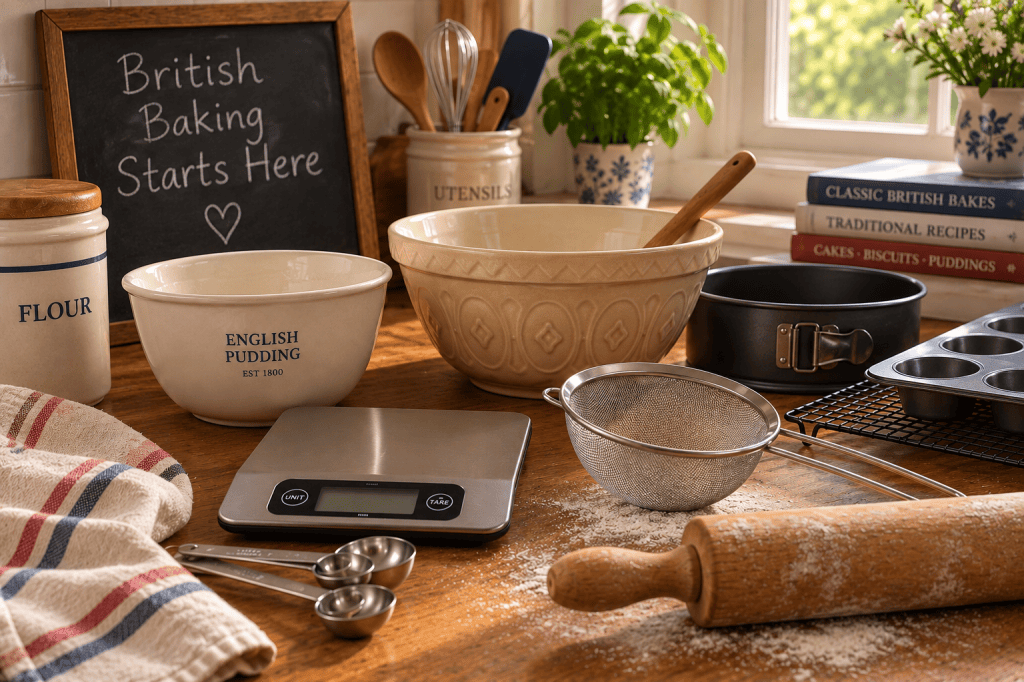
British baking doesn’t require a collection of mysterious specialist equipment. A dependable rolling pin, a good set of baking tins, a kitchen scale and a few other basics will take you remarkably far.
For a complete rundown, see our British Baking Equipment Guide: Everything an American Kitchen Needs.
 Brit & Skillet