Tag: health

  • Best Kitchen Scales for British Recipes: A Guide for American Bakers

    Best Kitchen Scales for British Recipes: A Guide for American Bakers

    If you’ve ever opened a British recipe and wondered why the flour, sugar, and butter are listed in grams instead of cups, you’re not alone. For American bakers, one of the simplest ways to make British recipes easier to follow is to use a digital kitchen scale.

    Weighing ingredients lets you follow the recipe as it was originally written instead of converting every measurement into cups and tablespoons. It can also give you more consistent results, particularly with ingredients such as flour, where the amount that fits into a measuring cup can vary.

    The good news is that you don’t need an expensive professional scale. For many home bakers, a simple digital model with the right features is all you need. But if you frequently switch between British metric recipes and American volume measurements, some premium scales offer additional features that can be genuinely useful.

    Affiliate disclosure: Brit & Skillet may earn a commission from qualifying purchases made through links on this page, at no additional cost to you.

    In this guide, we’ll explain what to look for in a kitchen scale for British recipes, which features actually matter, and how to choose the right one for your kitchen.

    Why British Recipes Use Grams

    British recipes commonly measure ingredients by weight rather than volume. That means you’ll often see flour, sugar, butter, and other ingredients listed in grams instead of American cups.

    There’s a practical reason for this: weight is generally more consistent. A cup of flour can contain different amounts depending on how the flour is scooped, packed, or leveled, while 120 grams is 120 grams regardless of how it gets into the bowl.

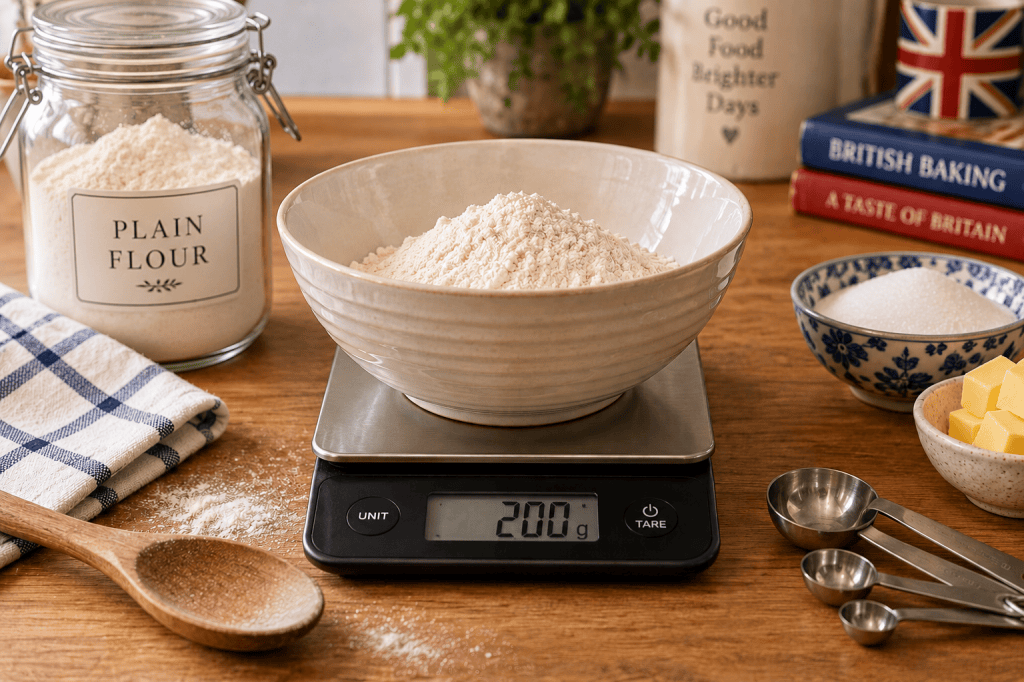
    Using a scale also makes British recipes much easier for American bakers. Instead of stopping to convert grams into cups, you can place your bowl on the scale, select grams, and weigh the amount shown in the original recipe.

    This is particularly useful for baking, where relatively small differences in ingredient quantities can affect the texture and consistency of cakes, biscuits, pastry, and bread.

    Brit & Skillet tip: When a British recipe provides measurements in both grams and cups, try using the gram measurements. It removes one more variable from the baking process and helps you follow the recipe closer to the way its author intended.

    What to Look for in a Kitchen Scale

    Kitchen scales can range from very simple models to more elaborate devices with features most home bakers will rarely use. For British baking, the basics matter much more than having lots of extras.

    A good scale should be accurate, easy to read, simple to clean, and capable of switching between the measurement units you’re most likely to encounter in British and American recipes.

    Measures in Grams and Ounces

    At a minimum, choose a scale that can display both grams and ounces. Grams will be your main setting for British recipes, while ounces can still be useful for American recipes and everyday kitchen tasks.

    A Tare Function

    The tare button resets the displayed weight to zero after you place a bowl or container on the scale. It also lets you weigh several ingredients into the same bowl by resetting the scale between additions.

    An Easy-to-Read Display

    Look for a display that remains visible when a reasonably large mixing bowl is sitting on the weighing platform. A scale isn’t very convenient if your favorite bowl covers the numbers every time you use it.

    A Practical Capacity

    Most home bakers don’t need an industrial-capacity scale, but the scale should comfortably handle the weight of your mixing bowl plus the ingredients inside it. This becomes particularly important when you’re making larger batches of bread dough, cakes, or puddings.

    Brit & Skillet tip: Don’t choose a kitchen scale based on the number of features printed on the box. For British baking, reliable gram measurements, a tare button, and a display you can actually see are more valuable than a long list of functions you’ll never use.

    How Accurate Does a Baking Scale Need to Be?

    For everyday British baking, a kitchen scale that measures in 1-gram increments is generally suitable for ingredients such as flour, sugar, butter, dried fruit, and chocolate.

    Very small quantities are a little different. Ingredients such as yeast, salt, baking powder, and spices may be used in amounts that are too small for an ordinary kitchen scale to measure reliably. In those cases, measuring spoons are often the simpler choice when the recipe provides spoon measurements.

    You may see specialized precision scales that measure fractions of a gram, but most home bakers don’t need one for everyday cakes, biscuits, scones, and puddings.

    What’s more important is consistency. Place your scale on a firm, level surface, make sure it reads zero before you begin, and avoid weighing ingredients while the scale is sitting on a soft tea towel or uneven countertop.

    Brit & Skillet tip: Your kitchen scale and measuring spoons make a great team. Use the scale for larger ingredients measured in grams and measuring spoons for the tiny quantities specified that way in the recipe.

    Our Kitchen Scale Picks for British Baking

    You don’t need a specialized British kitchen scale to follow British recipes. A reliable digital scale that measures accurately in grams is usually all an American home baker needs.

    However, different scales make sense for different bakers. Some people simply want an inexpensive way to start weighing flour in grams, while others regularly switch between British metric recipes and American volume measurements.

    We’ve divided our recommendations into four practical categories so you can choose the scale that best fits the way you bake.

    Quick Picks for American Bakers

    Best Premium Pick: King Arthur Volume and Weight Scale — A particularly useful choice for frequent bakers who regularly move between British metric recipes and American volume measurements.

    Best Everyday Pick: Escali Primo Digital Kitchen Scale — A straightforward choice for everyday British baking when you primarily want reliable gram measurements without lots of extras.

    Best for Large Mixing Bowls: OXO Good Grips 11 lb Food Scale with Pull-Out Display — A useful choice when large bowls or plates would otherwise block the scale’s display.

    Best Budget Pick: Amazon Basics Digital Kitchen Scale — A simple option for bakers who are just getting started with weighing ingredients in grams.

    For frequent Brit & Skillet bakers who work with both British and American recipes, the King Arthur scale offers the most interesting additional functionality. If you simply need a dependable everyday scale for weighing ingredients in grams, the Escali Primo keeps things simpler.

    Best Premium Pick: King Arthur Volume and Weight Scale

    For American bakers who frequently follow British recipes, the King Arthur Volume and Weight Scale offers an unusual combination of features that fits particularly well with the kind of baking we do at Brit & Skillet.

    The scale was developed by Escali with King Arthur’s test bakers and can work with both weight and volume. In addition to weighing ingredients, it includes hundreds of commonly used ingredients programmed into the scale so it can provide corresponding volume measurements.

    It can display weight in grams, ounces, and pounds and ounces, while volume measurements include cups, tablespoons, fluid ounces, and milliliters.

    That combination can be especially useful in an American kitchen where one recipe may call for 250 grams of flour while another gives ingredients in cups. Rather than being designed solely as a basic weighing scale, it provides additional tools for moving between the measurement systems American and British bakers commonly encounter.

    The trade-off is price. This is a premium scale, and someone who only needs to weigh ingredients in grams certainly doesn’t need to spend this much. Its extra functionality makes the most sense for frequent bakers who will actually use it.

    Best for: Frequent bakers who regularly switch between British metric recipes and American volume measurements.

    Keep in mind: The additional measurement functionality comes at a higher price than a basic digital kitchen scale.

    Best Everyday Pick: Escali Primo Digital Kitchen Scale

    For American home bakers who primarily want a straightforward way to follow British recipes in grams, the Escali Primo Digital Kitchen Scale is our everyday pick.

    The Primo measures in grams as well as ounces and pounds, has an 11-pound capacity, measures in 1-gram increments, and includes the tare function you’ll use constantly when weighing several ingredients into the same mixing bowl.

    Its simple design is part of its appeal. If your main goal is to put a bowl on the scale, press tare, and weigh 250 grams of flour, you don’t necessarily need the additional functionality of a premium model.

    Its raised weighing platform can also help keep the display visible when you’re using a reasonably large mixing bowl.

    Best for: Home bakers who want a simple, dependable scale for following British recipes in grams.

    Keep in mind: It doesn’t offer the more advanced weight-and-volume functionality of the King Arthur premium pick, but many bakers won’t need those additional features.

    Best for Large Mixing Bowls: OXO Good Grips 11 lb Food Scale with Pull-Out Display

    If you frequently weigh ingredients directly into large mixing bowls, the OXO Good Grips 11 lb Food Scale with Pull-Out Display is an especially practical choice.

    Its standout feature is the display, which pulls forward from the base of the scale. That means a large mixing bowl or plate can sit on the weighing platform without blocking your view of the measurement — a surprisingly useful feature when you’re weighing several ingredients into the same bowl.

    The scale has an 11-pound capacity, measures metric weights in 1-gram increments, and includes a zero function for taring your bowl between ingredients.

    Best for: Bakers who regularly use large mixing bowls, make bigger batches, or simply want an easier-to-see display.

    Keep in mind: The extra cost makes the most sense if you’ll actually benefit from the pull-out display.

    Best Budget Pick: Amazon Basics Digital Kitchen Scale

    If you’re new to weighing ingredients and want an inexpensive way to start following British recipes in grams, the Amazon Basics Digital Kitchen Scale is our budget pick.

    It offers the basic functionality needed to get started with weighing ingredients, including gram measurements and a tare function.

    Its simple design also makes it a sensible choice if you’re not yet sure how often you’ll use a kitchen scale and don’t want to spend much on your first one.

    Best for: Beginners and occasional bakers who want an inexpensive introduction to weighing British recipes in grams.

    Keep in mind: If you begin baking frequently, you may eventually appreciate the design or additional functionality offered by one of the other choices.

    Which Kitchen Scale Should You Choose?

    Choose the King Arthur Volume and Weight Scale if you bake frequently and regularly move between British metric recipes and American recipes using cups and other volume measurements. Its ability to work with both weight and volume makes it our premium choice for that particular kind of baking.

    Choose the Escali Primo if you don’t need those additional features and simply want a straightforward everyday scale for weighing British recipes in grams.

    Choose the OXO Good Grips 11 lb Food Scale with Pull-Out Display if you frequently weigh ingredients in large mixing bowls and want a display that won’t disappear underneath them.

    Choose the Amazon Basics Digital Kitchen Scale if you’re new to weighing ingredients and keeping the initial cost as low as possible is your priority.

    Whichever model you choose, prioritize gram measurements, a tare function, sufficient capacity for your mixing bowl and ingredients, and a design that’s easy for you to use.

    Kitchen Scale Comparison at a Glance

    ScaleBest ForKey Advantage
    King Arthur Volume and Weight ScaleFrequent British & American bakingWeight and volume measurements
    Escali PrimoEveryday bakingSimple gram weighing
    OXO Good Grips 11 lbLarge mixing bowlsPull-out display
    Amazon Basics Digital Kitchen ScaleBudget-conscious beginnersLow-cost way to start

    Our recommendation: If you frequently bake from both British and American recipes and want the additional measurement functionality, the King Arthur Volume and Weight Scale is our premium pick. For straightforward everyday weighing in grams, the Escali Primo remains the simpler choice. Choose the OXO if large bowls frequently block your scale display, or consider the Amazon Basics model if keeping the initial cost as low as possible is your priority.

    How to Use a Kitchen Scale with a British Recipe

    Once you get used to weighing ingredients, following a British recipe can actually feel simpler than measuring everything with cups.

    Start by placing your scale on a firm, level countertop and switching the measurement unit to grams.

    Put your empty mixing bowl on the scale and press the tare or zero button. The display should return to zero even though the bowl is still sitting on the platform.

    Add your first ingredient until the display reaches the weight specified in the recipe. If the next ingredient can go into the same bowl, press tare again to return the display to zero and then add the next ingredient.

    For example, if a cake recipe calls for 200 grams of flour and 200 grams of sugar, you can weigh the flour, press tare, and then weigh the sugar without having to calculate the combined weight yourself.

    Continue this process for ingredients that can safely be combined in the same bowl. For small quantities listed in teaspoons or tablespoons, simply use your measuring spoons as directed by the recipe.

    Brit & Skillet tip: Before adding an ingredient, glance at the scale and make sure it still says g for grams. Accidentally switching measurement units halfway through a recipe can produce a very unexpected cake!

    Do You Really Need a Kitchen Scale for British Baking?

    Technically, no. Many British recipes can be converted into American volume measurements, and some recipe writers provide both grams and cups.

    But if you plan to make British recipes regularly, a digital kitchen scale is one of the simplest and most useful additions you can make to your kitchen.

    Instead of searching for conversions every time you encounter 225 grams of flour or 100 grams of butter, you can simply weigh the amount the recipe calls for. It keeps you closer to the original recipe and eliminates much of the uncertainty that comes with converting ingredients by volume.

    You also don’t need to spend a fortune. For straightforward everyday weighing, the Escali Primo provides the basic functionality many home bakers need.

    If you frequently switch between British and American recipes and want the additional convenience of working with both weight and volume measurements, the King Arthur Volume and Weight Scale is our premium choice.

    The OXO is particularly useful if large mixing bowls tend to block your scale’s display, while the Amazon Basics model provides an inexpensive way to get started with baking by weight.

    The right choice ultimately depends on how often you bake and which features you’ll genuinely use.

    Once you start weighing ingredients, you may discover that British recipes aren’t harder to follow at all — they’re just measured a little differently.

    Happy baking!

    — Jane at Brit & Skillet

  • How British and American Measuring Cups Differ

    How British and American Measuring Cups Differ

    If you’ve ever followed a British recipe in an American kitchen, you may have noticed that the measurements don’t always look familiar. Grams and milliliters appear where you might expect cups and tablespoons, and even something as simple as a “cup” can cause confusion when recipes cross the Atlantic.

    British baking traditionally relies much more heavily on weight, while American recipes commonly measure dry ingredients by volume using cups. That difference can matter—especially in baking, where a little too much flour or too little sugar can change the finished result.

    In this guide, we’ll look at how British and American measuring methods differ, why weighing ingredients can be more accurate, and what American cooks should know before tackling a British recipe.

    Affiliate disclosure: This post may contain affiliate links. If you make a purchase through one of these links, I may earn a small commission at no additional cost to you.

    Do British Recipes Use Measuring Cups?

    British recipes can use measuring cups and spoons, but modern British baking recipes commonly give measurements in grams and milliliters rather than relying primarily on cups for dry ingredients.

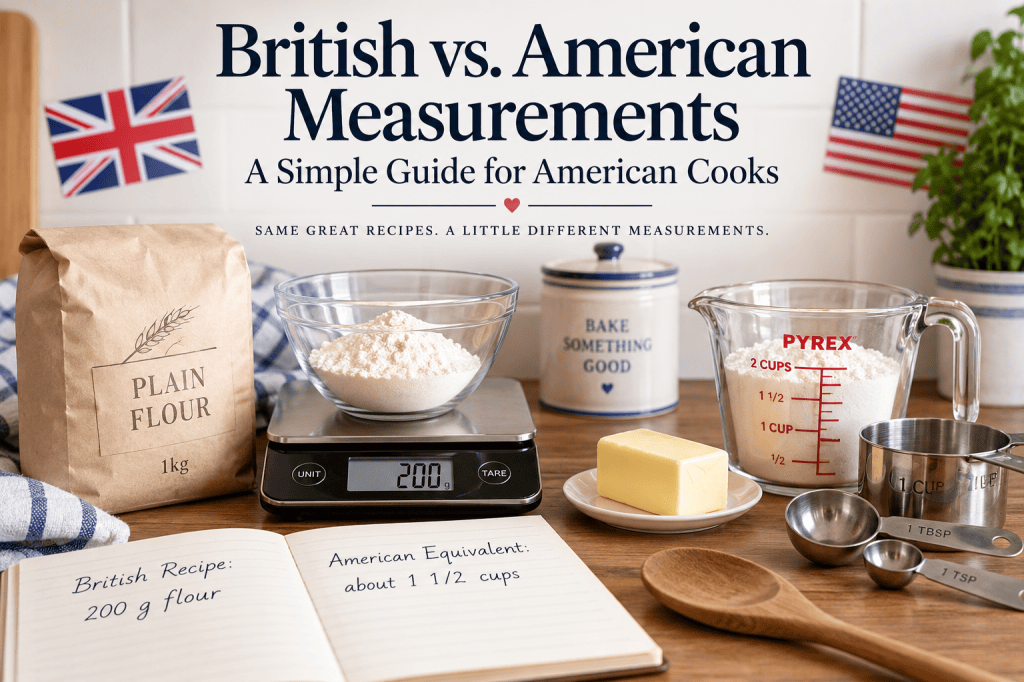
    This means a British recipe might tell you to use 200 g of flour instead of “about 1½ cups of flour.” For an American baker who is used to reaching for a measuring cup, that can initially seem inconvenient—but there’s a good reason for it.

    Measuring ingredients by weight is generally more consistent. A cup of flour can contain different amounts depending on how the flour is scooped, packed, or leveled, while 200 grams is always 200 grams.

    That’s why a simple digital kitchen scale can be one of the most useful tools for an American who wants to bake British recipes regularly.

    Is a British Cup the Same as an American Cup?

    Not necessarily. This is where measuring by “cups” can become confusing when recipes travel between countries.

    A standard US cup is about 237 milliliters, although it is commonly rounded to 240 mL in recipes and nutrition information. A metric cup is 250 milliliters and is used in some countries and recipes.

    Because many modern British recipes use grams and milliliters rather than cups, you shouldn’t automatically assume that a cup measurement you find in a British or international recipe means exactly the same thing as your American measuring cup.

    The safest approach is to follow the units provided by the recipe whenever possible. If the recipe gives ingredients in grams, use a kitchen scale rather than converting everything into cups. This avoids unnecessary rounding and usually gives you a more reliable result.

    British vs. American Tablespoons and Teaspoons

    The good news is that British and American teaspoon and tablespoon measurements are close enough that most home recipes won’t cause much confusion.

    A standard teaspoon is 5 milliliters in both modern British metric measurements and common American recipe measurements.

    A British metric tablespoon is 15 milliliters, which is also approximately the size of a standard US tablespoon. So when a modern British recipe calls for a tablespoon or teaspoon, your American measuring spoons will generally work just fine.

    However, measurements can vary in older recipes and between countries. If you’re following a vintage British cookbook or a recipe from somewhere outside the UK or United States, it’s worth checking exactly what measurement system the author is using.

    For modern British recipes, the bigger difference for American cooks is usually not the spoons—it’s getting accustomed to measuring ingredients in grams instead of cups.

    Why British Bakers Use Kitchen Scales

    Measuring ingredients by weight is especially useful in baking because it removes much of the variation that comes with measuring cups. Flour is a perfect example: one person might lightly spoon flour into a cup, while another might scoop directly from the bag and pack considerably more flour into the same cup.

    With a digital kitchen scale, you simply place your mixing bowl on the scale, set it to zero (often called tare), and add the ingredient until you reach the weight specified in the recipe.

    A scale can also mean fewer dishes. Instead of using several measuring cups, you can often add ingredients directly to the same bowl, resetting the scale to zero between additions.

    If you plan to make British recipes regularly, look for a digital kitchen scale that can easily switch between grams and ounces and has a tare function. You don’t need an expensive professional model for everyday home baking.

    British-to-American Measurement Quick Guide

    Here are a few useful measurements to keep in mind when working with British and American recipes:

    1 US cup → about 237 mL
    1 metric cup → 250 mL
    1 teaspoon → 5 mL
    1 tablespoon → about 15 mL
    1 ounce (weight) → about 28 grams
    1 pound → about 454 grams

    Remember that converting ingredients such as flour or sugar from grams to cups isn’t as simple as converting milliliters to cups. Different ingredients have different densities, so 100 grams of flour takes up a different amount of space than 100 grams of sugar.

    Whenever a British baking recipe provides weights in grams, using those original measurements with a kitchen scale is usually easier and more reliable than converting every ingredient into American cups.

    Can You Make British Recipes Without a Kitchen Scale?

    Yes. You can still make plenty of British recipes without owning a kitchen scale, especially if the recipe already provides American cup measurements or reliable conversions.

    However, if the original recipe is written in grams, converting every ingredient into cups can introduce small differences. This matters most in baking, where the balance between flour, sugar, butter, and liquids affects texture and structure.

    If you don’t have a scale, use a trustworthy ingredient-specific conversion rather than assuming the same cup conversion works for every ingredient. When measuring flour with American cups, spoon the flour lightly into the cup and level the top instead of packing it down.

    For occasional British cooking, measuring cups may be perfectly adequate. But if British baking becomes a regular part of your kitchen, a small digital scale can make following recipes considerably simpler.

    Making British Recipes Easier in an American Kitchen

    British measurements can seem unfamiliar at first, but you don’t need to completely change the way you cook. Once you become comfortable with grams and milliliters, following British recipes can actually become simpler.

    A basic digital kitchen scale takes much of the guesswork out of baking, particularly when measuring ingredients such as flour, sugar, and butter. Instead of worrying about whether a cup is packed too tightly or whether a conversion is exact, you can simply use the weight given in the original recipe.

    Measurements are only one of the differences you may encounter. British recipes also use ingredient names that can be unfamiliar to American cooks, including caster sugar, self-raising flour, golden syrup, black treacle, and bicarbonate of soda.

    For help translating those ingredients, see our guide British Baking Ingredients Americans Need to Know.

    With a kitchen scale, a few ingredient translations, and a willingness to try something new, you’ll be well prepared to bring a little Britain into your American kitchen.

  • Treacle vs. Molasses vs. Golden Syrup: What’s the Difference?

    Treacle vs. Molasses vs. Golden Syrup: What’s the Difference?

    If you’ve ever tried making a British recipe in an American kitchen, you may have run into ingredients like treacle and golden syrup and wondered what on earth you’re supposed to buy. Are they basically molasses? Can you substitute one for another? And why do British recipes seem to have so many different kinds of syrup?

    Treacle, molasses, and golden syrup are all thick, sweet syrups, but they aren’t exactly the same. They differ in flavor, color, and how they behave in recipes. Understanding those differences can make it much easier to follow British recipes without standing confused in the baking aisle.

    In this guide, we’ll look at the differences between treacle, molasses, and golden syrup, when you can substitute them, and which one to choose for your next British baking adventure.

    Affiliate disclosure: This post may contain affiliate links. If you make a purchase through one of these links, I may earn a small commission at no additional cost to you.

    What Is Treacle?

    Treacle is a thick sugar syrup commonly used in British baking. The word can be a little confusing for American cooks because “treacle” can refer to more than one type of syrup.

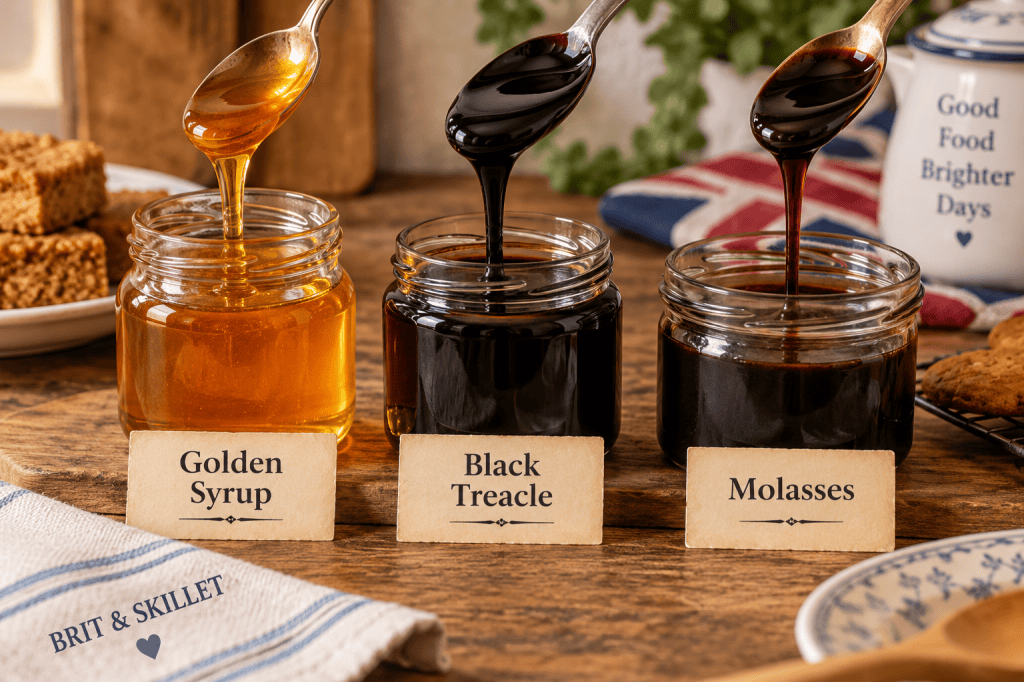
    In the UK, the two varieties you’re most likely to encounter are golden syrup and black treacle. Golden syrup is light in color with a buttery, caramel-like sweetness, while black treacle is much darker and has a stronger, slightly bitter flavor.

    Black treacle is especially useful in rich desserts and baked goods where you want a deep color and robust flavor. You may find it in recipes for gingerbread, fruit cakes, sticky puddings, and other traditional British treats.

    If a British recipe simply calls for “treacle,” pay attention to the recipe and its appearance. A pale, sweet syrup usually means golden syrup, while a dark, strongly flavored syrup generally means black treacle.

    What Is Molasses?

    Molasses is a thick, dark syrup produced during the process of refining sugar. It’s especially familiar in American baking, where it appears in recipes such as gingerbread, molasses cookies, baked beans, and barbecue sauces.

    Molasses comes in different varieties, ranging from relatively mild and sweet to very dark and intensely flavored. In general, its flavor is deeper and more robust than golden syrup.

    You may also come across blackstrap molasses. Blackstrap has a particularly strong, bitter flavor, so it isn’t automatically the best substitute when a British recipe calls for black treacle.

    Regular dark molasses is usually a closer match for black treacle, although the flavor still won’t be exactly the same. If you’re trying to recreate a traditional British recipe as closely as possible, using the ingredient specified in the original recipe is usually the safest choice.

    What Is Golden Syrup?

    Golden syrup is a thick, amber-colored sugar syrup with a smooth texture and a mild, buttery caramel flavor. It’s a familiar ingredient in British kitchens and appears in everything from flapjacks and biscuits to cakes, puddings, and treacle tart.

    Compared with molasses or black treacle, golden syrup is much lighter in both color and flavor. It adds sweetness and a subtle caramel note without giving baked goods the strong, slightly bitter taste associated with darker syrups.

    One of the best-known varieties is Lyle’s Golden Syrup, recognizable by its traditional green-and-gold packaging. American bakers can often find golden syrup in international food sections, specialty British shops, or online.

    If you’re in the United States and wondering where to find it, see our guide Golden Syrup in America: What to Buy and Where to Find It.

    Treacle vs. Molasses vs. Golden Syrup: The Main Differences

    The easiest way to understand these three syrups is to compare their color, flavor, and typical uses.

    Golden syrup is light amber in color and has a mild, buttery caramel flavor. It works especially well in flapjacks, biscuits, cakes, puddings, and treacle tart.

    Black treacle is much darker and has a richer, stronger flavor with a slightly bitter edge. It’s commonly used in darker cakes, gingerbread, sticky puddings, and other rich British desserts.

    Molasses is also dark and strongly flavored, making it the closest commonly available American alternative to black treacle. However, the exact flavor depends on the type of molasses you buy.

    Blackstrap molasses is the strongest and most bitter of the group. Because of its intense flavor, it shouldn’t automatically be substituted for black treacle or regular molasses in a recipe.

    Quick rule of thumb: If a British recipe calls for golden syrup, use golden syrup when possible. If it calls for black treacle and you can’t find it, regular dark molasses may be a reasonable substitute. Avoid assuming blackstrap molasses will give you the same result.

    Can You Substitute Molasses for Treacle?

    Sometimes—but it depends on which type of treacle the recipe calls for.

    If a British recipe calls for black treacle, regular dark molasses can often be used as a substitute. The flavors aren’t identical, but both provide the dark color and deep sweetness needed in recipes such as gingerbread, fruit cakes, and sticky puddings.

    If the recipe calls for golden syrup, molasses isn’t a particularly good substitute. Molasses is much darker and has a stronger flavor, so it can noticeably change both the taste and appearance of the finished dish.

    For golden syrup, a mild alternative such as light corn syrup or honey may work better when genuine golden syrup isn’t available, although each substitute will produce a slightly different result.

    When making a traditional British recipe for the first time, it’s worth using the original ingredient if you can find it. Once you know how the recipe is supposed to taste and behave, experimenting with substitutions becomes much easier.

    Which One Should You Buy?

    If you enjoy making British recipes, keeping both golden syrup and a darker syrup in your pantry can be useful.

    For recipes such as flapjacks, treacle tart, biscuits, and many traditional puddings, golden syrup is the one you’re likely to reach for most often. Its mild caramel flavor makes it versatile for both baking and desserts.

    Black treacle is worth having if you plan to make richer British recipes such as gingerbread, dark fruit cakes, or sticky puddings. If black treacle is difficult to find in the United States, regular dark molasses can often serve as a practical alternative.

    If you’re just beginning to explore British baking, golden syrup is probably the best one to buy first. You’ll be able to use it in plenty of recipes—and, of course, it gives you the perfect excuse to make a batch of British flapjacks.

    Bringing British Baking Into Your American Kitchen

    Treacle, molasses, and golden syrup may look similar on the pantry shelf, but each brings something different to a recipe. Golden syrup offers a light caramel sweetness, black treacle provides a deeper and more robust flavor, and molasses gives American bakers a useful alternative for many darker British recipes.

    Once you understand the differences, British recipes become much less mysterious. Instead of wondering what to substitute, you can choose the syrup that best matches the flavor and texture the recipe is meant to have.

    If you’re new to British baking, golden syrup is a great place to start. Try it in a batch of traditional British flapjacks, then branch out into treacle tarts, sticky puddings, gingerbread, and other British favorites.

    And if you’re having trouble finding golden syrup in the United States, read our Golden Syrup in America: What to Buy and Where to Find It guide for more help.