
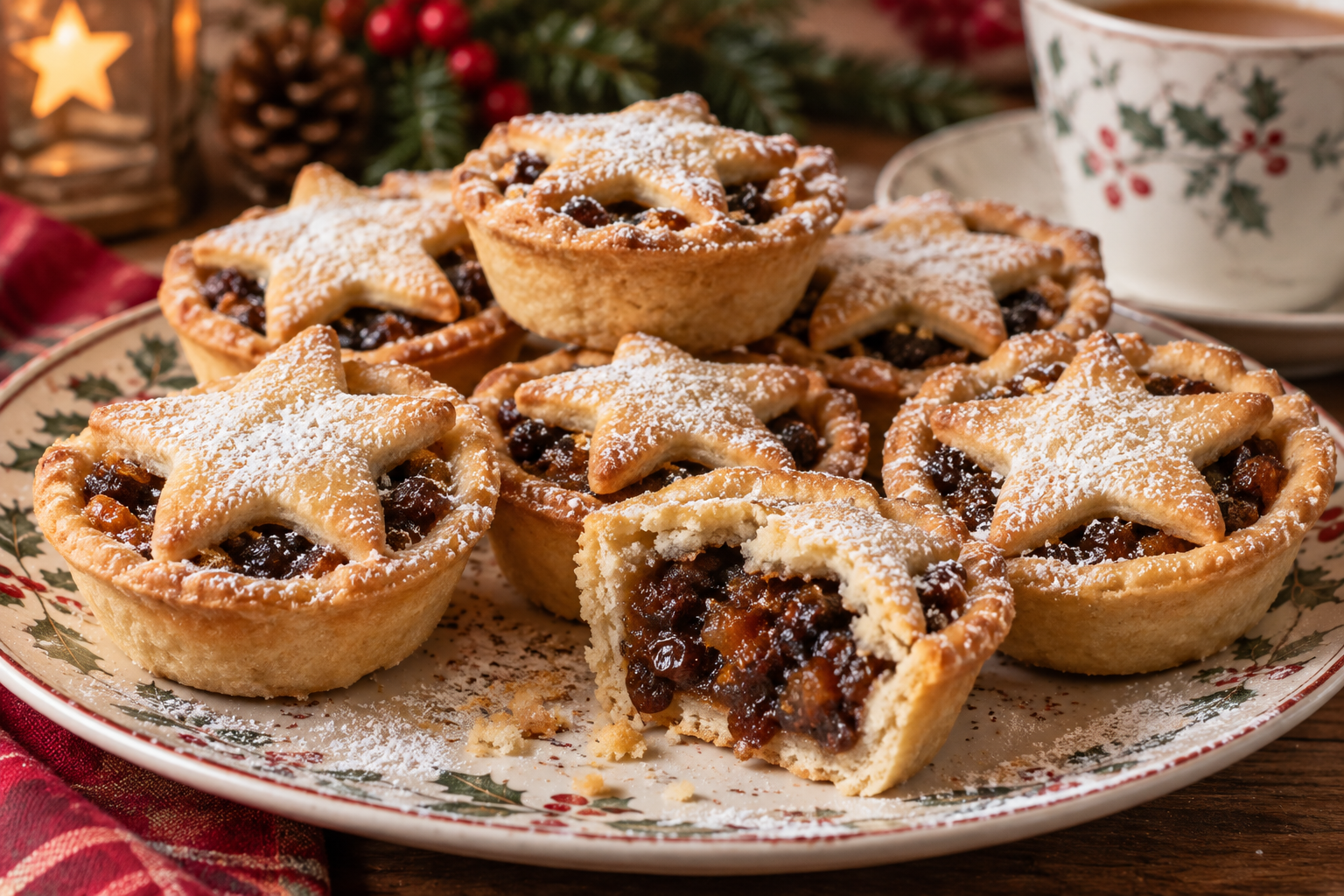
Few foods say British Christmas quite like a plate of warm mince pies.
These small, buttery pastry pies filled with rich, spiced mincemeat begin appearing in British shops and kitchens long before Christmas Day. They’re served at holiday parties, eaten with cups of tea, offered to visitors and traditionally left out for Father Christmas on Christmas Eve.
But the name can be confusing if you didn’t grow up in Britain.
Despite being called mince pies, the sweet Christmas versions you’ll find in Britain today don’t normally contain minced meat. Instead, they’re filled with mincemeat — a sweet mixture of dried fruit, citrus, spices and often brandy.
For American bakers, they’re also surprisingly easy to recreate. You can make your own mincemeat or use a good-quality prepared version, tuck it inside buttery shortcrust pastry and finish the little pies with pastry lids or festive stars.
What Are British Mince Pies?
Modern British mince pies are small sweet pastries traditionally eaten during the Christmas season.
They consist of shortcrust pastry filled with mincemeat, a mixture that commonly contains ingredients such as:
- Raisins
- Currants
- Sultanas or golden raisins
- Candied citrus peel
- Apples
- Sugar
- Spices
- Suet or butter
- Brandy or another spirit
Recipes vary enormously from family to family and between commercial brands.
The filling is rich, fruity and warmly spiced rather than overwhelmingly sweet.
Do Mince Pies Contain Meat?
Usually, no.
Historically, mincemeat really did contain meat. Medieval versions combined minced meat with dried fruit, spices and fat.
Over centuries, the recipe evolved, and modern British Christmas mincemeat is generally a sweet fruit filling.
Some traditional mincemeat recipes still contain suet, but this is fat rather than minced meat. Vegetarian mincemeat made with vegetable suet or butter is also widely available.
So if you’re an American seeing a mince pie for the first time, don’t expect a little meat pie!
For an actual savory British pastry filled with meat, our Traditional Cornish Pasties are a much better example.
What Is Mincemeat?
Mincemeat is the intensely flavored fruit filling inside a mince pie.
Although you can make it from scratch, prepared mincemeat is extremely common in Britain and is perfectly acceptable for homemade mince pies.
In the United States, imported British mincemeat sometimes appears in international sections, specialty food stores or online, particularly during the holiday season.
Check the label carefully if you’re vegetarian, because recipes differ.
What Can I Use in America?
If you can find a jar of British-style mincemeat, that’s the easiest option.
Look for a thick fruit mixture rather than anything resembling ground beef.
If imported mincemeat isn’t available, homemade mincemeat is straightforward and can be prepared ahead of time.
Our British Baking Ingredients Americans Need to Know guide is also useful when British recipe terminology doesn’t quite match what you see on American supermarket shelves.
Traditional British Mince Pies Recipe
Prep Time: 30 minutes
Chilling Time: 30 minutes
Bake Time: 18–22 minutes
Total Time: About 1 hour 20 minutes
Makes: Approximately 12 mince pies
Ingredients
For the Shortcrust Pastry
- 2 cups (250g) all-purpose flour
- 3 tablespoons (38g) granulated sugar
- 1/4 teaspoon salt
- 3/4 cup (170g) cold unsalted butter, cut into small cubes
- 1 large egg yolk
- 3–5 tablespoons (45–75ml) ice-cold water
For the Filling
- 1 1/4 cups (approximately 350g) prepared British-style mincemeat
- 1 tablespoon brandy or dark rum, optional
- Finely grated zest of 1/2 orange, optional
For Finishing
- 1 egg beaten with 1 teaspoon water, for egg wash
- Powdered sugar, for dusting
Instructions
1. Make the Pastry
Place the flour, sugar and salt in a large mixing bowl.
Add the cold cubed butter.
Using your fingertips or a pastry cutter, rub the butter into the flour until the mixture resembles coarse breadcrumbs with a few slightly larger pieces remaining.
Add the egg yolk and 3 tablespoons of ice water.
Mix gently until the pastry begins to come together, adding additional cold water 1 tablespoon at a time only if needed.
Avoid overworking the dough.
2. Chill the Dough
Shape the pastry into a flat disc, wrap it and refrigerate for 30 minutes.
Chilling makes the pastry easier to roll and helps prevent it from shrinking during baking.
3. Prepare the Filling
Place the mincemeat in a small bowl.
If desired, stir in the brandy or dark rum and orange zest.
This is optional, particularly if your prepared mincemeat is already strongly flavored.
Brit & Skillet Tip
Taste your prepared mincemeat before adding anything to it.
Some brands are already quite boozy and heavily spiced, while others are milder. There’s no reason to add extra alcohol or spice simply because a recipe says you can.
4. Preheat the Oven
Preheat the oven to 375°F (190°C).
Lightly grease a standard 12-cup muffin pan.
A shallower tart or bun tin is more traditional if you have one, but an American muffin pan works perfectly well.
5. Roll the Pastry
Lightly flour your work surface.
Roll approximately two-thirds of the chilled pastry to about 1/8 inch (3mm) thick.
Using a round cutter approximately 3 1/2–4 inches (9–10cm) across, cut 12 pastry circles.
The exact size you need will depend on your pan.
6. Line the Pan
Gently press one pastry circle into each muffin cup.
Don’t stretch the pastry.
If necessary, reroll the scraps once to make enough circles.
7. Add the Mincemeat
Place approximately 1 generous tablespoon of mincemeat into each pastry case.
Do not overfill them.
The mincemeat becomes hot and bubbly during baking and can overflow if the cases are packed too full.
8. Make the Tops
Roll out the remaining pastry.
For classic closed mince pies, cut smaller circles to create lids.
For a particularly festive appearance, use a star-shaped cookie cutter instead.
Place a pastry star on top of each pie, allowing some of the mincemeat to remain visible around it.
9. Add Egg Wash
Brush the exposed pastry lightly with the beaten egg wash.
If you’re using full pastry lids, cut a tiny slit in the center of each to allow steam to escape.
10. Bake
Bake for 18–22 minutes, or until the pastry is golden brown.
The mincemeat may bubble slightly around the edges.
11. Cool
Leave the pies in the pan for approximately 5–10 minutes.
Carefully loosen them and transfer to a wire rack.
Be cautious — hot mincemeat contains a lot of sugar and can be extremely hot straight from the oven.
12. Finish
Once slightly cooled, dust lightly with powdered sugar.
Serve warm or at room temperature.
What Pan Should I Use?
Traditional British mince pies are often made in a shallow bun tin rather than the deeper muffin pans common in American kitchens.
But you absolutely don’t need to buy a special pan.
A standard American 12-cup muffin pan works well. Simply press the pastry into the bottom and partway up the sides rather than trying to create a very deep pie.
If you already enjoy making traditional British pastry recipes such as Traditional British Custard Tart, you’ll find the basic shortcrust technique very familiar.
Can I Use Store-Bought Pie Crust?
Yes.
Homemade shortcrust gives the pies a particularly buttery texture, but refrigerated American pie dough is a perfectly reasonable shortcut during the busy Christmas season.
Avoid sweet cookie-style crusts. You want something closer to a standard flaky pie pastry.
Can I Use Puff Pastry?
You can, although shortcrust pastry is more traditional.
Puff pastry creates a lighter, flakier mince pie and works particularly well for the tops.
Some bakers even use shortcrust for the bases and puff pastry for the lids.
How Much Mincemeat Goes in Each Pie?
Less than you might think.
About one generous tablespoon is usually enough for a standard muffin-pan mince pie.
Overfilling is one of the easiest ways to end up with sticky mincemeat bubbling over the pastry and onto the pan.
Why Did My Mince Pies Stick to the Pan?
Escaping mincemeat is usually responsible.
Because the filling contains a lot of sugar, it becomes extremely sticky when baked.
Lightly greasing the pan helps, but the best prevention is simply not overfilling the pies.
If some filling does escape, loosen the pies while they’re still slightly warm rather than waiting until the sugar has completely hardened.
Can I Make Homemade Mincemeat?
Absolutely.
A simple homemade version can be made with chopped apples, raisins, currants, golden raisins, candied citrus peel, brown sugar, butter, orange and lemon zest, warm spices and optional brandy.
Homemade mincemeat is especially useful if you’d like greater control over the amount of dried fruit, sweetness or alcohol.
It can also be made well before Christmas, making the actual pie-making day much quicker.
Can I Make Mince Pies Without Alcohol?
Yes.
Many prepared mincemeats contain alcohol, so check the label if you need an alcohol-free version.
For homemade mincemeat, orange juice or apple juice can provide additional moisture and flavor instead.
Mince Pie Variations
Star-Topped Mince Pies
Instead of covering the filling completely, place a pastry star over each pie.
They’re festive, simple and probably my favorite way to make them.
Orange Mince Pies
Add finely grated orange zest to the mincemeat or pastry.
Almond Mince Pies
Sprinkle a few sliced almonds over the filling before adding the pastry top.
Rum Mince Pies
Stir a small splash of dark rum into the mincemeat.
If you’ve already made our Traditional British Rum Truffles, this is another easy way to bring that warm rum flavor into your Christmas baking.
Mini Mince Pies
Use a mini muffin pan and smaller pastry cutters to make bite-size pies for a Christmas party.
Begin checking them earlier because smaller pies will bake more quickly.
Brit & Skillet Tip
Don’t try to make every pastry star or edge look absolutely identical.
Slightly uneven edges and differently shaped pastry tops are part of what makes a tray of homemade mince pies look inviting rather than factory-made.
What Do You Serve With Mince Pies?
Mince pies are usually served on their own with tea or coffee, but warm pies are also delicious with:
- Whipped cream
- Pouring cream
- Brandy butter
- Vanilla ice cream
- Clotted cream
At Christmas parties, simply arrange them on a platter and dust them with powdered sugar.
They also work beautifully alongside Traditional British Trifle when you want several British desserts on a holiday table.
Why Do British People Leave Mince Pies for Father Christmas?
On Christmas Eve, many British children traditionally leave a mince pie and a drink for Father Christmas.
A carrot is often left for the reindeer too.
The drink varies from household to household — you may see milk, sherry, whisky or another festive tipple depending on family tradition.
It’s one of those small traditions that makes mince pies particularly tied to British Christmas memories.
Can I Make Mince Pies Ahead?
Yes — and they’re an excellent make-ahead Christmas bake.
Bake the pies, allow them to cool completely and store them in an airtight container.
They can be refreshed briefly in a warm oven before serving.
You can also prepare the pastry ahead and refrigerate it for up to 2 days.
How to Store Mince Pies
Once completely cool, keep mince pies in an airtight container.
They’ll generally keep for about 3–4 days at room temperature, depending on the mincemeat used.
For longer storage, refrigerate them and warm them slightly before serving.
Can You Freeze Mince Pies?
Yes.
Mince pies freeze extremely well.
Freezing Baked Mince Pies
Cool them completely and place them in a freezer-safe container with parchment between layers.
Freeze for up to 3 months.
Thaw at room temperature and warm briefly in a 325°F (165°C) oven.
Dust with fresh powdered sugar before serving.
Freezing Unbaked Mince Pies
Assemble the pies in a freezer-safe pan and freeze until firm.
Transfer them carefully to a freezer container.
They can then be returned to the pan and baked after thawing in the refrigerator.
A Proper Taste of British Christmas
Mince pies are one of those recipes that make much more sense once you’ve actually eaten one.
The name may sound strange to American ears, but beneath that confusing name is simply a little buttery pastry filled with rich, fragrant Christmas fruit.
Make a batch alongside our Traditional British Pigs in Blankets, and you’ve already got two of the foods most strongly associated with a British Christmas table.
Add a few Rum Truffles, put the kettle on and suddenly Christmas feels rather British indeed.
For more traditional dishes adapted for an American kitchen, explore our British Recipes at Brit & Skillet.