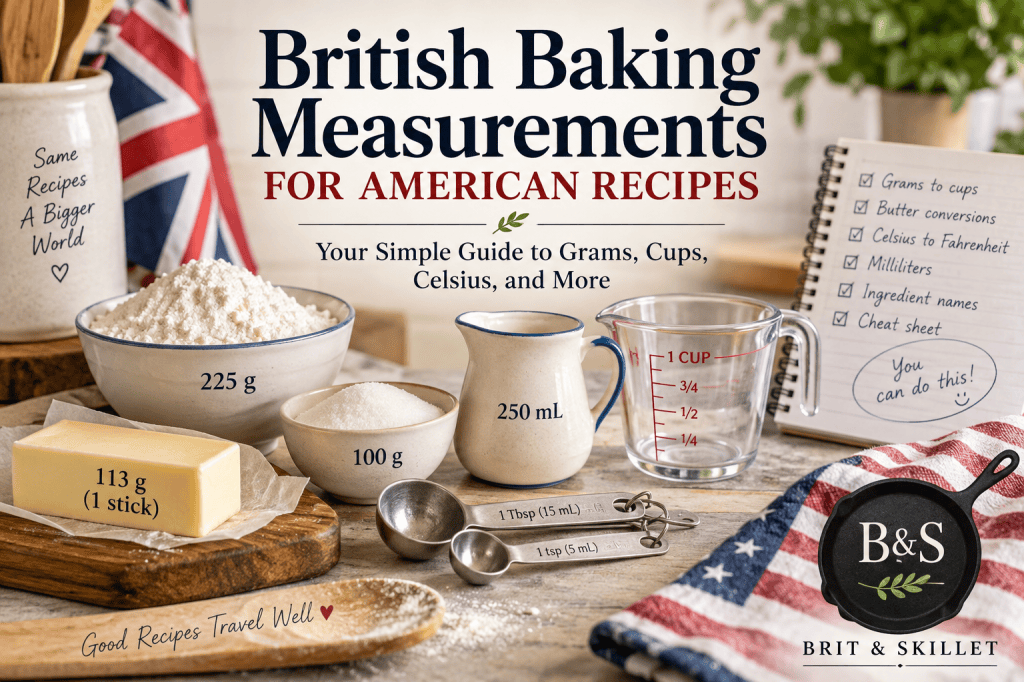
British recipes can sometimes look like they’re written in another language—even when every word is technically English.
Instead of cups of flour and sticks of butter, you may see ingredients measured in grams and milliliters. Oven temperatures might be listed in Celsius or for a fan oven, while familiar ingredients such as caster sugar and self-raising flour come with their own translation challenges.
For an American baker trying a Victoria sponge, sticky toffee pudding, scones, or another British favorite, all those little differences can make a straightforward recipe feel more complicated than it really is.
The good news is that you don’t need to rewrite every British recipe before you start baking.
In many cases, the easiest—and most accurate—approach is simply to use a digital kitchen scale and follow the gram measurements given in the original recipe. Professional baking resources such as King Arthur Baking also recommend weighing ingredients when possible because weight measurements avoid many of the inconsistencies that come with measuring dry ingredients by volume. King Arthur Baking
But sometimes you really do need a conversion. Maybe your oven only displays Fahrenheit, you don’t own a metric measuring jug, or you’re trying to understand how 200 grams of an ingredient relates to the cups and ounces you’re accustomed to using.
That’s where this guide comes in.
We’ll explain how to handle grams, ounces, cups, milliliters, Celsius, Fahrenheit, fan ovens, butter measurements, and some of the most common British baking ingredients so you can follow British recipes confidently in an American kitchen.
Most importantly, we’ll explain when converting a measurement is perfectly reasonable—and when you’re better off leaving the recipe in grams.
Why British Recipes Use Grams Instead of Cups
Great. Next add this as an H2:
Why British Recipes Use Grams Instead of Cups
Then paste:
One of the biggest adjustments for American bakers using British recipes is getting used to seeing ingredients measured in grams rather than cups.
The difference comes down to what the two systems are actually measuring. Grams measure weight, while cups measure volume. That distinction matters in baking because two ingredients that fill the same measuring cup can weigh very different amounts.
A cup of flour, for example, does not weigh the same as a cup of sugar. Even two people measuring the same cup of flour can end up with different amounts depending on how tightly the flour is packed into the cup.
That’s one reason weighing ingredients can make baking more consistent. Instead of worrying about whether flour has been scooped, spooned, packed, or leveled correctly, you can place a bowl on a digital scale, reset it to zero, and add the ingredient until you reach the weight specified in the recipe.
Why This Is Actually Good News for American Bakers
At first, a British recipe calling for 225 g of flour may look less familiar than one calling for cups.
But if you own a digital kitchen scale, there’s usually no conversion required at all.
Set the scale to grams, place your mixing bowl on top, press the tare or zero button, and weigh the amount listed in the recipe.
You can then reset the scale between ingredients and continue adding them to the bowl when the recipe allows.
This approach can also mean fewer measuring cups to wash—which is perhaps the most persuasive argument of all. 😂
Why We Don’t Recommend Converting Every Gram Measurement to Cups
It can be tempting to find a conversion calculator and translate every ingredient into American cups before starting a British recipe.
The problem is that grams and cups don’t have a single universal conversion.
Different ingredients have different densities. King Arthur Baking’s ingredient weight chart, for example, lists one cup of all-purpose flour at 120 grams, while one cup of granulated sugar is 198 grams.
That means a conversion needs to be specific to the ingredient—not simply the size of the measurement.
Even flour conversions can differ slightly between recipe publishers because their measuring methods and reference weights aren’t always identical. For that reason, when a trustworthy British recipe already gives you weights in grams, using those original gram measurements is usually the simplest choice.
For Brit & Skillet recipes and guides, we’ll make American terminology easier to understand whenever possible, but we don’t want to sacrifice the accuracy that makes weight-based baking so useful.
British Grams to American Cups: Common Baking Conversions
If you don’t have a kitchen scale, the following conversions can help you understand common gram measurements found in British baking recipes.
Keep in mind that these are approximate conversions. The weight of one cup depends on the ingredient, and different recipe publishers sometimes use slightly different reference weights. When the original recipe provides grams, using those gram measurements will generally give you the most reliable result. King Arthur Baking likewise recommends following the weight stated in a recipe when one is provided. King Arthur Baking
Common Ingredient Conversions
| Ingredient | 1 Cup (approx.) | 1/2 Cup (approx.) | British/American Note |
|---|---|---|---|
| All-purpose flour | 120 g | 60 g | Similar role to UK plain flour |
| Caster/superfine sugar | 190 g | 95 g | Caster sugar is commonly sold as superfine sugar in the US |
| Granulated sugar | 198 g | 99 g | Standard white granulated sugar |
| Brown sugar, packed | 213 g | 107 g | Weight assumes the sugar is packed |
| Icing/confectioners’ sugar | 113 g | 57 g | Icing sugar = confectioners’ or powdered sugar |
| Butter | 227 g | 113 g | 1 US cup = 2 sticks |
| Demerara sugar | 220 g | 110 g | Coarse, golden-colored sugar |
These reference weights are based on King Arthur Baking’s current ingredient-weight chart: it lists all-purpose flour at 120 g per cup, superfine/caster sugar at 190 g, granulated sugar at 198 g, packed brown sugar at 213 g, unsifted confectioners’ sugar at 113 g, butter at 227 g per cup, and demerara sugar at 220 g. King Arthur Baking
A Quick Example
Suppose a British cake recipe calls for:
225 g of plain flour
Using the 120 g-per-cup reference above, that’s roughly:
225 ÷ 120 = 1.875 cups
—or about 1 7/8 cups.
But here’s the important part: if the recipe already says 225 g, don’t convert it unless you have to.
Put your bowl on a digital kitchen scale, press tare, and weigh out 225 g. It’s easier, involves less guesswork, and preserves the measurement the recipe developer actually intended.
What About Oats?
Oats are a particularly good example of why conversion charts need to be treated carefully.
King Arthur lists ordinary old-fashioned or quick-cooking oats at approximately 89 g per cup, while its own rolled oats are listed at 113 g per cup. King Arthur Baking
Differences in the type and cut of an ingredient can change how much fits into a cup. That’s another reason we recommend treating cup conversions as a convenience rather than an exact replacement for the original weight.
Brit & Skillet tip: When a British recipe gives you grams, think of your kitchen scale as the translator. You don’t actually have to convert the recipe—you just have to change the scale to g.
British Butter Measurements: Grams to American Sticks and Tablespoons
British baking recipes usually measure butter by weight. An American recipe, on the other hand, might call for sticks, tablespoons, or cups.
Fortunately, butter is one of the simpler ingredients to translate.
In the United States, one standard stick of butter is approximately 113 grams, or 4 ounces. That same stick equals 1/2 cup or 8 tablespoons. King Arthur Baking’s ingredient chart confirms 8 tablespoons (1/2 cup) of butter at 113 grams.
Quick Butter Conversion Chart
| British Weight | Approx. US Sticks | Tablespoons | Cups |
|---|---|---|---|
| 57 g | 1/2 stick | 4 tbsp | 1/4 cup |
| 113 g | 1 stick | 8 tbsp | 1/2 cup |
| 170 g | 1 1/2 sticks | 12 tbsp | 3/4 cup |
| 225–227 g | 2 sticks | 16 tbsp | 1 cup |
| 340 g | 3 sticks | 24 tbsp | 1 1/2 cups |
Why 225 Grams Appears So Often in British Baking
If you’ve spent much time looking at British cake recipes, you’ll probably encounter 225 g of butter sooner or later.
For an American baker, that’s conveniently close to two sticks of butter. Two US sticks weigh approximately 226–227 grams, so the tiny difference between 225 g and 227 g isn’t something you need to lose sleep over in an ordinary cake recipe. King Arthur’s reference weight puts one cup—or two sticks—at 226 grams when calculated from its rounded 113 g half-cup measurement. King Arthur Baking
So when a British recipe calls for 225 g of softened butter, two standard American sticks will generally put you right where you need to be.
What About 100 Grams of Butter?
This is where using a scale becomes much easier than trying to slice a stick into increasingly mysterious fractions. 😂
Since one stick is approximately 113 g, 100 g is a little less than one full stick.
Rather than estimating visually, place the butter on your kitchen scale and cut off enough to reach 100 g. This is especially useful when a recipe calls for less convenient amounts such as 75 g, 100 g, or 150 g.
Salted or Unsalted?
The measurement conversion itself doesn’t substantially change depending on whether you’re using salted or unsalted butter.
What does matter is what the recipe calls for. If a British recipe specifies unsalted butter, use unsalted butter. If it simply says butter, check the recipe author’s notes before making assumptions—particularly if the recipe also contains added salt.
Brit & Skillet shortcut: Remember just one number:
1 American stick of butter ≈ 113 g.
Once you know that, translating British butter measurements becomes considerably less intimidating.
Celsius to Fahrenheit: British Oven Temperature Conversions
British recipes generally give oven temperatures in Celsius, while most American ovens are set in Fahrenheit. Fortunately, converting between the two is fairly straightforward.
The extra wrinkle is the fan oven.
British recipes often provide two temperatures, such as:
180°C / 160°C fan
The first temperature is for a conventional oven. The second, lower temperature is for an oven using a fan to circulate hot air.
Fan oven temperatures are commonly around 20°C lower than conventional oven temperatures because the circulating air transfers heat more efficiently. Which?’s current oven conversion guidance uses that same 20°C difference across its standard conversion table. Which?
British Oven Temperature Conversion Chart
| Conventional °C | Fan °C | Fahrenheit °F | Gas Mark |
|---|---|---|---|
| 140°C | 120°C fan | 275°F | 1 |
| 150°C | 130°C fan | 300°F | 2 |
| 160°C | 140°C fan | 325°F | 3 |
| 180°C | 160°C fan | 350°F | 4 |
| 190°C | 170°C fan | 375°F | 5 |
| 200°C | 180°C fan | 400°F | 6 |
| 220°C | 200°C fan | 425°F | 7 |
These are standard rounded cooking conversions rather than exact mathematical equivalents. For example, Which? lists 180°C conventional / 160°C fan / 350°F / Gas Mark 4 and 200°C conventional / 180°C fan / 400°F / Gas Mark 6. Which?
What Does “180°C Fan” Mean?
This is where it’s easy to make a mistake.
If a British recipe specifically says:
180°C fan
don’t treat that as the same instruction as 180°C conventional.
Using the standard conversion chart, 180°C fan corresponds roughly to 200°C conventional, or 400°F. Which?
So if you’re using an American conventional oven and the British recipe specifically calls for 180°C fan, approximately 400°F is the corresponding conventional setting.
On the other hand, if the recipe says:
180°C / 160°C fan
then an American conventional oven would normally be set to approximately 350°F.
That’s why it’s important to notice whether the word fan appears next to the temperature rather than simply converting the Celsius number by itself.
A Common British Recipe Example
You may encounter an instruction such as:
200°C / 180°C fan / Gas 6
For an American conventional oven, that translates neatly to approximately:
400°F
British recipes commonly use exactly this style of notation. Good Food, for example, gives recipes at 200°C conventional / 180°C fan / Gas 6. Good Food
Don’t Forget That Ovens Vary
Even after you’ve converted the temperature correctly, your actual oven may run somewhat hotter or cooler than its setting.
Which? has found substantial temperature variation in oven testing and notes that even a 20°C difference can noticeably affect a Victoria sponge’s appearance and texture. Which?
If cakes consistently brown too quickly, take much longer than expected, or bake unevenly, an inexpensive oven thermometer can help you determine whether your oven temperature matches the setting on the dial.
Brit & Skillet shortcut: When you see a British recipe written as:
180°C / 160°C fan / Gas 4
think:
350°F in a conventional American oven.
Once you’ve recognized that pattern, British oven instructions become considerably less mysterious.
Milliliters to American Cups, Tablespoons, and Teaspoons
British recipes commonly measure liquids in milliliters (mL) rather than cups and fluid ounces. You might see milk, cream, water, or another liquid listed as 100 mL, 250 mL, or 500 mL.
Unlike converting cups of flour into grams, this is a true volume-to-volume conversion, so it’s much more straightforward.
A standard US cup holds approximately 236.6 mL. A US tablespoon holds approximately 14.79 mL, and a US teaspoon holds approximately 4.93 mL, according to NIST’s conversion guidance. NIST
Quick Milliliter Conversion Chart
| Milliliters | US Cups (approx.) | US Fluid Ounces (approx.) | Handy Kitchen Measure |
|---|---|---|---|
| 5 mL | — | — | 1 tsp |
| 15 mL | — | 1/2 fl oz | 1 tbsp |
| 60 mL | 1/4 cup | 2 fl oz | 4 tbsp |
| 120 mL | 1/2 cup | 4 fl oz | 8 tbsp |
| 240 mL | 1 cup | 8 fl oz | 16 tbsp |
| 250 mL | 1.06 cups | 8.45 fl oz | Just over 1 US cup |
| 500 mL | 2.11 cups | 16.9 fl oz | Just over 2 US cups |
These are rounded kitchen conversions. Technically, one US cup is about 236.6 mL, so the familiar 240 mL figure is a convenient kitchen approximation rather than an exact conversion. King Arthur similarly lists one US fluid ounce as 29.57 mL. King Arthur Baking
The 250 mL Cup Trap
Here’s one worth remembering.
A 250 mL metric cup is not exactly the same as an American measuring cup.
One US cup is approximately 236.6 mL, so 250 mL is a little more than one US cup. The difference isn’t enormous, but it can matter when you’re trying to follow a baking recipe accurately. NIST
If the original British recipe gives a liquid measurement in milliliters and your measuring jug has metric markings, the easiest solution is simple:
Use the milliliter markings and don’t convert it at all.
What About Tablespoons and Teaspoons?
For everyday cooking, British metric recipes commonly work with approximately 15 mL per tablespoon and 5 mL per teaspoon. Those figures are extremely close to American measures: NIST gives the US tablespoon as approximately 14.79 mL and the US teaspoon as approximately 4.93 mL. NIST
So if a modern British recipe calls for 1 teaspoon or 1 tablespoon, your standard American measuring spoons will generally do the job just fine.
Don’t Confuse Fluid Ounces With Ounces by Weight
This one deserves a warning because the names are spectacularly unhelpful. 😂
A fluid ounce measures volume.
An ounce measures weight.
They’re different measurements, even though both use the word ounce.
King Arthur’s conversion guidance puts one US fluid ounce at approximately 29.57 mL, while one ounce by weight equals approximately 28.35 grams. King Arthur Baking
So if a British recipe says 200 g of flour, don’t try to convert that using fluid ounces. And if it says 200 mL of milk, don’t treat that as 200 grams unless the recipe specifically provides that equivalence.
Brit & Skillet shortcut: If your American liquid measuring cup already has mL markings on the side, use them. Sometimes the easiest conversion is no conversion at all. 😄
British vs. American Measuring Cups: Are They the Same?
Not necessarily—and this is where international recipes can become surprisingly confusing.
A standard US customary cup holds approximately 236.6 mL. A metric cup holds 250 mL, while the older British imperial cup was approximately 284 mL. Modern British recipes, however, generally rely much more heavily on grams and milliliters than on traditional imperial cups. Precision Convert
That means you shouldn’t automatically assume that every recipe using the word cup is referring to exactly the same amount.
American Recipes and Cups
Cup measurements remain extremely common in American home baking. A standard set typically includes measurements such as:
- 1 cup
- 1/2 cup
- 1/3 cup
- 1/4 cup
Good Food even describes measuring cups as particularly useful when following American recipes, where cup measurements are standard. BBC Good Food
If you’re following an American recipe, your ordinary US measuring cups are therefore exactly what you would expect to use.
British Recipes Are Different
With a modern British baking recipe, you’re much more likely to encounter flour, sugar, and butter measured in grams, with liquids given in milliliters.
That’s actually helpful for an American baker because grams and milliliters don’t change when they cross the Atlantic.
200 g is still 200 g.
250 mL is still 250 mL.
There’s no need to determine which country’s cup the recipe author had sitting in the cupboard.
Be Careful With Older British Cookbooks
Older British recipes can require a little more attention because you may encounter imperial measurements.
A traditional imperial cup is approximately 284 mL, substantially larger than the approximately 236.6 mL US customary cup. CoolConversion
So if an older British cookbook genuinely uses imperial cups, substituting an American cup measure without converting it could change the proportions of the recipe.
Fortunately, this isn’t something you’re likely to encounter frequently in modern British baking recipes.
The Simplest Rule
When following a British recipe:
If it gives grams, use grams. If it gives milliliters, use milliliters.
If a recipe specifically uses cups, check where the recipe originated before assuming that your American measuring cup represents exactly the same volume.
For a deeper look at this particular difference, see our guide How British and American Measuring Cups Differ.
Brit & Skillet tip: You don’t need to convert a perfectly good metric recipe just because your kitchen is in America. A digital scale and a measuring jug marked in milliliters can do most of the translating for you.
British Baking Ingredient Names Americans Need to Know
Sometimes the measurements aren’t the confusing part of a British recipe—the ingredient names are.
British and American bakers often use different names for ingredients that are identical or very similar. Learning a handful of these translations makes British recipes much easier to shop for and understand.
Quick British-to-American Ingredient Guide
| British Recipe Says | Look for in the US | What to Know |
|---|---|---|
| Plain flour | All-purpose flour | Usually the closest everyday equivalent |
| Caster sugar | Superfine sugar | Finer crystals than ordinary granulated sugar |
| Icing sugar | Confectioners’ or powdered sugar | Used for buttercream, icing and dusting |
| Self-raising flour | Self-rising flour | Contains raising agents; formulations can vary |
| Double cream | Heavy cream | Closest commonly available US option, though not identical |
| Bicarbonate of soda | Baking soda | Same basic leavening ingredient |
| Cornflour | Cornstarch | In British recipes, cornflour usually means the fine starch Americans call cornstarch |
Caster Sugar vs. Superfine Sugar
Caster sugar is one of the most common ingredients American bakers encounter in British cake recipes.
In the United States, look for superfine sugar, sometimes sold as baker’s sugar. King Arthur describes superfine sugar as also being known as caster sugar and notes that its smaller crystals dissolve particularly easily, making it useful for cakes, meringues, and other delicate mixtures. King Arthur Baking
If you can’t find it, ordinary granulated sugar can sometimes be processed briefly in a blender or food processor to make the crystals finer. King Arthur recommends this approach as a substitute, preferably measuring the sugar by weight. King Arthur Baking
Icing Sugar vs. Powdered Sugar
When a British recipe calls for icing sugar, an American baker should generally reach for confectioners’ sugar or powdered sugar.
These names refer to the finely powdered sugar commonly used for buttercream, glazes, and dusting cakes. King Arthur specifically identifies confectioners’ sugar as also being called powdered sugar or icing sugar. King Arthur Baking
So if your Victoria sponge tells you to dust the top with icing sugar, there’s no need to hunt down a mysterious imported ingredient. The powdered sugar already sitting in your pantry is what you’re looking for.
Plain Flour vs. All-Purpose Flour
British plain flour generally fills the role that all-purpose flour does in an American kitchen.
However, flours aren’t necessarily manufactured to identical specifications across countries and brands, so treating the terms as practical equivalents doesn’t mean every bag will perform exactly the same way.
For most ordinary cakes, biscuits, pastry, and similar recipes, though, American all-purpose flour is the natural starting point when a British recipe specifies plain flour.
Self-Raising vs. Self-Rising Flour
Here’s one where the names are nearly identical:
British recipes say self-raising flour.
American packages usually say self-rising flour.
Both combine flour with leavening, but formulations can vary. Good Food describes self-raising flour as plain flour combined with baking powder. Good Food
If you don’t have self-rising flour, don’t automatically add a random amount of baking powder. Follow a substitution from a reliable recipe source. King Arthur’s Victoria Sandwich instructions, for example, provide a specific all-purpose-flour, baking-powder and salt substitution for the self-rising flour used in its recipe. King Arthur Baking Shop
Double Cream vs. Heavy Cream
British double cream doesn’t have a perfect everyday American equivalent.
For many recipes, heavy cream or heavy whipping cream is the most practical American choice, particularly for whipping and fillings. But they’re not literally identical products, so it’s better to think of heavy cream as a common substitute rather than a translation that’s exact in every recipe.
This is another good example of why translating British recipes is sometimes about understanding the ingredient’s purpose, rather than simply swapping one name for another.
Bicarbonate of Soda
This one’s easy:
British bicarbonate of soda is what Americans normally call baking soda.
Don’t confuse it with baking powder, though. Baking powder contains both alkaline and acidic components, whereas bicarbonate of soda is the alkaline component itself. Good Food’s baking-powder guide explains that distinction and notes that baking powder combines bicarbonate of soda with an acid and a moisture-absorbing filler. Good Food
Cornflour vs. Cornstarch
This translation can be especially confusing because corn flour means something different in American cooking.
When a British baking recipe calls for cornflour, it generally means the fine white starch Americans know as cornstarch.
So don’t automatically grab an American product labeled corn flour. Check what role the ingredient is playing in the recipe first.
Brit & Skillet tip: When a British ingredient sounds unfamiliar, don’t assume you need to order an expensive imported version. Quite often, the ingredient is already available in an American supermarket—it just has a different name.
Should You Convert a British Recipe or Bake It in Grams?
Yep — this is the section where we give readers permission to stop doing unnecessary baking algebra. 😂
Add this as the next H2:
Should You Convert a British Recipe or Bake It in Grams?
Then paste:
If a British recipe already provides ingredient weights in grams, the simplest approach is usually to leave the recipe exactly as it is and bake by weight.
That might feel unfamiliar at first if you’re accustomed to American cups and measuring spoons, but it actually removes one of the biggest sources of uncertainty in baking.
King Arthur Baking recommends weighing ingredients with a digital scale for best results and points out that the amount of flour contained in a cup can vary depending on how it is measured. A weight such as 120 grams, on the other hand, remains 120 grams regardless of how you scoop it. King Arthur Baking
When You Should Keep the Original Measurements
If the recipe gives you:
225 g flour
225 g caster sugar
225 g butter
there’s usually no advantage to converting those amounts into cups.
Put your bowl on the scale, press the tare or zero button, and weigh each ingredient according to the original recipe.
This is particularly useful for ingredients such as flour and sugar because their cup-to-gram conversions aren’t interchangeable. For example, King Arthur’s current reference chart lists a cup of all-purpose flour at 120 g and a cup of superfine/caster sugar at 190 g. King Arthur Baking
When Converting Makes Sense
There are still plenty of situations where a conversion is useful.
You may need to convert the oven temperature from Celsius to Fahrenheit, for example, because your American oven displays Fahrenheit.
You might also convert milliliters if your measuring jug doesn’t have metric markings, or translate a British ingredient name so you know what to look for at an American supermarket.
And if you simply don’t own a kitchen scale yet, ingredient-specific cup conversions can help you get started.
The important thing is to convert only what actually needs converting.
Don’t Convert Grams to Cups With One Formula
This is perhaps the most important rule in the entire guide:
There is no universal formula that converts grams into cups for every ingredient.
Grams measure mass, while cups measure volume. Different ingredients have different densities, which is why the same cup can contain very different weights depending on what’s inside it.
If you must convert a weight measurement to cups, use a conversion specifically for that ingredient rather than a generic grams-to-cups calculator.
A Kitchen Scale Makes British Recipes Much Easier
If you expect to bake British recipes regularly, a digital kitchen scale is one of the simplest tools you can add to your kitchen.
You don’t need a special British scale. A normal American digital kitchen scale that can switch to grams will do the job.
It can also make scaling recipes easier. Instead of trying to divide awkward measurements such as 1 3/4 cups, weight measurements can simply be divided mathematically. King Arthur recommends using gram measurements when reducing recipes for precisely this reason. King Arthur Baking
And we’ve already covered this topic in more detail in our guide Best Kitchen Scales for British Recipes: A Guide for American Bakers.
Highlight that article title in WordPress and link it to your existing kitchen-scale post. That’s another nice internal link for #13.
The Brit & Skillet Rule
When you’re standing in an American kitchen with a British recipe in front of you, remember:
Keep grams as grams.
Keep milliliters as milliliters when you can.
Convert Celsius to Fahrenheit if your oven requires it.
Translate unfamiliar British ingredient names into their American equivalents.
Do that, and you’ll avoid a surprising amount of unnecessary conversion.
After all, the goal isn’t to turn baking into a mathematics exam.
It’s to get the Victoria sponge into the oven. 😂
Quick British-to-American Baking Conversion Cheat Sheet
If you’re standing in the kitchen with a British recipe in one hand and an American measuring cup in the other, this quick-reference chart covers many of the conversions you’re most likely to need.
Remember that ingredient weights are different from liquid-volume conversions. Don’t use one universal grams-to-cups formula. Different ingredients have different weights per cup; for example, King Arthur lists all-purpose flour at 120 g per cup but superfine/caster sugar at 190 g per cup.
| British Recipe Says | American Equivalent | Quick Note |
|---|---|---|
| 113 g butter | 1 stick | Also 1/2 cup |
| 225–227 g butter | 2 sticks | About 1 cup |
| 120 g all-purpose/plain flour | About 1 cup | Ingredient-specific conversion |
| 190 g caster sugar | About 1 cup | Look for superfine sugar |
| 250 mL liquid | Just over 1 US cup | 1 US cup is about 237 mL |
| 15 mL | About 1 US tbsp | US tbsp is 14.79 mL |
| 5 mL | About 1 US tsp | US tsp is 4.93 mL |
| 180°C conventional | 350°F | Common cake temperature |
| 200°C conventional | 400°F | Common hotter oven setting |
| 160°C fan | About 350°F conventional | Equivalent to roughly 180°C conventional |
NIST’s official conversion guidance gives a US tablespoon as approximately 14.79 mL, a teaspoon as 4.93 mL, a fluid ounce as 29.57 mL, and a US cup as approximately 0.24 liter.
The Bottom Line
British baking measurements can look unfamiliar at first, but you don’t need to convert every number in a recipe before you can start baking.
If a recipe provides ingredients in grams, use the grams whenever possible. A digital kitchen scale removes much of the uncertainty involved in converting ingredients into cups, and baking resources such as King Arthur recommend weighing ingredients when a scale is available. King Arthur Baking
Use milliliters directly if your measuring jug has metric markings. Convert Celsius to Fahrenheit when your oven requires it, and pay attention to whether a British recipe specifies a conventional or fan oven.
For unfamiliar ingredient names, remember that many have perfectly ordinary American counterparts. Caster sugar becomes superfine sugar, icing sugar becomes confectioners’ sugar, bicarbonate of soda becomes baking soda, and British cornflour generally means American cornstarch.
Most importantly, don’t feel as though a British recipe has to be rewritten into American measurements before you can make it.
A kitchen scale that reads grams and a measuring jug marked in milliliters will do most of the translating for you.
The recipe may be British. Your kitchen doesn’t have to be.
And if all else fails, put the kettle on and reread the instructions. That part translates perfectly on both sides of the Atlantic. 😂
Note: Baking conversions in this guide are approximate and may vary slightly depending on the ingredient, brand, measuring method, and recipe source. When a recipe provides measurements in grams, we recommend using the original weight measurements whenever possible.
 Brit & Skillet