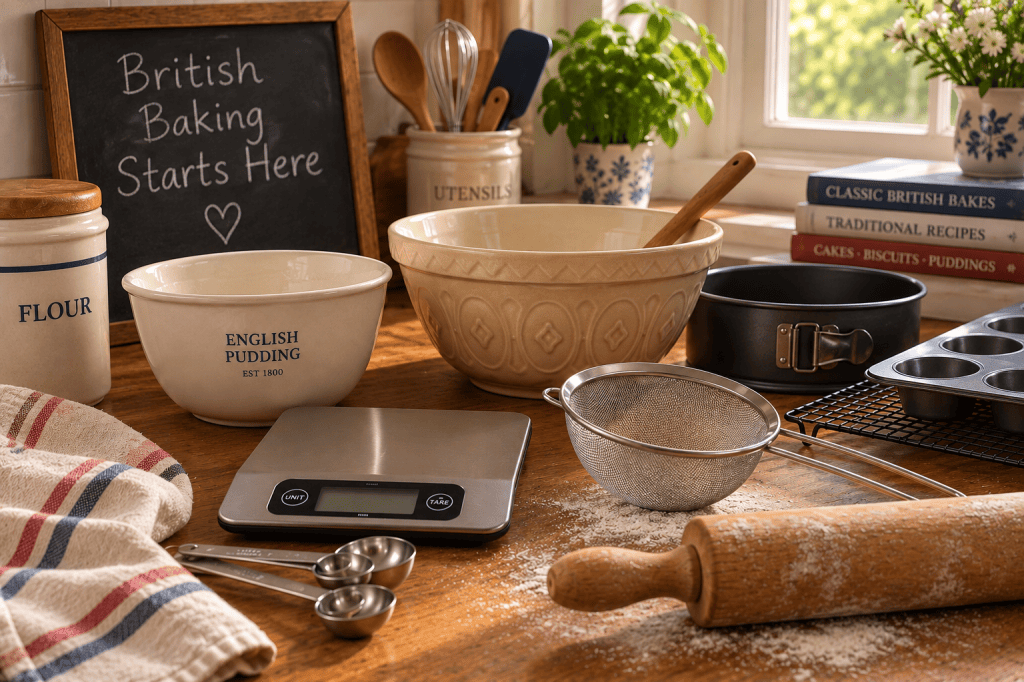
British baking doesn’t require a completely different kitchen, but having the right tools can make traditional recipes much easier to follow—especially when you’re baking from a British recipe in an American kitchen.
From weighing flour in grams to finding the right tin for a Victoria sponge, a few simple pieces of equipment can help take the guesswork out of converting British recipes.
Here are 10 useful kitchen tools for anyone who wants to make British cakes, biscuits, breads, puddings, and other classic bakes at home in the United States.
1. A Digital Kitchen Scale
If you buy only one tool specifically for British baking, make it a digital kitchen scale. British recipes commonly list ingredients by weight in grams rather than relying primarily on cups.
Weighing ingredients is especially helpful with flour, sugar, butter, and other ingredients where measuring by volume can produce inconsistent results. It also means you can follow a British recipe without constantly converting grams into American cups.
Look for a digital scale that can switch between grams and ounces, has an easy-to-read display, and includes a tare function so you can place a bowl on the scale and reset the display to zero before adding your ingredients.
Brit & Skillet tip: Keep the recipe in grams whenever possible instead of converting everything to cups. It’s usually simpler—and you’ll be following the measurements the recipe was originally designed around.
2. The Right Baking Tins
In British recipes, you’ll often see the word “tin” where an American recipe might say “pan.” A cake tin is simply a cake pan, a loaf tin is a loaf pan, and a roasting tin is what Americans would usually call a roasting pan.
The important thing is the size. British recipes frequently specify tins in centimeters, so check the dimensions before choosing an American pan. Even a small difference in the size or depth of a tin can affect how quickly a cake bakes and how thick the finished layers are.
If you plan to make classic British cakes, a pair of round cake tins is particularly useful. They’re ideal for layered bakes such as Victoria sponge and many other traditional cakes.
Brit & Skillet tip: Don’t worry if your American pan isn’t an exact metric match. Choose the closest size available and start checking the bake a little earlier if your pan is wider or shallower than the one specified in the recipe.
3. A Good Set of Measuring Spoons
Even though British baking relies heavily on weighing ingredients, measuring spoons are still essential for smaller quantities such as baking powder, baking soda, spices, vanilla, and salt.
British recipes generally use familiar teaspoon and tablespoon measurements, but there is one important difference to watch for: an Australian tablespoon is traditionally larger than the British and American tablespoon. If you’re following a British recipe, a standard American tablespoon is generally the appropriate equivalent.
A set with clearly marked tablespoon, teaspoon, 1/2 teaspoon, and 1/4 teaspoon measurements will handle most British recipes without any trouble.
Brit & Skillet tip: When a recipe calls for a level teaspoon or tablespoon, run the back of a knife across the top of the spoon rather than using a heaping spoonful. Small differences can matter with ingredients such as baking powder and baking soda.
4. A Reliable Set of Mixing Bowls
A good set of mixing bowls is one of those simple kitchen essentials you’ll use for almost every British bake. From scones and biscuits to sponge cakes and bread dough, having several bowl sizes makes preparing ingredients much easier.
Stainless steel, glass, and sturdy ceramic bowls can all work well. A larger bowl is useful for mixing cake batters and doughs, while smaller bowls are handy for weighing ingredients separately before combining them.
If you use a digital kitchen scale, choose bowls that sit comfortably on the weighing platform without covering the scale’s display. Lightweight bowls are particularly convenient when you’re weighing several ingredients directly into the same bowl.
Brit & Skillet tip: Try the “weigh as you go” method. Place your mixing bowl on the scale, press tare to return it to zero, add the first ingredient, then tare the scale again before adding the next. It saves dishes and makes British recipes surprisingly easy to follow.
5. A Pudding Basin
If you want to venture beyond cakes and biscuits into traditional British puddings, a pudding basin is a useful addition to your kitchen. These deep, rounded bowls are traditionally used for steamed puddings such as Christmas pudding, sticky toffee-style puddings, and other classic recipes.
Pudding basins are commonly made from ceramic, stoneware, or heat-resistant plastic. The rounded shape helps a steamed pudding cook evenly and gives it the traditional domed appearance when turned out onto a plate.
British recipes may specify the size of a pudding basin in pints rather than cups or quarts. Before buying one, check the capacity called for in the recipe rather than judging the size by appearance alone.
Brit & Skillet tip: You don’t need a cupboard full of pudding basins. Start with one versatile medium-sized basin, and add another size only if you find yourself making steamed puddings regularly.
6. A Fine-Mesh Sieve
British baking recipes often tell you to “sift” flour, icing sugar, cocoa powder, or other dry ingredients. A fine-mesh sieve makes this quick and easy while helping break up lumps before the ingredients go into your mixture.
A sieve is particularly useful when working with icing sugar—called powdered or confectioners’ sugar in the United States—or when dusting the top of a finished cake or bake.
You don’t need anything elaborate. A medium-sized fine-mesh sieve with a comfortable handle is versatile enough for most home baking jobs and can also be used for everyday cooking.
Brit & Skillet tip: If a British recipe tells you to sift flour together with baking powder or another dry ingredient, put them into the sieve at the same time. This helps distribute the ingredients throughout the flour before you begin mixing.
7. A Good Rolling Pin
A rolling pin is essential for many British bakes, especially when you start making pastry, biscuits, pies, tarts, and other traditional favorites.
You don’t need an expensive rolling pin. A simple wooden or silicone model works perfectly well for most home bakers. The most important thing is that it feels comfortable to use and gives you enough length to roll dough evenly.
When rolling pastry or biscuit dough, use only enough flour on your work surface to prevent sticking. Adding too much extra flour can make the finished bake tougher or drier than intended.
Brit & Skillet tip: When a British recipe tells you to roll something to a thickness measured in millimeters, don’t worry about getting out a ruler every time. After a little practice, you’ll become surprisingly good at judging the thickness by sight.
8. A Wire Cooling Rack
A wire cooling rack may not seem particularly exciting, but it makes a noticeable difference when cooling cakes, biscuits, scones, and other British bakes.
The raised wire surface allows air to circulate underneath your bake instead of trapping steam against the bottom. This is especially useful for biscuits and pastry, where trapped moisture can make the bottoms softer than intended.
Choose a sturdy rack that’s large enough to hold one of your usual baking tins or a batch of biscuits. If you have limited kitchen storage, a rectangular rack that fits inside one of your baking trays can be particularly convenient.
Brit & Skillet tip: Let cakes cool in their tins for the amount of time specified in the recipe before turning them onto the rack. Removing a delicate sponge too soon can cause it to crack or break apart.
9. An Electric Hand Mixer
You can make plenty of British bakes with nothing more than a wooden spoon and a little determination, but an electric hand mixer makes many recipes considerably easier.
It’s particularly useful for creaming butter and sugar together, whipping cream, beating eggs, and preparing light cake batters. For classic British sponge cakes, properly creamed butter and sugar can help create the light, tender texture you’re looking for.
A basic hand mixer is sufficient for most home bakers. Look for several speed settings, comfortable controls, and removable beaters that are easy to clean. You don’t necessarily need a large stand mixer unless you bake frequently or regularly work with heavier mixtures and doughs.
Brit & Skillet tip: When creaming butter and sugar, start with properly softened butter rather than trying to compensate with a higher mixer speed. The butter should be soft enough to mix easily but not melted.
10. A Food Processor
A food processor isn’t essential for every British recipe, but it can become one of the most useful tools in your kitchen once you start making pastry, breadcrumbs, scones, and other traditional bakes.
For pastry in particular, a food processor can quickly combine cold butter and flour while helping you avoid overworking the mixture with warm hands. It can also make quick work of chopping nuts, preparing breadcrumbs, and mixing certain doughs and fillings.
You don’t need the largest or most powerful model available. For most home cooks, a reliable food processor with a standard blade and a reasonably sized bowl will handle everyday baking and cooking jobs perfectly well.
Brit & Skillet tip: When using a food processor for pastry, use short pulses rather than running the machine continuously. Stop once the mixture reaches the texture described in your recipe—you don’t want to overwork the dough.
Start Your British Baking Kitchen
You don’t need to replace everything in your kitchen to start baking British recipes. In fact, you probably already own several of the tools on this list.
If you’re just getting started, begin with a digital kitchen scale and the baking tins you need for the recipes you want to make. From there, you can gradually add tools such as a pudding basin, sieve, mixer, or food processor as your British baking adventures expand.
The most important thing is having equipment that helps you follow the original recipe confidently—without turning every bake into a complicated exercise in conversions.
With a few dependable tools and a willingness to try something new, an American kitchen can be perfectly equipped for everything from a Victoria sponge to a proper British pudding.
Happy baking!
— Jane at Brit & Skillet
Affiliate Disclosure: Brit & Skillet may earn a commission from qualifying purchases made through links on this page, at no additional cost to you. We only recommend products that we believe are relevant and useful to our readers.
 Brit & Skillet