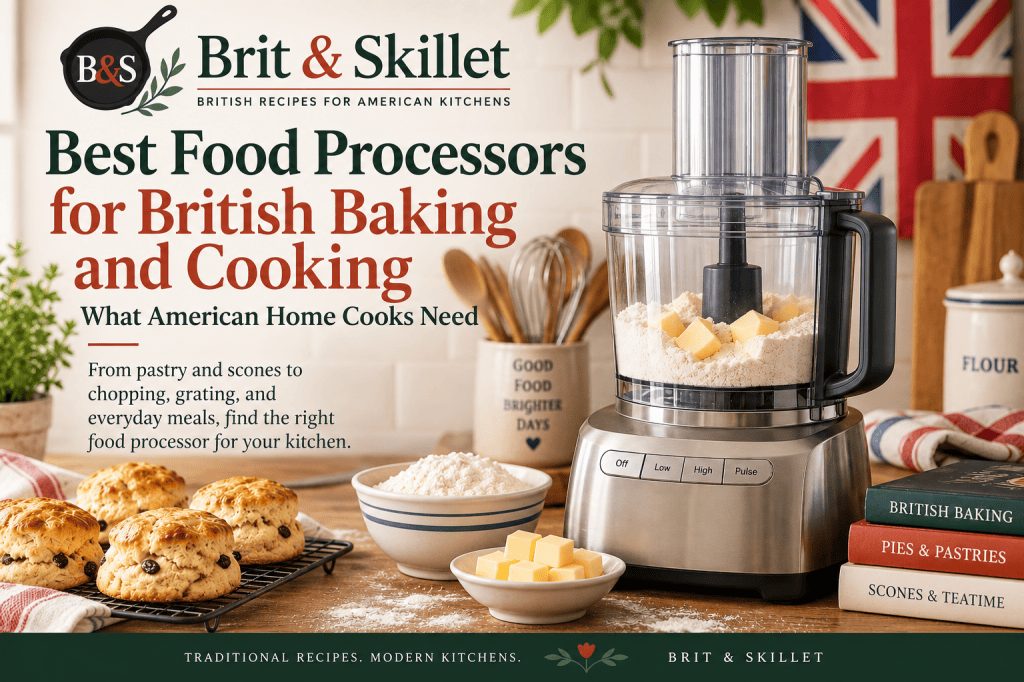
British cooking has plenty of recipes that can be made with little more than a good knife, a wooden spoon, and a mixing bowl. But a food processor can make some of the more time-consuming jobs considerably easier.
From rubbing cold butter into flour for pastry and scones to chopping vegetables, making breadcrumbs, grating cheese, and preparing fillings, a food processor can quickly become one of the most useful appliances in a busy kitchen.
For American cooks exploring British recipes, it can be particularly handy. Classic dishes such as sausage rolls, savory pies, shortcrust pastry, scones, crumbles, and homemade breadcrumbs often involve preparation jobs that a food processor can handle in seconds.
The challenge is choosing the right one.
Food processors vary considerably in bowl capacity, attachments, power, storage requirements, and price. A large premium machine may be wonderful for someone who cooks every day, while a smaller and simpler processor may make far more sense in an occasional baker’s kitchen.
In this guide, we’ll explain what to look for in a food processor for British baking and cooking and compare several strong options available to American home cooks. Our recommendations are based on current independent testing and manufacturer information rather than personal testing by Brit & Skillet.
Current independent testing supports that general use case: Food Network’s 2026 testing included chopping vegetables, shredding cheese, making pesto and making pie dough, while Bon Appétit describes food processors as useful for chopping, slicing, grating, kneading and preparing pie crusts.
Do You Need a Food Processor for British Baking and Cooking?
You certainly don’t need a food processor to make British food. Pastry, scones, breadcrumbs, and chopped vegetables were being prepared long before food processors arrived on kitchen counters.
But a food processor can make some of those jobs considerably quicker.
One of its biggest advantages for baking is working cold butter into flour. Shortcrust pastry and scones depend on handling the mixture carefully, and a food processor can cut cold butter into flour very quickly. The key is using short pulses rather than letting the machine run continuously. King Arthur Baking’s food-processor pie crust method, for example, uses very brief pulses to incorporate chilled butter while deliberately leaving pieces of butter visible in the dough. King Arthur Baking
The same technique can work particularly well for scones. British recipes from Good Food use a food processor to pulse cold butter into flour before the wet ingredients are added. BBC Good Food
Beyond baking, a food processor can also be useful for everyday kitchen jobs such as chopping vegetables, grating cheese, making breadcrumbs, preparing pastry, and creating fillings for savory pies and other dishes.
There is one important limitation: a food processor can make it very easy to over-process a mixture. Scones and pastry generally benefit from gentle handling, so once the machine has done the hard work of cutting in the butter, it’s often better to finish the dough by hand. King Arthur similarly cautions against over-handling scone dough because it can produce tougher results. King Arthur Baking
For someone who only bakes occasionally, a food processor isn’t essential. But if you regularly make pastry, scones, savory pies, breadcrumbs, or recipes involving lots of chopping and grating, it can be one of the most useful multipurpose appliances in the kitchen.
What to Look for in a Food Processor for British Baking and Cooking
Choosing a food processor isn’t simply a matter of buying the biggest or most powerful machine. The best choice depends on what you cook, how much food you normally prepare, and how much kitchen space you’re willing to give the appliance.
Bowl Capacity
Capacity is one of the first things to consider. Small processors are convenient for chopping herbs, nuts, or small quantities of ingredients, but they can become restrictive when you’re making pastry, scones, pie fillings, or larger family meals.
For many home cooks, a medium-sized processor in roughly the 8- to 12-cup range provides a useful balance between capacity and storage. Cuisinart similarly positions its 8- to 11-cup machines for larger meals and bulkier jobs such as dough preparation. Cuisinart
A larger 14- or 16-cup processor can be worthwhile for frequent cooks or large batches, but it also requires considerably more cupboard or counter space.
A Good Pulse Control
For British baking, a reliable pulse button is particularly important.
Pastry and scone mixtures often need short bursts of processing rather than continuous mixing. Pulsing gives you greater control and makes it easier to stop before the ingredients become overworked.
It’s a simple feature, but for the kinds of recipes we’re interested in, it’s one we’d consider essential.
Useful Blades and Discs
Most full-size food processors include an S-shaped chopping blade, but additional discs can make the appliance considerably more versatile.
A slicing disc can quickly prepare vegetables or fruit for pies and other dishes, while a shredding disc is useful for cheese, carrots, potatoes, and similar ingredients. Some machines also include a dedicated dough blade.
Cuisinart notes that food-processor blades and discs can cover chopping, mixing, dough preparation, slicing and shredding, depending on the model. Cuisinart
Dough and Pastry Capability
If British baking is one of the main reasons you’re buying a processor, look carefully at its dough capabilities.
Some processors include a dedicated dough blade, while others use their main blade for certain doughs. Breville, for example, provides instructions for preparing pastry by processing chilled cubed butter with flour before gradually adding liquid. Breville
That can be useful for shortcrust pastry and similar recipes, but remember that more processing isn’t necessarily better. You still want control over the mixture rather than simply running the machine until everything is completely smooth.
Storage and Counter Space
Food processors can come with a surprising collection of blades, discs, pushers, and accessories. Before buying one, consider where all of those pieces will actually live.
Some models provide in-bowl storage, while larger premium processors may include a separate accessory box. Cuisinart currently offers processors with attachments that nest inside the work bowl, while Breville’s larger Sous Chef models include dedicated accessory storage. Cuisinart
If your kitchen is short on storage space, this can matter just as much as another attachment.
Easy Cleaning
A food processor that takes forever to clean has a remarkable ability to remain permanently inside the cupboard. 😂
Look for a bowl, lid, and accessories that are straightforward to remove and wash. It’s also worth checking the manufacturer’s instructions rather than assuming every component can go in the dishwasher. For example, Cuisinart identifies the removable components of many current models as dishwasher safe, while cleaning recommendations can differ between manufacturers and models. Cuisinart
Don’t Choose by Wattage Alone
As with hand mixers, wattage isn’t the only indication of how useful a food processor will be.
Motor strength becomes more important for demanding jobs and larger machines, but blade design, bowl capacity, controls, attachments, and overall construction also affect how useful the processor is in everyday cooking. Cuisinart’s own buying guidance recommends considering power alongside size, capacity, attachments, price, and the foods you plan to prepare. Cuisinart
For most Brit & Skillet readers, a practical bowl size, good pulse control, useful slicing and shredding attachments, and easy cleanup are more important than simply choosing the machine with the largest wattage number.
Our Food Processor Picks for British Baking and Cooking
All right — recommendation time. 😄 One important update from the research: Breville’s older BFP660 Sous Chef 12 has been discontinued, but Breville now sells a newer Sous Chef 12 (BFP710). So we’re going to avoid accidentally recommending the discontinued version. Breville
Add this H2:
Our Food Processor Picks for British Baking and Cooking
Then paste:
There isn’t one food processor that’s right for every kitchen. A frequent baker may appreciate a premium machine with an adjustable slicing system and dough blade, while someone who mainly makes pastry, scones, and occasional family meals may be happier with a simpler processor.
For our recommendations, we considered current independent testing, manufacturer specifications, bowl capacity, attachments, storage, and how useful each machine would be for the kinds of British recipes featured on Brit & Skillet. These recommendations are based on research rather than personal testing.
Best Overall: Breville Sous Chef 12
For home cooks who expect to use a food processor regularly, the current Breville Sous Chef 12 is our premium overall choice.
Breville’s current 12-cup model includes an S-blade, reversible shredder, adjustable slicer, and dedicated dough blade. One particularly useful improvement is its onboard storage caddy, which keeps those accessories inside the bowl rather than requiring a separate box in the cupboard. It also has a wide feed chute and a heavy-duty induction motor. Breville
Those features translate particularly well to British cooking. The dough blade adds versatility for baking projects, while the chopping, shredding, and slicing accessories can handle everything from breadcrumbs and grated cheese to vegetables for savory pies.
Independent testing also gives the Breville line a strong showing. Food Network’s 2026 tests named the Sous Chef 12-Cup its best overall processor after evaluating tasks including puréeing, slicing, grating, and dough making. One caveat is that Food Network tested the earlier 12-cup version, rather than the newly updated model we’re recommending here. Food Network
The biggest drawback is cost. This is a premium food processor, so it makes the most sense for someone who cooks or bakes frequently enough to take advantage of its capabilities.
Best for: Frequent bakers and home cooks who want a versatile premium food processor for both baking and everyday meal preparation.
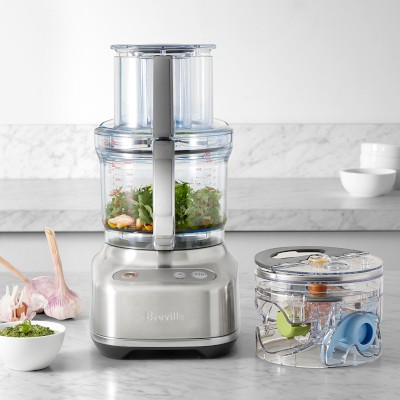
Breville Sous Chef 12-Cup Food Processor
Best Classic Workhorse: Cuisinart Custom 14-Cup
The Cuisinart Custom 14-Cup Food Processor takes a somewhat different approach. Instead of loading the machine with complicated controls, Cuisinart has kept the design relatively straightforward while providing a generous 14-cup work bowl.
The current model has a 720-watt motor and includes a stainless-steel chopping and mixing blade, 4mm slicing disc, medium shredding disc, and extra-large feed tube. Cuisinart also lists kneading dough among the machine’s capabilities. Cuisinart
That large bowl can be particularly useful for cooks preparing bigger batches of pastry, breadcrumbs, grated cheese, vegetables, or fillings. It may be more capacity than a very occasional baker needs, but families and frequent cooks may appreciate the additional room.
The Cuisinart also performed extremely well in current independent testing. Tom’s Guide named the Custom 14-Cup its best food processor overall for 2026, praising its performance, relatively quiet operation, and ability to complete preparation tasks with little mess. Bon Appétit also lists the Custom 14-Cup as a runner-up among its current food-processor recommendations. Tom’s Guide
Best for: Home cooks who want a large, proven food processor with straightforward controls and plenty of capacity.

Cuisinart Custom 14-Cup Food Processor
Best Value: Ninja Professional Plus Food Processor
For someone who wants useful food-processing capability without spending as much as the premium machines, the Ninja Professional Plus is worth considering.
It has a 9-cup bowl and is designed for chopping, slicing, puréeing, shredding, and dough preparation. That capacity should be sufficient for many everyday baking and cooking jobs without requiring as much storage space as a 14-cup processor.
Food Network selected the Ninja Professional Plus as its Best Value food processor in its 2026 testing, making it an appealing option for someone who wants a capable multipurpose processor while keeping the budget under control. Food Network
For British baking, that makes it particularly attractive to beginners. It provides the functionality needed for jobs such as pastry preparation, breadcrumbs, grated cheese, and everyday chopping without requiring the investment of a premium processor.
Best for: Beginners and occasional bakers who want a capable food processor at a more approachable price.
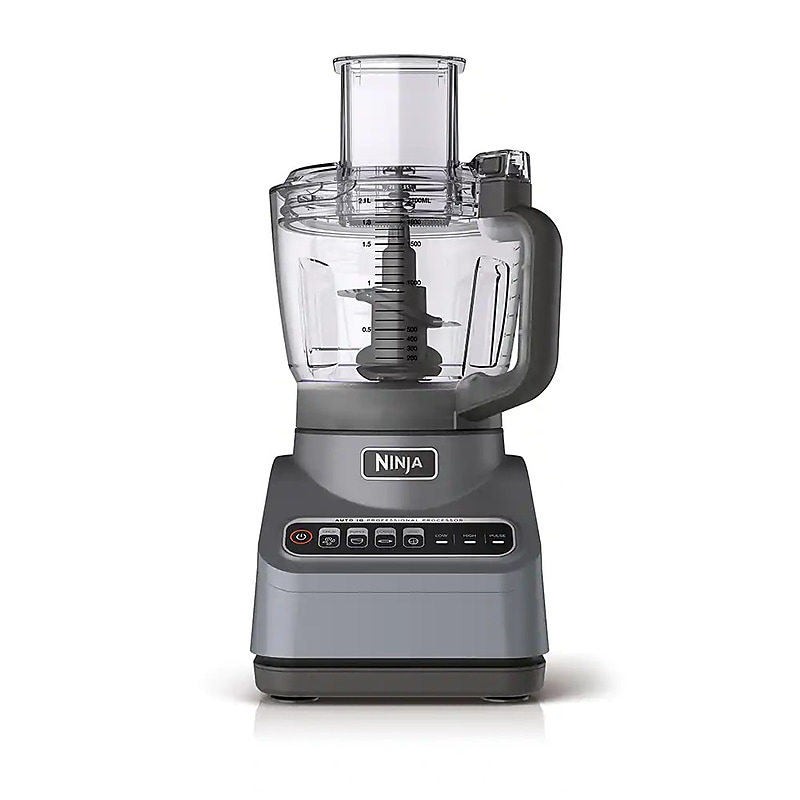
Ninja Professional Plus Food Processor
Food Processor Comparison at a Glance
| Food Processor | Best For | Capacity | Standout Features | Price Level |
| Breville Sous Chef 12 | Best overall | 12 cups | Adjustable slicer, reversable shredder, dough blade, onboard accessory storage | $$$ |
| Cuisinart Custom 14-Cup | Classic workhorse | 14 cups | Large bowl, 720W motor, slicing and shredding discs, simple controls | $$-$$$ |
| Ninja Professional Plus | Best value | 9 cups | Preset programs, slicing/shredding, dough capability, compact size | $ |
Which Food Processor Should You Choose?
For most home cooks, the right food processor depends on how often you’ll use it and how much food you normally prepare.
Choose the Breville Sous Chef 12 if you want the most versatile premium option. Its adjustable slicing system, reversible shredding disc, dough blade, and onboard accessory storage make it particularly appealing for someone who expects to use a food processor for both British baking and everyday cooking.
Choose the Cuisinart Custom 14-Cup if you want a large, straightforward workhorse. Its generous bowl is useful for bigger batches, while the chopping blade and slicing and shredding discs cover most everyday food-processing jobs. Cuisinart also specifically lists chopping, shredding cheese and kneading dough among its capabilities. Cuisinart
Choose the Ninja Professional Plus if budget and kitchen space are bigger considerations. Its 9-cup bowl is smaller, but that may actually be an advantage for someone who doesn’t routinely cook large batches. Current shopping results show the BN601 with a 9-cup bowl and dough functionality at a much lower price than our two premium choices.
For many Brit & Skillet readers, the Cuisinart is probably the sweet spot if you regularly cook for a family or make larger batches. The Ninja makes more sense for beginners trying to keep costs down, while the Breville is the splurge option for someone who expects their food processor to earn a permanent place in the kitchen.
Food Processor vs. Blender: Which Do You Need?
A food processor and blender may look as though they perform similar jobs, but they’re designed for different kinds of kitchen tasks.
A blender is generally better for liquids. Smoothies, soups, sauces, and other mixtures that need to become very smooth are where a blender is most at home.
A food processor is better suited to chopping, slicing, shredding, and working with thicker or relatively dry mixtures. Depending on the attachments, it can grate cheese, slice vegetables, make breadcrumbs, chop nuts, and prepare certain types of dough and pastry. Food Network
That distinction makes the food processor particularly useful for British baking and cooking. If you’re making shortcrust pastry, for example, a processor can quickly pulse cold butter into flour while leaving small pieces of butter in the mixture. King Arthur Baking uses precisely this technique for its food-processor pastry method and cautions against overworking the finished dough. King Arthur Baking
If your kitchen revolves around smoothies and blended soups, buy a blender first. But if you’re more interested in pastry, scones, breadcrumbs, grated cheese, chopped vegetables, and savory cooking, a food processor will probably be the more useful appliance.
The Bottom Line
A food processor isn’t essential for making British food, but it can remove a surprising amount of repetitive preparation from both baking and everyday cooking.
The Breville Sous Chef 12 is our overall choice for frequent cooks who want a premium, versatile machine.
The Cuisinart Custom 14-Cup is a strong choice for home cooks who value a large capacity and straightforward design, particularly if they’ll regularly prepare bigger batches.
And the Ninja Professional Plus offers a more approachable option for beginners who want useful food-processing capabilities without making the same investment as the premium machines.
Whichever model you choose, think about the jobs you’ll actually ask it to perform. Bowl capacity, pulse control, useful blades and discs, storage, and easy cleaning will usually matter more in everyday cooking than simply choosing the machine with the longest specification sheet. Cuisinart’s buying guidance similarly emphasizes capacity, attachments, power, price, kitchen space, and intended use when choosing a processor. Cuisinart
For British baking in particular, the humble pulse button may end up being one of your favorite features. A few quick pulses can take much of the work out of preparing pastry—while still leaving you in control of the final dough.
And anything that gets a homemade pie onto the table a little faster sounds like a worthwhile kitchen assistant to us.
This article may contain affiliate links. If you make a purchase through one of these links, Brit & Skillet may earn a commission at no additional cost to you. Our recommendations are based on independent research and product information; we do not claim to have personally tested products unless explicitly stated.
 Brit & Skillet