
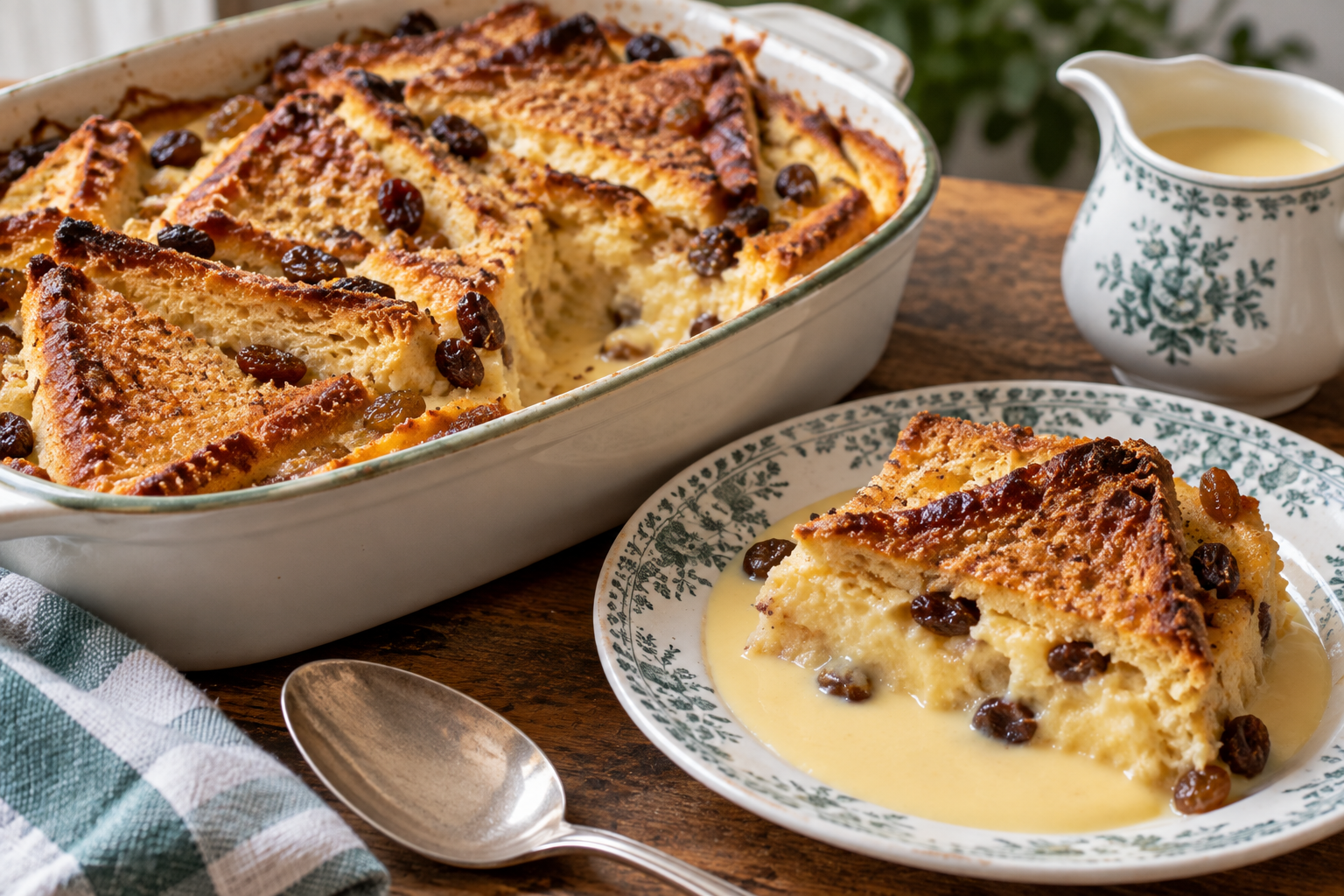
Bread and butter pudding is one of those wonderfully simple British desserts that turns a handful of everyday ingredients into something warm, comforting and surprisingly special.
Slices of buttered bread are layered with raisins or sultanas, soaked in a lightly sweetened vanilla custard and baked until the top is golden and crisp while the middle stays soft and creamy.
It’s the sort of old-fashioned pudding that has been served in British homes for generations — economical, unfussy and absolutely lovely with a generous pour of warm custard.
And if you’re making it in an American kitchen, there’s good news: you don’t need any unusual equipment or difficult-to-find ingredients.
This version uses ingredients readily available in American grocery stores, with both US and metric measurements included.
What Is Bread and Butter Pudding?
Bread and butter pudding is a traditional British baked dessert made by layering slices of buttered bread in a baking dish, usually with dried fruit, then pouring a sweet egg-and-milk custard over the top.
As it bakes, the bread absorbs the custard.
The pieces underneath become wonderfully soft and creamy, while the exposed edges on top turn crisp and golden.
Traditionally, the pudding was a practical way to use bread that was beginning to go stale rather than letting it go to waste.
Today, it remains one of Britain’s classic comfort-food desserts.
Bread and Butter Pudding vs. Bread Pudding
American bakers may be more familiar with bread pudding, but British bread and butter pudding is slightly different.
American bread pudding is often made with cubes or chunks of bread mixed throughout a custard.
Traditional British bread and butter pudding usually keeps the bread in slices.
Each slice is buttered before being arranged in overlapping layers in the baking dish.
The result is a pudding with distinct layers of bread, fruit and custard, plus those characteristic crisp golden edges across the top.
What Kind of Bread Should I Use?
A simple white sandwich loaf works beautifully.
Slightly stale bread is actually ideal because it absorbs the custard particularly well without immediately becoming soggy.
You can also use:
- Brioche
- Challah
- Soft white bakery bread
- A simple homemade white loaf
Brioche will make the pudding richer and slightly sweeter, but an ordinary white loaf is closer to the humble spirit of the traditional dessert.
Avoid bread with a very tough or chewy crust.
What Are Sultanas?
Traditional British recipes often call for sultanas.
In the United States, the closest readily available substitute is golden raisins.
Regular raisins also work perfectly well.
You can use either one in this recipe.
Traditional British Bread and Butter Pudding Recipe
Prep Time: 20 minutes
Soaking Time: 20 minutes
Bake Time: 35–40 minutes
Serves: 6–8
Equipment
- Approximately 2-quart baking dish
- Large measuring jug or mixing bowl
- Whisk
- Small saucepan, optional
Ingredients
For the Pudding
- 8 slices white sandwich bread, preferably slightly stale
- 4 tablespoons (56 g) unsalted butter, softened
- ½ cup (75 g) golden raisins or regular raisins
- ½ teaspoon ground cinnamon
- ¼ teaspoon ground nutmeg
For the Custard
- 2 cups (480 ml) whole milk
- ½ cup (120 ml) heavy cream
- 3 large eggs
- ¼ cup (50 g) granulated sugar
- 1 teaspoon vanilla extract
- Pinch of salt
For the Top
- 1 tablespoon granulated sugar
- Small pinch of nutmeg, optional
Instructions
1. Prepare the Baking Dish
Lightly butter a roughly 2-quart baking dish.
Preheat the oven to 350°F (175°C).
2. Butter the Bread
Spread the softened butter generously over one side of each slice of bread.
Cut each slice diagonally into two triangles.
You can leave the crusts on unless they are particularly thick or tough.
3. Arrange the First Layer
Place approximately half of the bread triangles in the baking dish, overlapping them slightly with the buttered sides facing upward.
Scatter half of the raisins over the bread.
Sprinkle with a little cinnamon and nutmeg.
4. Add the Second Layer
Arrange the remaining bread triangles over the first layer.
Scatter the remaining raisins between and over the bread.
Sprinkle with the remaining cinnamon and nutmeg.
Try to leave some of the upper edges of the bread exposed. These will become beautifully golden and crisp during baking.
5. Make the Custard
Add the milk, heavy cream, eggs, sugar, vanilla and a pinch of salt to a large bowl or measuring jug.
Whisk until completely combined.
Alternatively, you can gently warm the milk and cream in a saucepan before whisking them gradually into the eggs and sugar.
Do not allow the milk to boil.
Warming the dairy isn’t essential, but it can help the custard soak into the bread a little more quickly.
6. Pour Over the Custard
Slowly pour the custard evenly over the bread.
Make sure the liquid reaches all areas of the baking dish.
Gently press the bread down with the back of a spoon so that it begins absorbing the custard.
Don’t completely submerge the upper edges — we want those to stay exposed so they become crisp.
7. Let It Soak
Leave the assembled pudding to stand for about 20 minutes.
This gives the bread time to absorb the custard before baking.
If your bread is particularly fresh, giving it the full soaking time is especially helpful.
8. Add the Topping
Sprinkle the tablespoon of sugar evenly over the top.
Add another small pinch of nutmeg if you like.
9. Bake
Bake for 35–40 minutes, until the custard is set and the exposed bread is golden brown.
The centre should still have a slight softness but shouldn’t look liquid.
If the bread begins browning too quickly, loosely cover the dish with aluminum foil for the remainder of the baking time.
10. Rest and Serve
Allow the pudding to rest for about 10 minutes before serving.
Serve warm.
Brit & Skillet Tips
Use slightly stale bread. Bread that’s a day or two old absorbs the custard particularly well and helps give the pudding its classic texture.
Don’t drown the top layer. Some bread should remain above the custard so those lovely crisp, buttery edges develop in the oven.
Give it time to soak. Twenty minutes before baking makes a noticeable difference, especially when using fresh sandwich bread.
Golden raisins are the American equivalent of sultanas. If you see sultanas listed in a British recipe, golden raisins are usually an easy substitute.
Don’t overbake the custard. The pudding should be set but still soft and creamy inside rather than dry.
Can I Use Brioche?
Absolutely.
Brioche makes a particularly luxurious bread and butter pudding because it already contains plenty of butter and eggs.
Simply use the same amount of bread and follow the recipe as written.
Because brioche is sweeter than ordinary sandwich bread, you can reduce the sugar in the custard slightly if you prefer a less sweet pudding.
Can I Leave Out the Raisins?
Yes.
Although dried fruit is traditional, you can leave it out if you don’t enjoy raisins.
You could also experiment with currants or a small amount of chopped dried fruit.
But for a classic British version, sultanas or raisins are the traditional choice.
What to Serve with Bread and Butter Pudding
Bread and butter pudding is delicious warm straight from the baking dish.
For a proper British pudding experience, serve it with warm custard poured over the top.
It’s also lovely with:
- Heavy cream
- Whipped cream
- Vanilla ice cream
- A light dusting of powdered sugar
A cup of tea alongside certainly doesn’t hurt either.
Why Is My Bread and Butter Pudding Soggy?
Bread and butter pudding should be soft inside, but it shouldn’t be swimming in liquid.
If yours seems overly soggy, a few things may have happened.
The pudding may simply need a little longer in the oven.
Very fresh bread can also become softer than slightly stale bread.
And make sure you’re using approximately the amount of bread called for in the recipe so there is enough to absorb the custard.
Why Is My Pudding Dry?
Usually this means the pudding was baked for too long or there wasn’t enough custard.
Remove it from the oven once the custard has set.
The inside should remain moist and creamy even though the bread on top is crisp.
Can I Make Bread and Butter Pudding Ahead?
Yes.
You can assemble the pudding several hours ahead, cover it and refrigerate it until you’re ready to bake.
Because the bread will have much longer to absorb the custard, there’s no need for an additional 20-minute soaking period before baking.
Let the dish sit at room temperature briefly while the oven preheats if your baking dish manufacturer recommends avoiding sudden temperature changes.
How to Store Leftovers
Allow leftover bread and butter pudding to cool, then cover and refrigerate it.
It will keep for approximately 3 days in the refrigerator.
Reheat individual portions in the microwave, or cover the baking dish loosely with foil and warm it in a 325°F (165°C) oven until heated through.
Can You Freeze Bread and Butter Pudding?
Yes.
Once baked and completely cooled, portion the pudding and place it in freezer-safe containers.
Freeze for up to 2 months.
Thaw overnight in the refrigerator before reheating.
The texture may be slightly softer after freezing, but it will still taste delicious.
A Proper British Comfort Pudding
There are certainly fancier British desserts, but that’s part of the charm of bread and butter pudding.
It takes ordinary bread, butter, milk, eggs and a handful of raisins and turns them into something warm, creamy and wonderfully comforting.
It’s also exactly the kind of British recipe that translates beautifully to an American kitchen.
If you’re exploring more traditional British food, try our Traditional British Sticky Toffee Pudding, Traditional British Treacle Tart and Traditional British Millionaire’s Shortbread, or browse all of the Brit & Skillet Recipes for more British favourites made approachable for American kitchens.