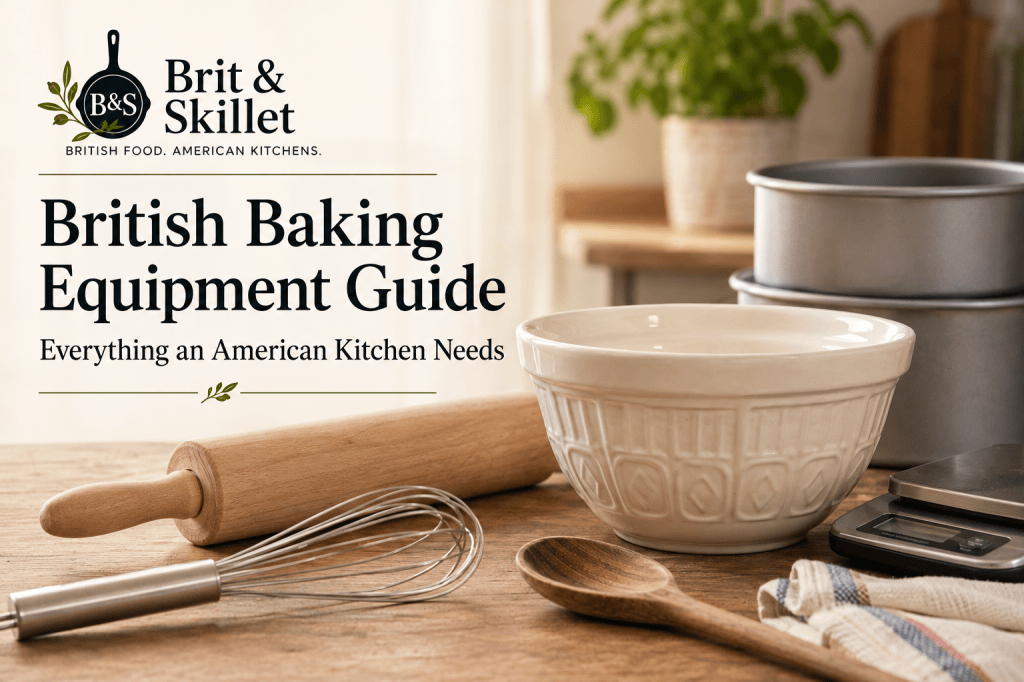
Baking from a British recipe in an American kitchen can feel like following instructions from someone who knows your kitchen—but calls everything by a different name.
They mention sandwich tins. You look at your cake pans. They ask for a pudding basin. You wonder whether a cereal bowl counts.
The good news? You may already own much of what you need.
This guide will help you work out which equipment deserves cupboard space, which specialist pieces suit the recipes you want to make, and what can wait. We’ll also point you toward our detailed Brit & Skillet guides when you need help choosing a particular tool or understanding British measurements.
Whether you’re starting with scones, planning a Victoria sponge, or contemplating your first steamed pudding, let’s get your kitchen ready—without buying half a baking shop.
Affiliate Disclosure: This post contains affiliate links. If you purchase through one of these links, Brit & Skillet may earn a small commission at no additional cost to you. I only recommend products that are relevant to the recipes and information shared here.
Start With What You Already Own
Before buying anything, take a look through your kitchen cupboards. Mixing bowls, wooden spoons, a whisk, a spatula, and a rolling pin can all earn their keep in British baking.
Start with the recipe you want to make, then check what it actually requires. A batch of scones calls for a different setup from a steamed Christmas pudding, and neither automatically requires an electric mixer.
Some British equipment names may sound unfamiliar even when the item itself looks familiar. A “sandwich tin,” for example, is a shallow round cake pan used to bake layers for cakes such as Victoria sponge.
Before substituting a pan you already own, compare its diameter, depth, and shape with the recipe’s instructions. A different pan can change the depth of the batter and how quickly it bakes.
Choose a few recipes you’re excited to bake and let those guide your purchases. You’ll soon discover which tools you reach for regularly and which specialist pieces can wait.
There’s no need to buy a pudding basin before you’ve decided whether steamed pudding is something you actually want to make.
Although, after our pudding-basin guide, we understand if you’ve already become emotionally attached to a bowl.
A Digital Kitchen Scale
One of the first differences you’ll notice in British baking recipes is the use of grams for ingredients such as flour, sugar, and butter.
A digital kitchen scale lets you follow those measurements directly, without converting each ingredient into cups.
A cup of flour can contain different amounts depending on how it’s filled. Scooping directly from the bag can pack flour into the cup, while spooning it in more lightly may give you less.
Weighing ingredients removes that particular source of variation. If your recipe asks for 225 grams of flour, you can measure 225 grams without wondering how firmly someone else filled a cup.
It also makes British butter measurements easier. You can weigh the amount the recipe requests instead of working out fractions of an American stick.
Brit & Skillet Tip: If you’re going to buy one piece of equipment specifically to make British recipes easier in an American kitchen, a digital scale is a very good place to start. Working directly in grams removes a whole layer of conversion and guesswork.
For a scale that can handle the everyday measuring jobs involved in British baking, the King Arthur Volume & Weight Scale is one option worth considering.
Place your mixing bowl on the scale, then press the tare—or zero—button. This resets the display so you’re measuring the ingredient rather than the bowl.
You can reset it again before adding another ingredient, provided the recipe calls for those ingredients to go into the same bowl.
Add slowly as you approach the target weight. Taking extra sugar out of a bowl of flour is considerably less convenient than putting it in.
Measuring cups and spoons still have a place in your kitchen, especially when you’re following American recipes. A scale simply gives you another way to measure.
When a British recipe provides weights, use those original measurements where possible. If you need help interpreting the alternatives, see our guide to British baking measurements for American recipes.
British Baking Tins and American Baking Pans
British recipes usually call baking pans “tins,” even when they’re made from another material. The name may be different, but the job is familiar.
What matters most is choosing the size and shape specified in your recipe.
Sandwich Tins
Sandwich tins are shallow round cake pans used to bake separate layers for cakes such as Victoria sponge.
Check both the diameter and depth before using a pan you already own. Two shallow sandwich tins and one deep cake pan aren’t automatically interchangeable: changing the depth of the batter can affect baking time.
Brit & Skillet Tip: Want to see sandwich tins doing the job they were made for? Our Classic Victoria Sponge Cake uses those separate sponge layers to make one of Britain’s best-loved cakes.
For a sturdy American option, Fat Daddio’s Anodized Aluminum Round Cake Pans are available in multiple sizes, including an 8-inch pan that’s a useful match for many British recipes calling for a 20cm round or sandwich tin.
Loaf Tins
Loaf tins are useful for loaf cakes and bread. British recipes sometimes describe them by a pound size, such as a “2 lb loaf tin.”
Those labels aren’t a reliable guide to exact dimensions across every manufacturer. If the recipe provides measurements or capacity, compare those with your own pan before filling it.
For a dependable American option, Fat Daddio’s Anodized Aluminum Bread & Loaf Pans come in a range of sizes, making it easier to choose a pan that closely matches the dimensions called for in a British recipe.
Baking Trays
A baking tray is the British equivalent of a baking sheet. You may already have one suitable for scones, biscuits, and other everyday bakes.
Check whether the recipe needs a flat sheet, a rimmed tray, or a deeper pan. A shallow baking sheet cannot substitute for a deep traybake tin holding cake batter.
Start with the pans required for your first few recipes. Add specialist shapes when you have a use for them.
A cupboard full of lovely tins is enjoyable. Being able to open that cupboard without a small metal avalanche is also enjoyable.
For more help choosing suitable pans, see our guide to British baking tins and their uses.
For a sturdy everyday option, Fat Daddio’s Natural Aluminum Baking Sheet Pans are available in several sizes and work well for the kinds of biscuits, scones, and tray bakes you’ll come across in British baking.
Mixing Bowls and Everyday Utensils
Not every British bake needs an electrical appliance. Mixing bowls and a few familiar utensils can handle plenty of everyday preparation.
Before adding anything to your shopping basket, check what’s already in your kitchen drawer.
Choose a bowl with enough space to stir or fold without sending flour over the sides. A larger bowl is useful for cake mixtures and dough, while a smaller one comes in handy for beating eggs or combining dry ingredients.
A stable base helps keep the bowl steady as you work. If yours slides around the counter, placing a damp kitchen towel underneath can help.
If you’re building a baking setup from scratch, the King Arthur Complete Lightweight Mixing Bowl Set gives you several sizes for different jobs.
If you prefer the durability and simplicity of metal bowls, the King Arthur Stainless Steel Mixing Bowls are another option.
Brit & Skillet Tip: You don’t necessarily need both types. Choose the bowl set that suits the way you bake and the storage space you have. A useful bowl earns its cupboard space; a beautiful stack you never reach for does not.
A wooden spoon is useful for stirring mixtures and beating softened ingredients together by hand.
A flexible spatula helps scrape the sides of the bowl and fold ingredients together. It also gets more batter into the tin, although this does slightly reduce the amount available for the traditional bowl inspection.
A balloon whisk is useful for beating eggs, blending liquids, and whisking small amounts of cream.
For mixtures that need prolonged beating, an electric mixer can reduce the effort. But you don’t need to bring one out every time a recipe asks you to mix something.
A sieve is useful when a recipe calls for sifted ingredients, particularly if flour, cocoa powder, or icing sugar contains lumps.
“Icing sugar” is the British name you’ll commonly encounter for powdered or confectioners’ sugar. Your sieve doesn’t mind which name is on the bag.
For a closer look at choosing a bowl, read our guide to Best Mixing Bowls for British Baking: What Size and Material Do You Need?
Hand Mixers and Stand Mixers
An electric mixer can make some baking jobs easier, particularly when a recipe calls for creaming butter and sugar or whisking a mixture for several minutes.
Whether you need one depends on what you bake and how often you bake it.
Hand Mixers
A hand mixer is useful for many cake mixtures, whipped cream, and beaten egg whites. It also takes up relatively little cupboard space.
You’ll still need to hold and move it through the mixture, but it can take much of the effort out of prolonged beating.
Start at a low speed when incorporating loose ingredients. A cloud of icing sugar is rarely the kitchen decoration anyone intended.
Stand Mixers
A stand mixer holds the bowl and mixing attachment in place, leaving your hands free while it runs.
That can be convenient for frequent baking or recipes requiring longer mixing. However, it takes up more space, and you don’t need one simply because you’re baking from a British recipe.
Use the attachment, speed, and batch size recommended for your machine and recipe.
An electric mixer doesn’t replace every mixing technique. If a recipe asks you to gently fold in an ingredient, switch to a spatula or suitable spoon rather than continuing to beat.
The aim is to combine the ingredients while preserving as much of the mixture’s air as possible.
Brit & Skillet Tip: Start with the equipment you own. If mixing by hand becomes the part that puts you off baking, that’s a useful sign that an electric helper might actually earn its place.
If you’re considering one, explore our guide to electric hand mixers for British baking.
Rolling Pins and Pastry Tools
If pies, tarts, or scones are on your baking list, a rolling pin and a clear work surface will come in handy.
You can add specialist pastry tools as you discover which recipes you enjoy making.
A simple straight rolling pin gives you direct control over the pressure you’re applying to pastry or dough. If you need one, the King Arthur Straight Rolling Pin is an option that fits neatly into this basic British-baking toolkit.
Follow your recipe’s instructions for flouring the surface. Too little flour can leave dough sticking, while repeatedly adding more can change the dough.
Some recipes suggest rolling between sheets of baking parchment to help prevent sticking.
Round cutters are useful for shaping scones and cutting pastry for small pies or tarts. In British recipes, “biscuit cutters” generally means what American bakers call cookie cutters.
Buy shapes and sizes that suit your recipes. A small set of round cutters can cover several jobs without taking over a drawer.
A pastry brush helps apply egg wash, milk, or other glazes evenly.
Use a light touch and follow the recipe’s directions about where to brush. For layered pastry, coating the cut edges can interfere with how those layers rise.
A dough scraper can help lift sticky dough and gather scraps from the work surface. Pastry guides can help you roll to a consistent thickness.
Both can be convenient, but start with the tools your chosen recipe requires. You don’t need a miniature hardware department to make your first jam tart.
Pudding Basins
If you want to make Christmas pudding or a steamed treacle sponge, you may encounter a piece of equipment less familiar in American kitchens: the pudding basin.
This deep, rounded bowl holds the mixture while the pudding steams. Traditional basins often have a pronounced rim that helps secure the covering.
Check the basin capacity in the recipe before buying. Its width alone won’t tell you how much mixture it holds.
You’ll also need a steaming pot large enough to accommodate the basin and any support specified in the recipe, with room for the lid to close.
Use a basin that its manufacturer identifies as suitable for steaming. A bowl’s appearance—or a microwave-safe label alone—doesn’t establish that it’s suitable for this cooking method.
Follow the recipe and manufacturer’s instructions for covering, positioning, and handling the basin.
A pudding basin can wait until you’re ready to try a steamed-pudding recipe. It isn’t necessary for every British dessert, and many cakes and baked puddings use ordinary baking tins or dishes.
For a closer look at materials, capacities, and what to consider before buying, see our guide to the best pudding basins for traditional British desserts.
Brit & Skillet Tip: Yes, this is the bowl we devoted an entire article to. It has earned its moment.
Cooling Racks, Parchment and Finishing Tools
Getting a bake out of the oven is only part of the job. Cooling it properly and preparing it for serving deserve a little attention, too.
A few simple tools can help with these final steps.
A cooling rack allows air to circulate underneath your baking. It helps steam escape instead of collecting against a solid surface.
Brit & Skillet Tip: If you need a sturdy rack for cooling cakes, biscuits, and other bakes, the Fat Daddio’s Stainless Steel Cooling & Baking Racks are a practical option that can also be used for baking when a recipe calls for a rack.
Follow your recipe’s instructions about when to transfer the bake to a rack. Some cakes need time to firm up in their tins first, while delicate bakes can break if moved too soon.
British recipes often call for “baking parchment,” which American bakers know as parchment paper. It’s useful for lining tins and baking sheets when the recipe calls for it.
Use parchment rated for your baking temperature. Wax paper is a different product and should not be used as an oven-lining substitute.
A palette knife or offset spatula can help spread icing and fillings. A small one is handy for working around the edges of a cake without dragging your knuckles through your efforts.
For a simple cake, an ordinary spatula or the back of a spoon may be all you need. Decorative swirls are perfectly respectable.
Unless your recipe says otherwise, let cakes cool before adding buttercream or another heat-sensitive topping.
After all that measuring and mixing, the final challenge is sometimes simply leaving the cake alone.
Do You Need a Food Processor?
A food processor can help with tasks such as chopping nuts, making breadcrumbs, and preparing pastry using a recipe written for that method.
Whether it deserves space in your kitchen depends on how often you’ll use those functions.
For pastry recipes that specify a food processor, short pulses can help combine the fat and flour. Follow the recipe’s cues for texture and when to stop.
A processor can also make quick work of crushing biscuits for a cheesecake base. In an American kitchen, those biscuits might be cookies or graham crackers, depending on the recipe.
Check your machine’s instructions for suitable ingredients, attachments, and quantities.
A food processor and an electric mixer work differently. Don’t assume a recipe’s whisking, beating, or folding instructions can be transferred directly to a processor.
Use the method the recipe specifies, particularly when the mixture depends on incorporating or preserving air.
If you regularly make pastry, crumb bases, or recipes requiring chopped ingredients, a processor may be useful.
If those jobs only come up occasionally, hand methods may suit you perfectly well. Biscuits can be crushed in a sturdy food bag with a rolling pin, and many pastry recipes include instructions for mixing by hand.
Brit & Skillet Tip: Choose equipment that makes your usual baking easier. Cupboard space deserves a say in the matter, too.
For more help deciding whether one suits your kitchen, read our guide to food processors for British baking.
British Baking Equipment Checklist
You don’t need everything in this guide before you start. Use this checklist to take stock of what you own, then fill the gaps for your chosen recipe.
- Digital kitchen scale for recipes measured in grams
- Mixing bowls
- Measuring spoons and a liquid measuring jug
- Wooden spoon, flexible spatula and whisk
- Baking tin or tray in the size your recipe specifies
- Oven gloves
- Wire cooling rack
- Baking parchment when needed
- Scones, biscuits and pastry: rolling pin and suitable cutters
- Glazed pastry: pastry brush
- Steamed puddings: a basin suitable for steaming and a pot that accommodates it
- Iced cakes: palette knife or offset spatula
- Recipes requiring prolonged beating: an electric mixer can reduce the effort
- Processor-method pastry or crumb bases: a food processor can be convenient
Read the whole recipe, check the equipment you already own, and compare pan dimensions or basin capacities carefully.
The best-equipped kitchen is one that supports the baking you actually enjoy.
Start with a recipe that makes you want to put the kettle on. Let the collection grow from there.
Ready to Start British Baking?
You don’t need a completely different kitchen to bake British recipes in America.
Start with familiar tools, pay attention to measurements and tin sizes, and add specialist equipment when a recipe actually calls for it.
For more help, explore our guides to British baking measurements for American recipes, British baking tins and their uses, and the best pudding basins for traditional British desserts.
Or put some of that equipment to work with our Classic Victoria Sponge Cake.
Choose a recipe, clear a little counter space, and see what you enjoy making.
British food. American kitchens. Something good in the oven.
 Brit & Skillet