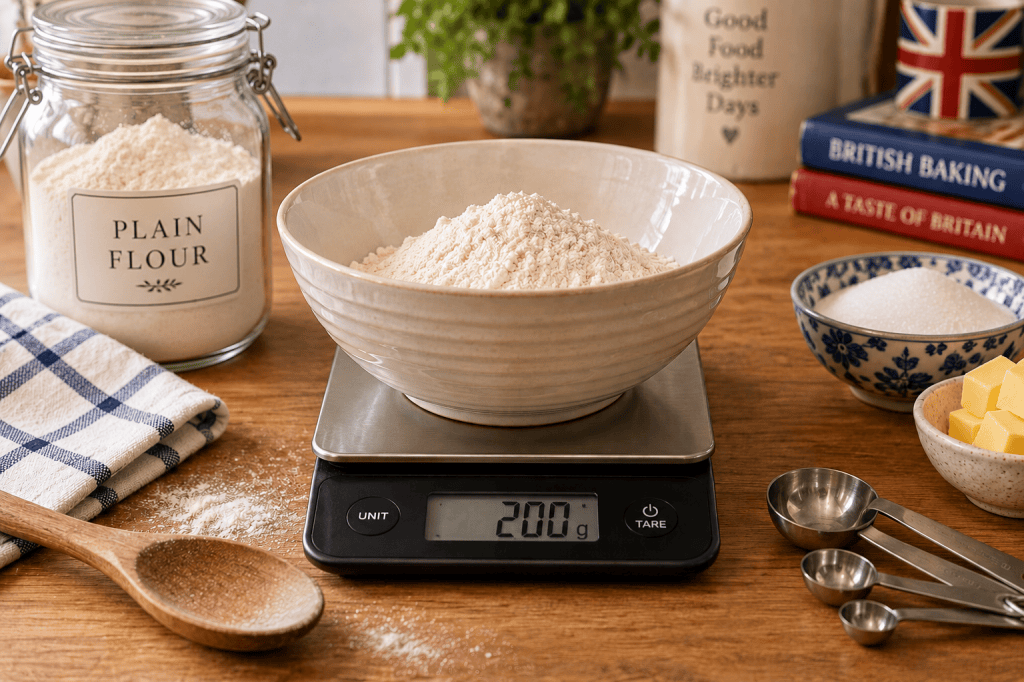
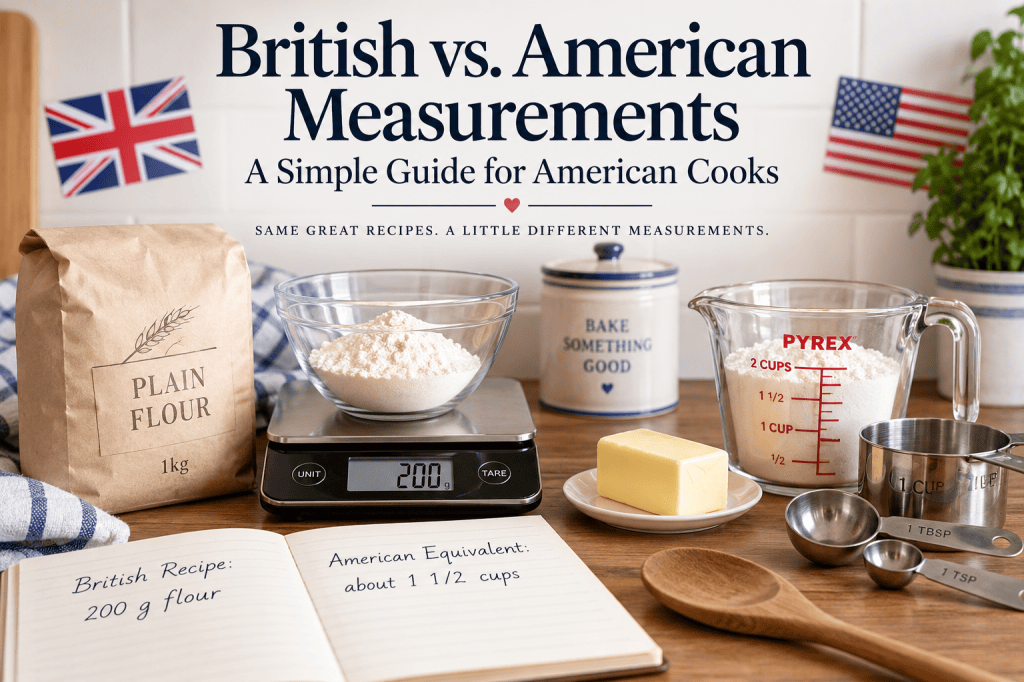
If you’ve ever opened a British recipe and wondered why the flour, sugar, and butter are listed in grams instead of cups, you’re not alone. For American bakers, one of the simplest ways to make British recipes easier to follow is to use a digital kitchen scale.
Weighing ingredients lets you follow the recipe as it was originally written instead of converting every measurement into cups and tablespoons. It can also give you more consistent results, particularly with ingredients such as flour, where the amount that fits into a measuring cup can vary.
The good news is that you don’t need an expensive professional scale. For many home bakers, a simple digital model with the right features is all you need. But if you frequently switch between British metric recipes and American volume measurements, some premium scales offer additional features that can be genuinely useful.
Affiliate disclosure: Brit & Skillet may earn a commission from qualifying purchases made through links on this page, at no additional cost to you.
In this guide, we’ll explain what to look for in a kitchen scale for British recipes, which features actually matter, and how to choose the right one for your kitchen.
Why British Recipes Use Grams
British recipes commonly measure ingredients by weight rather than volume. That means you’ll often see flour, sugar, butter, and other ingredients listed in grams instead of American cups.
There’s a practical reason for this: weight is generally more consistent. A cup of flour can contain different amounts depending on how the flour is scooped, packed, or leveled, while 120 grams is 120 grams regardless of how it gets into the bowl.
Using a scale also makes British recipes much easier for American bakers. Instead of stopping to convert grams into cups, you can place your bowl on the scale, select grams, and weigh the amount shown in the original recipe.
This is particularly useful for baking, where relatively small differences in ingredient quantities can affect the texture and consistency of cakes, biscuits, pastry, and bread.
Brit & Skillet tip: When a British recipe provides measurements in both grams and cups, try using the gram measurements. It removes one more variable from the baking process and helps you follow the recipe closer to the way its author intended.
What to Look for in a Kitchen Scale
Kitchen scales can range from very simple models to more elaborate devices with features most home bakers will rarely use. For British baking, the basics matter much more than having lots of extras.
A good scale should be accurate, easy to read, simple to clean, and capable of switching between the measurement units you’re most likely to encounter in British and American recipes.
Measures in Grams and Ounces
At a minimum, choose a scale that can display both grams and ounces. Grams will be your main setting for British recipes, while ounces can still be useful for American recipes and everyday kitchen tasks.
A Tare Function
The tare button resets the displayed weight to zero after you place a bowl or container on the scale. It also lets you weigh several ingredients into the same bowl by resetting the scale between additions.
An Easy-to-Read Display
Look for a display that remains visible when a reasonably large mixing bowl is sitting on the weighing platform. A scale isn’t very convenient if your favorite bowl covers the numbers every time you use it.
A Practical Capacity
Most home bakers don’t need an industrial-capacity scale, but the scale should comfortably handle the weight of your mixing bowl plus the ingredients inside it. This becomes particularly important when you’re making larger batches of bread dough, cakes, or puddings.
Brit & Skillet tip: Don’t choose a kitchen scale based on the number of features printed on the box. For British baking, reliable gram measurements, a tare button, and a display you can actually see are more valuable than a long list of functions you’ll never use.
How Accurate Does a Baking Scale Need to Be?
For everyday British baking, a kitchen scale that measures in 1-gram increments is generally suitable for ingredients such as flour, sugar, butter, dried fruit, and chocolate.
Very small quantities are a little different. Ingredients such as yeast, salt, baking powder, and spices may be used in amounts that are too small for an ordinary kitchen scale to measure reliably. In those cases, measuring spoons are often the simpler choice when the recipe provides spoon measurements.
You may see specialized precision scales that measure fractions of a gram, but most home bakers don’t need one for everyday cakes, biscuits, scones, and puddings.
What’s more important is consistency. Place your scale on a firm, level surface, make sure it reads zero before you begin, and avoid weighing ingredients while the scale is sitting on a soft tea towel or uneven countertop.
Brit & Skillet tip: Your kitchen scale and measuring spoons make a great team. Use the scale for larger ingredients measured in grams and measuring spoons for the tiny quantities specified that way in the recipe.
Our Kitchen Scale Picks for British Baking
You don’t need a specialized British kitchen scale to follow British recipes. A reliable digital scale that measures accurately in grams is usually all an American home baker needs.
However, different scales make sense for different bakers. Some people simply want an inexpensive way to start weighing flour in grams, while others regularly switch between British metric recipes and American volume measurements.
We’ve divided our recommendations into four practical categories so you can choose the scale that best fits the way you bake.
Quick Picks for American Bakers
Best Premium Pick: King Arthur Volume and Weight Scale — A particularly useful choice for frequent bakers who regularly move between British metric recipes and American volume measurements.
Best Everyday Pick: Escali Primo Digital Kitchen Scale — A straightforward choice for everyday British baking when you primarily want reliable gram measurements without lots of extras.
Best for Large Mixing Bowls: OXO Good Grips 11 lb Food Scale with Pull-Out Display — A useful choice when large bowls or plates would otherwise block the scale’s display.
Best Budget Pick: Amazon Basics Digital Kitchen Scale — A simple option for bakers who are just getting started with weighing ingredients in grams.
For frequent Brit & Skillet bakers who work with both British and American recipes, the King Arthur scale offers the most interesting additional functionality. If you simply need a dependable everyday scale for weighing ingredients in grams, the Escali Primo keeps things simpler.
Best Premium Pick: King Arthur Volume and Weight Scale
For American bakers who frequently follow British recipes, the King Arthur Volume and Weight Scale offers an unusual combination of features that fits particularly well with the kind of baking we do at Brit & Skillet.
The scale was developed by Escali with King Arthur’s test bakers and can work with both weight and volume. In addition to weighing ingredients, it includes hundreds of commonly used ingredients programmed into the scale so it can provide corresponding volume measurements.
It can display weight in grams, ounces, and pounds and ounces, while volume measurements include cups, tablespoons, fluid ounces, and milliliters.
That combination can be especially useful in an American kitchen where one recipe may call for 250 grams of flour while another gives ingredients in cups. Rather than being designed solely as a basic weighing scale, it provides additional tools for moving between the measurement systems American and British bakers commonly encounter.
The trade-off is price. This is a premium scale, and someone who only needs to weigh ingredients in grams certainly doesn’t need to spend this much. Its extra functionality makes the most sense for frequent bakers who will actually use it.
Best for: Frequent bakers who regularly switch between British metric recipes and American volume measurements.
Keep in mind: The additional measurement functionality comes at a higher price than a basic digital kitchen scale.
Best Everyday Pick: Escali Primo Digital Kitchen Scale
For American home bakers who primarily want a straightforward way to follow British recipes in grams, the Escali Primo Digital Kitchen Scale is our everyday pick.
The Primo measures in grams as well as ounces and pounds, has an 11-pound capacity, measures in 1-gram increments, and includes the tare function you’ll use constantly when weighing several ingredients into the same mixing bowl.
Its simple design is part of its appeal. If your main goal is to put a bowl on the scale, press tare, and weigh 250 grams of flour, you don’t necessarily need the additional functionality of a premium model.
Its raised weighing platform can also help keep the display visible when you’re using a reasonably large mixing bowl.
Best for: Home bakers who want a simple, dependable scale for following British recipes in grams.
Keep in mind: It doesn’t offer the more advanced weight-and-volume functionality of the King Arthur premium pick, but many bakers won’t need those additional features.
Best for Large Mixing Bowls: OXO Good Grips 11 lb Food Scale with Pull-Out Display
If you frequently weigh ingredients directly into large mixing bowls, the OXO Good Grips 11 lb Food Scale with Pull-Out Display is an especially practical choice.
Its standout feature is the display, which pulls forward from the base of the scale. That means a large mixing bowl or plate can sit on the weighing platform without blocking your view of the measurement — a surprisingly useful feature when you’re weighing several ingredients into the same bowl.
The scale has an 11-pound capacity, measures metric weights in 1-gram increments, and includes a zero function for taring your bowl between ingredients.
Best for: Bakers who regularly use large mixing bowls, make bigger batches, or simply want an easier-to-see display.
Keep in mind: The extra cost makes the most sense if you’ll actually benefit from the pull-out display.
Best Budget Pick: Amazon Basics Digital Kitchen Scale
If you’re new to weighing ingredients and want an inexpensive way to start following British recipes in grams, the Amazon Basics Digital Kitchen Scale is our budget pick.
It offers the basic functionality needed to get started with weighing ingredients, including gram measurements and a tare function.
Its simple design also makes it a sensible choice if you’re not yet sure how often you’ll use a kitchen scale and don’t want to spend much on your first one.
Best for: Beginners and occasional bakers who want an inexpensive introduction to weighing British recipes in grams.
Keep in mind: If you begin baking frequently, you may eventually appreciate the design or additional functionality offered by one of the other choices.
Which Kitchen Scale Should You Choose?
Choose the King Arthur Volume and Weight Scale if you bake frequently and regularly move between British metric recipes and American recipes using cups and other volume measurements. Its ability to work with both weight and volume makes it our premium choice for that particular kind of baking.
Choose the Escali Primo if you don’t need those additional features and simply want a straightforward everyday scale for weighing British recipes in grams.
Choose the OXO Good Grips 11 lb Food Scale with Pull-Out Display if you frequently weigh ingredients in large mixing bowls and want a display that won’t disappear underneath them.
Choose the Amazon Basics Digital Kitchen Scale if you’re new to weighing ingredients and keeping the initial cost as low as possible is your priority.
Whichever model you choose, prioritize gram measurements, a tare function, sufficient capacity for your mixing bowl and ingredients, and a design that’s easy for you to use.
Kitchen Scale Comparison at a Glance
| Scale | Best For | Key Advantage |
|---|---|---|
| King Arthur Volume and Weight Scale | Frequent British & American baking | Weight and volume measurements |
| Escali Primo | Everyday baking | Simple gram weighing |
| OXO Good Grips 11 lb | Large mixing bowls | Pull-out display |
| Amazon Basics Digital Kitchen Scale | Budget-conscious beginners | Low-cost way to start |
Our recommendation: If you frequently bake from both British and American recipes and want the additional measurement functionality, the King Arthur Volume and Weight Scale is our premium pick. For straightforward everyday weighing in grams, the Escali Primo remains the simpler choice. Choose the OXO if large bowls frequently block your scale display, or consider the Amazon Basics model if keeping the initial cost as low as possible is your priority.
How to Use a Kitchen Scale with a British Recipe
Once you get used to weighing ingredients, following a British recipe can actually feel simpler than measuring everything with cups.
Start by placing your scale on a firm, level countertop and switching the measurement unit to grams.
Put your empty mixing bowl on the scale and press the tare or zero button. The display should return to zero even though the bowl is still sitting on the platform.
Add your first ingredient until the display reaches the weight specified in the recipe. If the next ingredient can go into the same bowl, press tare again to return the display to zero and then add the next ingredient.
For example, if a cake recipe calls for 200 grams of flour and 200 grams of sugar, you can weigh the flour, press tare, and then weigh the sugar without having to calculate the combined weight yourself.
Continue this process for ingredients that can safely be combined in the same bowl. For small quantities listed in teaspoons or tablespoons, simply use your measuring spoons as directed by the recipe.
Brit & Skillet tip: Before adding an ingredient, glance at the scale and make sure it still says g for grams. Accidentally switching measurement units halfway through a recipe can produce a very unexpected cake!
Do You Really Need a Kitchen Scale for British Baking?
Technically, no. Many British recipes can be converted into American volume measurements, and some recipe writers provide both grams and cups.
But if you plan to make British recipes regularly, a digital kitchen scale is one of the simplest and most useful additions you can make to your kitchen.
Instead of searching for conversions every time you encounter 225 grams of flour or 100 grams of butter, you can simply weigh the amount the recipe calls for. It keeps you closer to the original recipe and eliminates much of the uncertainty that comes with converting ingredients by volume.
You also don’t need to spend a fortune. For straightforward everyday weighing, the Escali Primo provides the basic functionality many home bakers need.
If you frequently switch between British and American recipes and want the additional convenience of working with both weight and volume measurements, the King Arthur Volume and Weight Scale is our premium choice.
The OXO is particularly useful if large mixing bowls tend to block your scale’s display, while the Amazon Basics model provides an inexpensive way to get started with baking by weight.
The right choice ultimately depends on how often you bake and which features you’ll genuinely use.
Once you start weighing ingredients, you may discover that British recipes aren’t harder to follow at all — they’re just measured a little differently.
Happy baking!
— Jane at Brit & Skillet
 Brit & Skillet